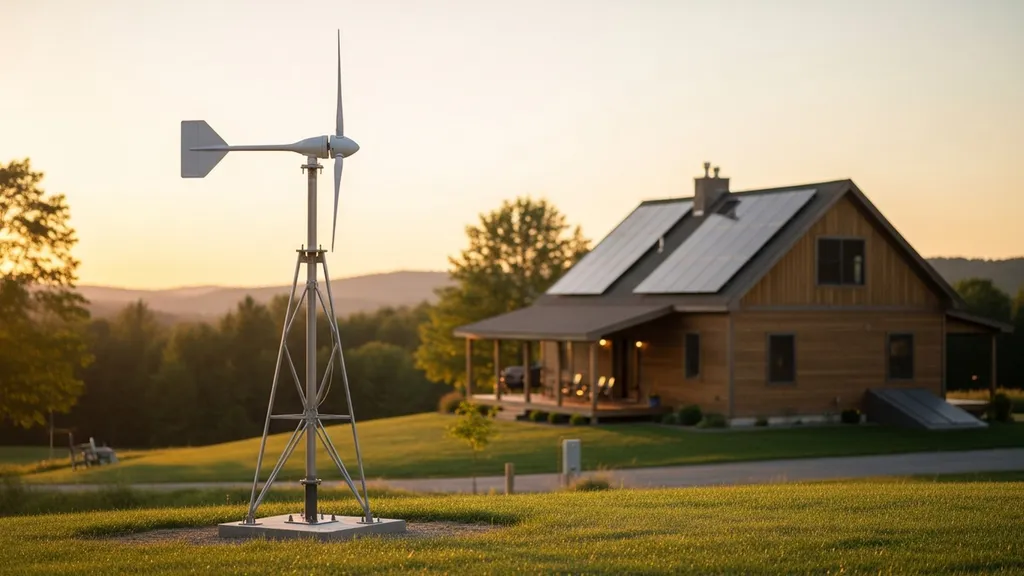
A practical guide to whether a small wind turbine makes sense for your home — costs, siting, integration with solar, and realistic payback examples.
Small Wind Turbines for Homes: Are They Worth IT?
TL;DR:
- Best-case sites with average wind >6 m/s at hub height can produce 4,000–8,000 kWh/year from a 3–5 kW turbine; capacity factors typically run 10–25%.
- Typical installed costs range from about $8,000 for micro systems to $35,000+ for 5–10 kW systems; simple payback often >20 years unless wind resource is strong or incentives apply.
- If your property lacks height and open exposure, prioritize air sealing and solar first; add a small wind turbine only when you can build a tall, unobstructed tower and permitting allows it.
How Small Wind Turbines Work for Homes
Small wind turbines convert wind kinetic energy into electricity through a few core parts and aerodynamic principles. The term small wind turbine covers a range from micro turbines (hundreds of watts) up to 10 kW residential units. Systems are often described as micro wind turbine or residential wind turbine depending on size and application.
Basic Components (rotor, Generator, Tower, Controller)
- Rotor (blades): Horizontal-axis turbines use 2–3 blades; vertical-axis turbines use different blade configurations and sit closer to the ground. Blade diameter largely determines swept area and energy capture.
- Generator and hub: Convert mechanical rotation to electrical output. Small machines produce DC or AC depending on the controller design.
- Tower: Raises the hub into stronger, less-turbulent wind. Tower type and height often affect production more than slightly larger rotors.
- Controller and safety systems: Include charge controllers, yaw/brake systems, and dump-loads for off-grid battery protection.
For practical guidance on what to ask before buying a system see the University of Nebraska extension's guide to small wind questions at Html.
Common Sizes and Output Ranges (typical Kw Bands)
- Micro (0.2–1 kW): Good for lighting, small cabins, or supplemental charging; hardware costs low but per-kWh costs high.
- Small (1–5 kW): Typical residential machines for supplemental home power or off-grid cabins.
- Larger small systems (5–10 kW): Can offset a significant portion of a household’s use in strong-wind sites but require stout towers and permitting.
Performance Basics: Cut-in Speed, Rated Speed, and Capacity Factor
- Cut-in speed: The wind speed where the turbine begins producing — often 2–4 m/s for residential models.
- Rated speed: Wind speed where the turbine reaches rated power (commonly 10–14 m/s).
- Capacity factor: The ratio of actual output over time to theoretical maximum (nameplate). For small wind this typically ranges 10–25% depending on site. Capacity factors matter far more than nameplate kW when estimating annual kWh.
Also note vertical-axis turbines are often quieter and simpler to install but usually have lower efficiency than a comparable horizontal-axis unit. Noise and rotor safety must be considered for nearby neighbors or property accesses.
When Are Small Wind Turbines Worth It for a Home?
The short answer: a small wind turbine is worth considering only when you have a strong, consistent wind resource and space for a tall, unobstructed tower. Many suburban and tree-lined plots are poor candidates.
Assessing Your Wind Resource and Site Constraints
- Use wind speed estimates at 10 m and 30 m hub heights where possible. Wind shear means wind speeds increase with height; a 30 m hub often sees 20–40% higher speeds than 10 m on the same site.
- Practical threshold: average annual wind speeds greater than about 5–6 m/s at hub height are often required for reasonable economics. Sites with 6–7+ m/s at hub height can produce useful energy.
- Measure or consult wind maps, then validate with at least a year of on-site anemometer data for critical projects. Short-term handheld measurements can mislead.
- Bad sites: dense trees, deep valleys, and sheltered suburban lots. Good sites: coastal bluffs, ridgelines, open farmland, and high clearings.
For a homeowner’s permit checklist and regional guidance see the local permits guide: permits guide.
Household Energy Profile and Load Matching
- Wind tends to produce more in winter and during storms in many climates — that can match heating loads if you use electric heat. But small turbines are variable; battery buffering or grid interconnection improves utility.
- Match machine size to typical loads. A 3 kW residential wind turbine in a good wind year can produce several thousand kWh, while micro units produce only a few hundred.
Compare solar alternatives when wind is marginal: our 7 kW solar sizing article shows how predictable solar yields stack up against variable wind, and solar lighting for off-grid homes highlights lower-cost off-grid lighting options.
Local Rules: Zoning, Permits, and HOA Issues
- Many counties restrict tower height, require setbacks equal to tower height, or need structural/engineering review. Covenants and HOAs often prohibit visible towers.
- Consult local building and utility rules early. The New York consumer guide to small wind systems explains common permitting requirements and is a helpful reference: Fy05osti
If you can’t secure a 25–30 m tower or need large setbacks, wind economics often collapse. Visual impact and neighbor objections are common permit blockers.
Costs, Incentives, and Realistic Payback for Small Wind Turbines
Installed costs and operating assumptions shape whether a residential wind turbine is a practical investment.
Typical Purchase and Installed Cost Ranges
- Hardware only: $3,000–$30,000+ depending on size and certification.
- Installed cost (including tower, foundation, electrical work, permitting): roughly $8,000 for the smallest micro systems up to $35,000–$60,000 for 5–10 kW installations with tall towers.
- O&M: plan on roughly 1–3% of capital cost annually for inspections, lubricants, and minor repairs; major component replacement (generator, blades) raises lifecycle costs.
Insurance premiums can rise modestly; talk to your insurer about wind turbine add-ons and liability coverage.
Available Incentives, Rebates, and Tax Credits
- Incentives and tax credits vary by state and utility. The U.S. Department of Energy's Small Wind Guidebook lists incentive programs, standards, and consumer guidance: Small wind guidebook
- Check state energy offices and DSIRE for rebates or tax credits in your area. Incentives can alter payback significantly but are often smaller for small turbines than for solar.
For labor vs DIY budgeting see our DIY vs hiring builders guide.
Sample Payback Scenarios (table with Examples)
Assumptions: electricity price $0.15/kWh, capacity factor 10% at 5 m/s and 20% at 7 m/s, 8,760 hours/year. Installed costs are illustrative.
| Turbine size | Installed cost | Annual kWh (5 m/s) | Annual kWh (7 m/s) | Payback (5 m/s) years | Payback (7 m/s) years |
|---|---|---|---|---|---|
| 1 kW | $8,000 | 876 | 1,752 | 61 | 30 |
| 3 kW | $20,000 | 2,628 | 5,256 | 51 | 25 |
| 5 kW | $35,000 | 4,380 | 8,760 | 53 | 27 |
Notes: These are simple paybacks ignoring O&M and incentives. Real payback improves with higher local electricity prices, rebates, or stronger winds. If your price is $0.30/kWh (high-utility areas), payback halves. For solar benchmarks, compare yields and costs in our 3 kW solar workshop guide.
Sizing, Siting, and Tower Choices for Residential Small Wind Turbines
This section gives the practical math and tower trade-offs that determine production. A modest increase in hub height often outperforms a small increase in rotor size.
How to Estimate Production: Capacity Factor and Energy Yield
- Convert rated kW to annual kWh: Annual kWh = rated kW × 8,760 × capacity factor.
- Example: a 3 kW turbine at 15% capacity factor → 3 × 8,760 × 0.15 ≈ 3,942 kWh/year.
- Wind shear example: if wind is 5 m/s at 10 m, a typical shear exponent (0.14–0.20 for open terrain) gives roughly 6.4–6.5 m/s at 30 m — that 30–35% increase in speed can double energy (because power ∝ velocity^3).
A helpful handbook covering sizing methods and certified models is this small wind turbine handbook: a1solarstore.com
Tower Types: Guyed, Freestanding, Tilt-up — Pros and Cons
- Guyed towers: Least expensive per meter, require anchor footprints and guying clearances. Good for rural lots with space.
- Freestanding monopoles/masts: More expensive, smaller footprint, better for sites with limited guy-wire space.
- Tilt-up towers: Feature hinged bases for lowering the turbine to ground level for maintenance. More convenient; still need secure anchors.
Cost trade-off: adding 10–15 m of tower height can be cheaper and more effective than upgrading to a higher-rated turbine on a short tower.
Setbacks, Height Trade-offs, and Noise Considerations
- Setbacks are often equal to tower height for safety. Plan for access and clear fall zones.
- Noise from small turbines is typically low at 30 m; at close distances some models can create tonal noise. Vertical-axis machines may emit different frequency profiles.
- Checklist for a quick site assessment:
- Is the site free of trees and buildings within a radius equal to hub height?
- Can you build a 25–30 m tower with required setbacks?
- Are there neighbors or visual constraints?
- Is year-long wind data available or feasible to collect?
What to watch for: wake effects behind ridges and turbulent lee zones near trees reduce production and increase wear.
Before installing, view a practical how-to video that shows siting and erection techniques. The clip demonstrates tilt-up tower erection and highlights hub-height trade-offs:
This DIY video shows you the hands-on process:
Integrating Small Wind Turbines with Solar, Batteries, and Inverters
Wind pairs well with solar because wind often produces during different times than sun, but electrical integration requires careful choices.
Grid-tied vs Off-grid Hybrid System Design Decisions
- Grid-tied with net metering: Wind AC output can be exported to the grid via a compliant inverter. Utility interconnection rules and anti-islanding protections are required.
- Off-grid with batteries: Wind charges a battery bank via controllers and dump loads; batteries smooth variability. Off-grid systems must handle high variability and have robust charge control.
- For background on architecture choices see our explainer on grid-tied vs off-grid.
State-level small-wind interconnection guidance appears in the Montana consumer guide to small wind generation systems: Building codes permits
Inverter and Charge Controller Options for Mixed Renewables
- Options include DC-coupled battery chargers fed by the turbine's rectifier, hybrid inverters that accept PV and battery inputs, and AC-coupled architectures where wind feeds an AC bus and inverters manage export.
- For wiring examples and inverter selection see our practical guide on how to connect a hybrid inverter.
- If you plan to combine wind with a PV array, select an inverter that supports multi-inputs or design a system where wind charges the battery via a charge controller and solar connects to the inverter.
Sizing Batteries and Wiring for Variable Wind Output
- Example system: 3 kW turbine + 5 kW solar array + 10 kWh usable battery.
- In a moderate-wind site, the turbine might average 4,000 kWh/year; solar might add 6,500 kWh/year (site-dependent).
- Daily variability means the battery will cycle irregularly. A 10 kWh battery will often absorb short-term surpluses, but persistent wind during low-sun periods can require larger capacity.
- Battery chemistry trade-offs: see lithium vs lead acid batteries for depth on cycle life, depth-of-discharge, and charging rates.
- For small cabin projects see system examples in DIY ventilation for cabins.
Anti-islanding protection, AC disconnects, and surge protection (lightning arrestors) are critical components. For larger or safety-sensitive installations, hire a licensed electrician.
Maintenance, Lifespan, and Common Performance Issues with Small Wind Turbines
Small wind turbines require periodic maintenance and realistic lifetime expectations.
Routine Inspections and Seasonal Checks
- Quarterly: Visual inspection of blades, tower, guy wires, and electrical connections.
- Annually: Mechanical and electrical inspection, lubrication of bearings, torque checks on bolts, controller diagnostics, and performance logging.
- After storms: Inspect for blade chips, loose fasteners, or tower tilt.
Keep a log of vibration, RPM, and output trends to catch degradation early. Follow manufacturer-recommended service intervals.
Typical Failure Points and Repair Costs
- Blade erosion or impact damage, yaw bearing wear, gearbox or generator problems, and controller failure are common. Brush-type generators need periodic brush replacement.
- Typical minor repairs run a few hundred dollars; major generator or blade replacement can be several thousand. Availability of certified parts and local service impacts total lifecycle cost.
A practical checklist for installation and inspection tasks appears in this consumer checklist for small wind: Checklist voor het plaatsen van kleine windturbines
Expected Lifespan and Replacement Considerations
- Lifespans vary widely: 10–25 years depending on build quality, exposure, and maintenance. High-wind, turbulent sites shorten component life.
- Consider ease of obtaining spare parts, local technicians, and whether the tower and foundation will outlast the turbine hardware. Replacement blades or a new generator can keep a tower productive for decades.
DIY maintenance is reasonable for routine checks if you have safely lowered the turbine (tilt-up tower). For generator or structural repairs, hiring a specialist is often safer and more cost-effective.
Key Factors Checklist and Alternatives to Small Wind Turbines
This quick checklist helps you decide whether to proceed with a small wind project, plus alternatives that may give better returns.
Quick Decision Checklist: 8 Must-ask Questions
- Wind resource: Do you have average wind >5–6 m/s at proposed hub height?
- Tower feasibility: Can you build a 25–30 m tower with required setbacks?
- Permitting: Will local rules and HOA allow a tower?
- Access to service: Are parts and technicians available regionally?
- Electricity rate: Is your utility price high enough to shorten payback?
- Budget for O&M: Can you cover 1–3% annual maintenance costs?
- Alternatives compared: Have you evaluated solar and efficiency first?
- Safety and insurance: Can you meet insurance and safety requirements?
Answering these usually separates viable projects from marginal ones.
When to Choose Solar, Heat Pumps, or Conservation Instead
- If your property is sheltered or suburban, solar PV plus batteries typically offers lower cost per kWh and easier permitting.
- Energy efficiency measures — air sealing, insulation, and efficient heat pumps — reduce the generation required. See our air sealing guide for entry-level measures.
- For small homes and cabins, a well-sized solar array plus efficient lighting often costs less and delivers predictable output. Use our how many solar panels tool to compare.
Combining Options: Small Wind + Solar for Better Reliability
- Where wind resource exists, pairing a small wind turbine with solar increases annual yield and reliability across seasons. Wind often produces more at night and during winter storms while solar peaks at midday in summer.
- Do the math: adding a small turbine to an existing PV system can boost annual production and reduce battery cycling, but only if wind is strong and tower siting is feasible.
Consider upgrading building envelope with products like natural fiber insulation and window upgrades in window efficiency options to lower load before committing to generation. For material choices see how to choose green materials and insulation trade-offs in spray foam vs cellulose.
The Bottom Line
A small wind turbine can be worth it when you have a proven wind resource, space for a proper tower, and favorable permitting; otherwise, solar plus energy-efficiency upgrades typically give lower risk and faster payback. The top decision drivers are site wind resource, tower feasibility, and local costs/incentives — measure wind, run a production/payback calculation, and compare to solar and conservation before committing.
Frequently Asked Questions
How much electricity will a small wind turbine produce for my house?
Production depends mainly on turbine size, capacity factor, and hub height. Use rated kW × 8,760 × capacity factor to estimate annual kWh. For example, a 3 kW turbine at a 15% capacity factor yields roughly 3,942 kWh/year. Capacity factors for residential wind typically range from 10% (marginal sites) to 25% (excellent exposed sites).
Measure or estimate wind speeds at proposed hub height (10 m and 30 m are common reference heights) before relying on production estimates.
Are small wind turbines noisy or dangerous?
Most modern residential machines are relatively quiet at distances beyond the tower height; vertical-axis turbines can be quieter at low rpm. Safety risks include blade failure and tower collapse in extreme conditions, which is why proper engineering, setbacks, and maintenance matter. Local setback rules often aim to manage safety risk.
What are typical maintenance needs and costs?
Plan quarterly visual checks and an annual mechanical/electrical inspection. Expect annual O&M of roughly 1–3% of installed capital for small systems. Major component replacements like a generator or blades are more expensive and depend on model and part availability.
Can I combine a small wind turbine with a solar array and battery?
Yes. Wind complements solar seasonally and diurnally. Integration options include charging batteries via a charge controller, using a hybrid inverter that accepts multiple inputs, or AC-coupling into the grid. Design must include charge control, anti-islanding protection, and appropriate inverter selection. See our guide on how to connect a hybrid inverter for wiring options.
How do I check if my property has enough wind?
Start with regional wind maps and then collect site data at the proposed hub height with an anemometer for at least several months, ideally a year. Also evaluate nearby obstructions and terrain for turbulence. If you lack long-term measurements, assume conservative capacity factors or consult a professional site assessor.