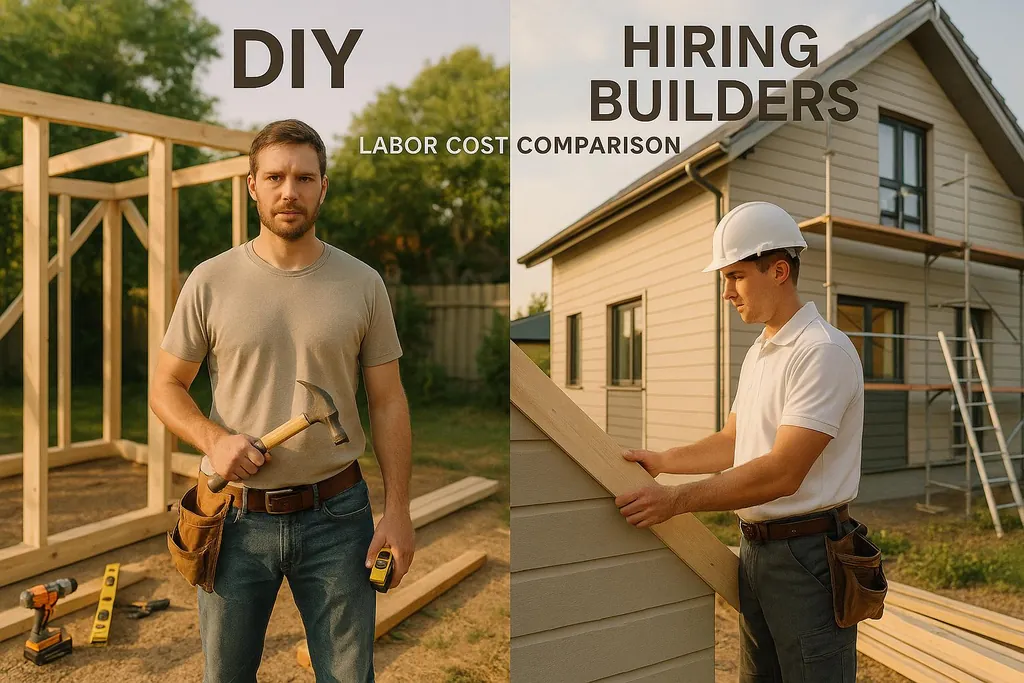
How much do you actually save going DIY? Labor cost breakdowns, time estimates, and where hiring a pro is worth the money for home building projects.
DIY vs. Hiring Builders: Labor Cost Comparison
DIY home building can save you 20–40% on labor costs, but it takes twice as long and risks costly mistakes. Hiring professionals ensures faster completion and higher quality but costs more upfront.
Key Cost Highlights:
- DIY Savings: Avoid contractor fees, saving $20,000–$60,000. But mistakes can add $10,000–$20,000 in repairs.
- Professional Costs: Labor accounts for 40–60% of total costs. Builders charge $50–$150/hour or 10–20% of project cost.
- Time: DIY takes 12–18 months vs. 6–9 months for professionals.
- Eco-Friendly Projects: Specialized skills for green features can raise costs by 6.5–31%.
Quick Comparison:
| Factor | DIY Approach | Professional Builders |
|---|---|---|
| Labor Costs | Save ~40% | 40–60% of total project costs |
| Timeline | 12–18 months | 6–9 months |
| Risk | Higher risk of costly errors | Lower risk, warranties included |
| Control | Full control, skill-dependent | Limited control, consistent quality |
| Special Skills | Learn or hire for complex tasks | Professionals handle all complexities |
Bottom Line: DIY saves money but takes more time and effort, while hiring professionals costs more but delivers speed and expertise. A hybrid approach can balance cost and quality.
Pro's and Cons of DIY vs. Hiring Out Your Home Renovation to Building Pros
Labor Cost Breakdown: DIY vs. Hiring Builders
Getting a clear picture of labor costs is key when deciding whether to build your home yourself or hire professionals. The financial gap between the two options is often noticeable, but so are the differences in time and skill requirements.
DIY Labor Costs
When you take on the challenge of building your own home, the biggest "cost" is your time. While you won’t be paying yourself an hourly wage, expect to spend significantly more time compared to hiring professionals. In fact, DIY builds often take twice as long. For example, a project that professionals might complete in 6–9 months could take you anywhere from 12–18 months .
You’ll also need to budget for tools and equipment rentals. Renting heavy machinery like excavators or concrete mixers can add up quickly. Even so, taking the DIY route can save you roughly 40% on labor costs .
On average, building your own home costs about $230,000, with most projects ranging between $98,000 and $370,000 . That breaks down to about $100 per square foot, though this can vary widely - from $75 to $450 per square foot - depending on factors like location and the complexity of the build .
In contrast, professional builders deliver quicker results and bring specialized skills to the table, but at a higher cost.
Professional Builder Labor Costs
Professional builders typically charge in one of two ways: a flat project fee or an hourly rate. General contractors and design-build firms often charge a management fee, which is around 10–20% of your total project cost. This fee covers project oversight, overhead, and profit . For hourly work, rates usually fall between $50 and $150 per hour, depending on the trade .
Here’s a breakdown of typical labor costs for professional trades:
Structural and Systems Work:
- Foundation installer: $4,000–$15,000
- House framer: $1,400–$7,600
- Roofer: $5,800–$13,200
Utilities and HVAC:
- Plumber: $10,000–$20,000
- Electrician: $1,500–$10,000
- HVAC technician: $5,000–$12,000
Finishing Work:
- Drywall installer: $2,500–$8,500
- Flooring installer: $5,000–$20,000
- Window installer: $1,700–$16,500
Additional Services:
- Architect: $6,000–$35,000
- Septic installation: $3,600–$12,400
- Gutter installer: $600–$8,500
- Landscaper: $1,200–$6,200
Labor Cost Comparison Table
| Aspect | DIY Approach | Professional Builders |
|---|---|---|
| Labor Cost Impact | Can save around 40% on labor expenses | Labor may account for 40–60% of total project costs |
| Project Timeline | Typically twice as long (e.g., 12–18 months) | Generally faster (e.g., around 6–9 months) |
| Management Fee | 0% | 10–20% of project cost |
This comparison outlines the balance between saving money and saving time, giving you a clearer picture of what to expect with each option.
What Affects Labor Costs
Several factors influence labor expenses for both DIY and professionally managed construction projects. Understanding these variables is key to creating an accurate budget.
Project Size and Complexity
The size and complexity of a construction project play a major role in determining labor costs. For instance, labor can account for about 50–60% of the total budget for home additions, which typically range from $75,500 to $500,000, with an average cost of approximately $250,000. This highlights the need for thorough planning.
Professional builders often handle complex projects more efficiently. Larger builds usually involve coordinating multiple trades, navigating permits, and adhering to building codes. These tasks can overwhelm DIY builders. On the other hand, experienced professionals often have established processes that can offset their higher hourly rates.
For eco-conscious builds, specialized features like passive solar design, advanced insulation, or renewable energy systems require skilled labor, which can further increase costs. These complexities emphasize how other factors, such as location, also influence labor expenses.
Location-Based Cost Differences
Where you build has a significant impact on labor rates. For example, constructing a home in San Diego, California, can cost up to 38% more than in El Paso, Texas. Similarly, building an apartment complex in New York City costs 52% more than in Atlanta.
Hourly labor rates vary widely across locations:
- New York City: $35–$50 per hour
- Chicago: $30–$45 per hour
- Dallas: $25–$40 per hour
- Cincinnati and Raleigh: $20–$35 per hour
- Cheyenne and Fargo: $15–$25 per hour
In New York, labor costs have been as much as 78.2% higher than the 30-city average, while San Antonio’s costs have been up to 36.3% lower than that average.
For DIY builders, location affects more than just wages. Expenses like tool rentals, permit fees, and hiring specialists can vary. Rural areas may offer lower overall costs but often have fewer skilled tradespeople, while urban areas provide more options at higher rates. Factors like union membership and local regulations also influence labor pricing.
Special Skills and Equipment Needs
Certain tasks require specialized skills or equipment, which can drive up labor costs. Plumbing, electrical, and roofing work are particularly challenging for DIY builders. Elizabeth Dodson, Co-Founder of HomeZada, explains:
> "Plumbing, electrical, and roofing work can result in severe damage if improperly handled."
DIY builders face a choice: invest time in learning these skills or hire professionals. Hiring specialists for smaller, segmented tasks can sometimes lead to higher costs. While basic framing can be done with standard tools, tasks like foundation work or HVAC installation often require renting specialized equipment. Professional builders usually have access to the necessary tools and equipment, which helps control additional expenses.
Highly specialized systems, such as geothermal installations, advanced solar setups, or passive house certifications, demand premium rates - even from seasoned professionals. Acting as your own general contractor can save between $20,000 and $60,000, but this requires careful coordination of trades and schedules. Proper planning and budgeting are essential for keeping DIY projects on track.
Pros and Cons: DIY vs. Professional Labor
Deciding between tackling a project yourself or hiring professional builders comes down to key factors like cost, time, and the level of risk you're willing to take. DIY projects can save a lot of money and provide a hands-on learning experience, but they often take longer and come with greater risks. On the other hand, professionals bring speed, expertise, and peace of mind, though their services come at a higher upfront cost.
DIY labor is a great way to cut expenses, especially since labor typically accounts for 40–60% of a project's total cost. You’ll have full control over the quality and timing of the work, which means you can make adjustments as needed without waiting on contractors. Plus, there’s something deeply satisfying about completing a challenging project yourself. The money saved on labor can even be reinvested into upgrades like energy-efficient features or high-end materials, potentially increasing your home’s resale value.
That said, DIY projects often take much longer to complete. This delay can lead to higher holding costs, such as ongoing mortgage payments and utility bills, which might add between $1,300 and $3,900 per month to your expenses.
Professional builders, on the other hand, offer the advantage of speed and consistent quality. Their expertise ensures efficient work, and they handle compliance and permitting, reducing the risk of costly fines, which can range from $2,000 to $5,000 for violations. However, hiring professionals means paying more upfront, and you’ll have less control over the project’s finer details, as you’ll need to work within their schedules and processes.
To make the differences clearer, here’s a side-by-side comparison:
Side-by-Side Comparison: DIY vs. Professional Labor
| Factor | DIY Labor | Professional Labor |
|---|---|---|
| Cost Savings | Significant reduction in labor costs | Higher upfront expense |
| Time Investment | Longer completion times | Quicker completion with expert scheduling |
| Quality Control | Full personal control, skill-dependent | Reliable professional standards |
| Risk Management | Higher potential for costly errors | Lower risk, warranty included |
| Learning Opportunity | Gain skills and personal satisfaction | Minimal hands-on involvement |
| Tool Investment | Must buy or rent tools | No extra tool costs |
| Permitting & Compliance | Personally responsible for permits and codes | Professionals handle all requirements |
| Project Management | Self-coordination of trades and schedules | Managed by experienced professionals |
Ultimately, the choice depends on your skill level, available time, and how much risk you’re willing to take on. While DIY work can save money, poor craftsmanship might hurt your property’s value. Professional builders, on the other hand, usually deliver work that maintains or even enhances home value.
If you're aiming for an eco-friendly build, DIY gives you the freedom to directly incorporate sustainable practices and energy-efficient solutions. For those new to construction, starting with smaller DIY projects can help you gauge your abilities before committing to something bigger. Understanding your limits early on can help you build confidence and gradually take on more complex tasks.
Tips for DIY Home Builders
After examining labor costs, let's dive into some practical tips for DIY home builders to manage expenses effectively while achieving great results.
Taking on the challenge of building your own home involves strategic planning, especially when deciding which tasks to handle yourself and which to leave to professionals. Labor costs often make up a large portion of your budget , so thoughtful decisions here can lead to big savings without compromising your eco-friendly building goals.
Use Educational Resources
Before you grab a hammer, it's crucial to build your knowledge base. Platforms like [DIY Eco Homes](/) offer step-by-step guides, detailed cost breakdowns, and practical advice for sustainable building. They cover essential topics like passive house standards, off-grid technologies, and energy-efficient retrofitting, giving you the technical know-how to avoid costly mistakes.
Workshops and online courses are another great way to learn basic techniques, helping you confidently take on more tasks yourself and trim labor expenses . Starting with smaller projects is a smart way to build your skills and identify when professional help is necessary. This hands-on experience can also prepare you to integrate energy-efficient features into your build.
Plan for Energy-Efficient Features
Energy-efficient designs don't have to blow your budget. Passive house principles, for example, simplify construction while drastically cutting energy use. A certified Passive House can use 90% to 95% less energy for heating and cooling compared to standard homes , with only a modest 3% to 5% increase in construction costs .
Some energy-saving measures are DIY-friendly. For example:
- Air Sealing: This task requires attention to detail but no specialized skills. Passive Houses are nearly 10 times more airtight than Energy Star standards , achieved through careful workmanship rather than expensive materials.
- Insulation: Installing thick, properly fitted insulation in walls and ceilings is a straightforward way to save energy and lower costs over time.
- Window Placement: Thoughtful design can maximize solar heat in winter while reducing heat gain in summer .
Locally sourced materials, like cob or adobe, can also help meet passive house standards without driving up costs . These earth-based techniques are often manageable for unskilled labor, making them ideal for DIY builders .
Energy efficiency not only reduces long-term expenses but also aligns with sustainable building practices.
Create a Clear Labor Budget
A well-planned labor budget is key to staying on track financially. Focus on elements that are hard to change later, like the structure and building envelope. As Patrick Ranger, General Manager at Belvedair, advises:
> Be sure to place the greatest priority on the components that are difficult to change in the future, like the structure and building envelope. If you end up needing to make material compromises in order to stay on budget, it's better that those be aesthetic; don't risk affecting the performance or durability.
Carefully monitor costs throughout the project. Ranger also stresses:
> Obviously it is important to be rigorous in monitoring costs at every stage. It's not enough to establish a detailed budget – you need to comply with it, and track all the expenses during construction and renovations to ensure that the established budget is respected.
A semi-DIY approach can strike the right balance between saving money and ensuring quality. For instance, you could handle demolition, painting, and basic carpentry while hiring professionals for complex tasks like foundation work, electrical, and plumbing. Don’t forget to account for often-overlooked expenses such as excavation, permits, taxes, and land surveys .
Opt for a simple design to keep labor manageable. Single-story layouts are easier to build and can help you meet energy-efficient standards more affordably . Smaller homes with efficient use of space reduce both resource needs and overall costs .
Finally, research rebates and tax incentives for energy-efficient upgrades . These can offset some labor costs and make high-performance building techniques more accessible. By budgeting wisely, you can reinvest savings into eco-friendly features that enhance your home's value and reduce long-term expenses.
Conclusion: Choosing the Right Approach
Deciding between building your home yourself or hiring professional builders hinges on your budget, skill level, and goals for sustainability. For eco-friendly projects, the key is finding the right balance between saving on labor costs with DIY work and ensuring professional precision where it truly matters. While DIY construction can cut labor costs by 20% to 40% , the decision goes beyond just saving money upfront.
Professionals may charge more, but their expertise can prevent costly mistakes and reduce long-term expenses. This is especially critical in eco-friendly construction, which is often more complex than standard building projects . Professional builders are well-versed in zoning laws, permits, and inspections , ensuring your green home complies with all regulations and avoids potential setbacks.
Safety and an honest assessment of your skills are also crucial factors. DIY home projects contribute to over 200,000 accidents annually . Carmel Woodman, a former content manager at a leading real estate platform, emphasizes this point:
> If you're inexperienced with complex repairs or simply uncomfortable handling high-stakes tasks on your own, a contractor's expertise can save you time, money, and stress.
For many, a hybrid approach might be the best solution. This allows you to save on labor costs by tackling simpler tasks yourself while leaving critical systems - like electrical, plumbing, and HVAC - to the professionals.
Time and convenience are other key considerations. DIY projects often take longer due to learning curves and limited availability, potentially driving up holding costs . Professionals, on the other hand, can work within set timelines, delivering faster results - but at a higher cost.
If your long-term vision includes energy efficiency and sustainability, resources like [DIY Eco Homes](/) can provide valuable guidance for incorporating passive house principles and eco-friendly features into your DIY plans. However, for more complex systems, professional installation is essential to ensure optimal performance.
Ultimately, whether you go the DIY route, hire professionals, or combine both approaches, focus on safety, quality, and staying aligned with your sustainable building goals. By carefully weighing cost efficiency against the demands of your project, you can make the choice that best fits your needs.
FAQs
What hidden costs should I consider when building a home yourself that could reduce labor cost savings?
While building your own home might seem like a great way to cut labor costs, there are plenty of hidden expenses that can sneak up on you. Think about fees for permits, preparing the site, and connecting utilities. Then there are those unexpected costs - like dealing with trash removal, theft, or the need for extra insurance. You might also end up spending more on things like landscaping, last-minute design changes, or fixing water drainage issues that pop up along the way.
And let’s not forget the finishing touches. Appliances, furniture, and fixtures can add up fast, often blowing past what you initially budgeted. These extra expenses can chip away at the savings you hoped to achieve by taking the DIY route. The best way to avoid being caught off guard? Spend time creating a detailed budget and planning carefully to keep your project on track.
How do I decide which parts of my home-building project I can DIY and which need a professional?
Deciding whether to take on a project yourself or hire a professional comes down to a few key factors: the task's complexity, your skill level, and safety concerns. For example, straightforward projects like painting a room, installing light fixtures, or sprucing up your yard are often perfect for a DIY approach. But when it comes to more technical or potentially hazardous work - like structural repairs, electrical wiring, or plumbing - it's usually best to call in licensed professionals. Not only does this ensure the job is done safely, but it also keeps everything up to code.
Before diving into any project, think about your time, tools, and experience. It’s also a good idea to check local regulations, as some areas have strict rules about the kind of work homeowners can legally perform, especially for plumbing, electrical, or mechanical tasks. Striking the right balance between DIY and professional help can help you save money while maintaining safety and quality.
What are the advantages of adding energy-efficient features to a DIY home, and how can they save you money over time?
Adding energy-efficient features to your DIY home offers a range of perks, from cutting down on utility bills to enhancing overall comfort and even increasing your home's resale value. Upgrades like top-notch insulation, energy-efficient windows, and [solar panels](/blog/how-to-choose-solar-panels-that-match-your-roof) can make a big difference by lowering heating, cooling, and electricity expenses over time.
Beyond saving money, these improvements help create a more eco-friendly lifestyle. They reduce greenhouse gas emissions and lessen reliance on fossil fuels. While the upfront costs for energy-efficient materials and technologies might seem high, they often pay for themselves through long-term savings and a reduced environmental impact.