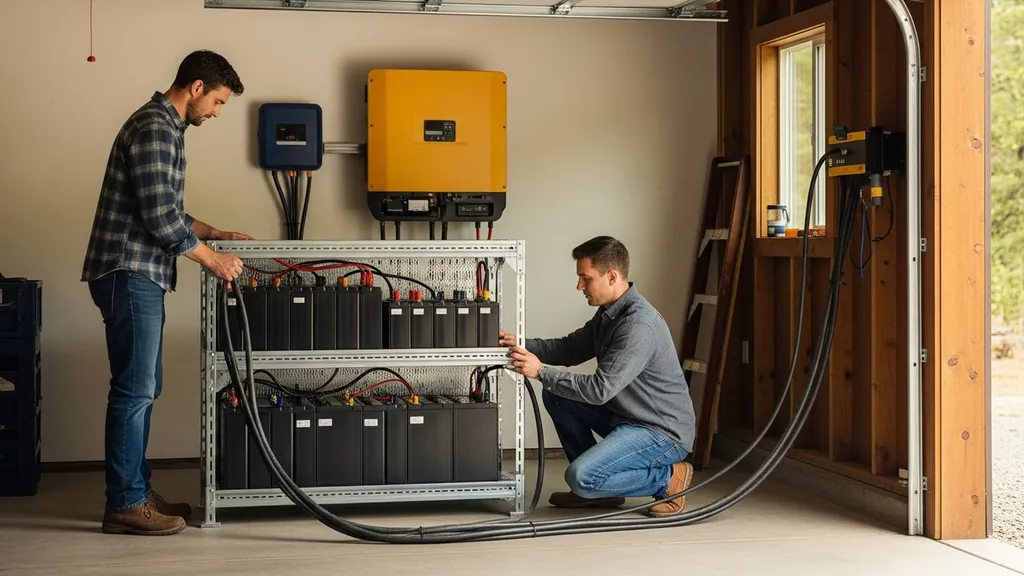
Practical guide for DIYers on choosing, sizing, installing, and maintaining solar battery storage for budget-conscious self-builds.
Solar Battery Storage: Complete Buying Guide
Solar battery storage is the system that captures electricity from solar panels and saves it for later use—enabling evenings of reliable power, safer backup during outages, or true off-grid living. For budget-conscious DIY builders, understanding how battery chemistry, usable capacity, inverter sizing, and installation architecture interact is the difference between a system that lasts a decade and one that needs early replacement. This guide explains what solar battery storage does, how to size and choose batteries, installation options, costs and warranties, safety and permits, and a short buyer checklist to use when shopping.
TL;DR:
- Match battery usable kWh to measured daily load; example: tiny house 3–8 kWh/day, cabin 6–15 kWh/day.
- Choose LFP for long life and safety; lead-acid only if upfront budget is tightly constrained and maintenance is expected.
- Size batteries as: (daily kWh × autonomy days) ÷ (usable DoD × inverter efficiency); verify inverter continuous kW rating for peak loads.
What is Solar Battery Storage and How It Works: Basics for DIY Builders
Solar battery storage stores DC electricity from solar panels (or the grid) for later use through an inverter that supplies AC to home circuits. Common DIY applications include daily time-shifting (store daytime solar to use at night), backup power for critical loads during outages, and full off-grid autonomy for cabins or tiny houses.
Quick definition and common use cases
- Daily time-shifting: Store midday excess, use at night to reduce grid draw.
- Backup power: Provide hours of power to selected circuits during outages.
- Off-grid autonomy: Replace the grid entirely for remote cabins or homesteads.
Main system components
- Battery bank: One or more battery modules that store energy.
- Inverter/charger: Converts DC to AC and manages charge/discharge.
- Battery Management System (BMS): Protects cells, balances charge, and prevents unsafe conditions.
- Monitoring: Local display or cloud portal to track state of charge and performance.
Key performance terms explained
- kWh (kilowatt-hour): Energy capacity—how much energy the battery can store.
- kW (kilowatt): Power—how much load the battery/inverter can supply at once.
- Depth of discharge (DoD): Percent of battery capacity usable without shortening life; LFP commonly allows ~80–90% usable DoD; lead-acid around 50%.
- Cycle life: Number of full charge/discharge cycles before capacity drops to a warranty threshold.
- Round-trip efficiency: Energy retained after charging and discharging; modern lithium systems typically achieve 85–95%.
- System voltages: Small systems often use 12/24/48 V nominal; most home-scale banks and modern inverters use 48 V for safety and efficiency.
For an accessible step-by-step approach to siting and permitting larger battery systems, government guidebooks can help clarify local requirements—see the New York State battery guide for a practical checklist and siting resources: New york state battery energy storage system guidebook.
This video explains the fundamentals:
Choosing the Right Battery Type: Pros and Cons
Selection of battery chemistry is a central decision. It affects usable lifetime, temperature tolerance, maintenance, safety, and final cost.
Lithium Iron Phosphate (LFP) — Why It’s Popular for DIY
LFP offers high cycle life (typically 3,000–8,000 cycles depending on depth of discharge and manufacturer), high usable DoD (about 80–90%), strong thermal stability, and minimal maintenance. Energy density is lower than some lithium chemistries but still far better than lead-acid, which saves space in small builds. Round-trip efficiency commonly sits between 88% and 95%. LFP systems usually have higher upfront price but lower lifecycle cost because they last longer and need less replacement.
Lead‑acid (flooded, AGM) — Budget Option and Trade-offs
Lead-acid batteries have low upfront cost per unit but offer limited usable DoD (around 50% for deep-cycle types) and lower cycle life (300–1,200 cycles typical). Flooded lead-acid requires regular maintenance (electrolyte checks and watering) and ventilated enclosures because of hydrogen off-gassing. AGM sealed lead-acid is lower maintenance but still shorter lived than LFP. Lead-acid may suit very tight budgets or strictly backup-only systems where battery cycling is rare.
Other Chemistries and Emerging Options
- Flow batteries: Long calendar life and deep discharge but large footprint and higher installation complexity—rare for small DIY installs.
- Nickel-based: Higher energy density but poorer thermal stability and costlier; generally unsuitable for residential DIY.
- Second-life EV cells: Can lower costs, but variability in health and more complex BMS/integration needs careful vetting.
Market trends show rapid growth of battery storage deployment; for high-level market context and chemistry shifts, see the EIA’s battery storage market update: U.S. battery storage market trends.
Which chemistry suits common DIY scenarios?
- Tiny houses/van builds: LFP when space and weight allow; small sealed LFP modules at 12–48 V are widely available.
- Remote cabins/off-grid: LFP for long life and limited maintenance. Lead-acid only if budget forces it and the owner is comfortable with servicing.
- Backup-only setups: Lead-acid may be acceptable if cycles are rare and cost is the limiting factor, but plan early for replacement costs.
Sizing Your Solar Battery System: Step-by-step for DIY Projects
Proper battery sizing matches real measured loads, desired autonomy, and charging window from the solar array. Follow this practical worksheet.
Estimate Your Usable Daily Energy (kwh) — Simple Worksheet
- Inventory loads: fridge, LED lights, phone chargers, pump, outlets.
- Measure or estimate hours of use and appliance power. Alternatively, log actual usage with a clamp meter or smart plug for a week.
- Example typical daily use:
- Tiny house: 3–8 kWh/day.
- Small cabin: 6–15 kWh/day.
- Workshop bench: 0.5–2 kWh/day.
If a reader wants worked examples for panel-to-load scaling, check the 10 kW tiny-house plan and the 3 kW tiny-house guide for context.
Decide on Backup Days and Autonomy — Backup vs Daily Cycling
- Daily cycling: One day of storage to shift energy nightly is common and minimizes battery size.
- Short backup: 1–3 days autonomy for occasional cloudy periods or to ride out outages.
- Full off-grid: Multiple days (3–7+) depending on location and winter insolation.
Sizing Formula and Example Calculations
Use: Battery bank size (kWh nominal) = (Daily kWh × Autonomy days) ÷ (Usable DoD × Inverter efficiency)
Assume inverter efficiency 90–95%. DoD: LFP ≈ 0.85 usable, lead-acid ≈ 0.5 usable.
Example 1 — Tiny house (3 kWh/day), 1 day autonomy, LFP:
- Required nominal kWh = (3 × 1) ÷ (0.85 × 0.92) ≈ 3.8 kWh → choose a 4–6 kWh LFP bank to allow headroom.
- Inverter sizing: continuous loads may peak; recommend a 2–3 kW inverter for modest tiny-house loads, higher for electric cooktops or heaters.
Example 2 — Off-grid cabin (12 kWh/day), 2-day autonomy, lead-acid:
- Required nominal kWh = (12 × 2) ÷ (0.5 × 0.92) ≈ 52 kWh nominal — a large lead-acid bank; here LFP would halve the required nominal capacity and likely be more practical long-term.
- For real off-grid projects, see the 7 kW cabin example and the small cabin power example to compare array and battery sizing.
Factor in solar production window: a smaller array limits how much battery can be charged each day. Use the solar panels calculator or interactive solar sizing tool to estimate daily production and charging hours before finalizing battery size.
Match inverter continuous and surge kW to peak loads. For motors and pumps, allow surge capacity (inverter peak) typically 2–6× the continuous rating, but check specs carefully.
Installation Options: Grid-tied, Off-grid, Hybrid, and Coupling
System architecture shapes hardware choices and installation complexity.
Grid-tied with Backup vs Fully Off-grid Systems
- Grid-tied with backup: Keeps the grid as primary power but provides backup circuits or whole-house backup during outages with a transfer switch. Simpler for smaller batteries.
- Fully off-grid: No grid connection; requires larger battery banks, robust charge control, and a generator as a secondary resource for prolonged low-sun periods.
- Hybrid systems: Designed to operate grid-connected and provide intentional islanding during outages.
See the high-level differences and implications for integration in grid-tied vs off-grid differences and full off-grid planning in off-grid home planning.
AC Coupling vs DC Coupling: How Each Affects Batteries and Inverters
- AC coupling: Solar inverter supplies AC to a hybrid inverter/charger or battery inverter via the AC bus. Retrofits are easier with existing grid-tied inverters. Slightly lower round-trip efficiency.
- DC coupling: Solar DC routes to a charge controller that charges batteries directly before the inverter—typically more efficient for new systems and for high battery charging rates.
Read the technical comparison in the AC vs DC coupling guide.
Integrating a Generator or Existing Inverter and Practical Wiring Notes
- For off-grid or backup-heavy setups, a generator helps recharge batteries during extended cloudy periods—configure automatic start/stop through the inverter/charger when state of charge drops below a setpoint.
- Transfer switches and anti-islanding protections are required for grid-tied backups; work with the local utility and follow interconnection rules early.
- For retrofit projects, consult adding solar to an existing home to review how existing inverters and load centers affect battery integration.
- For siting and best-practice siting considerations for battery installations, the Lawrence Berkeley National Laboratory provides a concise factsheet on siting and safety: Best practices and considerations for siting battery storage systems.
Cost, Warranties, Lifespan, and Financing: Budgeting for Diyers
Budgeting must include lifecycle costs, not just upfront price. Installed costs vary widely by region and complexity.
Typical Installed Cost Ranges and What Affects Price
- Installed battery cost per usable kWh varies by chemistry and system size. Conservative ranges (2025–2026 market context) might be:
- LFP: $600–$1,200 per usable kWh installed.
- Lead-acid: $200–$500 per usable kWh installed (but much shorter life).
- Flow batteries: $1,000+ per usable kWh, niche for specialized sites.
Final costs depend on balance-of-system items (inverter/charger, BMS, wiring, racks, permits, labor) and whether the install is DIY or professional.
For regional market trends and solar-plus-storage economics, see national analyses such as the Naval Research Laboratory’s solar-plus-storage study: Solar-Plus-Storage analysis.
Warranties and How to Interpret Cycles vs Years
- Warranties are often cycle-based (X cycles to Y% capacity) or time-based (years). Example: warranty to 70% capacity after 10 years or 5,000 cycles—read both metrics carefully.
- Watch for throughput warranties (total kWh delivered over life) and exclusions that void coverage (improper temperature range, DIY installs that violate installation rules, or non-approved inverters).
- Manufacturer warranty terms vary; keep spec sheets and serial numbers for claims.
Financing Options, Incentives, and Budget Strategies for Diyers
- Check federal and state incentives, residential tax credits, and utility rebates—programs change, so verify current availability.
- Financing options include loans, personal lines of credit, or PACE programs where available.
- Budget strategies:
- Stage installations: start with one battery module now, add more later as budget allows.
- Consider refurbished or used batteries with careful testing, but buyer beware—warranty and lifetime are uncertain.
- Explore second-life EV battery packs for experimental projects, understanding additional engineering and BMS work required.
Estimate project costs using calculators like the site’s solar cost calculators and pair battery choices with budget-friendly panel options to control overall project spend.
Maintenance, Safety, and Regulations for DIY Installers
Safety and permits are non-negotiable parts of DIY battery projects.
Safe Siting, Ventilation, Fire Considerations and BMS Best Practices
- Site batteries in a cool, dry, accessible area with temperature within the manufacturer’s specified range (many LFP banks prefer 0–40°C for long life).
- Enclose batteries in lockable ventilated cabinets and route DC cabling through protected conduits. Install clear signage for emergency responders.
- Use an appropriately rated BMS and follow manufacturer wiring diagrams closely. BMS must manage overcharge, overdischarge, and cell balancing.
- Consider a dedicated fire extinguisher rated for electrical fires and consult local fire code for requirements. For detailed enclosure steps, see the DIY battery enclosure how-to: DIY battery enclosure how-to.
Permits, Codes, and Working with the Authority Having Jurisdiction (AHJ)
- Most jurisdictions require permits and inspections for battery installations, especially if grid-connected. Submit plans that include battery location, electrical one-line, disconnects, and ventilation.
- Contact the AHJ early. Utilities may require specific interconnection agreements and anti-islanding measures for grid-tied systems.
- Keep records of equipment specs, wiring diagrams, and test results for inspections.
End-of-life, Recycling, and Disposal Options
- LFP and other lithium chemistries are recyclable, but processes differ by region. Check manufacturer take-back programs and certified recyclers.
- Lead-acid recycling networks are well-established—recycled lead and plastics have high recovery rates; return used lead-acid to a certified recycler.
- Treat batteries as hazardous waste if local programs require it and never dispose in household trash. For practical guidance on safe handling and household-scale recycling, see consumer education resources such as Green Mountain Energy’s overview: Understanding home solar battery storage.
Quick Buyer Checklist & What to Compare Before You Buy
Short Checklist (top 10 Questions to Answer Before Purchase)
- How many usable kWh do I need? Measure or estimate daily kWh and desired autonomy.
- What is the usable DoD? Ask for usable capacity, not only nominal kWh.
- What is the continuous and peak kW rating? Match this to your inverter and peak loads.
- Is a BMS integrated? Confirm BMS features and protections.
- What is the warranty wording? Check cycles, years, and capacity retention thresholds.
- What is the operating temperature range? Ensure fit with your chosen location.
- Is the system modular/expandable? Verify compatibility for future additions.
- What are installation requirements? Cabling, clearances, ventilation, and mounting hardware.
- How does the vendor support claims and RMA? Get contact and process details.
- What is the estimated life-cycle cost? Consider replacement cadence and maintenance.
How to Compare Specs
When comparing spec sheets, line up these values side-by-side:
- Usable kWh (not just nominal).
- Continuous kW and peak kW rating.
- Round-trip efficiency percentage.
- Cycle life at specified DoD and end-of-warranty capacity.
- Warranty coverage (cycles, years, throughput).
- Physical size and weight for mounting.
- Safety certifications such as UL 1973, UL 9540, or IEC equivalents.
Red flags include no BMS, ambiguous DoD or usable energy, missing safety certifications, or unclear warranty claim process.
Comparison Specs Table: Batteries at a Glance
| Chemistry | Typical usable kWh per module | Cycle life (approx) | Usable DoD | Round-trip efficiency | Typical installed cost per usable kWh | Best use case |
|---|---|---|---|---|---|---|
| LFP (LiFePO4) | 2–20 kWh modules | 3,000–8,000 cycles | 80–90% | 88–95% | $600–$1,200 | Daily cycling, off-grid, long-life DIY |
| Lead-acid (flooded/AGM) | 1–10 kWh modules | 300–1,200 cycles | ~50% | 70–85% | $200–$500 | Low upfront budget, rare cycle use, backup |
| Flow batteries (small residential) | 5–20 kWh systems | 5,000–10,000+ cycles | 70–100% | 60–80% | $1,000+ | Long-duration storage, specialty sites |
These figures are conservative ranges and approximate. For most DIYers seeking low maintenance and long life, LFP is the recommended default. Lead-acid may make sense for very low budgets if the owner plans and budgets for frequent replacement and maintenance.
The Bottom Line
Solar battery storage lets DIY builders shift solar energy to when it's needed, provide reliable backup, and enable off-grid living; pick chemistry by the use case (LFP for longevity, lead-acid only if strict budget constraints require it). Size batteries from measured loads and desired autonomy, confirm inverter continuous kW and surge needs, plan for safety and permitting, and budget lifecycle cost rather than just upfront price. Next step: run the solar sizing tool to match array production to battery charge needs and review the DIY battery enclosure how-to before purchasing.
Frequently Asked Questions
How long do home batteries typically last?
Battery life depends on chemistry and depth of discharge: LFP commonly delivers 3,000–8,000 cycles (roughly 10–20 years depending on usage), while lead-acid often lasts 300–1,200 cycles (3–7 years under regular cycling). Warranty terms usually specify years and capacity retention to a percentage, which provides a useful baseline for expected service life.
Can I add batteries later if my needs grow?
Many systems are modular and allow adding modules later, but compatibility matters: ensure the same chemistry, voltage, and BMS compatibility, and confirm the inverter/charger supports the increased bank size. Verify expandability with the manufacturer before initial purchase to avoid mismatch issues.
Is lfp worth the extra cost compared with lead-acid?
For most DIYers, LFP is worth the higher upfront cost because of higher usable DoD, longer cycle life, lower maintenance, and better safety, leading to lower lifecycle cost. Lead-acid can save money initially but often requires replacement sooner and more hands-on maintenance.
Can I install a home battery system myself?
DIY installation is possible for many components, but it depends on local codes and whether the install is grid-tied. Permits, inspections, and utility interconnection rules often apply; a licensed electrician may be required for final connections or for approval by the authority having jurisdiction (AHJ). Consult local permitting authority early in the project.
How do I safely recycle or dispose of old batteries?
Return lead-acid batteries to a certified recycler or retailer that accepts cores; they have established recycling streams. For lithium batteries, check manufacturer take-back programs or certified recyclers in the area; never dispose in household trash. Contact local hazardous-waste programs for collection options if unsure.