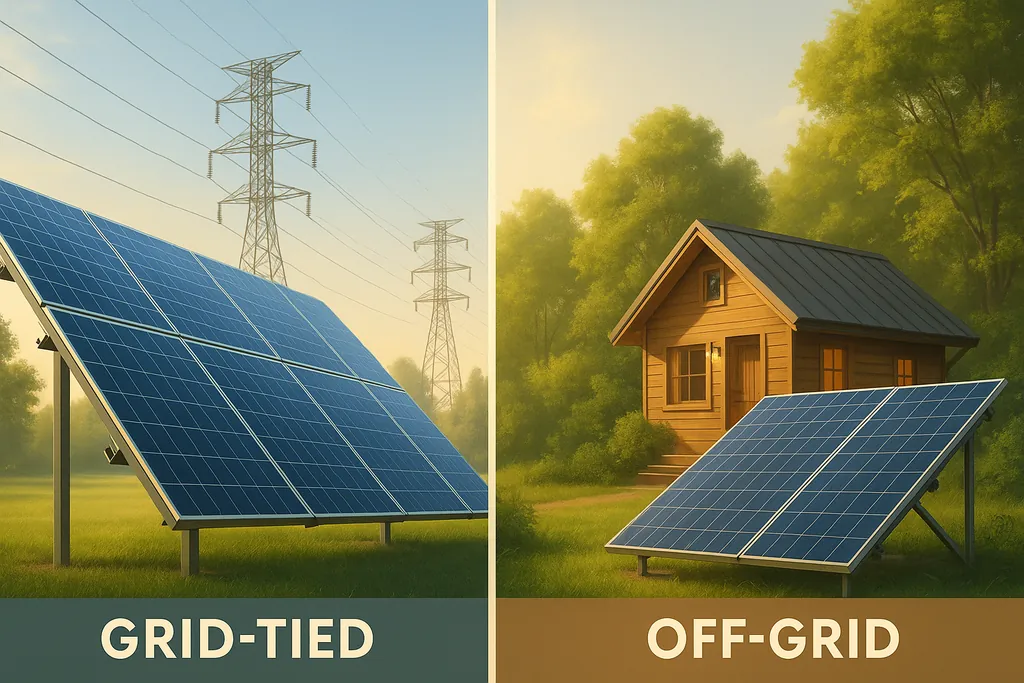
Explore the differences between grid-tied and off-grid solar systems to find the best solution for your energy needs and location.
Grid-Tied vs Off-Grid Solar: Key Differences
Choosing between grid-tied and off-grid solar systems depends on your energy needs, location, and budget. Here's a quick breakdown:
- Grid-Tied Systems
- Connect to the utility grid.
- Cost: $25,000–$55,000.
- Use grid power as backup and offer net metering for bill credits.
- Best for urban/suburban areas.
- Lower maintenance and no batteries required.
- Off-Grid Systems
- Fully independent from the grid.
- Cost: $50,000–$65,000.
- Depend on battery storage and often require a backup generator.
- Ideal for remote locations or achieving total energy independence.
- Higher maintenance due to battery upkeep.
Quick Comparison Table:
| Feature | Grid-Tied Systems | Off-Grid Systems |
|---|---|---|
| Initial Cost | $25,000–$55,000 | $50,000–$65,000 |
| Power Access | Grid backup available | Battery storage only |
| Best Location | Urban/suburban areas | Remote locations |
| Maintenance | Lower requirements | Higher requirements |
| Energy Bills | Reduced through credits | Eliminated entirely |
Key Takeaway: Grid-tied systems are cost-effective for most homes, while off-grid systems are better for remote areas or complete energy independence. Choose based on your location, energy goals, and budget.
Understanding Solar: Grid-Connected vs Off-Grid Systems
How Each System Works
Let's break down how energy is managed in grid-tied and off-grid solar systems, focusing on storage, power supply, and how each setup responds to outages.
Battery Storage vs. Grid Connection
Grid-tied and off-grid systems handle energy storage in distinct ways. Grid-tied systems use the utility grid as a kind of virtual battery. When your solar panels generate more electricity than you need, the excess is sent back to the grid. This setup eliminates the need for a physical battery bank, which can be expensive, while still ensuring a steady power supply.
Off-grid systems, on the other hand, depend entirely on battery storage. During the day, solar panels charge a battery bank, which stores any surplus energy for later use, such as at night or during cloudy weather. These systems typically use lead-acid batteries, which operate at an efficiency rate of 80–90%.
| Storage Method | Grid-Tied | Off-Grid |
|---|---|---|
| Primary Storage | Utility Grid | Battery Bank |
| Efficiency | ~93% (7% loss) | 80–90% |
| Backup Required | No | Yes (Generator) |
| Storage Cost | $0 (uses grid) | 30–40% of system cost |
Power Supply Options
In grid-tied systems, any extra energy your solar panels produce flows back into the utility grid through net metering. This process essentially uses the grid as a backup power source. As Paradise Energy puts it:
> "A grid-tied solar system is seamlessly connected to the utility grid, allowing solar owners to send excess electricity to the grid when production exceeds demand - effectively utilizing the grid as a backup battery."
Off-grid systems take a different approach. Solar panels send electricity to a charge controller, which regulates how much power enters the battery bank. From there, an off-grid inverter converts the stored direct current (DC) into alternating current (AC), making it usable for household appliances. This setup provides complete energy independence, making off-grid systems a practical choice for those seeking autonomy.
Power Outage Response
Grid-tied systems are designed to shut down during power outages. This is a safety measure to prevent back-feeding electricity into the grid, which could endanger utility workers. Unfortunately, this means that even if the sun is shining, your solar panels won't power your home during a blackout.
Off-grid systems, however, are unaffected by grid outages. Since they operate independently, they continue to supply power without interruption. The growing interest in off-grid systems is clear - 4.3 million solar energy kits were sold in just the first half of 2023. This trend highlights a rising demand for energy independence and reliable backup power, especially during grid disruptions.
Price Comparison
Initial Setup Costs
Grid-tied solar systems generally cost between $15,000 and $20,000, while off-grid systems can range from $45,000 to $65,000. For grid-tied setups, the average installation cost is $2.56 per watt, with typical post-tax credit expenses landing around $20,552.
Off-grid systems are more expensive because they require additional components to operate independently. Here's a quick breakdown of the essential equipment:
| Component | Approximate Cost |
|---|---|
| Solar Panels (10 kW array) | $5,000+ |
| Inverter with Charge Controller | $4,000+ |
| Battery System (20 kWh) | $20,000+ |
The total cost also depends on the type of off-grid system you choose:
| System Type | Cost Range |
|---|---|
| DC Solar System | $6,000–$10,000 |
| Mixed DC and AC System | $10,000–$50,000 |
| AC Solar System | $30,000–$60,000 |
| AC with Backup Generator | $40,000–$70,000 |
Long-term Upkeep Costs
Grid-tied systems are easier to maintain since they don't rely on batteries, which is a major advantage over off-grid systems. Off-grid setups, however, require regular battery maintenance, and battery replacement is a significant expense. The starting cost for battery storage alone is $20,000. That said, off-grid systems can potentially save more in areas with high electricity rates or frequent power outages.
Now, let's look at how tax credits and incentives can help offset these costs.
Available Tax Credits and Savings
Tax incentives can make a big difference in reducing installation and maintenance expenses. Both grid-tied and off-grid systems qualify for the federal Residential Clean Energy Credit, which offers a 30% tax credit on installation costs. Catherine Lane, Written Content Manager at SolarReviews, explains:
> "The federal solar tax credit is the most widespread solar incentive in the United States. Every U.S. taxpayer who purchases a solar installation is eligible to receive 30% of the cost back as an income tax credit in the year after installation"
Some states also provide additional incentives, such as:
| State | Tax Credit Details |
|---|---|
| Arizona | 25% of costs (up to $1,000) |
| Hawaii | 35% of costs (up to $5,000) |
| New York | 25% of costs (up to $5,000) |
| Massachusetts | 15% of costs (up to $1,000) |
It's worth noting that the federal tax credit will gradually decrease in the coming years - dropping to 26% in 2033 and 22% in 2034, before expiring in 2035. For example, a typical 7.2-kilowatt solar installation costing $21,816 would qualify for an average federal tax credit of $6,544.
Best Uses by Location
City vs Country Installation
When deciding between grid-tied and off-grid solar systems, the location of your property and its access to the electrical grid play a big role. For city dwellers, grid-tied systems are often the go-to choice. These systems take advantage of the existing grid infrastructure, which means lower costs since batteries aren't necessary. This makes them especially appealing for urban households.
In contrast, for those living in remote rural areas, off-grid systems shine. They provide energy independence without the expense of extending grid access. Here's how different locations align with specific system types:
| Location Type | Recommended System | Primary Benefits |
|---|---|---|
| Urban Areas | Grid-tied | Lower costs, access to net metering |
| Suburban Areas | Grid-tied or Hybrid | Flexibility with potential backup power |
| Remote Rural | Off-grid | Energy independence, no utility fees |
| Developing Areas | Off-grid | Self-sufficiency without infrastructure |
Location is just one piece of the puzzle - weather and environmental factors also play a critical role in system performance.
Weather Impact
Weather patterns have a direct influence on solar panel efficiency. Interestingly, solar panels function better in cooler temperatures, with peak efficiency often occurring when the temperature is below 77°F.
> "Solar panel efficiency typically improves in temperatures below 77°F", explains Navigate Power. They also highlight that "home battery systems perfectly complement wintertime renewable energy production"
Here are some common weather scenarios and their impact on solar systems:
| Weather Condition | Impact on System | Recommended Setup |
|---|---|---|
| Cold with Snow | Cooler temps improve efficiency if panels stay clear | Grid-tied systems with tilted panels for snow-shedding |
| Frequent Storms | Reduced solar output during storms | Hybrid or off-grid systems with strong battery backup |
| Hot Climate | Efficiency can drop by up to 20% in extreme heat | Panels designed to handle high temperatures |
| Variable Seasons | Seasonal production changes | Grid-tied systems leveraging net metering |
Understanding how weather affects performance helps tailor the system to your specific environment.
Power Requirements
Alongside location and weather, your household's energy needs are key to choosing the right system. Grid-tied systems are ideal for homes with consistent energy use, as they balance production with grid support. On the other hand, off-grid systems need to be carefully sized to ensure enough stored energy for periods of low solar output.
For properties that experience frequent power outages or fluctuating energy demands, hybrid systems or off-grid setups with reliable battery storage are excellent options. According to DIY Eco Homes, it's wise to add about 20% extra capacity to off-grid systems to handle seasonal changes and maintain a steady power supply year-round.
Self-Installation Guide
Before diving into a DIY solar installation, it's important to understand how each type of system works. Let's break down the key steps for both off-grid and grid-tied setups.
Off-Grid DIY Setup Steps
Installing an off-grid system takes careful planning and coordination. Each component needs to work together seamlessly to ensure reliable power. Here's a quick overview of the process:
| Phase | Components | Key Considerations |
|---|---|---|
| Planning | Energy audit, system design | Determine your energy needs |
| Equipment | Panels, batteries, controller | Size the battery bank properly |
| Safety | Grounding, protection | Follow NEC (National Electrical Code) rules |
| Power | Inverter, backup generator | Calculate peak load capacity |
DIY Eco Homes stresses the importance of accurate battery sizing and load calculations to ensure your off-grid system can provide power year-round.
Now, let's shift gears to the simpler process of setting up a grid-tied system.
Grid-Tied DIY Setup Steps
Grid-tied systems are easier to install and boast higher energy efficiency - about 98% compared to off-grid systems. However, they come with specific safety requirements and need approval from your utility provider.
> "Grid-tied systems must have anti-islanding protection that automatically disconnects from the grid during power outages", according to the National Electrical Code guidelines.
Here's what you'll need to get started:
- Permits and utility agreements: Ensure you have the necessary approvals.
- Safety disconnects: These are required for grid compliance.
- Monitoring systems: Track your system's performance.
- Building code compliance: Follow local regulations.
DIY Installation Help
To simplify the installation process, there are plenty of resources available for both grid-tied and off-grid systems. DIY Eco Homes, for example, provides:
- System Design Guides: Learn how to plan panel placement and size your system effectively.
- Equipment Selection Tips: Find compatible components for your setup.
- Step-by-Step Instructions: Access detailed guides and technical documentation for safe installation.
It's important to note that, per the National Electrical Code, grid connections must be handled by licensed electricians. Also, conducting a thorough energy audit will help ensure your system is tailored to meet your power needs throughout the year.
Making Your Choice
Selecting the right solar system depends on what works best for your specific situation. Grid-tied systems are a great option for urban or suburban settings, offering lower upfront costs, simpler upkeep, and the advantage of net metering, which can offset your utility bills.
| Factor | Best for Grid-Tied Systems | Best for Off-Grid Systems |
|---|---|---|
| Location | Homes in urban/suburban areas with reliable grid access | Remote locations with limited or no grid access |
| Budget | Lower upfront costs | Higher initial investment |
| Energy Usage | Properties with higher daily energy needs | Homes designed for reduced energy consumption |
| Primary Goal | Cutting down on utility bills | Achieving full energy independence |
These comparisons highlight the key differences and set the stage for evaluating three essential factors in your decision-making process.
Key Factors to Consider
1. Grid Reliability If your area is prone to frequent power outages, you might want to consider an off-grid system or a hybrid system that includes battery backup. While grid-tied systems are efficient, they automatically shut down during outages for safety reasons.
2. Energy Needs For homes with high energy consumption, grid-tied systems are often the better choice since they allow you to pull extra power from the grid when your solar panels can't meet demand. On the other hand, off-grid systems require precise planning and management, making them more practical for energy-conscious homes with lower power requirements.
3. Financial Considerations Grid-tied systems are more affordable upfront and boast high energy conversion efficiencies - up to 98% of the solar energy collected can be utilized effectively. Off-grid systems, while more expensive initially, free you from utility bills and provide complete energy independence.
For those looking for a balance, hybrid systems combine the cost savings of grid-tied setups with the security of battery backup, offering flexibility and peace of mind.
FAQs
What are the pros and cons of grid-tied and off-grid solar systems?
Grid-tied and off-grid solar systems offer different advantages and challenges, making them suitable for various energy needs and lifestyles. Here's a closer look at each:
Grid-tied systems connect directly to the local utility grid, allowing you to use grid power when your solar panels aren't generating enough energy - like at night or during cloudy weather. These systems are generally more affordable to install and maintain since they don't require batteries. However, their reliance on the grid means you'll lose power during outages unless you add a backup system, such as a battery.
Off-grid systems, in contrast, function entirely independent of the utility grid. They use batteries to store energy for times when solar production dips. This setup provides complete energy independence and is perfect for remote locations without grid access. That said, off-grid systems come with higher upfront costs and demand careful energy management to ensure you don't run out of stored power.
Deciding between these two options depends on your location, budget, and energy priorities. For those interested in off-[grid living](/blog/solar-vs-wind-power-which-is-better-for-off-grid-living) or building a more self-sufficient home, platforms like DIY Eco Homes offer helpful resources to guide you along the way.
How do weather conditions impact grid-tied and off-grid solar systems?
Weather has a big impact on how well both grid-tied and off-grid solar systems perform. Bright, sunny days are the sweet spot for solar panels, as they generate the most electricity under direct sunlight. But when the weather turns cloudy or overcast, energy production takes a hit. Thankfully, modern solar panels are built to still produce some power, even in low-light conditions.
For grid-tied systems, this dip in output isn't a huge problem. They can simply pull electricity from the grid to make up the difference. Off-grid systems, on the other hand, depend entirely on stored energy in batteries. If cloudy weather sticks around for too long, batteries can run low. That's why it's crucial to have a backup plan, like a generator, or to design the system to handle your energy needs based on your local climate.
Ultimately, understanding your area's weather patterns and planning accordingly is key to keeping energy production steady, no matter the conditions.
What financial incentives are available for installing solar systems, and how can they reduce costs?
In the United States, there are several ways to make installing [solar panels more budget](/blog/15-budget-friendly-solar-panel-options-for-off-grid-homes)-friendly, thanks to financial incentives. One of the most notable is the federal solar investment tax credit (ITC), which lets you deduct 30% of your solar installation costs from your federal taxes as of 2023.
On top of that, many states offer their own perks, such as rebates, property tax exemptions, and performance-based incentives (PBIs). PBIs, for instance, reward you based on the amount of energy your solar system produces. Some utility companies also chip in with net metering programs, which allow you to earn credits for any extra energy your system sends back to the grid. These credits can help offset your energy bills even further.
Altogether, these incentives can cut down the upfront cost of going solar and make the long-term savings even more appealing. Make sure to explore the programs offered by your state and local authorities to take full advantage of the benefits available in your area.