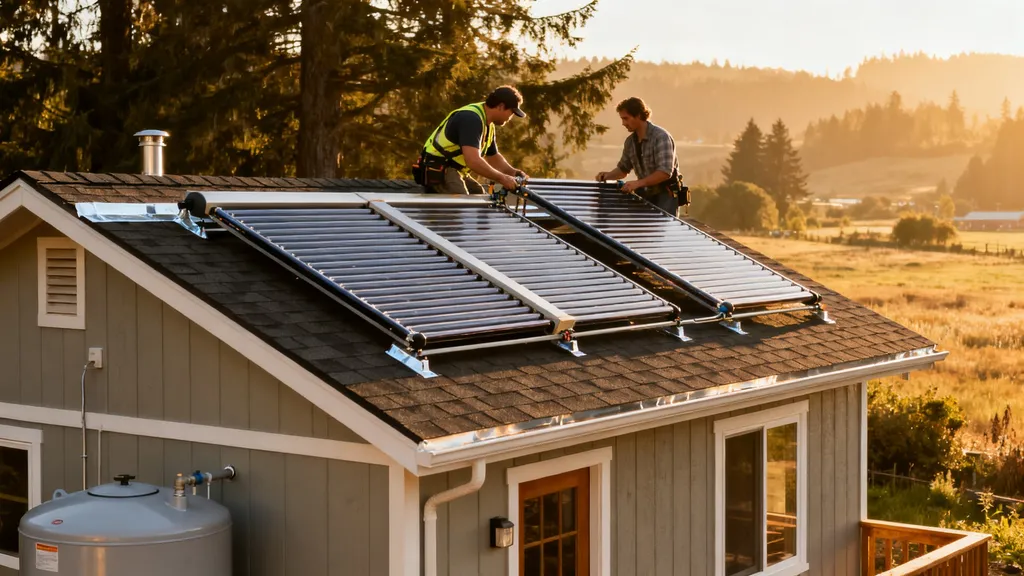
Practical guide to solar water heater systems for DIY and off-grid builders—compare passive vs active, sizing, installation tips, costs, and maintenance.
Solar Water Heating: Passive and Active Systems
Solar water heater systems capture sunlight and turn it into usable hot water for showers, dishes, and laundry. For DIY and off-grid builders, choosing between passive and active systems affects upfront cost, freeze protection, maintenance, and how much of the household hot-water load can be covered by solar. This guide explains how a solar water heater works, compares passive versus active designs, shows a worked sizing example, and gives hands-on installation and maintenance guidance tailored to budget-conscious self-builders.
TL;DR:
- Passive systems use gravity or storage-integrated collectors for the simplest, lowest-cost hot water; best for mild climates and small cabins.
- Active systems use pumps and controllers to boost performance and provide reliable freeze protection in cold climates.
- Estimate demand (liters/gallons per person), check local solar insolation, size collectors and tank conservatively, and choose closed-loop antifreeze or drainback for freezing sites.
How Solar Water Heating Works: Passive vs Active Systems
Solar water heating turns solar irradiation into heat at a collector, then stores or transfers that heat to the household water supply. A working definition: a solar water heater is a system consisting of one or more solar collectors, a storage vessel, and the piping or controls that move heat between them. Collectors convert sunlight to thermal energy; storage holds usable hot water; piping and valves control flow.
Basic Physics: Converting Sunlight Into Usable Heat
Solar collectors absorb shortwave solar radiation and convert it to heat at a dark absorber plate. That heat is transferred to a liquid (water or a heat-transfer fluid) by conduction and convection. Useful metrics to watch:
- Collector area (m² or ft²)
- Storage volume (liters or gallons)
- Heat output (kWh/day or BTU/day)
Collector output depends on incident solar energy (kWh/m²/day), collector efficiency (often 40–80% depending on design), and temperature rise required.
For technical guidance on component reliability and maintenance, see the Department of Energy–sponsored best practices overview from Pacific Northwest National Laboratory: solar water heating systems best practices.
Common Components Across Both System Types
- Collector: Flat plate or evacuated tube; glazed or unglazed.
- Storage tank: Tank with or without integrated heat exchanger; often insulated.
- Piping: Insulated supply and return lines; check valves and tempering valves as needed.
- Controls: Thermostats and safety devices; pumps and differential controllers in active systems.
When to Choose Passive or Active (quick Decision Guide)
- Small cabin in a mild climate, simple budget, minimal maintenance: passive (ICS or thermosiphon).
- Colder climates, larger households, or where freeze protection and higher performance are required: active (pumped) systems with closed-loop antifreeze or drainback.
- Off-grid sites with solar-electric generation and batteries: active systems using DC pumps can integrate with PV arrays for precise control.
Passive Solar Water Heater Systems: Types, Pros, and Limits
Passive systems move water without powered pumps. Two common passive types are integral collector-storage (ICS) and thermosiphon.
Integral Collector-storage (ICS) Systems Explained
ICS systems combine the collector and storage in one unit. Water is heated inside channels or tubes in a collector box and stored there until used. They are simple and cheap to build or adapt from off-the-shelf components. Best use: small cabins, seasonal homes, or locations with long periods above-freezing temperatures.
Thermosiphon Systems: How Natural Circulation Works
Thermosiphon relies on density differences: heated water rises from the collector to a storage tank placed higher than the collector; cooler water returns by gravity. It requires no pumps or controllers, but the storage tank must be above the collector and piping must be arranged to preserve natural flow. Thermosiphon is commonly used for roof-mounted glazed collectors feeding an attic or rack-mounted tank.
Advantages and Limitations for DIY/off-grid Builds
- Advantages: Low complexity, no electrical parts, lower upfront cost, simple repairs.
- Limitations: Poor freeze protection unless system is drained, lower efficiency in low-sun seasons, roof orientation and tank placement constraints.
Materials and design choices matter:
- Collectors: Copper or aluminum absorbers for longevity; evacuated tubes have higher winter output but cost more.
- Glazing: Glazed collectors (glass) retain heat better; unglazed (rubber/black polyethylene) collectors are cheaper and work well for swimming-pool heating or warmer climates.
- Freeze risk: Passive systems are vulnerable to freezing; drainback designs or seasonally drained ICS tanks reduce damage risk.
Practical example sites:
- A south-facing low-slope roof on a temperate coastal cabin: good fit for ICS.
- A small homestead in a mild inland climate with moderate winter lows: thermosiphon with careful piping can work.
For sizing household tanks and understanding rated performance, Energy Star’s overview of solar water heaters is a good reference on capacity and labeling: Energy Star solar water heaters.
Active Solar Water Heater Systems: Designs and Components
Active systems use pumps and controllers to circulate fluid between collectors and storage. They offer higher control and can protect against freezing.
Direct (open-loop) vs Indirect (closed-loop) Systems
- Direct (open-loop): Potable water circulates through the collector. Simpler and slightly more efficient but risky in freezing climates and hard water areas.
- Indirect (closed-loop): A heat-transfer fluid (commonly propylene glycol) circulates through the collector in a closed loop; heat is passed to potable water through a heat exchanger. Closed-loop protects collectors from freeze damage and scaling.
Pump Choices, Controllers, and Sensors
- Pumps: AC pumps are standard; DC pumps can run directly from PV arrays or low-voltage systems. For off-grid setups, look at dedicated DC solar circulators or brushless DC pumps sized for loop head and flow rate.
- Controllers: Differential controllers switch pumps on when the collector is hotter than storage by a preset delta (e.g., 8–12°C). Advanced controllers add timers, freeze protection, and digital logging.
- Sensors: Temperature sensors on collectors and tank inlets provide the data controllers need.
Consider certified collectors and components; SRCC ratings are a recognized industry standard that can inform expected output and affect incentives.
Heat Exchangers, Antifreeze Loops, and Freeze Protection
- Heat exchangers: Plate or coil heat exchangers transfer heat from the antifreeze loop to potable water in an indirect system.
- Antifreeze: Propylene glycol is common; it protects the loop down to specified freeze temperatures but needs monitoring and replacement per manufacturer guidance.
- Drainback systems: An alternative freeze protection: fluid drains back to a reservoir when the pump stops, leaving collectors unfrozen.
Active systems scale better for larger households and can maintain higher delivery temperatures in winter. They add cost and require electrical wiring and maintenance for pumps and glycol.
For a practical buyer’s view on component selection and system layouts, see this guide to choosing a solar water heater: guide to choosing a solar water heater.
Sizing a Solar Water Heater for DIY and Off-grid Homes
Sizing determines whether the system will meet hot-water needs most days. Key inputs are household demand, climate, and collector yield.
Key Variables: Household Hot Water Demand, Climate, and Collector Output
- Hot-water demand: Typical DIY planning uses about 40–50 liters (10–13 gallons) per person per day for modest use; higher if you have long showers or a washing machine. Use actual meter data if available.
- Climate and insolation: Collector yield depends on kWh/m²/day at the site. Local solar maps and meteorological data help; colder climates yield less useful heat per square meter.
- Collector output: Flat-plate collectors might yield 2–6 kWh/m²/day depending on season and tilt; evacuated tubes generally yield more in low-sun conditions.
Illustrative Sizing Example (step-by-step Calculation)
Illustrative calculation: For a two-person tiny house with modest hot-water use, assume 40 liters per person per day = 80 liters/day (~21 gallons). Aim to supply ~60–70% of demand with solar to keep backup size reasonable.
- Estimate daily energy need: Heating 80 liters from 15°C to 50°C requires roughly 3.0 kWh (use specific heat 4.18 kJ/kg·K).
- Target solar fraction: If aiming for 70% solar coverage, required solar energy ≈ 2.1 kWh/day.
- Collector sizing: If local collector yield is ~3 kWh/m²/day, required area ≈ 0.7 m² (~7.5 ft²). Rounding up for losses and cloudy days, select a 1–1.5 m² collector.
- Storage sizing: Common rule of thumb is 40–60 liters per square meter of collector for moderate systems; for the small example, a 100–120 L tank (~26–32 gallons) provides buffer and morning/evening supply.
This is illustrative; actual sizing varies with insolation, system efficiency, and desired solar fraction. For broader household and whole-house energy comparisons, see the 10 kW system sizing guide and the 7 kW off-grid sizing.
Storage Tank Sizing and Orientation Tips
- Place tanks where heat loss is minimized—inside conditioned envelope or well-insulated enclosure.
- Orientation: Collectors should face true south (in the northern hemisphere) or within 15–30° of true south for best year-round performance. Tilt equals latitude for a balanced yearly output; increase tilt 10–15° for winter-focused systems.
- Oversize storage modestly if expecting multi-day cloud cover or if using a lower solar fraction.
For pairing rainwater or cistern water with hot water supply, consult water collection guidance: water collection methods.
Installation Basics and DIY Considerations (includes Youtube Video Embed)
A careful installation reduces leaks, improves performance, and keeps the system safe. The following checklist covers mounting, plumbing, and electrical essentials.
Mounting Collectors: Roof vs Ground Mounts and Orientation
- Roof mounts: Use secure racking anchored to rafters, add flashing and counterflashing at penetration points, and keep tilt and orientation optimized for site. Check roof load capacity and wind uplift requirements.
- Ground mounts: Easier access for maintenance and optimal tilt, but take up yard space and may need fencing or screening.
- Tilt and orientation: Aim for true south orientation and tilt roughly at local latitude for year-round use; add angle for winter performance if needed.
Plumbing Connections, Valves, and Safety Devices
- Pipe runs: Minimize length and insulate all hot and cold piping with closed-cell insulation rated for outdoor exposure. Keep runs straight and avoid unnecessary elbows to preserve thermosiphon flow if using passive systems.
- Safeties: Install pressure relief valves, expansion tanks for closed systems, check valves to prevent backflow, and tempering (mixing) valves at the outlet to prevent scalding.
- Materials: Use UV-resistant tubing for exposed runs, and choose fittings rated for potable water and the system’s maximum temperature and pressure.
Electrical Needs for Active Systems and Pump Wiring
- Pump wiring: Match pump voltage and controller voltage; for off-grid or PV-driven pumps, follow voltage matching tips and consider DC pump options linked in the off-grid pump guide.
- Controllers: Differential controllers require sensor placement at collector and tank; mount controllers in weatherproof enclosures.
- Integration with PV: If using PV to run a DC pump or power controllers, reference connecting panels to a hybrid inverter for integration practices.
Before pressurizing a system or installing a storage tank, check local building and plumbing codes and consider professional sign-off for pressure vessels and gas-fired backups. A clear installation walkthrough comparing thermosiphon and pumped systems can help visualize steps and common pitfalls:
This video provides a helpful walkthrough of the key concepts:
For pump selection and off-grid circulation options, see the site's discussion of off-grid water pump options.
Costs, Incentives, Maintenance, and Expected Lifespan
Understanding long-term costs and upkeep helps budget and reduces surprises.
Typical Cost Components and Example Cost Ranges
Cost categories: collectors, storage tank, piping and valves, pump and controller (for active), mounting hardware, insulation, and labor if hiring installation help. Example ranges vary widely by region and system size; these are ballpark examples for planning:
- Small passive kit plus tank: lower range for materials.
- Active system with glazed collectors, pump, glycol loop, and exchanger: mid to higher range.
Label these as examples and gather local quotes for firm estimates. Use an online budgeting tool to refine numbers: solar cost calculators.
Common Maintenance Tasks and Annual Checklist
- Inspect collectors for cracks, glazing damage, and shading.
- Check plumbing insulation and repair any UV-damaged sections.
- For glycol systems: check concentration and top up or replace per manufacturer intervals.
- Test expansion tanks, pressure relief valves, and check for leaks.
- Replace sacrificial anode in storage tanks according to tank manufacturer intervals.
Typical lifespans:
- Collectors: 15–25 years (evacuated tubes may need earlier replacement of tubes).
- Storage tanks: 10–20 years depending on maintenance and anode condition.
- Pumps and controllers: 5–10 years; keep spare pumps on hand for remote sites.
For broader solar budgeting and related off-grid equipment, see the site's solar lighting overview for context on managing limited energy budgets: solar lighting guide.
Incentives, Rebates, and Certification to Look For
Check federal, state, and utility incentive programs for solar thermal rebates and tax credits. Equipment certification such as SRCC and Energy Star can influence eligibility. Search local rebate databases and consult installers for paperwork — incentives change frequently, so confirm current rules before purchasing.
For tips on installation best practices that affect warranty and performance, a practical installer-focused guide is useful: installation best practices guide.
Passive vs Active — At-a-glance Comparison Table and Decision Checklist
| Characteristic | Passive systems | Active systems |
|---|---|---|
| Complexity | Low | Medium–high |
| Upfront cost | Lower | Higher |
| Climate suitability | Best for mild/warm climates | Suitable for cold climates with freeze protection |
| Freeze protection | Limited; drain or seasonal shut-down needed | Closed-loop glycol or drainback options |
| Maintenance | Simple, low-tech | Requires pump/controller maintenance and fluid checks |
| Scalability | Limited | Highly scalable |
| DIY difficulty | Beginner-friendly | Intermediate; electrical work may be required |
Decision checklist:
- Site climate: Are winter freezes common? If yes, prefer active closed-loop or drainback.
- Roof orientation: Is there a reliable south-facing area with few obstructions?
- Budget: Is the priority lowest upfront cost or long-term reliable performance?
- Desired performance: Do you need year-round hot water or mostly summer-only supply?
- Willingness to maintain: Will someone check glycol levels and pumps annually?
- Hybrid need: Would a passive collector with a small pump (hybrid) give the balance desired?
A hybrid approach — passive collector with a small DC pump controlled by a simple thermostat — can be a pragmatic compromise for many off-grid builders.
Key Takeaways and Quick Reference (bullet List)
- Solar water heater: A collector, storage tank, and plumbing or controls that deliver hot water using solar energy.
- Passive systems: Best for simple, low-cost setups in mild climates; watch freeze risk.
- Active systems: Use pumps/controllers for better year-round performance and freeze protection.
- Sizing reminder: Start with per-person daily liters/gallons, convert to kWh using temperature rise, and size collector area using local insolation.
- Storage tip: Insulate tanks and locate them inside the building envelope where possible.
- Installation red flags: Poor roof anchoring, uninsulated piping, missing pressure relief, and lack of tempering valve.
- Maintenance priorities: Inspect collectors, check fluid and anode, replace failed pumps promptly.
- Incentive check: Use SRCC-rated equipment and verify local rebates before purchase.
- Integration note: For off-grid systems, match pump voltage to PV or use a small battery-backed supply; consult voltage matching tips.
- Backup planning: Plan for a backup heater or fuel source if reliable year-round hot water is required.
The Bottom Line
Passive solar water heaters offer the simplest path to solar hot water where freezes are rare and budgets are tight; active systems cost more but deliver reliable year-round performance and freeze protection. Start by assessing your hot-water demand, local insolation, and willingness to maintain pumps or glycol loops, then run a simple sizing calculation and evaluate incentives before purchasing. Consult local building codes and, when in doubt, get professional sign-off for pressurized storage or complex piping.
Frequently Asked Questions
Can I use a solar water heater in freezing climates?
Yes, but choose an active closed-loop system with propylene glycol or a drainback design to protect collectors from freeze damage. Closed-loop systems circulate antifreeze through the collector and transfer heat through a heat exchanger, while drainback systems empty the collector when the pump stops.
How long do solar water heaters last?
Collector panels commonly last 15–25 years, storage tanks 10–20 years, and pumps/controllers around 5–10 years depending on quality and maintenance. Regular inspections, fluid replacement in glycol systems, and timely anode replacement extend service life.
Do I need a backup water heater?
Most installations benefit from a backup heater sized to cover cloudy periods or peak demand; common options include electric or gas tankless backups and small electric elements in the storage tank. Design the backup to complement the solar fraction you target rather than match peak load alone.
Can I DIY the entire system?
Many homeowners can install passive systems or well-documented active systems if they have plumbing and basic electrical skills, plus proper permits. However, professionals should inspect or certify pressure vessels and complex closed-loop systems to ensure safety and code compliance.
How much roof space do I need?
Collector sizes vary; a small household may need 1–3 m² (10–30 ft²) of collector area for partial hot-water coverage, while larger households require more. Use a simple sizing calculation based on daily hot-water energy need and local insolation, and remember to allow space for proper tilt and access for maintenance.