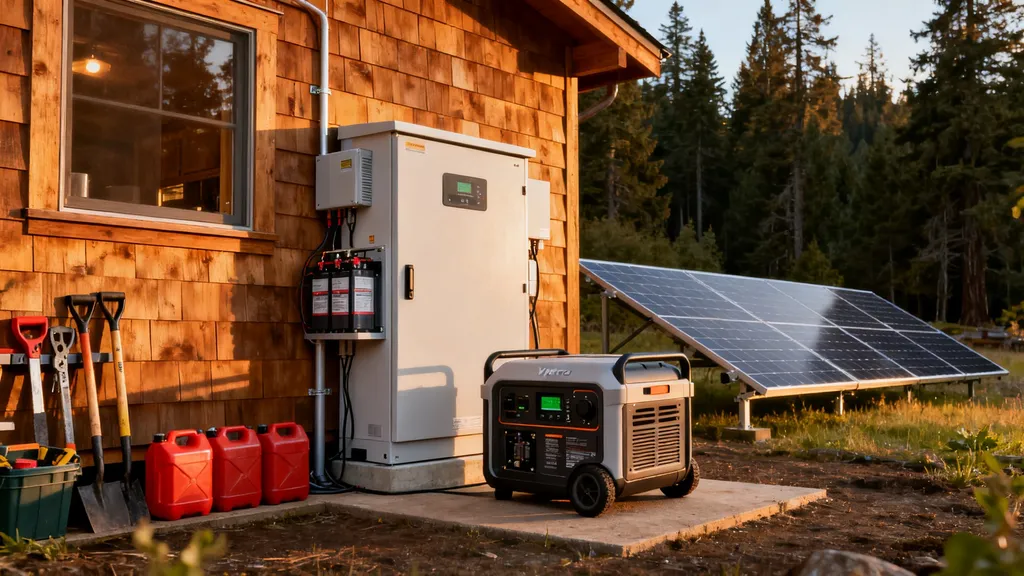
Practical guidance for choosing and sizing an off-grid generator: load calculations, fuel options, inverter pairing, costs, and maintenance for DIY builders.
Off-Grid Backup Generators: Sizing and Selection
Off-grid generator choices determine how reliable and comfortable an off-grid cabin or homestead will be during extended cloudy periods, heavy-start appliance use, or while self-building. This guide walks through practical load calculations, the difference between running and starting watts, fuel trade-offs (gas, diesel, propane), how to pair a genset with battery/inverter systems, and what to budget for purchase and upkeep. Read on to learn how to pick a generator that covers essential loads without overspending on fuel or equipment.
TL;DR:
- Choose a generator sized for total running watts plus 25–30% headroom for starting surges; typical small-homestead needs are 6–12 kW.
- Prioritize load reduction first (insulation, LED lighting, efficient fridge) to shrink generator and battery requirements and lower long-term fuel costs.
- Match genset capacity to inverter/charger demand if you plan to charge a battery bank quickly; a 5 kW inverter with a 100 A charger usually needs a 6–8 kW generator.
Why Off-grid Backup Generators Matter for DIY Homes
Off-grid generators are the safety net for systems that rely on solar and batteries. Photovoltaics provide daily energy but may underproduce during multi-day overcast stretches, heavy winter loads, or when construction tools are operating during a build. For many DIY homesteads, the design question is how many days of autonomy you need: 24 hours, 48 hours, 72+ hours? A few realistic scenarios:
- Short outage (1–2 days): Run a compact inverter generator to top up batteries and run essentials.
- Multi-day low-sun streak (3+ days): A standby propane or diesel genset sized to recharge batteries and run critical circuits reduces the required battery bank size.
- High-start loads during construction: Tools and well pumps need high surge capacity; a genset can handle repeated starts without rapidly depleting batteries.
Industry vendor guides illustrate why a backup generator remains common in off-grid planning; for an overview of off-grid generator types and real use cases, see this off-grid generator guide with best picks and builds. For readers sizing PV arrays as the baseline of power, our solar panel installation tips explain how PV limits affect backup needs. Water systems and filtration are common critical loads; review off-grid water filtration options when listing essential appliances.
Why not just buy more batteries? Batteries are getting cheaper, but storing several days of autonomy entirely on batteries raises upfront cost, adds weight and enclosure requirements, and increases fire-safety complexity. Generators let you trade fuel and maintenance for smaller battery banks while keeping reliable power for pumps, freezers, and electric heating.
Types of Off-grid Backup Generators and How They Differ
Generators fall into categories that matter for fuel, noise, service, and starting power. Below are the common types DIY builders encounter:
Portable Petrol (gasoline) Inverter Generators
- Typical sizes: 1–3 kW and up to ~6 kW for larger models.
- Pros: Lightweight, quiet (for portables with inverter tech), affordable entry cost, clean sine wave suitable for electronics.
- Cons: Short shelf life of gasoline, limited continuous run time, higher long-term fuel cost per kWh.
- Good for: Cabins, short-term backup, site power during construction.
- See small-system comparisons like our 2kW solar example for when a portable gen is enough.
Standby Diesel and Propane Generators
- Typical sizes: 6–20+ kW (standby home units commonly 8–20 kW).
- Pros: Long run times, better fuel economy (diesel), stable for frequent charging and high loads.
- Cons: Higher purchase and installation cost, louder, heavier, may require anti-freeze measures in cold climates.
- Use cases: Whole-house backup, long-term homesteads, frequent heavy loads.
- Briggs & Stratton provides a thorough overview of whole-house standby considerations in this off-grid living guide.
Hybrid Generator-inverter Systems and Inverter-chargers
- Combine a generator with an inverter/charger that manages battery charging and AC loads.
- Pros: Seamless handoff between battery, solar, and genset; can optimize genset runtime for charging.
- Cons: Higher system complexity and cost, requires correct sizing between genset and inverter/charger.
- Good for: Systems that require automated battery support and minimal user intervention.
Alternative Options: Micro-chp, Small Wind, Biofuel-capable Gensets
- Micro-CHP units produce heat plus electricity (best where heat is also needed).
- Small wind or biofuel gensets can supplement solar in specific sites but add variability and mechanical maintenance.
- For sheds and very small buildings, see our 3kW shed sizing for alternatives.
When comparing options, think about noise, service access, and emissions. Standby units and hybrid setups often require professional installation and an automatic transfer switch, while portable inverter units can be moved and used temporarily.
How to Size an Off-grid Generator: Step-by-step
Sizing a generator begins with a precise inventory of loads and ends with a genset rating that covers running watts plus surge. This section uses a small-cabin example to show the math.
Step 1 — Inventory Essential Loads (appliances, Pumps, Heating)
List every device you want the generator to support and note whether it’s essential. For a small cabin, a typical "critical loads" list:
- LED lighting: 100 W total
- Refrigerator (modern inverter type): running 120 W, start 600–2000 W
- Well pump (1 HP): running 1500 W, start 3000–4000 W
- Mini-split heat pump (3,000–6,000 BTU): running 600–1500 W, start 2000–3000 W
- Laptop/chargers: 100 W
- Microwave: 1000 W (used briefly)
- Water heater/instant: 1500 W (if used occasionally)
- Router/communications: 30 W
Step 2 — Calculate Running vs Starting (surge) Watts
Starting watts are often higher than running watts. Industry guidance and product specs provide ranges—refrigerators commonly show a start surge of 3–7× running for older units but only ~3× for newer inverter compressors. Pumps vary by motor horsepower; a 1 HP pump may have 2–3× start.
Example: Add running watts:
- Lights 100 + Fridge 120 + Pump 1500 + Mini-split 1200 + Laptop 100 + Router 30 = 3050 W running.
Highest single start load: Pump start 3500 W; mini-split start 2500 W. If both start together, peak could be ~6000 W.
Step 3 — Determine Required Continuous Kw and Recommended Generator Rating
Choose a genset that covers running watts and the largest expected surge with headroom. Two practical sizing methods:
- Conservative: Add the largest start surge to the running total and add 25–30% headroom.
- Practical: Stagger starts (use soft-start or pump delay) and select generator to cover running watts plus the largest surge, with 25% headroom.
Using the cabin example:
- Running = 3050 W
- Largest surge = 3500 W (pump)
- If pump and mini-split might start together, peak ~6050 W.
- Add 25% headroom → 6050 × 1.25 ≈ 7,560 W → choose an 8 kW generator.
Convert watts to amps for wiring or breaker sizing:
- At 120 V: Amps = Watts ÷ 120 → 8,000 W ÷ 120 = ~66.7 A
- At 240 V: Amps = Watts ÷ 240 → 8,000 W ÷ 240 = ~33.3 A
Most DIY homes use single-phase 120/240 V systems. Three-phase is rare for residential use unless you have heavy workshop equipment.
Step 4 — Runtime, Fuel Needs, and Autonomy Targets
Decide how long the generator must run between refueling or until solar returns sufficient output. Runtime depends on fuel tank and generator load. As an example:
- A portable inverter generator rated 3 kW may burn ~0.3–0.6 gallons/hour at 50% load.
- An 8 kW standby diesel might burn 0.6–1.0 gallons/hour at 50% load.
If you need 48 hours of running time at an average load of 3.5 kW and the genset uses 0.5 gal/hr per kW equivalent, estimate fuel = 3.5 kW × 0.5 gal/hr × 48 hr = 84 gallons. These are ballpark numbers—consult manufacturer consumption curves for accuracy.
A practical tip: measure actual starting loads with a kill-a-watt or a portable clamp meter during commissioning. If you plan to charge batteries while running the generator, see the next section for charger-current math and how that increases genset size.
For a visual demonstration, check out this video on powering the off-grid cabin super cheap - before:
.For heavy appliance guidance (washers/dryers) that dramatically affect sizing, review our off-grid laundry tips. If comparing small-cabin cases, our 3kW cabin example provides realistic load profiles to cross-check your numbers.
Matching an Off-grid Generator to Batteries and Inverter/charger Systems
Generators are often used both to run loads directly and to recharge battery banks. Size the genset to handle both roles if you want fast recharge or simultaneous heavy loads.
Generator Sizing for Battery Charging — C-rate and Charger Current
Define:
- Battery bank capacity (kWh): e.g., 10 kWh usable
- Desired recharge time: e.g., 4 hours
- Required charging power = battery kWh ÷ hours → 10 kWh ÷ 4 hr = 2.5 kW (plus inverter/charger inefficiency ~10–15%) → ~2.8–3 kW
To convert to charging current for a 48 V battery: Current (A) = Power (W) ÷ Voltage → 2800 W ÷ 48 V ≈ 58 A. If your inverter/charger is rated 60 A, allowance must be made for charger inefficiency and house loads. If you also need to supply 3 kW of house loads, the generator needs to supply ~6 kW continuous.
Inverter-generator Compatibility and Sync/setup
Inverter/chargers (Victron, OutBack, Schneider are common brands) often have programmable charge current and built-in transfer logic. Match the inverter/charger input and generator output:
- Check the inverter's AC input rating (e.g., 30 A, 50 A, 100 A).
- Ensure the genset can maintain stable voltage at the inverter's required frequency—inverter input is sensitive to frequency/voltage swings.
- Many inverter/chargers have a limited input current; sizing the genset higher than the inverter's maximum won't force higher charger current, but it does provide headroom for loads.
Automatic Transfer Switches (ATS), Auto-start, and Control Wiring
If you want automatic operation, an ATS with auto-start wiring is needed. ATS basics:
- The ATS senses grid or generator presence and switches critical circuits.
- Auto-start modules can be set to run the generator when batteries fall below a set state-of-charge or on a schedule.
- Proper wiring, interlocks, and a licensed electrician are strongly recommended for safe, code-compliant installs.
For wiring patterns, transfer switch choices, and off-grid wiring differences, see our guidance in cabin electrical setup and our battery enclosure build for practical enclosure and wiring notes. For broader off-grid planning that ties generator sizing to solar system design, review a typical 5kW solar sizing guide.
Fuel Choices, Availability, Safety, and Storage for Off-grid Generators
Fuel selection affects run-time, storage logistics, emissions, and cost. The common fuels are gasoline, diesel, and propane.
Comparing Gasoline, Diesel, and Propane for Off-grid Use
- Gasoline: High energy per volume but poor shelf life (months) unless treated. Good for portable units and construction sites. Not ideal for long-term standby storage.
- Diesel: Energy-dense, durable storage life (with filtration and biocide management), good fuel economy under heavy loads. Diesel gensets handle continuous use well but may require winterization and are louder.
- Propane (LP): Excellent shelf life in sealed tanks, cleaner-burning than diesel, simple storage in above- or below-ground tanks. Propane gensets are common for standby residential use; a propane generator may run slightly less efficiently in kWh/gallon than diesel but offers long-term reliability and easy refueling via exchange or bulk delivery.
If you want in-depth legal and code context for living off-grid and fuel-related compliance, see this overview on legal considerations for off-grid living: can you legally live off the grid in the US?.
Fuel Storage Best Practices and Seasonal Considerations
- Use approved containers and tanks rated for the fuel type, located per local code setback distances from structures.
- Keep gasoline rotating and use stabilizers for storage beyond 3 months. Diesel may require biocide treatments to prevent microbial growth.
- Propane tanks should be installed by a certified technician and include a regulator sized for your genset demand.
- Label tanks and keep spill kits and fire extinguishers nearby.
For household propane uses (stoves, heaters) that often pair with propane gensets, check our propane stove options to plan combined fuel needs.
Regulatory and Emissions Constraints to Check Locally
Local air-quality rules, zoning, and fire code can limit generator fuel types, permissible sound levels, or fuel tank sizes. Verify NEC requirements for transfer switches and equipment listing. When in doubt, contact your local building department before installing a permanent standby unit.
Noise, Emissions, Maintenance, and Long-term Reliability Trade-offs
Generators are mechanical machines that need regular care. Plan for maintenance, siting to reduce noise, and emission considerations.
Noise Mitigation and Siting Tips for Rural Homes
- Place the generator as far as practical from sleeping areas; noise drops with distance (approximately 6 dB per doubling of distance in ideal conditions).
- Use mufflers or upgrade factory silencers; many inverter portables already include quieter designs (50–60 dB at 7 m).
- Build an acoustic enclosure with airflow: ventilated intake and exhaust, non-combustible materials, and service access panels. Ensure adequate cooling air to avoid overheating.
Routine Maintenance Checklist and Service Intervals
A basic schedule:
- Oil change: every 50–200 hours depending on load, oil type, and manufacturer.
- Air filter: inspect every 100 hours or annually; replace if dirty.
- Fuel filter: replace per manufacturer schedule, typically every 200–500 hours.
- Spark plugs (gasoline): replace per spec, often yearly or 100–200 hours.
- Coolant checks for liquid-cooled units: inspect and replace per schedule.
- Run the generator monthly under load for 30 minutes to keep seals lubricated and prevent fuel system gumming.
For hybrid systems, pair electrical checks with the generator schedule. Our troubleshooting guide for PV plus backup systems gives further electrical maintenance tips: how to troubleshoot solar power systems.
Emissions, Permits, and Environmental Considerations
Diesel and gasoline engines emit NOx and particulates; some areas restrict emissions or require permit-based operation. Propane emits fewer particulates and can be easier to permit in some jurisdictions. Check EPA and local air-quality rules if the generator will run frequently.
For deeper, compiled guidance (including varied vendor and community resources), the broader "Ultimate Off-Grid Generator Guide" archive includes many practical maintenance and emissions points: Ultimate off grid generator guide 1.
Budgeting and Lifecycle Costs for Off-grid Generators
Upfront purchase price is only part of the cost. Fuel, maintenance, and replacement parts over the genset life can exceed the initial investment.
Estimating Upfront vs Operating Costs (fuel, Maintenance)
- Portable inverter generator: $600–$3,000 purchase; fuel cost high per kWh; good for occasional use.
- Small standby propane/diesel unit (6–10 kW): $3,000–$8,000 plus installation and ATS.
- Medium standby (12–20 kW): $8,000–$20,000 installed.
Fuel cost per kWh varies widely by fuel type, generator efficiency, and local prices; ballpark figures:
- Gasoline: $0.40–$0.80 per kWh
- Diesel: $0.30–$0.60 per kWh
- Propane: $0.35–$0.70 per kWh
Add annual maintenance: $200–$800 depending on hours run and whether you service it yourself or hire a technician.
Sizing Strategies to Minimize Generator Runtime and Fuel Costs
- Reduce loads first: air-sealing, LED lighting, efficient mini-splits, and induction cooking lower baseline consumption.
- Use the generator primarily to recharge batteries rather than run every load continuously.
- Consider a larger battery bank with slower recharge if fuel access is difficult; or choose a more efficient diesel genset if runtime will be long and frequent.
For self-build budgeting and to plan where the generator fits into the overall project cost, see the self-build checklist. Simple efficiency upgrades like door weatherstripping can reduce heating and cooling loads, letting you choose a smaller genset; see our air-sealing tips.
When to Invest in a Larger Genset vs Larger Battery Bank
- Choose a larger genset if fuel access is easy, you expect extended outages, or you need to support heavy intermittent loads (well pumps, shop equipment).
- Choose a larger battery bank when fuel access is limited, you want silent operation, or you prioritize low operational emissions and can accept longer recharge times via solar or a smaller generator.
A qualitative 10-year view often favors hybrid systems: modest battery bank sized for 1–2 days of autonomy plus a genset sized for fast recharge and peak loads.
Quick Sizing Checklist and Generator Comparison Table
Essential Checklist for Picking and Installing an Off-grid Generator
- Inventory loads: make a list of all essential devices and note running and starting watts.
- Measure in-situ: use a clamp meter or wattmeter to confirm real-world draw where possible.
- Choose fuel: balance storage, access, and emissions between gasoline, diesel, and propane.
- Select genset size: cover running watts + largest start surge + 25–30% headroom.
- Plan charging: size genset larger if you expect simultaneous charging and load supply.
- Arrange ATS/auto-start: choose manual vs automatic transfer depending on automation needs.
- Site and ventilate: plan distance, concrete pad, fuel tank placement, and sound mitigation.
- Schedule maintenance: oil, filters, and exercise runs; keep a log.
- Verify codes: confirm NEC, local building, and air-quality requirements before installation.
- Test under load: commission the system and test transfer, charging, and emergency procedures.
Comparison/specs Table: 5 Common Genset Options for Small Off-grid Homes
| Category | Typical running watts | Typical peak/start watts | Fuel | Ideal use-case | Noise range (dB) | Maintenance cadence |
|---|---|---|---|---|---|---|
| Portable inverter 1–3 kW | 1,000–3,000 W | 2,000–6,000 W | Gasoline | Tiny cabins, chargers, small tools | 50–65 dB | Oil/filter every 50–100 hr |
| Portable inverter 3–6 kW | 3,000–6,000 W | 6,000–12,000 W | Gasoline | Larger cabins, short-term whole-circuit backup | 55–70 dB | Oil/filter every 50–100 hr |
| Small standby 6–10 kW | 6,000–10,000 W | 8,000–12,000 W | Propane/Diesel | Critical loads + moderate charging | 60–75 dB | Service 100–300 hr, annual checks |
| Medium standby 12–20 kW | 12,000–20,000 W | 18,000–30,000 W | Diesel/Propane | Whole-house backup, shop equipment | 65–80 dB | Service 100–300 hr, annual checks |
| Hybrid inverter-generator | 3–10 kW inverter coupled | Varies by model | Diesel/Propane/Gas | Automated battery charging and load support | 55–75 dB | Follow inverter + engine schedule |
These ranges are typical and meant to guide selection rather than replace manufacturer specifications. For readers building a solar-plus-generator system, review the solar off-grid hub for deeper design links and examples.
The Bottom Line — Choosing the Right Off-grid Generator for Your Build
Reduce loads first, then size a generator to cover essential running watts and starting surges with 25–30% headroom. Pick the fuel that matches storage and access needs—propane often wins for long-term standby, diesel for heavy-duty efficiency, gasoline for portability. If you plan fast battery recharge, match genset output to inverter/charger demands. Use the checklist and comparison table to make a practical selection, and consult local codes and a licensed electrician for transfer-switch wiring and permanent installs.
Frequently Asked Questions
What size generator do I need for a cabin?
Start by listing essential running watts and the largest starting surge (for pumps, fridge, or heat pump). Small cabins often land in the 3–8 kW range; a cabin with a 1 HP well pump and a mini-split commonly needs an 6–8 kW unit to cover simultaneous starts with 25–30% headroom. Measure actual appliance start currents where possible to refine the calculation.
Can a small inverter generator charge batteries?
Yes. Many inverter generators provide clean AC suitable for charging batteries through an inverter/charger. The key is matching the generator's continuous output to the inverter/charger input rating. A small 2–3 kW inverter generator can charge small battery banks slowly, but it won't support fast charging of a large battery bank while also powering other loads.
Is propane better than diesel for off-grid systems?
Propane has advantages for standby use: long shelf life in sealed tanks, cleaner combustion, and easier storage safety. Diesel tends to be more fuel-efficient under heavy loads and is common for long-run scenarios. The "better" choice depends on fuel access, expected run hours, temperature (diesel can gel in cold), and local emissions rules.
How often should I run a backup generator?
Monthly test runs under load for 20–30 minutes help keep seals lubricated and prevent fuel gum. For engines used as regular backup or to charge batteries, follow manufacturer service intervals—oil changes and inspections every 50–200 hours, plus annual checks. Regular exercise also reveals issues before an emergency.
Can a generator run my whole house off-grid?
Yes, provided the genset is sized for the total house peak demand and starting surges. Whole-house standby units typically start at 8–20 kW depending on home's heating, cooking, and appliance profile. For long-term off-grid living, combining a generator with a battery bank and efficient loads usually gives the most practical and economical setup.