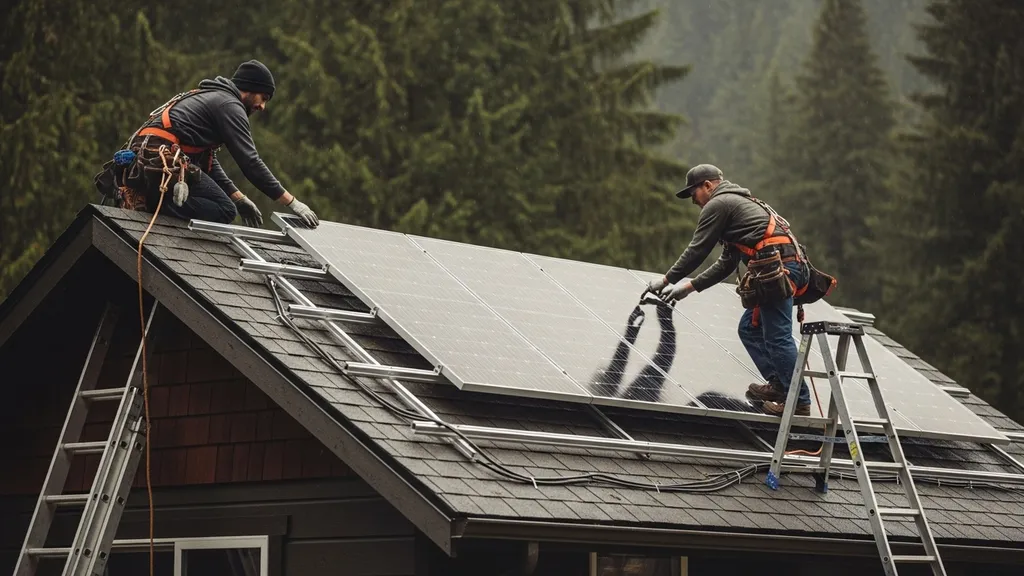
Practical, step-by-step sizing for a 2kW off-grid solar system — panels, batteries, inverter, performance expectations, costs, and DIY safety tips.
2KW Solar System for Off Grid Home: Complete Sizing Guide
A 2kw solar system for off grid home is a practical starting point for a small cabin, tiny house, or weekend retreat. This guide shows how to turn the 2 kW nameplate into realistic daily energy, how to size panels, batteries, and inverters, what performance to expect across seasons, and where a small generator or hybrid setup makes sense. Read on to learn concrete calculations, component examples, and DIY safety steps so you can decide if 2 kW meets your needs.
TL;DR:
- A 2 kW array typically produces about 6–10 kWh/day raw (3–5 sun-hours); realistic usable output after losses is roughly 4.5–8 kWh/day.
- For 1–3 days of autonomy on 6 kWh/day loads, plan a ~12–36 kWh battery bank (usable); prefer 48 V LiFePO4 for efficiency and cycle life.
- If daily consumption exceeds ~10 kWh, or you need reliable winter power, choose a larger array (3 kW+) or a hybrid with generator backup.
How a 2KW Solar System Fits an Off-grid Home
The phrase "2 kW" refers to the array nameplate — the sum of panel wattages under standard test conditions — not the amount of usable electricity you'll get each day. With typical peak sun-hours between 3 and 5, a 2 kW array produces:
- 2 kW × 3 sun-hours = 6 kWh/day (raw)
- 2 kW × 5 sun-hours = 10 kWh/day (raw)
Apply derating for real-world losses (panel temperature, soiling, wiring, inverter, mismatch). Use a derating factor around 0.75–0.8 to estimate usable production: 6–10 kWh/day raw becomes roughly 4.5–8 kWh/day usable.
Common panel sizes for a 2 kW array:
- 5 × 400 W panels = 2.0 kW
- 6 × 350 W panels = 2.1 kW
MPPT charge controllers are the norm for off-grid arrays feeding a battery bank; don’t pair a 2 kW array with a small PWM controller. Single-string or small multi-string architectures are typical for cabins. Note that a 2 kW array will support modest daily loads: LED lighting, phone/laptop charging, small refrigerator, water pump with short duty cycles, and limited cooking loads if using efficient induction. Larger, continuous loads like electric heating or full-size electric ovens usually exceed the practical limits for a 2 kW system.
Compare this to smaller and larger systems:
- See a 1 kW cabin example for bare-minimum setups and trade-offs.
- For households needing more daytime and storage capacity, review a 3 kW off-grid comparison.
- If planning a larger tiny-house system with more appliances, the tiny house 7 kW example shows how loads scale.
Local rules can matter. Some jurisdictions set minimum array or battery sizing for off-grid permits; for example, Santa Cruz County lists adjusted minimums and inverter sizing guidance for off-grid permits, which is useful when preparing permit drawings and specifications (see their off-grid design requirements here: off-grid solar requirements - Santa Cruz County PlanningSystemBatteryPermits/Off-GridSolarDesign.aspx)SystemBatteryPermits/Off-GridSolarDesign/Off-GridSolarRequirements.aspx)).
Estimate Your Home's Energy Needs for a 2KW System
Start by building a simple load list. Track every device’s wattage and runtime for 7–14 days to capture variability. If you can’t measure, use typical values below to estimate watt-hours per day.
Example appliance rundown (typical tiny home):
- LED lights: 6 fixtures × 6 W × 4 hours = 144 Wh/day
- Small 12V fridge: average 60–120 Wh/day (duty-cycle dependent) = 1,500–3,000 Wh/day (fridge duty varies; measure with a Kill A Watt or clamp meter)
- Water pump (shallow well): 0.75 kW × 0.25 hour = 187 Wh per usage; daily depends on household
- Phone charging: 10 Wh/day
- Laptop: 60 W × 4 hours = 240 Wh/day
- Electric induction cooktop (occasional): 1.5 kW × 0.25 hour = 375 Wh
Sample totals:
- Tiny home / 1–2 people (conservative): 3–8 kWh/day
- Modest off-grid home with more appliances: 8–15 kWh/day
Research-based case studies show wide variance; one field study of off-grid households demonstrates that disciplined load management and efficient appliances keep daily consumption in the low single-digit kWh for many small cabins (see case study analysis here: Living off the grid with renewable energy: a case study).
Weekly and seasonal patterns matter:
- Summer: longer days, higher solar production; pumps and fans may increase demand.
- Winter: shorter days and lower sun-angle reduce production; heating loads (if electric) can dominate.
- Multi-day cloudy stretches decrease available energy and require reserves or backup.
Efficiency Upgrades That Make a 2 Kw System More Viable:
- Replace old fridge with a high-efficiency 12V compressor model.
- Switch to LED lighting and efficient induction cooktops.
- Reduce hot-water electric loads by using propane or solar thermal for water heating.
- Reduce pump runtimes with pressure tanks and low-flow fixtures; see our water-efficiency guide for strategies.
Boxed example: If your target is 6 kWh/day,
- Expected usable solar from 2 kW array (0.75 derating) with 4 sun-hours = 2 × 4 × 0.75 = 6 kWh/day.
- For 1 day autonomy: battery usable = 6 kWh.
- For 2 days autonomy: battery usable = 12 kWh.
- For 3 days autonomy: battery usable = 18 kWh.
Track real loads for 7–14 days before final sizing. The recommendations above follow standard off-grid sizing practice; for a deeper methodology, consult the system design guide.
Sizing Components for a 2KW Solar System: Panels, Batteries, Inverter
Panel Array: How Many Panels and Expected Voltages
Common panel choices:
- 350 W mono PERC modules or 400 W high-efficiency modules are common for small arrays.
- Example arrays: 6 × 350 W = 2.1 kW or 5 × 400 W = 2.0 kW.
String and voltage notes:
- For 48 V systems, string voltages are sized to match MPPT input ranges; keep VOC under controller max at cold temperatures.
- Aim to design array voltage for MPPT sweet spot; many MPPT controllers accept 100–600 V input for grid-tied inverters, while smaller off-grid MPPTs are 60–150 V nominal.
Battery Bank Sizing: Usable Kwh, Ah, and Chemistry Comparison
Battery sizing formula: Battery bank capacity (kWh) = (Daily kWh × Days of autonomy) / usable DoD
Convert to amp-hours at system voltage: Ah = (kWh × 1000) / system voltage
Example: 2 days autonomy for 6 kWh/day, targeting 80% usable DoD (LiFePO4):
- Required usable = 6 × 2 = 12 kWh usable
- Bank size = 12 kWh / 0.8 = 15 kWh nominal
- At 48 V: Ah = (15,000 Wh) / 48 V = 312.5 Ah → specify 48 V × 350 Ah nominal bank to provide margin.
Comparison table:
| Component | Typical choices | Example spec for 2 kW system |
|---|---|---|
| Panels | 350 W–400 W mono PERC | 6 × 350 W (2.1 kW) or 5 × 400 W (2.0 kW) |
| Battery chemistry | Flooded lead-acid, AGM, LiFePO4 | Recommended: 48 V LiFePO4, 15–30 kWh nominal for 1–3 days |
| Battery usable DoD | Lead-acid 30–50%, AGM 50%, LiFePO4 80–90% | Use LiFePO4 for smaller physical size and longer cycle life |
| Inverter type | Pure sine inverter, hybrid inverter/charger | 3–5 kW pure sine inverter (continuous) with 5–8 kW surge |
| Charge controller | MPPT | 60–150 V MPPT sized for 2 kW array (or integrated in hybrid inverter) |
Chemistry trade-offs:
- Flooded lead-acid: lower upfront cost, heavy, 30–50% DoD, short cycle life if cycled deep.
- AGM: sealed lead-acid option with better maintenance profile, 50% DoD typical.
- LiFePO4: higher cost, higher usable DoD (80–90%), long cycle life (2000–5000+ cycles), compact and lighter.
For a 2 kW array, 48 V battery systems are recommended for wiring efficiency and lower currents in the DC bus. At 2 kW continuous output, a 12 V system draws ~167 A; at 48 V it’s ~42 A, simplifying cable sizing.
Inverter and Charge Controller Selection
- Choose a pure sine wave inverter sized at or above expected peak AC load. For many cabins, a 3 kW inverter with a 5–8 kW surge rating covers common startup loads (pump motors, refrigerators).
- Hybrid inverter/chargers (Victron Multiplus II, OutBack Radian, Schneider Conext) combine inverter and battery charging and often include AC transfer switches for generator backup. See hybrid inverter connection guide for wiring specifics.
- MPPT vs PWM: MPPT controllers extract more energy and are recommended for arrays feeding batteries. PWM is only suitable for very small systems.
Derating notes: temperature coefficients, dirt, mismatch, and aging reduce output. When selecting components, add 10–20% headroom on controllers/inverters to avoid continuous near-maximum loading. For inverters, choose models with good efficiency (≥92%) and a pure sine output for sensitive electronics.
(Research and field implementations of off-grid designs provide specific performance benchmarks; see comparative studies at the NCBI article for design-to-performance relationships: design, implementation and performance analysis of an off-grid system.)
Cabling, Fuses, and System Voltage Considerations
- Choose system voltage (48 V preferred). Size DC cables to limit voltage drop to <2–3% for critical runs.
- Fuse strings at combiner boxes and install appropriate DC disconnects. Use MC4 connectors and torque to manufacturer specs.
- Grounding and PV combiner strategies must follow NEC Article 690 (for jurisdictions using NEC). For battery systems, follow recommended battery disconnect and overcurrent protection practices.
Expected Performance of a 2KW Off-grid System (daily to Seasonal)
Estimating production across climates:
- High-sun site (Southwest, 5 sun-hours): 2 kW × 5 × 0.75 ≈ 7.5 kWh/day usable. Monthly ≈ 225 kWh.
- Low-sun site (Pacific Northwest, 3 sun-hours): 2 kW × 3 × 0.75 ≈ 4.5 kWh/day usable. Monthly ≈ 135 kWh.
Mini-case: Pacific Northwest vs Southwest
- Pacific Northwest: shorter winter days, more cloud cover; winter usable output might fall below 2–3 kWh/day unless array tilted and oriented optimally; plan larger battery bank or backup.
- Southwest desert: higher irradiance but higher temperature; high ambient temps lower module voltage and output — account for temperature coefficient losses (see below).
Derating factors to include in calculations:
- Temperature coefficient: high temps reduce panel voltage and power; modules with low negative temperature coefficients (e.g., -0.25%/°C) perform better in hot climates. See hot-climate panel performance for specifics.
- Shading: even small shade on a single cell string can cut a panel’s output dramatically unless you use module-level power electronics (MLPE) or optimizers.
- Wiring and connection losses: use proper cable sizing and keep DC runs short where possible.
- Inverter efficiency and battery round-trip efficiency: include both in end-to-end yield; battery round-trip often 85–95% for LiFePO4, lower for lead-acid.
Sizing for winter worst-case:
- Identify the lowest monthly average production (worst month).
- Decide acceptable risk: many off-grid owners size for autonomy with generator support for the worst months.
- Typical reserve conventions: 1–3 days autonomy for frequent cloudy seasons; 7+ days if no generator backup is possible.
PVWatts-style quick check:
- Use local insolation data (kWh/m²/day) and multiply by array nameplate and derating factor to estimate usable kWh/day. For quick planning, 3–5 sun-hours is a reasonable range for most U.S. climates.
Design Options and Hybrid Choices to Improve a 2KW System's Reliability
Pure off-grid vs hybrid:
- Pure off-grid: solar + battery sized to meet expected loads with no utility connection. Reliability depends on battery capacity and conservative load limiting.
- Hybrid: solar + battery + generator (or propane) + hybrid inverter/charger. Generator provides long-term energy during extended low-sun periods and allows smaller battery banks for the same reliability.
When to add a generator or propane backup:
- If refrigeration, freezing, or heating are critical and you want guaranteed uptime.
- If you expect multi-day low-production stretches and don’t want to oversize batteries.
Backup integration options:
- Small portable generator (2–5 kW) tied into an automatic transfer switch or through the inverter/charger’s generator input.
- Propane standby generators for hands-off operation in longer outages; see backup fuel options for sizing refrigeration backups and trade-offs.
- Some hybrid inverters accept generator charging and automatically prioritize charging batteries while powering loads.
Load-shifting and priority management:
- Shift high draws to midday when solar is available (cook, run washing machine).
- Use smart relays or an energy management system to shed non-critical loads when batteries are low.
- Micro-grid tactics: create critical and non-critical circuits; keep refrigerator and essential lights on the critical bus.
Hybrid systems often yield the best balance: daytime solar covers much usage, batteries supply evening peaks, and a generator fills long deficits. See the broader hybrid strategy in the hybrid systems guide.
Cost Breakdown and Budget Tips for a 2KW Off-grid Solar System
Rough Component Cost Ranges (2024–2026 Ballpark, USD):
- Panels (2 kW): $800–$2,000 (depending on brand and efficiency)
- Battery bank: $3,000–$15,000+ (lead-acid lower, LiFePO4 higher)
- Inverter/charger (3–5 kW hybrid): $1,200–$6,000
- Charge controller / MPPT: $300–$1,200 (if separate)
- Mounting hardware and rails: $200–$1,000
- Wiring, combiner, fuses: $150–$800
- Permits and inspections: $0–$1,000+ (varies widely)
- Generator backup (optional): $500–$5,000
Sample budget table:
| Item | Typical cost range |
|---|---|
| Panels (2 kW) | $800–$2,000 |
| Batteries (15–30 kWh nominal) | $3,000–$15,000+ |
| Inverter/charger | $1,200–$6,000 |
| Mounting & wiring | $350–$2,000 |
| Permits & labor | $0–$3,000+ |
DIY Savings vs Contractor Work:
- High savings potential in labor for racking, panel installation, and conduit runs.
- Hire a licensed electrician for final AC connections, main service modifications, transfer switch installations, and to sign off on permits where required.
- Permits vary by jurisdiction; failing to obtain permits risks liability and resale complications. Budget for permit fees and inspection time.
Where to Prioritize Spend:
- Safety and reliability first: inverter/charger with good support, proper protection devices, quality battery management system (BMS).
- Spend more on LiFePO4 if you plan frequent cycling and want long service life.
- Buy panels and inverters with valid warranties; used batteries can be tempting but often deliver poor remaining life. See more on hybrid system economics in the hybrid system costs guide.
Money-saving tips:
- Reduce loads before upsizing hardware — efficient appliances reduce battery and array needs.
- Consider staged upgrades: start with 2 kW array and modular battery additions.
- Shop for bundled inverter/charger systems with integrated MPPT to save on component complexity.
Installation and Safety Checklist for Installing a 2KW Off-grid System
Before wiring, plan site and mounting:
- Choose roof vs ground. Roof saves space but requires fall protection and roof-load check. Ground mounting simplifies orientation and tilt.
- Tilt and azimuth: optimize for seasonal priorities — higher tilt favors winter production.
- Avoid shading from trees or chimneys; even small shading reduces output.
Electrical safety and permits:
- Follow NEC and local codes for PV, inverter, and battery installations. For general safety practices, review our installation safety checklist.
- Install proper grounding, PV combiner fuses, DC isolators, and AC disconnects.
- Batteries require ventilation (for flooded lead) and fire-safety planning; LiFePO4 reduces venting needs but still requires safe spacing and BMS.
Practical DIY safety checklist:
- Use fall protection, harnesses, and a spotter for roof work.
- Torque MC4 and bus-bar terminals to manufacturer specs.
- Fuse each PV string and each battery sub-bank appropriately.
- Keep battery terminals covered; use insulated tools when working on battery banks.
- Label all disconnects and conductors for inspection.
Commissioning checklist:
- Verify PV open-circuit voltage and short-circuit current (at ambient) before connecting.
- Check inverter/site grounding continuity and polarity.
- Confirm inverter settings for battery chemistry, charging voltages, and grid/generator priorities.
- Test transfer switch and generator auto-start (if installed).
Maintenance schedule:
- Panel cleaning: inspect and clean 1–2 times per year or after heavy pollen/soiling events.
- Battery checks: monthly visual inspection, quarterly terminal torque checks, annual capacity checks.
- Inverter firmware: check manufacturer updates and install as recommended.
- Record keeping: keep a commissioning log and maintenance checklist.
Watch this step-by-step guide on sizing a solar system for your house! examples and calculations:
Quick Sizing Checklist and the Bottom Line
One-page Quick Checklist
- Measured daily kWh: Track for 7–14 days; target ≤6 kWh/day is ideal for 2 kW.
- Array size and expected kWh/day: 2 kW array → ~4.5–8 kWh/day usable depending on sun-hours and derating.
- Battery capacity (usable): For 1–3 days autonomy at 6 kWh/day → 6–18 kWh usable. Nominal bank = usable / DoD.
- Inverter sizing: 3–5 kW continuous, with surge for motors (5–8 kW).
- System voltage: Prefer 48 V for efficiency and lower cable costs.
- Backup: Add small generator (2–5 kW) if you need reliable multi-day autonomy for critical loads.
- Critical load check: Refrigerators, pumps, heating — confirm duty cycles (see off-grid pump options).
The Bottom Line
A 2 kW solar system for off grid home is a realistic, cost-effective solution for small cabins and tiny homes using efficient appliances and modest daily loads (roughly 3–8 kWh/day). For reliable year-round use, pair the array with a properly sized battery bank (preferably 48 V LiFePO4) and plan a hybrid or generator backup for extended cloudy periods.
Frequently Asked Questions
Can a 2 kW system run a refrigerator off-grid?
Yes, a 2 kW array can support a refrigerator if the fridge is energy-efficient and the system has enough battery buffer. Typical small 12V compressor fridges draw 40–100 W on average with a duty cycle that results in 1.5–3 kWh/day. If your array produces 4.5–8 kWh/day and you have a battery sized for evening and cloudy-day use, the fridge is usually sustainable. Measure your fridge's real duty cycle before sizing to be safe.
How big a battery do I need with a 2 kW array?
Use the formula: battery nominal (kWh) = (daily kWh × days autonomy) ÷ usable DoD. For example, 6 kWh/day × 2 days ÷ 0.8 DoD (LiFePO4) = 15 kWh nominal, which at 48 V is about 312 Ah. Decide how many days of autonomy you need (1–3 days typical) and choose chemistry accordingly; LiFePO4 is preferred for frequent cycling and smaller physical size.
Is 48V better than 24V for a 2 kW off-grid setup?
For a 2 kW system, 48 V is usually better. Higher system voltage reduces DC current, lowers cable sizes and losses, and is more efficient when charging and inverting power. 24 V can work for very small systems, but 48 V simplifies expansion and reduces thermal losses for continuous loads around 2 kW.
What happens on multi-day cloudy stretches?
On extended cloudy periods, the system draws from batteries. If batteries deplete, you have three main options: shed non-critical loads, run a generator to recharge batteries, or accept reduced service. Many off-grid designs combine modest battery storage with a small generator to avoid oversizing the solar array for infrequent events.
Can I expand from 2 kW later?
Yes. Plan the inverter, charge controller capacity, and battery voltage/architecture with expansion in mind. Many systems allow adding panels, additional battery modules, or a larger inverter later. Use modular batteries (compatible chemistry and voltage) and reserve space on racking and in the battery room for future additions.