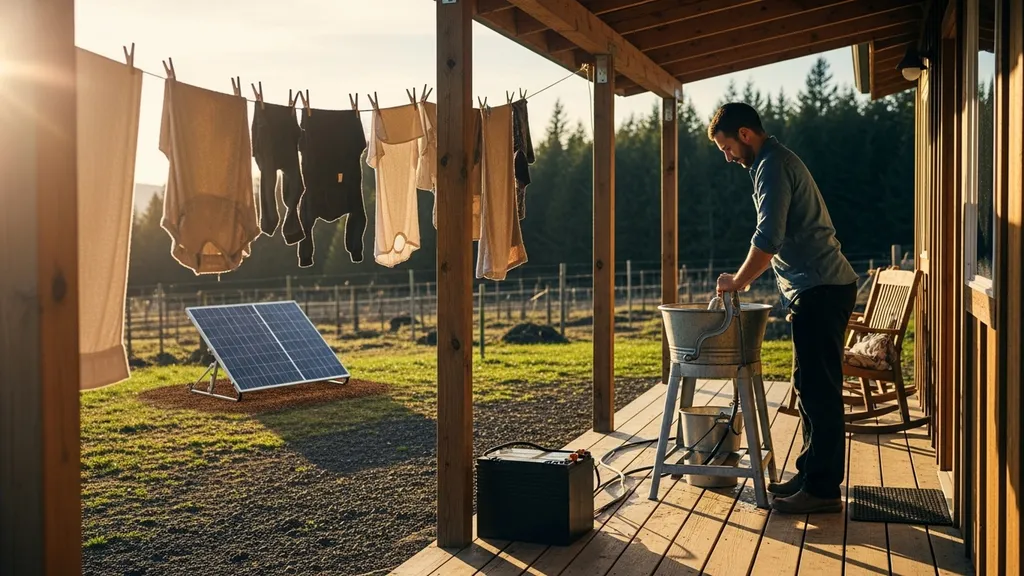
Practical guide to off-grid laundry: manual methods, solar & battery options, water systems, drying, costs, and DIY setups for sustainable self-builds.
Off-Grid Washing: Laundry Without Grid Power
Doing laundry without grid electricity—off-grid laundry—can save hundreds in utility costs, reduce environmental impact, and keep a homestead self-reliant. This guide explains practical ways to wash, wring, dry, and manage water without a utility hookup: manual systems, 12V/DC appliances, solar + battery setups, water sourcing and graywater, low-cost DIY builds, and costs you can expect. Read on to choose a path that fits a tiny home, cabin, or small self-build.
TL;DR:
- Choose a method: manual two-bucket or hand-crank for <$150 and near-zero energy; small 12V washers or a portable 120V washer on an inverter for moderate energy and higher convenience.
- Estimate energy: expect ~0.2–1.0 kWh per load for efficient electric washers; size PV and battery with 25–50% margin for surge and inverter losses.
- Prioritize water and spin extraction: use high-spin or a wringer to cut drying time and water demand; route graywater for irrigation where allowed.
Why Choose Off-grid Washing (laundry Without Grid Power)?
Many small homesteads, tiny houses, and remote cabins see laundry as a surprisingly large part of household energy and water budgets. Research and appliance data show modern clothes washers vary widely: older top-loaders can use 1–2 kWh per load; newer front-load and high-efficiency models often fall in the 0.2–0.6 kWh per load range, depending on cycle and water temperature. Studies on off-grid living also report that reducing appliance loads is a top priority for households switching to renewables or living remotely (see the academic survey in the next section).
Typical Use Cases:
- Homesteads with intermittent grid access who want resilience during outages.
- Tiny homes and vans where roof or ground-mounted PV is primary power.
- Remote cabins or guest cottages where hauling water is a limiting factor.
Benefits include:
- Lower monthly bills and more predictable energy planning.
- Less dependence on fuel deliveries or generator runtime.
- Reduced environmental footprint when combined with solar and efficient water systems.
On the flip side, off-grid laundry requires deliberate choices: labor (hand methods), initial capital for solar/batteries, and water planning. For context on other low-energy household systems that pair well with off-grid laundry, see the guide to emergency off-grid cooking at Homestead.org: Hand-Washing on the Homestead: Off-Grid Laundry.
Off-grid Laundry Options: Manual, Electric 12V/DC, and Hybrid Systems
There are three practical categories for off-grid washing: manual methods, low-voltage (12V/DC) electrics, and hybrid solutions that mix human power with small motors.
Manual Methods: Washboards, Nancy Tubs, Hand-crank & Pedal Washers
Manual systems range from a simple washboard plus basin to purpose-built hand-crank tubs and pedal washers. A two-bucket system (wash + rinse) with a plunger can clean a small load in 20–40 minutes of active time. Hand-crank tubs (e.g., the "nancy" or scrub tub with a crank) reduce effort and improve agitation. Pedal-powered drum washers are less common but useful if you want continuous mechanical input without batteries.
Performance and labor:
- Typical cleaned load: 2–6 kg (small load) per session.
- Time: 20–60 minutes active, plus wringing and drying.
- Water: 10–40 liters per small load (bucket methods scale up).
Manual washing methods are ideal when labor is available, water is scarce, or capital is minimal. For hygiene guidance and stain treatment when hand-washing, see CDC laundry recommendations: Laundry: washing and drying to prevent infection.
Low-voltage and 12V/DC Washers: Pros and Limitations
Portable 12V washers (or DC-convertible portable washers) are available for RVs and off-grid setups. They typically draw 100–400 W continuous and have low energy per load if paired with the right battery bank. Advantages include lower inverter complexity and direct PV charging possibilities with MPPT controllers.
Limitations:
- Most 12V units are small (4–8 lb/2–4 kg capacity).
- Spin extraction is limited; users often need a separate spinner or manual wringer.
- Surge protection and correct controller choice are critical.
A university review of off-grid household choices highlights perception trade-offs: convenience vs ongoing maintenance and energy supply limits (see the study by USF researchers): Household energy choices and attitudes.
Hybrid Solutions: Foot-powered Wringers, Counter-current Hand Pumps, and Battery-assisted Cycles
Hybrid approaches mix methods: wash by hand, then use a small battery-assisted spinner or 12V pump for mechanical agitation; or pair a foot-treadle for agitation with a solar-charged battery to run a short spin cycle. These hit a balance: lower labor than pure hand methods and much lower energy consumption than full-size washers.
Match the approach to the user:
- Low-labor, low-cost: two-bucket + wringer.
- Moderate convenience: 12V washer + spinner + small battery.
- High convenience: inverter-connected high-efficiency washer plus full PV + battery bank.
Power and Energy Planning for Off-grid Laundry
Sizing power for laundry starts with per-load energy, then considers cycles per week, inverter type, and surge. Accurate planning avoids undersizing inverters or batteries.
How to Calculate Kwh Per Load and Daily Energy Needs
Steps:
- Identify appliance energy per cycle (kWh) — use manufacturer spec or measure with a kill-a-watt for grid units.
- Multiply by expected loads per day/week.
- Add inverter losses (10–15% for small systems) and reserve margin.
Example calculation:
- Efficient front-load washer: 0.5 kWh/load.
- 3 loads per week → 1.5 kWh/week → ~6 kWh/month.
- Add inverter/battery/inconsistent sun margin: plan 8–10 kWh/month for monthly PV sizing.
For broader energy estimation methods that adapt lighting approaches to appliances, see the off-grid energy calculator method: how to calculate off-grid energy.
Battery, Inverter, and PV Sizing Basics (quick Math)
Quick rules:
- Battery capacity: Size for usable kWh using Depth of Discharge (DoD). For lead-acid at 50% DoD, double the usable kWh; for lithium at 80–90% DoD, divide by 0.8–0.9.
- PV sizing: Divide daily kWh need by average peak sun hours (site-specific) and add 25–50% for inefficiencies and cloudy days.
Sample PV/battery suggestion for 3 loads/week at 0.5 kWh/load (approx. 2 kWh/month):
- Daily average ~0.07 kWh → trivial; a tiny PV array (50–100 W) will easily keep a 12V battery charged if laundry is infrequent.
- For running a 120V portable washer (0.5 kWh) occasionally: plan for a 500–1,000 Wh usable battery and 200–400 W PV to recharge between cycles.
Inverter Type and Surge Considerations
Inverter choice matters:
- Use a pure sine wave inverter for sensitive motors. Modified sine might damage motor controllers or increase heat.
- Check surge rating: washing machines have high motor start surges (several times running watts). A small portable washer may require 400–1,000 W start; a full-size washer can spike to 1,500–3,000 W.
- Account for inverter efficiency (90–95%) and derating at high loads.
Small comparison table: manual vs 12V vs inverter washer (example ranges)
| Type | Energy (kWh/load) | Typical surge (W) | Cycle time | Suggested battery (Ah @12V) |
|---|---|---|---|---|
| Manual (bucket) | 0 | 0 | 20–60 min human time | None |
| 12V portable | 0.1–0.4 | 200–600 | 20–40 min | 100–200 Ah (12V) |
| 120V inverter washer (small) | 0.3–0.8 | 800–2,500 | 30–90 min | 200–400 Ah or inverter + generator |
Be mindful of panel-to-battery matching and inverter wiring: see practical guidance on connecting panels and common inverter issues: how to connect solar panels to a hybrid inverter and 5 common solar inverter issues and fixes. For panel choice to match a roof, consult how to choose solar panels that match your roof and how to compare solar panel efficiency ratings. For global off-grid renewable trends and sizing context, see IRENA statistics: Off-grid renewable energy statistics 2023.
Water Supply, Pumps, Filtration, and Graywater for Off-grid Laundry
Laundry planning often fails because water logistics are overlooked. Decide water source, pumping, and wastewater handling before choosing a washing method.
Sourcing Water: Rainwater Harvesting, Wells, and Hauled Water
Common sources:
- Rainwater: great for detergent-free pre-rinse, but needs filtration for longer-term storage.
- Well water: steady supply but pressure and pump reliability matter.
- Hauled water: used where other options are unavailable; emphasizes water-efficiency.
Typical water per load:
- Older top-loaders: 60–120 liters/load.
- Efficient front-loaders: 20–40 liters/load.
- Bucket washing: adjustable, often as low as 10–25 liters/load.
Reduce water use with pre-soaks, spot-cleaning, and using washboard or scrub brushes on heavily soiled areas. For plumbing strategies that minimize water demand and help greywater reuse, see water-efficient plumbing and moisture control guide.
Pumps and Pressure: Solar vs Manual vs Electric Pumps
Pump choices:
- Hand pumps and foot pumps: low-tech and no electricity, good for bucket systems or small amounts of water.
- Solar-powered DC pumps: pair well with PV arrays and a pressure tank; ideal for wells or tanks with daily draw.
- AC pumps on an inverter: good if doing many loads and a full AC distribution exists.
Technical note: choose a pump rated for the head (vertical lift) and flow you need. For off-grid pump comparison, see off-grid water pumps solar and manual options.
Filtration and Treating Laundry Water; Graywater Reuse Options
Treat raw water to protect fabric and appliances:
- Pre-filter with sediment screens (5–50 µm) for rain or well water.
- Consider softening if hard water causes wear or scaling.
- For whole-house treatment that includes laundry, see off-grid water filtration whole house systems.
Graywater reuse:
- Laundry graywater can irrigate non-food plants if detergents are plant-friendly and local code allows it.
- Avoid routing graywater directly to potable systems; consult local regulations and the Ultimate Guide to DIY Building Permits before installation.
- Simple gravity-fed mulched beds or subsurface irrigation work well with detergent formulations labeled safe for graywater.
DIY and Low-cost Off-grid Washing Setups — Step-by-step
This section gives build recipes, materials, and safety pointers for three practical setups.
Build a Basic Wash Station: Bucket Wash + Wringer Setup
Materials:
- Two 20–30 L buckets with lids.
- A washing plunger (dolly) or scrub brush.
- A spin-wringing bucket or hand-crank wringer (can be reclaimed).
- Basic detergent and stain treatment supplies.
Steps:
- Fill Bucket A (wash) with warm water and detergent; fill Bucket B (rinse) with clean water.
- Agitate with the plunger for 5–15 minutes per garment batch.
- Transfer to rinse, agitate until suds clear.
- Use a wringer or press garments against a clean surface to remove excess water.
- Hang on a line.
Safety: Use gloves for hot water and be careful with wringers to avoid pinching.
Convert a Portable Machine for Off-grid Use
Common conversions:
- Replace AC motor control with a DC motor and controller for direct battery use (requires motor matching and wiring knowledge).
- Add a DC-powered small spinner or centrifugal dryer to improve extraction.
Materials and tools:
- Multimeter, appropriate wire gauge, DC motor controller, fuses, and a safety disconnect.
For safe battery mounting and electrical safety when installing battery-assisted components, consult the DIY battery enclosure guide and the solar installation safety checklist: how to build a DIY battery enclosure for off-grid homes and ultimate guide to solar installation safety.
Staging a Solar-assisted Laundry Corner: Wiring and Safety
Design tips:
- Place the washer near the battery/inverter enclosure to minimize DC/AC run length.
- Use a dedicated circuit and correct breaker size for inverter outputs.
- Install GFCI protection on outlets serving laundry equipment.
If adding a small inverter for an occasional 120V machine, choose a pure sine inverter with adequate continuous and surge ratings. For wiring steps and panel-to-inverter connections, see how to connect solar panels to a hybrid inverter. Always follow local code and get a licensed electrician sign-off when converting or modifying fixed wiring.
[YouTube placeholder introduction: Watch a short demo to see build details, cycle times, and user effort for hand-crank and solar-assisted washers.]
Watch this review for practical insights:
Appliances and Portable Washers: Comparison Table and Buying Guide for Off-grid Laundry
Choosing the right appliance depends on capacity, spin extraction, energy, and durability.
Comparison/specs Table: Manual vs 12V vs 120V Inverter Washers
| Model/type | Energy (kWh/load or W) | Surge W | Water use (L/load) | Typical cost | Best for |
|---|---|---|---|---|---|
| Bucket + plunger | 0 | 0 | 10–40 | <$50 | Tight budget, water-limited |
| Hand-crank tub | 0 | 0 | 15–40 | $100–$250 | Low-labor manual |
| 12V portable washer (RV type) | 0.1–0.4 kWh | 200–600 | 15–40 | $200–$700 | Tiny homes, RVs |
| Small inverter-fed portable (120V) | 0.3–0.8 kWh | 800–2,500 | 20–60 | $300–$900 | Small families with PV+inverter |
| Full-size front-load washer | 0.3–1.2 kWh | 1,500–3,000 | 20–60 | $500–$1,500 | High convenience, larger PV budget |
Choosing Capacity, Spin Efficiency, and Durability
- Capacity: Match washer size to typical load frequency. Smaller loads more often uses more energy overall.
- Spin efficiency: Higher spin RPM removes more water, cutting drying time. Look for high extraction percentages (or use a separate spinner).
- Durability: Simpler motors and fewer electronics are easier to repair off-grid.
Where to Buy, Cost Ranges, and Salvage/used Options
- New units: RV supply stores, outdoor retailers, and major online marketplaces.
- Used: Thrift stores and salvage yards often have washers with good mechanical parts—look for intact drums and motors.
- Retrofits: Salvaged motors can power DIY agitators or spinners but require wiring expertise.
For budgeting the PV and system costs needed to support a chosen appliance, consult the solar cost guide: solar power costs by house size ultimate guide.
Drying, Ventilation, and Moisture Control for Off-grid Laundry
Drying strategy is as important as washing—drying consumes time and, if done indoors, can create moisture problems.
Best Low-energy Drying Practices: Line Drying, Solar Tunnels, and Enclosed Solar Dryers
- Line drying: Sun and wind are free. In full sun, a cotton shirt can dry in 1–3 hours; in shade or humid conditions, 6–24 hours.
- Solar tunnel dryer: A simple box with a black absorber and a clear cover can accelerate drying by several hours.
- Enclosed solar dryer: A small insulated cabinet with solar gain and venting works in cold weather.
Solar dryer build notes: use a sloped clear polycarbonate top, black-painted metal or corrugated sheet inside, and a small vent or passive stack to move moisture.
Indoor Drying: Ventilation, Dehumidification, and MERV/HEPA Considerations
Indoor drying needs airflow and moisture control:
- Vent to outdoors where possible or use a condensing dryer that collects water.
- Install mechanical ventilation or a dehumidifier in frequently used drying rooms.
- Avoid blocking HVAC filters with lint; use a lint trap and regular cleaning.
For ventilation design and moisture control in small eco homes, see the ventilation guide: ultimate guide to ventilation for small eco homes. Use appropriate insulation like natural fiber insulation to help control indoor moisture pathways: ultimate guide to natural fiber insulation.
Winter Strategies and Frost Protection for Outdoor Lines
- Use indoor drying racks near a south-facing window with ventilation.
- Create a sheltered outdoor line with windbreaks; clothes freeze then thaw indoors, which can still be effective for microbial reduction.
- Warm-air recirculation systems with heat-recovery ventilators (HRVs) help dry clothes while preserving heat.
Key Points, Materials, and Cost Checklist for Off-grid Laundry
A concise decision guide, materials checklist, and ballpark costs.
Quick Decision Guide: Choose Manual, Hybrid, or Electric
- Manual: Choose if budget is < $150, labor is acceptable, and water is limited.
- Hybrid: Choose if you want moderate convenience with lower energy; budget $300–$1,200.
- Electric (inverter/full-size): Choose if you have a larger PV+battery budget and want near-grid convenience; budget $2,000+ for system and appliance.
Materials Checklist: Pumps, Washer Types, Battery/inverter Basics, Plumbing
- Water: storage tank, sediment filter, hose fittings.
- Pumps: hand pump or solar DC pump (off-grid water pumps).
- Washer: bucket/plunger, hand-crank tub, 12V portable, or inverter-fed washer.
- Extraction: wringer, spinner, or high-RPM washer spin.
- Power: battery bank, pure-sine inverter sized for surge, PV panels sized per production.
- Safety: GFCI, fuses, battery enclosure (DIY battery enclosure), and follow solar installation safety.
Ballpark Cost Ranges and Maintenance Items
- DIY manual setup: $30–$150; low maintenance but more labor.
- 12V washer + small battery/PV: $500–$2,000; regular battery maintenance (if lead-acid).
- Inverter-connected small washer + PV/battery: $2,000–$6,000+ depending on battery chemistry and panel area.
- Maintenance: pump servicing, filter replacement, belt/motor checks, detergent selection for graywater safety.
For baseline solar budgeting and incorporating laundry into whole-house costs, review the solar off-grid basics and the solar cost guide.
The Bottom Line
Off-grid laundry is achievable at multiple price and effort levels: start with a manual or portable option to test routines, prioritize high spin extraction and water efficiency to save drying energy, and size PV and batteries with surge margins if moving to electric washers. Next steps: pick a water source, trial a small manual or 12V setup, and then scale PV/battery capacity if needed.
Frequently Asked Questions
Can I run a standard washing machine off solar panels and batteries?
Yes, but only if the PV array, battery bank, and inverter are sized to handle the washer’s running and start-up surge. Full-size washers can have start surges of 1,500–3,000 W, so use a pure sine inverter with adequate surge rating and a battery bank sized for the kWh per cycle plus charging losses. Consult guidance on connecting panels to hybrid inverters and expect to add a 25–50% margin for cloudy days and inverter inefficiencies; see how to connect solar panels to a hybrid inverter for wiring considerations.
How much water does off-grid laundry use compared with on-grid?
Water use varies by method. Efficient front-loaders typically consume 20–40 liters per load, older top-loaders 60–120 liters, and manual bucket methods can be adjusted to 10–40 liters per load depending on rinsing technique. Reducing soak volume, using two-bucket rinse systems, and high-spin extraction all reduce total water demand. For plumbing-level strategies to reduce demand, see water-efficient plumbing and moisture control guide.
Is hand-washing clothes hygienic and effective?
Yes—hand-washing is effective when done properly. Agitation, adequate detergent, and a proper rinse remove dirt and most common pathogens. Hot water and full drying further improve hygiene. For specifics on washing to control infection risks and recommended temperatures, consult CDC laundering guidance: Laundry: washing and drying to prevent infection.
How do I handle laundry in winter when lines freeze?
Options include indoor drying near a ventilated south-facing window, using a small enclosed solar dryer or heated drying room with ventilation, or allowing clothes to freeze outside briefly then finishing indoors—frozen clothes often shed water when thawed and can be effective for heavy outerwear. Ensure indoor drying areas have ventilation to avoid moisture buildup; see the ventilation guide for small homes: ultimate guide to ventilation for small eco homes.
What are the safest inverter and battery setups for a washer?
Use a pure sine inverter sized for continuous and surge loads of your washer, and pair it with a battery bank that provides the needed usable kWh with appropriate DoD (Depth of Discharge). Lithium batteries allow higher usable capacity per Ah and lower maintenance, while lead-acid requires larger capacity for the same usable kWh. Include fusing, proper gauge wiring, ventilation for battery enclosures, and a GFCI-protected outlet for the washer. Consult how to build a DIY battery enclosure for off-grid homes and follow local electrical code and a licensed electrician for grid-to-off-grid conversions.