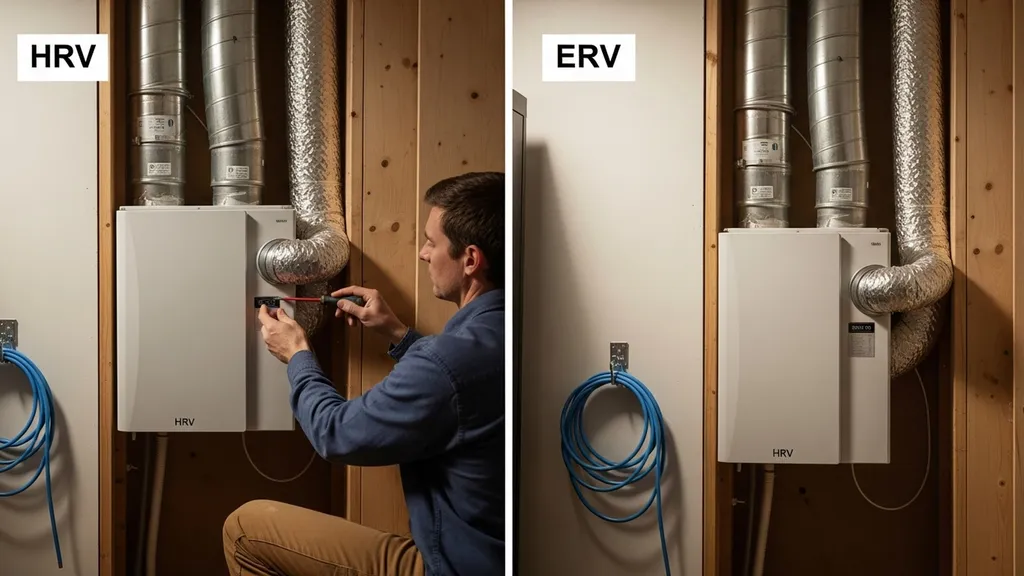
Clear, practical guide to choosing between HRV and ERV for energy-efficient, healthy homes — climate advice, pros/cons, and real-world scenarios.
HRV vs ERV: Which Ventilation System Do You Need?
Choosing between HRV vs ERV matters for airtight, energy-efficient homes because the right system controls heat, moisture, and indoor air quality while keeping operating costs down. This guide compares heat recovery ventilators (HRV) and energy recovery ventilators (ERV) with clear, practical advice for DIY and self-build projects: how each system transfers heat and moisture, expected recovery efficiency, maintenance, sizing basics, installation tips, and scenario-based recommendations for cold, hot-humid, mixed, and off-grid builds. Read on to decide which fits your climate, budget, and build style.
TL;DR:
- HRVs recover sensible heat only and typically reach ~60–90% sensible recovery — best for cold, dry climates to reduce heating load.
- ERVs transfer sensible heat and some latent heat (moisture), lowering summer humidity load in hot-humid areas while preserving indoor moisture in very cold dry winters.
- If you need quick guidance: choose an HRV for cold-dry or passive-house airtight builds, an ERV for hot-humid or mixed climates with indoor moisture sources, and consider switchable/bypass or hybrid strategies for mixed climates and tiny/off-grid cabins.
Why Compare HRV vs ERV: What This Guide Covers
Quick Orientation for DIY and Self-builders
The primary choice between HRV and ERV is whether you want moisture exchange along with heat recovery. This affects comfort, HVAC sizing, and condensation risk. This article explains the mechanical differences between a heat recovery ventilator and an energy recovery ventilator, compares performance metrics, and gives DIY-focused installation, maintenance, and cost advice. It also includes climate-based scenarios so you can match a system to a compact passive-house, a humid retrofit, or an off-grid cabin.
How to Use This Article (TL;DR, Scenarios)
Use the table below for a rapid comparison, then read the H2 section that matches your climate or use case. For deeper system and ducting design refer to our building guides hub. For envelope strategies that affect moisture control, see our piece on rain screen walls. Also helpful background on the practical difference between HRV and ERV is available from a technical overview like the article at Botts & Tye that explains moisture exchange: Erv vs hrv.
Quick Comparison: HRV vs ERV (TL;DR) — Comparison Table and Video
Comparison Table: Side-by-side Metrics
| Metric | HRV (Heat Recovery Ventilator) | ERV (Energy Recovery Ventilator) |
|---|---|---|
| Core function | Transfers sensible heat (air-to-air) only | Transfers sensible heat and latent heat (some moisture) |
| Heat recovery type | Sensible-only (plate or rotary) | Sensible + latent (enthalpy or desiccant cores) |
| Typical sensible recovery | 60–90% sensible recovery (varies by model) | 50–85% sensible sensible; plus latent transfer |
| Best climates | Cold, dry, cool temperate | Hot-humid, mixed climates, or where summer dehumidification helps |
| Maintenance points | Filters, core cleaning, frost control | Filters, core cleaning, condensate/drain checks |
| Noise and ducting | Similar to ERV; careful duct design reduces noise | Similar to HRV; moisture-handling may require drain |
| Upfront cost (ballpark) | Unit only: $600–$2,000; installed: $1,200–$5,000 | Unit only: $800–$2,500; installed: $1,400–5,500 |
| Passive House compatibility | Common in Passive House projects | Also used; check moisture transfer details and certification |
Short Takeaway: Which Climates Favor Which System
- Cold, dry climates: HRV is usually better because it maximizes sensible heat recovery without bringing in outdoor moisture.
- Hot, humid climates: ERV reduces indoor humidity load and eases air conditioning duty.
- Mixed climates: Either can work; ERV often helps summer moisture control, while HRV may be preferred where winter indoor humidity is very low. Consider switchable cores or bypass options.
This video provides a helpful walkthrough of the key concepts:
For efficiency context see the EPA's guidance on ventilation and whole-house energy performance at ENERGY STAR: About.
HRV Explained — When an HRV is the Right Choice (HRV vs ERV)
How Hrvs Work (sensible Heat Recovery)
A heat recovery ventilator passes outgoing stale air across a heat-exchange surface so incoming fresh air gains that heat without the two air streams mixing. Typical core types are counterflow or crossflow plates and rotary heat exchangers; all are designed to transfer sensible heat (temperature) only. HRVs do not transfer moisture between streams, which matters for humidity control.
Strengths of Hrvs
- Efficient sensible heat recovery in cold climates — sensible efficiencies often run 60–90% depending on flow and model.
- Simpler core design means fewer moisture-management risks indoors.
- Good option for tightly sealed buildings and Passive House projects when coupled with precise ventilation rates.
- Compatible with common heat-pump systems and reduces peak heating load.
Weaknesses of Hrvs
- No moisture exchange: in hot-humid climates you still need active dehumidification or larger AC to control humidity.
- Frost control strategies are required in very cold climates (preheat, recirculation, or defrost cycles), adding complexity.
- If indoor humidity is consistently low in winter, HRV will not recover indoor moisture — may lead to dry air unless humidification is used.
Best-for Use Cases
- Cold, dry climates and cold winters where heating energy is the dominant load.
- Passive House or other airtight builds that emphasize sensible heat recovery and strict heat-balance modeling.
- Installers and DIYers who want a simpler moisture profile to manage and fewer condensate drains.
Practical DIY considerations
- Sizing basics: use ASHRAE 62.2 as the baseline for ventilation rates (cfm per person + cfm per ft2); many builders use a rule-of-thumb like 0.35 ACH or ventilation based on occupants and floor area, but check local code. ASHRAE guidance is available from ASHRAE resources and is discussed further in technical documents.
- Maintenance: expect to clean or replace filters every 3–12 months depending on indoor pollutants; clean the core annually and check frost-control settings in winter.
- Installation tips: place the unit in an accessible mechanical room, not a dusty attic; ensure easy filter access and service clearance. For system design and balanced ducting see our balanced ventilation guide. For Passive House integration, review the passive house principles. The U.S. Department of Energy discusses whole-house ventilation and heat recovery fundamentals at Building technologies office.
ERV Explained — When an ERV is the Right Choice (HRV vs ERV)
How Ervs Work (sensible + Latent Transfer)
An energy recovery ventilator uses an enthalpy core or desiccant-treated surface that moves both sensible heat and a portion of moisture (latent heat) between exhaust and intake streams without mixing the air. That means in summer ERVs can reduce the humidity load brought in with fresh air, and in winter they can retain some indoor moisture.
Strengths of Ervs
- Lowers the moisture load in hot-humid climates, reducing air conditioning and dehumidifier runtime.
- Can help retain indoor humidity in very cold, dry climates, improving comfort without extra humidification.
- Useful in mixed climates where seasonal humidity swings matter; one system can often handle both heat and moisture needs.
- Modern ERVs can match heat recovery rates close to HRVs for sensible transfer while adding latent transfer.
Weaknesses of Ervs
- Slightly lower sensible recovery compared to an equivalent HRV in some models; tradeoff is moisture transfer capability.
- Potential for odor transfer if filters and cores are neglected — regular maintenance is more important.
- In some climates, ERV moisture transfer may increase condensation risk in ducts if drains and layout are poor.
Best-for Use Cases
- Hot and humid climates where managing summer indoor humidity reduces AC load.
- Mixed climates where summer humidity control is valuable but winters are not extremely dry.
- Homes with consistent indoor moisture sources (many occupants, cooking, indoor plants, or laundry) where latent loads matter.
Practical DIY considerations
- Sizing and airflow: follow ASHRAE 62.2 and model the latent load if humidity control is a primary goal. Manufacturers publish sensible and latent transfer rates — compare both numbers when selecting units.
- Bypassing: some ERVs offer bypasses or seasonal controls to limit moisture transfer when outdoor conditions would make it undesirable. Know how and when to bypass.
- Maintenance: inspect filters every 3–6 months, clean the enthalpy core annually, and check condensate drains. For standards guidance see ASHRAE ventilation documents at Read only versions of ashrae standards.
Other Ventilation Options in Context — How HRV and ERV Compare to Alternatives
Exhaust-only and Supply-only Systems: Pros/cons
Exhaust-only ventilation is low-cost and common in retrofits: a continuous bath/kitchen exhaust or a central fan depressurizes the house, drawing makeup air through leaks. Supply-only pushes fresh filtered air in, often with a controlled inlet. Both are simpler than balanced mechanical ventilation but can cause uncontrolled drafts, moisture migration, and backdrafting from combustion appliances. Balanced systems with recovery are preferred for airtight modern builds.
Hybrid and Demand-controlled Ventilation
Demand-controlled ventilation (DCV) uses sensors (CO2, VOC, humidity) to run ventilation only as needed, reducing fan energy. Hybrid systems combine spot exhasts with controlled supply or recovery on a timer. These can be cost-effective where full balanced recovery is harder to retrofit.
When Balanced Systems Without Recovery Still Make Sense
In low-occupancy cabins or very dry climates, simple supply-only or exhaust-only designs may be acceptable. For off-grid tiny houses with limited power budgets, consult our off-grid ventilation tips and consider low-power fans or interval ventilation strategies. For retrofit projects where envelope improvements are phased, see our deep retrofit guide which explains when to add balanced recovery during a later stage. Also consider impacts on whole-property systems such as water and septic when changing ventilation approaches; our off-grid water systems guide can help coordinate systems.
Installation, Sizing, and Cost Considerations for HRV vs ERV (HRV vs ERV Practicalities)
Sizing Basics and Airflow Targets
Start with ASHRAE 62.2 calculations (occupant + floor area baseline). A simple rule-of-thumb often used by builders is 0.35 ACH or a minimum continuous ventilation CFM that covers occupants (e.g., 15–30 CFM per person depending on code). Always verify with local code — see permits overview. For tiny houses, use occupancy-based sizing and check solar power limits in our tiny-house solar sizing.
Placement, Ducting and Noise Control Tips
- Place the unit in an accessible, conditioned mechanical space where filter changes and service are simple. Avoid dusty attics where service is difficult.
- Use smooth ducts and minimize sharp turns to reduce static pressure and noise.
- Use insulated ducts for supply and exhaust runs that pass through unconditioned space to prevent condensation and heat loss.
- Keep the unit away from bedrooms if noise is a concern; use acoustic duct liners or offset bends to reduce fan noise.
Upfront Cost vs Operating Cost
Ballpark costs vary by unit capacity, model, and labor. Expect a range roughly as shown in the table above; get local quotes. Operating costs depend on fan power and how well the envelope reduces heating/cooling loads — better air sealing lowers required ventilation rates and running costs. Prioritize air sealing: see our air sealing checklist and attic insulation advice.
Maintenance Checklist and Filter Guidance
- Check filters every 3 months; replace or clean per manufacturer instructions.
- Clean cores annually; some cores require gentle vacuuming or a mild wash.
- Inspect condensate drains (ERVs) and defrost controls (HRVs in cold climates) yearly before winter.
- Keep at least 12–18 inches clearance around unit for service access.
For safe electrical work related to connecting ventilation units, follow guidance in electrical basics. Always verify local code and hire licensed trades when permits require.
Which Should You Choose? HRV vs ERV Scenario-based Recommendations
Cold, Dry Climates (example Scenarios)
Recommendation: HRV is the usual choice. It maximizes sensible heat recovery and avoids bringing in outdoor moisture that could condense inside walls. If indoor humidity is too low, add a controlled humidifier rather than using an ERV to transport moisture.
Hot, Humid Climates
Recommendation: ERV is preferred to reduce the latent load on your air conditioner. ERVs limit the moisture entering with ventilation air and reduce runtime for dehumidifiers.
Mixed Climates
Recommendation: Consider ERV if summer humidity is a frequent problem; choose an HRV if winters are long and dry and summer humidity control is handled by good AC. Switchable cores or units with seasonal bypass offer a compromise.
Small Cabins, Tiny Houses, and Off-grid Builds
Recommendation: For tiny or off-grid homes, prioritize low-power fans and compact units sized to your occupancy and power budget. ERVs can be useful if summer humidity is an issue; HRVs suit very cold remote cabins. Pair your ventilation choice with solar sizing: see tiny-house solar sizing.
Retrofits and Older Homes
Recommendation: For deep retrofits, implement air sealing first, then add a balanced system. In many retrofits an exhaust-only system is a low-cost interim choice, but balanced HRV/ERV is better long-term for airtight envelopes. See our deep retrofit guide for sequencing.
Quick decision flow
- Is your location predominantly hot and humid in summer? If yes → ERV.
- Is your location predominantly cold and dry in winter? If yes → HRV.
- Mixed climate or uncertain? If summer humidity is a major concern, lean ERV; otherwise HRV or a switchable unit can work.
Cost-saving Tips, DIY-friendly Options, and Common Pitfalls (HRV vs ERV Savings)
Where to Save Without Sacrificing Performance
- Prioritize airtightness and insulation before sizing an HRV/ERV — smaller capacity and lower operating cost follow better sealing. See our air sealing checklist.
- Choose a unit with accessible filters and a clear service path to avoid future service costs.
- Consider refurbished units from reputable distributors if budgets are tight, but budget for new filters and a professional check.
Mistakes Diyers Make (and How to Avoid Them)
- Undersizing ducts or the unit: causes poor performance, higher fan energy, and noisy operation.
- Poor duct layout: excess bends and long runs increase static pressure and reduce recovery efficiency.
- Neglecting condensate drains or frost control: leads to water damage or shutdowns in winter.
- Forgetting permits and local code: always check the rules in your area—see permits overview.
When to Hire a Pro
- Complex duct networks, commissioning and balancing, and electrical connections beyond basic wiring should be handled by licensed HVAC or electrical professionals.
- If you plan a Passive House certification or tight performance target, hire a certified ventilation designer to ensure compliance and test balanced flows.
For budgeting around high-performance builds, review the trade-offs in our passive house costs and watch for the hidden items in our hidden DIY costs. Small steps like improved door seals can lower load — see door weatherstripping tips.
The Bottom Line
HRV vs ERV is primarily a climate and moisture-management decision: choose an HRV to maximize sensible heat recovery in cold, dry environments and an ERV when latent (moisture) transfer will improve summer comfort and reduce AC runtime. For mixed climates and small off-grid builds, weigh seasonal performance and consider switchable cores or hybrid strategies.
Frequently Asked Questions
How often should I clean filters and cores?
Filters should be inspected every 3 months and replaced or cleaned per manufacturer instructions; homes with pets or heavy dust may need more frequent checks. The heat or enthalpy core typically needs a gentle cleaning once a year, and drains for ERVs should be checked annually. Regular checks prevent odor transfer and decline in recovery efficiency.
Can I switch between HRV and ERV seasonally?
Some modern units offer seasonal bypass or switchable cores that change the moisture-transfer behavior; otherwise you cannot convert an HRV to an ERV without replacing the core. If seasonal needs vary, consider a unit with bypass or a combo strategy where an HRV runs in winter and supplemental dehumidification runs in summer.
Do I need a heat recovery unit with a wood stove or fireplace?
Balanced ventilation remains important in airtight homes even with a wood stove, but you must ensure combustion safety. Exhaust-only ventilation can create depressurization and backdrafting risks with combustion appliances. If you have an open combustion appliance, consult a professional and local code; a balanced HRV/ERV with proper makeup air and interlocks is usually safer.
How do I size a unit for a tiny house?
Use occupancy-based rates from ASHRAE 62.2 and consider continuous low-flow ventilation with higher intermittent rates for periods of occupancy. Typical tiny-house systems run 30–100 CFM depending on size and occupants; confirm with ASHRAE calculations and match to your electrical budget. Pair sizing decisions with solar or battery limits using guides such as our tiny-house solar sizing.
Are ERVs safe in mould-prone homes?
ERVs can be used in mould-prone homes but they require strict maintenance: frequent filter changes, core inspections, and ensuring drains are functional. If the building has uncontrolled moisture sources or active mould, address those problems first. ERVs are not a substitute for fixing leaks or poor drainage; they help manage indoor humidity when the envelope and services are sound.