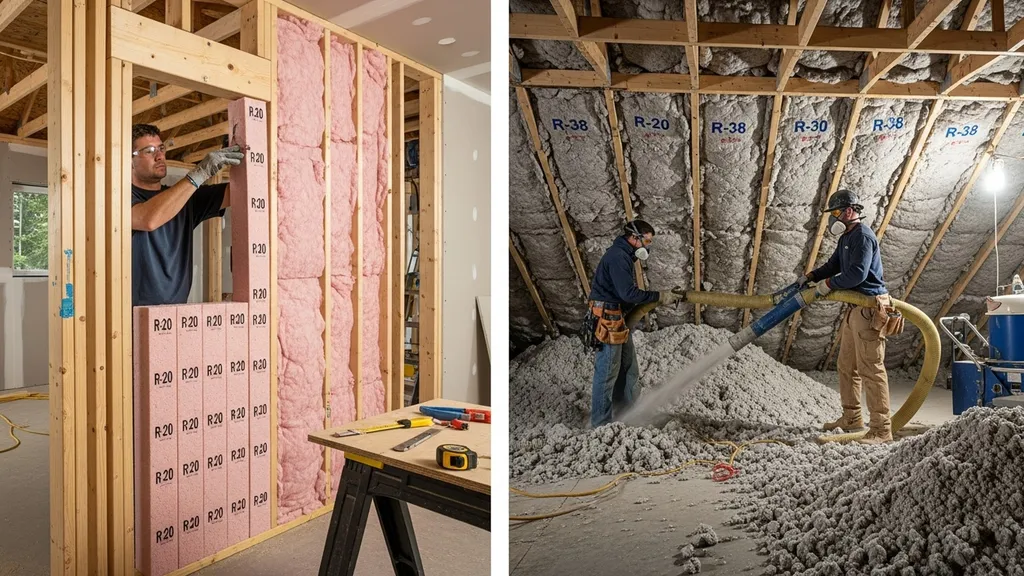
Compare R-20 and R-38: typical uses, thickness, costs, and DIY retrofit tips to pick the right insulation for your budget and climate.
R-20 vs R-38 Insulation: Which Do You Need?
Choosing the right insulation often comes down to a simple trade-off: material, thickness, and where you install it. This article compares "r20 vs r38 insulation" for typical DIY and retrofit projects so you can pick the most cost-effective approach for your climate, framing, and budget. You’ll get clear definitions of what R-20 and R-38 mean in real assemblies, typical thicknesses by material, installation tips, retrofit checklists, and scenario-based recommendations for new builds, attics, cabins, and tiny homes.
TL;DR:
- R-20 is a common target for 2x6 wall cavities (about 5.5–6.25" of common batt/cavity fill); it’s cost-effective for walls and moderate climates.
- R-38 is a typical attic target in cold climates (roughly 10–14" loose-fill or layered systems) and cuts heating loads substantially when combined with good air sealing.
- For best results, prioritize air-sealing and thermal-bridge reduction (continuous insulation) — extra R-value alone rarely gives the largest savings.
R-20 vs R-38 Insulation: Quick Answer and Why This Comparison Matters
TL;DR — Which is Usually Better and When
R-20 is the more common cavity target in standard 2x6 wall construction. R-38 is a common attic target where winters are cold and heating is the dominant load. Which you choose depends on framing depth (2x4 vs 2x6), climate zone heating demand, and whether you can add continuous exterior insulation to reduce thermal bridging.
Comparison Table — at a Glance
| Material | Typical R/inch (range) | Thickness for R-20 | Thickness for R-38 | Common applications | Typical installed cost per sq ft (rough) |
|---|---|---|---|---|---|
| Fiberglass batt | 3.1–3.4 | 6.0–6.5" | 11–12" (attic loose-fill or layered) | 2x6 walls (R-20), attic with deep fill | $0.50–$1.50 |
| Cellulose (dense/loose) | 3.2–3.8 | 5.5–6.5" | 10–12" loose-fill | Attic loose-fill, dense-packed walls | $0.75–$2.00 |
| Mineral wool | 3.0–3.3 | 6–6.5" | 11–13" | Fire-resistant wall cavity, attic | $1.00–$2.50 |
| Open-cell spray foam | ~3.5 | 5.5–6.5" | 10–11" | Air-sealing cavities; retrofit in some assemblies | $1.50–$3.50 |
| Closed-cell spray foam | 6–7 | 3–3.5" | 5.5–6.5" | Rim joists, below-grade, small cavity fill | $2.50–$4.50 |
Notes: Cost ranges and recommendations are ballpark estimates; see Energy Star and the Department of energy's building technologies office for climate-zone targets and payback context. For practical comparisons between nearby values see our guides on r-19 vs r-38 and r-13 vs r-38.
Energy-saving context: the U.S. Environmental Protection Agency and Department of Energy provide recommended home insulation R–values by climate zone; use those as your baseline when weighing the extra cost of R-38 in attics against expected heating savings: Energy Star's recommended home insulation R–values.
R-20 vs R-38 Insulation: What R-20 Actually is and Where It Performs Best
Typical Assemblies That Achieve R-20
R-20 is most commonly achieved by:
- Fiberglass or mineral wool batt in a 2x6 stud cavity (nominal cavity depth ~5.5" to 6"), often yielding roughly R-19–R-21 depending on product density and compression.
- Dense-packed cellulose or blown-in fiberglass in 2x6 walls.
- Composite systems: thinner cavity R plus a layer of continuous exterior insulation (CI) to reach whole-assembly R ≈ 20.
Typical R-per-inch ranges: fiberglass batts ~3.1–3.4/in; cellulose ~3.2–3.8/in; mineral wool ~3.0–3.3/in. For spray foam R-values see a specialist guide such as the spray foam R-value guide for up-to-date per-inch figures.
Strengths of Choosing R-20
- Fits 2x6 walls without changing framing depth, making it budget-friendly on new builds.
- Good balance of cost and thermal performance in mild-to-moderate climates.
- Easier DIY install for batt insulation: measure cavities, fit without compression, and add air-sealing details.
- When paired with modest exterior continuous insulation, R-20 cavity can meet higher whole-wall targets for energy-conscious builds.
Weaknesses and Limitations
- Thermal bridging through studs reduces whole-wall effectiveness; a nominal R-20 cavity does not equal whole-assembly R-20 unless you add CI.
- In cold climates, R-20 walls alone may not lower heating demand enough to justify the build strategy—thicker assemblies or CI are usually recommended.
- Batt materials are sensitive to compression and poor fit; compressed batts lose effective R-value.
Practical DIY notes: cut batts slightly over-length for a snug fit, avoid compressing insulation, and always prioritize air-sealing before installing batts. For tool checklists and air-seal materials see air sealing tools. If you’re comparing framing options, check the tradeoffs in 2x6 vs 2x8 walls to see when moving to deeper studs makes sense.
Best-for: Common DIY and New-build Cases
- Budget new builds using 2x6 framing where adding modest CI is feasible.
- Mild-climate homes where heating loads are moderate and payback on thicker walls is slow.
- Small cabins or off-grid builds where wall thickness and interior floor area are constrained (see cabin wall assembly for examples).
R-20 vs R-38 Insulation: What R-38 Delivers and Common Uses
How R-38 is Typically Built
R-38 is a common attic target. Typical builds include:
- Loose-fill fiberglass or cellulose in attics to depths of roughly 10–14 inches depending on material R/inch.
- Layered approaches: cavity insulation (e.g., R-21) plus 1–2" of polyiso or mineral wool continuous board above the roof deck or sheathing.
- Spray foam roofs in unvented attic assemblies where R-38 equivalent is achieved with a combination of spray foam and board insulation.
Compare attic-specific guidance in our attic insulation guide.
Strengths of Choosing R-38
- Strong reduction in attic heat loss in cold climates; reduces heating load and the likelihood of ice dams when attic air leakage is controlled.
- Loose-fill installs are relatively quick and inexpensive for large attic areas, making retrofits practical for many homeowners.
- When combined with air sealing, moving from R-19 to R-38 often yields noticeable energy savings in heating-dominated climates.
Weaknesses and Trade-offs
- Depth requirements: R-38 often requires 10–14" in attics, which can be challenging where joist depth or headroom is limited.
- Retrofit complexity: adding many inches of insulation around chimneys, recessed lights, or HVAC runs requires careful detailing.
- Diminishing returns: beyond a certain point (varies by climate), additional R-value returns less annual savings per dollar invested. See DOE recommendations for climate-zone targets at the Department of energy's building technologies office.
Example payback context: studies and guidance from Energy Star and DOE show that attic insulation upgrades in cold climates can have payback periods measured in a few years to a decade depending on fuel prices and existing insulation levels. Savings depend on how much air leakage you stop first; sealing attic bypasses often yields larger savings than one layer of extra R-value.
Best-for: Climates and Assemblies
- Cold climates (IECC climate zones 5–8): aim for R-38 or higher in vented attic spaces.
- Retrofits where the attic has accessible flat areas and existing insulation less than R-19.
- When insulating cathedral ceilings or unvented roofs, target whole-assembly strategies (CI or spray foam) rather than just cavity R-values—see comparisons on r-38 vs r-60 for when to go beyond R-38.
R-20 vs R-38 Insulation: Hybrid and Higher-performance Alternatives to Consider
Continuous Exterior Insulation and Thermal-bridge Reduction
Continuous exterior insulation (rigid polyiso, mineral wool boards) raises whole-assembly performance by breaking stud thermal bridges. A thin layer of CI can convert an R-20 cavity into an effective whole-wall R closer to R-25–R-30 without increasing interior cavity thickness. For Passive House-oriented roof and wall assemblies see our guide to exterior roof insulation.
Dense-pack Cellulose or Mineral Wool Options
Dense-pack cellulose in walls improves airtightness and reduces convective losses compared with loosely installed batts. In retrofits where drywall stays, dense-pack is often the most cost-effective way to raise wall R without rebuilding sheathing. Mineral wool offers fire resistance and water tolerance advantages, at a modestly higher cost.
Spray Foam and Hybrid Cavity Strategies
Closed-cell spray foam gives high R/inch (roughly 6–7 R/in), acts as an air and vapor control layer, and reduces the need for very deep cavities. Hybrid approaches — for example, a layer of closed-cell at the interior face of a cavity plus exterior CI — balance cost and performance. Read more on material trade-offs in our spray foam vs cellulose post and consider lower-impact choices in safer spray foam alternatives.
Carbon, Health, and Cost Trade-offs
Material choice affects embodied carbon and indoor air concerns. Natural fiber insulations and cellulose have lower embodied carbon than most foams, but they may be bulkier. Closed-cell polyurethane improves thermal performance per inch but has higher carbon intensity and cost. For a full comparison of environmental and cost factors see natural vs synthetic and our piece on safer spray foam alternatives.
Short callout: R-value alone doesn’t tell the whole story. Airtightness, thermal bridging, moisture control, and correct installation usually determine long-term performance more than a single R-number printed on a product.
R-20 vs R-38 Insulation: Installation, Retrofit Steps, and Cost Considerations
DIY vs Contractor — What to Expect
DIY friendly: batt installation in open wall cavities and adding loose-fill attic insulation are common DIY projects if you have basic carpentry skills and safety gear. Contractor or pro work: dense-pack wall fills, spray foam, and complicated roof assemblies are often best left to professionals for quality and code compliance.
Attic Retrofit Step-by-step (short Checklist)
- Measure existing depth and type of insulation to calculate current R-value.
- Air-seal attic bypasses: top plates, recessed lights, chases, and plumbing / chimney penetrations.
- Confirm attic ventilation strategy (vented vs unvented) before adding insulation.
- Add appropriate depth of loose-fill material to reach R-38 where recommended.
- Ensure vents, hatches, and mechanical equipment are properly sealed or boxed off.
Watch this step-by-step guide on installing blown-in or loose fill insulation:
Wall Retrofit Options (blow-in, Dense-pack, Exterior Sheathing)
- Blow-in cellulose or fiberglass: good where you can access wall cavities from a small hole.
- Dense-pack cellulose: better air-sealing and reduced settling risk; often used in retrofits.
- Exterior continuous sheathing and new siding: the highest-performance retrofit but also the most expensive and invasive.
Permits, Ventilation, and Moisture Risks
Check local code; many jurisdictions require permits for work that alters building thermal envelope or uses spray foam. For attic ventilation: if you convert a vented attic to an unvented (conditioned) attic, insulation must be applied to the roof deck, not the attic floor. Deep cavity fills can raise condensation risk if vapor profiles aren't correct — consider a hygrothermal analysis for retrofit on cold climates.
Typical installed cost ranges (very rough): adding attic insulation to reach R-38 typically runs from about $0.75 to $2.00 per square foot installed for loose-fill materials, while spray foam and continuous exterior upgrades cost more. For tools see installation tools. Always get multiple bids and verify installer references.
R-20 vs R-38 Insulation: Which Should You Choose? Scenario-based Recommendations
New 2x6 Wall Construction (budget New Build)
Recommendation: Use R-20 cavity batts as baseline; add 1–2" of continuous rigid insulation if the budget allows to reduce thermal bridging. Example: R-20 cavity + 1" polyiso (≈R-5) significantly improves whole-wall performance with limited added thickness. For cost context and deeper energy upgrade numbers see our passive house cost breakdown.
Short payback note: exterior CI has longer-term value for comfort and lower heating loads compared with chasing thicker cavity insulation alone.
Attic Retrofit in Cold Climate (high Heating Demand)
Recommendation: Prioritize attic air sealing, then add loose-fill to reach R-38 or higher per DOE/IECC recommendations. If attic space is tight, consider spray foam on the roof deck or exterior insulation for conditioned roofs. Example: moving from R-11 to R-38 in a 1,500 sq ft roof can reduce annual heating energy use materially — but sealing leaks first often recovers more energy per dollar.
Mild Climate or Limited Budget
Recommendation: Aim for R-20 in walls and R-38 in attics where feasible, but prioritize sealing major air leaks and insulating the top of the building envelope first. In warm climates, consider focusing on radiant barrier, ventilation, and moisture control as well as cavity R.
Passive-house or Deep-energy Retrofit
Recommendation: Use whole-assembly strategies: high-performance continuous exterior insulation, exceptional airtightness, and mechanical ventilation with heat recovery (MVHR). Don’t chase cavity R alone — design to the Passive House standard requires whole-building metrics rather than single R-values. See the passive-house cost considerations in passive house cost breakdown.
Tiny Homes, Mobile Homes and Small Buildings
Recommendation: With limited cavity depth, prefer high-R per inch materials and continuous exterior boards, or use closed-cell spray foam judiciously in rim and header areas. For mobile-home-specific advice see mobile home insulation.
The Bottom Line
R-20 is a solid, cost-effective target for 2x6 walls and mild climates; R-38 is the right target for attics in heating-dominated climates. If you can only choose one priority, seal air leaks first, then insulate to your climate’s DOE/IECC target. For balanced performance, pair cavity R with continuous exterior insulation and correct vapor control.
Frequently Asked Questions
Will upgrading from R-20 to R-38 always cut my heating bill in half?
No. The percentage savings depend on climate, current insulation, and how much air leakage you fix first. Research and DOE guidance show that sealing attic and wall leaks often delivers larger immediate savings than adding one increment of R-value. Upgrading from R-20 to R-38 in the attic can give noticeable savings in cold climates, but "half" is unlikely unless your starting point has very poor insulation and large, unsealed air leaks.
Can I DIY add R-38 in an attic or do I need a pro?
Many homeowners can DIY loose-fill attic insulation if the attic is safe to work in and ventilation and clearances to heat sources are respected. Key steps are measuring existing depth, air-sealing top-plate penetrations first, and avoiding covering required vents or recessed light fixtures. For dense-pack, spray foam, or when access is limited, hire a pro to ensure proper fill, ventilation, and code compliance.
Is dense-pack cellulose a better choice than R-38 fiberglass loose-fill?
Dense-pack cellulose offers better airtightness and settling resistance versus some loose-fill fiberglass, which can improve long-term performance in wall or attic retrofits. If air leakage is the primary problem, dense-pack cellulose can be the higher-value choice. However, material costs, local installer availability, and moisture exposure influence the best choice for any project.
What about moisture, ventilation and roof condensation with deep insulation?
Deep cavity insulation can change vapor and thermal profiles. In cold climates, make sure the wall or roof assembly controls vapor and dries in at least one direction. In attic work, maintain appropriate venting for vented attics or follow unvented attic rules (insulate at the roof deck). When in doubt on complex roof assemblies, consult a building scientist or use hygrothermal modelling for high-risk retrofits.
How do I compare R-values across different insulation materials?
Compare R/inch and whole-assembly performance, not just nominal cavity R. Materials vary: fiberglass batts (~3.1–3.4 R/in), cellulose (~3.2–3.8 R/in), mineral wool (~3.0–3.3 R/in), open-cell spray foam (~3.5 R/in), and closed-cell spray foam (~6–7 R/in). Account for thermal bridging, air leakage, and moisture control when picking a material — a higher nominal R may underperform if improperly installed or if studs short-circuit the insulation.