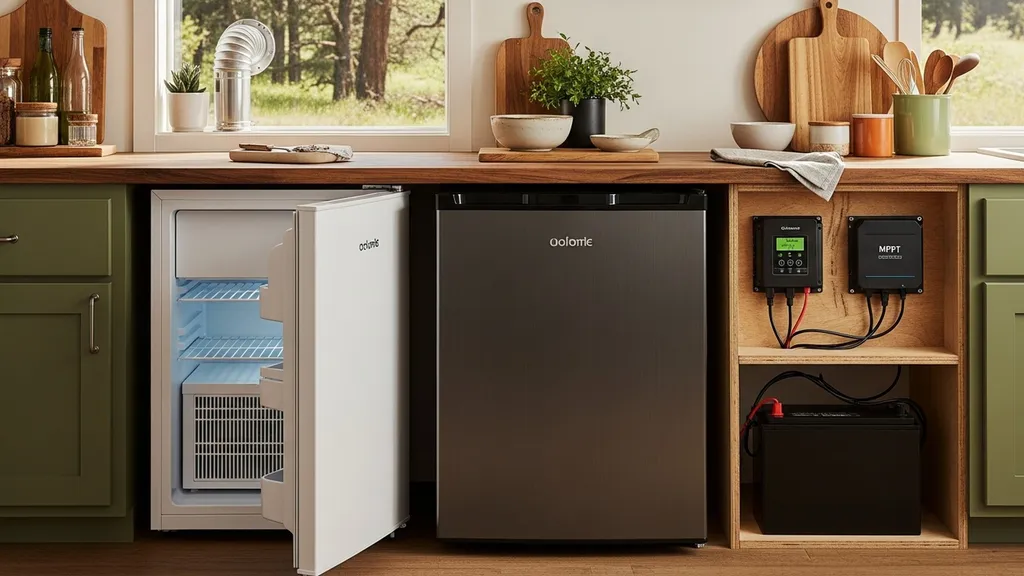
Compare propane and solar off-grid refrigerator options: costs, energy, sizing, pros/cons, and scenario-based buying guidance for DIY eco homebuilders.
Off-Grid Refrigeration: Propane vs Solar Options
Choosing the right off-grid refrigerator shapes daily life in a tiny house, weekend cabin, or homestead: it affects fuel logistics, battery sizing, noise, and how well food stays cold in summer. This article compares the leading off-grid refrigerator approaches—propane absorption, solar-powered DC compressor (12V/24V), AC compressor on an inverter (hybrid), and low-energy cold-storage strategies—so builders can match performance, cost, and maintenance to use case. Readers will find concrete sizing rules, expected energy and fuel ranges, installation and safety notes, and scenario-based recommendations to pick the best system for their project. The primary keyword "off-grid refrigerator" appears below and throughout to help with planning and sourcing.
TL;DR:
- Propane absorption is simple for sporadic use: expect low upfront electrical needs, roughly under 1 lb of propane per day for light use, but poorer performance in heat and requires venting.
- Solar DC compressor systems are most efficient for full-time off-grid living: plan ~0.5–2 kWh/day for a small efficient 12V fridge, with battery storage sized for 1–3 days autonomy.
- Hybrids (AC compressor + inverter) are best when you want household fridge options and local serviceability—choose an inverter with 2–4x surge rating and accept 10–15% inversion losses.
Related guides: Designing off grid solar system guide, Ultimate guide to emergency off grid cooking, DIY ventilation for off grid cabins, The Complete Guide to Water-Efficient Plumbing and Moisture Control: Design, Off-Grid and Smart Water Systems, Composting Toilets, and Crawl Space Solutions, Passive solar shading winter vs summer, Solar cost calculators for DIY projects, and Solar power costs by house size ultimate guide.
Off-Grid Refrigeration: Propane vs Solar Options — Quick Comparison Table
| Option | Upfront cost | Running cost / fuel | Reliability | Installation complexity | Noise | Performance in heat | Typical lifespan |
|---|---|---|---|---|---|---|---|
| Propane absorption | Low–Medium | Propane, ~<1 lb/day (light) to several lb/day (heavy) | Medium | Venting, gas plumbing, flame maintenance | Very quiet | Drops in very hot ambient temps | 10–20 years (depends on maintenance) |
| Solar DC compressor (12V/24V) | Medium–High | Electricity from PV, ~0.5–2 kWh/day | High (with batteries) | PV, charge controller, battery wiring | Low–moderate (fans/compressor) | Good — maintains setpoint better than absorption | 8–15 years (compressor,battery limited) |
| AC compressor + inverter (hybrid) | Medium–High | kWh via solar or generator, inverter losses (10–15%) | High (parts serviceable) | Inverter sizing, battery bank, proper fusing | Moderate | Very good | 8–20 years (fridge serviceability helps) |
| Low-energy cold storage | Low–Medium | Minimal (less cycling) | High (passive) | Root cellar/cold box build, insulation | Silent | Excellent if passive temps allow | Indefinite (structure dependent) |
Note: Numbers are model- and climate-dependent. For compressor fridges, expect typical daily draw in the 0.5–2 kWh/day range depending on size, insulation, and ambient temperature. For hybrids, size inverters for 2–4× compressor start surge. See the Efficiency for Access and Energy Department reports linked below for lab-tested comparisons.
Off-Grid Refrigeration: Propane Absorption Refrigerators
How propane absorption fridges work
Absorption refrigerators use heat to drive a refrigeration cycle: a small propane flame (or electric heating element) heats a mixture of ammonia, water, and hydrogen that circulates through the system to remove heat from the cabinet. Unlike compressors, there are no mechanical pistons or refrigerant compressors—just a burner, tubes, and a heat exchanger.
Strengths of propane refrigerators
- No battery bank needed: runs directly on propane so electricity requirements are minimal.
- Very quiet operation since there is no compressor noise.
- Simple fuel logistics for sporadic users who can refill propane bottles infrequently.
- Widely used in RVs and cabins, with brands such as Norcold and Dometic providing familiar cabin-style units.
Weaknesses and hidden costs
- Heat sensitivity: absorption units lose cooling efficiency as ambient temperature rises; performance can fall off significantly above ~90°F (32°C).
- Venting and combustion safety: requires a well-placed exterior vent and periodic burner cleaning; improper installation risks carbon monoxide or leaks.
- Fuel cost and supply: propane refills add recurring cost and require secure storage; consumption varies widely with model and load—light use estimates can be under 1 lb/day, but expect more with heavier loads or larger units.
- Maintenance: regular checks of seals, burner jets, and venting; igniter and flame adjustment may need attention. Parts may become harder to find on older models.
- Lower temperature stability and longer recovery time after door openings compared with compressor fridges.
Industry efforts to improve off-grid refrigeration quality are summarized by groups such as Sustainable Energy for All; the SEforALL report highlights deployment patterns and product performance in field conditions.
Best for: specific use-cases
- Weekend cabins or seasonal trailers where electricity is limited and use is intermittent.
- Remote owners who prioritize simplicity over peak cooling performance and can manage propane logistics.
- Install only if the site allows safe vent routing and propane storage; see our guidance on cabin ventilation in the section below and the ventilation for cabins guide for installation details.
Off-Grid Refrigeration: Solar-Powered Compressor Refrigerators (12V/24V DC)
How DC compressor fridges differ from absorption units
DC compressor fridges use a conventional compressor motor optimized for 12V or 24V operation and run directly from a battery bank with a charge controller. They cool more effectively by mechanically compressing refrigerant; they hold temperature better in hot ambients and have faster recovery after door openings.
Sizing solar panels and battery capacity
- Daily energy estimate: small efficient 12V fridge often draws ~0.5–2 kWh/day (model- and climate-dependent).
- Battery sizing rule of thumb: battery capacity (kWh) = daily fridge kWh × days of autonomy ÷ depth-of-discharge. Example: for 1 kWh/day and 2 days autonomy using lead-acid at 50% usable, battery bank should be ~4 kWh (≈ 400 Ah at 12V).
- Solar array sizing: account for worst-month insolation. As a start: PV watts ≈ (daily kWh ÷ peak sun hours) × system losses (1.3–1.5). Use MPPT charge controllers sized for battery voltage; see our link on how to match panel and battery voltage for details.
Compressor start-up surge matters: even low-wattage compressors can draw several times running current at startup. Use wiring, fusing, and battery cabling sized for surge, and ensure the MPPT/inverter can handle the inrush.
Strengths of solar-powered compressor fridges
- Better cooling and temperature stability, especially in hot climates.
- More energy-efficient per degree of cooling than absorption units.
- Compatible with monitoring systems to measure real-world energy use; consult the DIY energy monitor calibration guide to record accurate loads.
- Brands to consider include Engel, Sunfrost, and QuietRV for proven 12V/24V models; model insulation, gasket quality, and compressor control influence real consumption.
The U.S. Department of Energy studies the performance of refrigeration in off-grid PV systems; see the DOE analysis for measured behavior and design lessons: Analysis of refrigeration units in off grid pv/wind hybrid systems.
Weaknesses and real-world caveats
- Higher upfront system cost once PV, controllers, and batteries are included.
- Battery maintenance (or replacement for lead-acid) is required; battery life is a major ongoing cost.
- Poorly matched systems (undersized PV or batteries) can lead to frequent generator use.
- Wiring needs and surge protection demand some electrical skill; see the internal guide on how to connect solar panels to an inverter and the troubleshooting guide at how to troubleshoot solar power systems.
Best for: specific use-cases
- Full-time tiny homes and off-grid families who require reliable daily refrigeration and live in moderate-to-hot climates.
- Builders who can budget for a battery bank sized for at least 1–2 days autonomy and want quieter, more stable cooling.
- Sites with good solar resource or space for panels and owners prepared for battery management.
This DIY video shows you the hands-on process:
Off-Grid Refrigeration: AC Compressor + Inverter / Hybrid Systems
How hybrid setups work and where they fit
Hybrid systems use an AC compressor refrigerator (the common household type) powered by an inverter and battery bank, with solar panels charging the batteries. These setups can also switch to generator or grid power when available. They expand product choice because builders can use standard full-size fridges and freezers.
Strengths of hybrid AC compressor systems
- Wider selection of refrigerator models and local parts/service.
- Potentially better value for large-capacity freezers or chest freezers that are very efficient.
- Easier to service: replacement parts and technicians are widely available.
- With a generator backup, users can run large freezers for occasional heavy loads.
The off-grid appliance market overview in the Power for All fact sheet highlights how hybrid approaches increase consumer choices and reliability: Global off-grid appliance market fact sheet.
Weaknesses and installation priorities
- Inverter sizing: pick an inverter with continuous and surge capacity. Rule of thumb: choose an inverter that can handle 2–4× the fridge's running watts for the start surge.
- Efficiency losses: inversion and battery round-trip losses typically reduce overall system efficiency by ~10–15%.
- Electrical complexity: correct grounding, fusing, and surge-protection circuits are mandatory. Follow a wiring checklist; our hybrid wiring guide is a good start.
Best for: specific use-cases
- Homesteads that need large freezer capacity and benefit from local serviceability.
- Owners who already prefer a particular household fridge model and are ready to size an inverter/battery combination.
- Situations where generator backup is acceptable for occasional deficit days.
Off-Grid Refrigeration: Low-Energy Alternatives & Cold-Storage Strategies
High-efficiency chest freezers + thermal mass
Chest freezers are often the most energy-efficient electrically driven cold storage per liter. They cycle less because of better insulation and lid design. Pairing a chest freezer with thermal mass (water jugs) smooths cycles and reduces peak loads. Switching from an upright to a chest freezer can reduce daily energy by 10–30% depending on model and usage.
Passive cold boxes and root cellars
Root cellars or insulated passive cold boxes use earth temperature or shaded thermal mass to keep produce cool without continuous energy input. These solutions work best in temperate climates or with seasonal use and can dramatically cut refrigerator load for vegetables and some dairy items.
Using a small freezer for core needs and a cooler for short-term
A practical hybrid lifestyle: keep a small efficient chest freezer for frozen staples and use insulated coolers with ice/ice packs for short-term chilled storage. This reduces daily refrigeration needs and can shrink the required PV/battery capacity.
The cost analysis of solar refrigerators vs on-grid units shows that at current price points, solar-specific units still carry a premium; a combined approach often offers the best lifetime cost-performance balance. See the review here: When are solar refrigerators less costly than on-grid?
Measurable gains and trade-offs
- Switching to a chest freezer with added insulation can cut daily energy by ~10–30%.
- Adding thermal mass may reduce compressor cycle count by 20–40% on averagedays.
- Trade-offs include accessibility (chest freezers and root cellars are less convenient), defrosting needs, and space constraints.
Off-Grid Refrigeration: Which Should You Choose? Scenario-Based Recommendations
This checklist helps match system type to real needs: frequency of use, local fuel logistics, solar resource, noise tolerance, maintenance skills, and budget priorities.
Weekend/camping cabin (sporadic use)
Recommendation: Propane absorption or a small portable propane fridge. Reason: minimal electrical infrastructure, quiet operation, and ability to shut down between visits. Keep a spare propane bottle and check venting per the ventilation for cabins guidance.
Full-time tiny house or small family off-grid home
Recommendation: Solar-powered DC compressor (12V/24V) with 1–3 days battery autonomy. Reason: efficient daily use, better temperature stability in heat, and quieter continuous operation. Size PV to deliver daily fridge kWh and battery for cloudy days; follow the DOE sizing guidance above and use MPPT controllers.
Homestead with regular frozen storage needs
Recommendation: High-efficiency chest freezer on a hybrid system (inverter + battery + solar) or a DC chest freezer if available. Reason: chest freezers are energy-efficient; a hybrid system allows using standard freezer models and generator backup for extended grid-outage loads.
Hot climate vs cold climate considerations
- Hot climate: Avoid absorption fridges unless specially rated and well-vented—compressor solutions hold temperature better.
- Cold climate: Both systems perform better; absorption can be attractive for sporadic use. Batteries in solar systems need freeze protection; place batteries inside insulated, ventilated enclosures.
Tight-budget build vs long-term investment
- Tight budget, low use: Propane absorption may win on upfront cost.
- Long-term, full-time living: Solar compressor systems typically cost more upfront but can be cheaper per year and more reliable in performance. Research shows that product quality and performance testing (see the United4Efficiency model guidelines) matters when choosing higher-efficiency off-grid appliances: U4E off-grid refrigerator guidelines.
Example quick system sketches:
- Tiny house (DC fridge): 12V DC fridge (1 kWh/day), battery 4 kWh usable (2 days), PV 800–1,200 W (site-dependent).
- Cabin (propane): 2–4 cu ft propane absorption fridge, two 20 lb propane bottles for season, exterior venting and combustion air.
- Homestead freezer: 12–15 cu ft chest freezer, 1.5 kWh/day, hybrid inverter 2,000–3,000 W with 2–3× surge capacity, PV sized for seasonal usage.
For accurate load measurement before buying, follow the energy monitor calibration guide.
Off-Grid Refrigeration: Installation, Maintenance & Safety Considerations
Propane safety, venting, and fuel storage
- Place tanks downhill and outside, with secure mounting and signage per local code.
- Use certified fittings and flexible connectors rated for propane; include a shutoff valve near the appliance.
- Venting: run vent ducts straight to the exterior with minimal turns and use manufacturer-recommended clearances.
- Leak checks: perform soap-bubble tests on fittings after installation and at every refill.
- For detailed venting and indoor-air-quality guidance see our ventilation article: ventilation for cabins.
Battery, inverter and electrical safety for solar systems
- Use correct cable gauge for battery-to-inverter runs to limit voltage drop; fuse near the battery positive terminal.
- Provide battery ventilation for flooded lead-acid; lithium batteries need temperature control and battery management systems (BMS).
- Inverter sizing: continuous rating must cover running watts; surge rating should be 2–4× for compressor starts.
- Follow recommended charge controller (MPPT) match to panel and battery voltage; see how to match panel and battery voltage.
Routine maintenance checklist for each system
- Monthly: Check door gaskets, clean condenser or heat-exchanger surfaces, inspect vents and burner flames.
- Quarterly: Test battery state-of-charge, clean fan intakes, inspect propane lines and fittings.
- Yearly: Service burners/igniters on absorption units, test refrigerant pressures (by a licensed tech), inspect inverter and controller firmware updates.
Permits, local codes and refrigerant handling
- Check local building and fuel codes for propane tank placement, venting, and appliance installations.
- Refrigerant service must follow EPA rules in the U.S.; certified technicians should handle major repairs or refrigerant disposal.
For refrigerant and system performance data, see Energy Department analysis and other technical sources linked earlier: DOE refrigeration analysis.
The Bottom Line
For sporadic use, propane absorption often wins on simplicity and low electrical needs; for full-time off-grid living or hot climates, a solar-powered DC compressor fridge typically offers the best temperature control and energy efficiency. Hybrids suit large freezers and owners who want standard appliance choices with generator backup.
Frequently Asked Questions
Can I run a full-size fridge off solar without a generator?
Yes, but it requires a properly sized system. Estimate the fridge's daily energy (often 1–3 kWh/day for full-size models), then size batteries for desired autonomy (days × daily kWh ÷ usable battery depth-of-discharge). Add PV sized for worst-month production and losses (MPPT inefficiency, wiring). Plan an inverter with sufficient surge capacity if using an AC fridge. For common layouts and wiring tips see the DOE performance analysis linked above.
Is a propane refrigerator better in boiling-hot climates?
No. Propane absorption units lose cooling effectiveness as ambient temperature rises and typically perform worse than compressors in hot climates. Compressor fridges—either DC 12V/24V or AC—maintain setpoint more reliably in heat. If propane is the only viable fuel, choose a well-vented, shaded installation and accept reduced cooling or larger capacity.
How big of a solar array and battery bank does a 12V fridge need?
Typical small 12V fridges use ~0.5–2 kWh/day. Use this starting point: Battery kWh = daily kWh × days autonomy ÷ usable depth-of-discharge. PV watts ≈ (daily kWh ÷ peak sun hours) × 1.3. For example, 1 kWh/day with 2 peak sun hours needs ~650–700 W PV after losses, and 4 kWh battery for 2 days autonomy at 50% usable capacity. Always check the specific fridge's real measured draw and follow MPPT and wiring guidance in our system wiring articles.
What maintenance does a propane absorption refrigerator require?
Periodic burner cleaning and flame adjustment, vent inspections, gasket checks, and occasional igniter replacement. Absorption systems also need checks for corrosion and proper vent routing. Routine maintenance every 3–12 months depending on use is typical; follow the manufacturer's service schedule and local safety codes.
Are there hybrid setups that minimize both fuel and battery size?
Yes. Common hybrid patterns pair an efficient chest freezer or small compressor fridge with a modest battery bank and a generator or propane-powered generator as occasional backup. Smart controllers can prioritize PV and battery use, using the generator only when needed. The hybrid wiring guide linked earlier offers step-by-step layouts and inverter selection tips to balance upfront cost and ongoing fuel consumption.