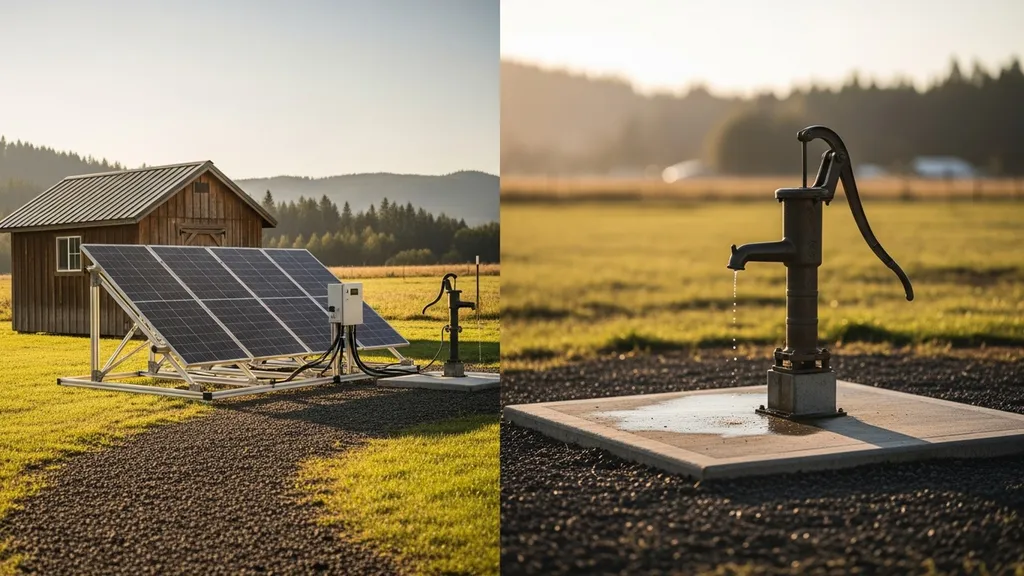
Compare solar and manual off-grid water pump options, sizing, costs, installation tips, and maintenance for budget-conscious DIY self-builders.
Off-Grid Water Pumps: Solar and Manual Options
Off-grid water pump choices shape how a self-builder accesses clean water, whether for a tiny cabin, a remote homestead, or livestock watering. This guide explains off-grid water pump options, focusing on solar and manual solutions, how they perform, realistic costs, and step-by-step sizing and installation tips. Readers will learn when a manual hand pump is the sensible low-cost choice, when a solar-powered pump gives the best balance of autonomy and convenience, and how to match pump, power, and storage to site conditions.
TL;DR:
- Solar systems: 500–4,000 USD upfront for small household setups, supply 50–300 L/day with properly sized panels and controllers.
- Manual pumps: 50–600 USD upfront, ideal for shallow wells (<8–9 m) or as reliable backups with 5–30 L/min peak flows.
- Start by measuring daily demand and total dynamic head (TDH); add a 20–30% safety margin when sizing pump and panels.
Related guides: Off grid refrigeration propane vs solar options, The Complete Guide to Water-Efficient Plumbing and Moisture Control: Design, Off-Grid and Smart Water Systems, Composting Toilets, and Crawl Space Solutions, How to automate existing water pumps on a budget, Designing off grid solar system guide, and How to Automate Existing Water Pumps on a Budget (2026).
Why Choose an Off-Grid Water Pump? Use-Cases, Trade-Offs, and Quick Points
Off-grid water pump systems are chosen for sites without grid power, for redundancy, or to reduce operating costs. Typical household water use varies: a tiny house often uses 50–150 L/day, a 2–3 person homestead 150–300 L/day, and small livestock watering can add 50–500 L/day depending on herd size. Research indicates that off-grid energy access often enables increased economic activity for households, which can make a dependable water supply a priority (Productive use of off-grid solar: appliances and solar water pumps).
Common Off-grid Scenarios
- Shallow-well cabin with low daily use: manual pump or small direct-drive solar pump.
- Rural homestead with livestock: solar pump with storage tank for continuous supply.
- Seasonal/remote camp: manual pump with portable storage or a battery-backed solar system.
When a Manual Pump Is Best
- Low budget or very low daily demand.
- Well depth within suction limits (<7–9 m for suction pumps).
- Preference for simplicity and serviceability; cast-iron lever pumps can be repaired with basic tools.
When Solar Makes More Sense
- Higher daily demand (100+ L/day) or automated irrigation needs.
- Deep wells beyond suction limits where submersible pumps are necessary.
- Desire for convenience and low operating cost, accepting higher upfront cost.
Quick points (pros/cons)
- Manual pump: Very low running cost, simple, durable; limited depth and flow, requires physical effort.
- Solar pump (direct-drive): Low maintenance, runs on sunlight; only works during sun hours unless battery-backed.
- Solar pump (battery-backed): Runs day/night, higher reliability; costs and maintenance increase.
Sanitation and water planning: choose water-saving fixtures and consider dry systems where appropriate. For broader sanitation planning and water budget impacts, see the composting toilet costs guide.
How Solar Off-Grid Water Pumps Work
Solar water pump systems convert PV energy into mechanical work to move water. Systems range from simple direct-drive setups to full battery-backed systems with inverters and controllers.
Basic Components and System Types
- PV array: Solar panels sized for the pump's power needs.
- Pump: Submersible or surface pump, typically DC brushless motors for direct-drive systems or AC motors for inverter systems.
- Controller: MPPT or PWM that matches PV output to pump input. In larger systems an inverter converts DC to AC for standard pumps.
- Optional battery bank and charge controller: Store energy for night or cloudy days.
Direct-drive (batteryless) vs Battery-backed Systems
- Direct-drive systems connect PV to an MPPT pump controller and pump. They are efficient and lower-maintenance, but output varies with sunlight; morning and cloudy-day performance drops. Many brands like Grundfos, Lorentz, and Shurflo offer direct-drive models sized for well pumping.
- Battery-backed systems provide consistent flow and can run pumps at night or during storms. They require battery sizing, additional controllers, and often an inverter if the pump is AC.
Solar Pump Types: Submersible, Surface, DC vs AC
- Submersible pump: Installed in the well, good for deep wells and higher heads.
- Surface pump: Sits above ground, suitable for shallow sources, springs, or cistern transfers.
- DC pumps: Efficient for direct solar use; brushless DC motors (BLDC) are common.
- AC pumps: Often more common at larger scales; require inverter when powered from DC panels/batteries.
Expected system sizing data points
- Small direct-drive systems often use 100–500 W of PV for modest household flows.
- Typical efficiencies vary; expect 40–70% system-level efficiency depending on controller and motor.
- Manufacturers: Grundfos (e.g., SQFlex line), Lorentz (PS2 series), and Shurflo produce commonly used models for DIY and small commercial use.
For optimization studies on hybrid PV/wind and storage for water systems see this analysis on off-grid optimization (Optimizing off-grid PV/wind systems with battery and water storage).
Short schematic checklist and wiring overview
- PV array → MPPT pump controller → pump motor (direct-drive), or
- PV array → charge controller → battery bank → inverter → AC pump.
- Safety items: DC fusing at panel and battery, grounding rod, surge protection on controller input.
- Wiring: Use voltage-drop calculators; keep DC runs short and use thicker cables for low-voltage high-current systems.
For guidance on matching panel voltages to battery and controllers see matching panel and battery voltages.
This DIY video shows you the hands-on process:
Manual Water Pumps for Off-Grid Homes: Types, Capabilities, and Realistic Performance
Manual pumps remain a practical solution when budgets are tight or simplicity is required. Their performance depends on type, depth, and user effort.
Types: reciprocating (hand), pitcher, treadle, and suction pumps
- Suction/hand pumps: Lift water by creating a vacuum; effective for shallow wells up to about 7–9 m.
- Deep-well lever pumps: Use a lever and long piston to reach deeper water (sometimes 30–50 m depending on model and installation).
- Treadle pumps: Foot-operated, often used for irrigation; good for sustained pumping without arm fatigue.
- Pitcher pumps: Simple on-surface pumps for very shallow sources or cisterns.
Performance: Flow Rates, Depth Limits, and Ergonomics
- Flow rates vary widely: suction hand pumps typically deliver 5–15 L/min at shallow depths; treadles and lever systems can produce 10–30 L/min with steady effort.
- Deep-well piston pumps reduce flow as depth increases and require mechanical advantage to reduce user force.
- Durability: Cast-iron pumps last decades with correct maintenance; plastic or stainless parts resist corrosion but may be less repairable in very remote settings.
Repairability and spares
- Keep spare leather or rubber seals, check valves, and gaskets. Pumps with readily available rebuild kits reduce downtime.
- Corrosion: Stainless or brass components for corrosive water; regular lubrication and flushing prevent seizing.
When manual is primary vs backup
- Primary: Low, predictable demand; site visits acceptable; purpose-built pump over a well.
- Backup: Paired with solar or generator systems for emergency use during power outages or system failures.
Academic work on simple off-grid pump design and losses provides engineering context for sizing and losses in off-grid systems (Development of an Off-Grid Solar Power System to Support a Water ...).
Sizing an Off-Grid Water Pump: Flow, Head, and Daily Demand
Correct sizing prevents undersupply and helps avoid overspending. The process converts daily demand and plumbing losses into pump power and energy needs.
Calculating Household and Irrigation Demand
- Estimate daily liters: Tiny cabin: 150–250 L/day; 2–3 person household: 200–400 L/day.
- Peak flow: Convert fixtures running simultaneously into L/min. Example: shower 9 L/min, kitchen tap 6 L/min, so a short simultaneous peak might be 15 L/min. For design, use peak flow = 10–15 L/min for a 2-person tiny house.
- Add irrigation or livestock needs separately and plan storage to smooth variable supply.
Measuring and Computing Total Dynamic Head (TDH)
- Static head: Vertical distance from water level to highest delivery point (m).
- Friction head: Losses from pipe length, diameter, fittings. Use standard friction tables or calculators.
- TDH = Static head + Friction losses + Pressure requirement (convert bar to meters: 1 bar ≈ 10 m).
- For pressure at taps, 20–30 m of head gives moderate tap pressure (~2–3 bar).
Example Sizing Calculation
- Tiny cabin: daily demand 200 L/day; required peak 12 L/min.
- Well static head 15 m; friction loss 3 m; TDH = 18 m.
- Choose pump that delivers 12 L/min at 18 m TDH. Add 25% safety margin → target 15 L/min at 18 m.
- Check pump curve from manufacturer (Grundfos, Lorentz, Shurflo) to match operating point.
- For solar: estimate energy per day. If pump draws 200 W at operating point and runs 2 hours total per day to deliver 200 L, energy = 0.4 kWh. Size panels accordingly: allow for inefficiencies and cloudy days (multiply by 2–3 for real-world sizing).
Models and simulation tools for PV water pumping can refine estimates; see PV sizing studies (Optimal sizing of pv water pumping system for off-grid rural ...).
For manual pumps consider the relation between depth and human effort; suction pumps are not suitable above ~9 m.
Side-by-Side Comparison: Solar vs Manual vs Generator/Grid Backup (Costs, Specs, Pros & Cons)
Comparison Table: Specs and Typical Cost Ranges
| System type | Typical upfront cost range | Typical flow range | Max depth capability | Energy source | Maintenance frequency | Expected lifespan | Best use-case |
|---|---|---|---|---|---|---|---|
| Manual hand pump | $50–$600 | 5–30 L/min | Shallow suction <9 m, deep lever to ~30–50 m | Human power | Low, annually | 10–50 years | Low-budget cabins, emergency backup |
| Small solar direct-drive | $500–$2,000 | 10–200 L/day (varies) | Submersible pumps to 100+ m | PV panels | Low-medium, yearly | 8–20 years | Remote homesteads, livestock watering |
| Solar battery-backed | $1,000–$4,000 | 50–500 L/day | Deep wells with submersible pumps | PV + battery | Medium, quarterly checks | 8–15 years (batteries) | Continuous supply, night use |
| Generator-backed submersible | $700–$3,000 + fuel | 50–500 L/day | 100+ m (depending on pump) | Fuel generator | Medium-high, monthly fuel/servicing | 10–20 years | High reliability where fuel available |
Long-term Running Cost and Lifecycle Considerations
- Manual pump: lowest lifecycle cost; parts occasional; human labor is the main ongoing cost.
- Solar direct-drive: almost zero fuel cost; panels degrade (~0.5–1%/year); controller replacement occasionally.
- Battery-backed solar: batteries require replacement every 5–15 years depending on chemistry (lead-acid shorter, LiFePO4 longer and costlier).
- Generator: ongoing fuel and maintenance costs; reliable during extended cloudy periods but expensive over time.
Researchers have analyzed external support strategies and sustainability of solar pumping projects (External Support for Solar-Powered Water Pumping Systems in ...), noting that community support and spare-part planning improve long-term outcomes.
For budgeting scenarios and planning capital vs operating costs, use the sustainable budget planner.
Setting Up a Solar Pump System: Components, Wiring, MPPTs, Batteries, and Mounting
This section covers practical setup guidance for DIYers building a solar pump system.
Choosing Controllers and Inverters: MPPT vs PWM
- MPPT (maximum power point tracking) controllers extract more power from PV for varying irradiance—recommended for most pump systems.
- PWM controllers are simpler and cheaper but less efficient; acceptable for very small systems.
- AC pumps need an inverter; DC pumps can run directly from MPPT controller.
Battery-backed vs Batteryless Setups and Battery Sizing
- Batteryless (direct-drive): Requires no battery bank. Size PV array to meet peak pumping periods. Good for daytime-only needs and lower maintenance.
- Battery-backed: Size battery to meet desired autonomy (days of autonomy often 1–3 days). Example: pump needs 1 kWh/day; for 2 days autonomy and 50% DOD (depth of discharge) use 4 kWh usable → battery bank 8 kWh nominal for lead-acid, smaller for LiFePO4.
- Battery chemistry trade-offs: lead-acid lower upfront cost, shorter life; LiFePO4 higher upfront, longer life and better cycle efficiency.
Solar Array Placement and Mounting Tips
- Panel tilt: match local latitude ±10 degrees for year-round performance; seasonally optimize if needed.
- Cooling: keep panels ventilated to avoid heat loss—see solar panel cooling tips.
- Ground mount or pole mount allows easier tilt adjustment and servicing than roof mounts.
- Lightning and surge protection: install surge arrestors on PV array and at controller; follow local codes.
Wiring and protection
- Use appropriately sized cables to limit voltage drop to <3% on DC runs.
- Place fuses between PV and controller, and between battery and inverter.
- Grounding rod and earth connections help with safety and lightning dissipation.
- For long runs, increase voltage (e.g., 48 V systems) to reduce current and cable size.
Monitoring and telemetry
- Consider smart monitoring for remote sites. For readers wanting telemetry, see the smart water hub setup.
- For hybrid generation options to improve seasonality, see the wind-solar hybrid guide.
Design guidance and best practices for solar water pump installation are summarized in technical guidelines (Design Selection and Installation of Solar water Pumping Systems).
Installation, Maintenance, and Winterizing Off-Grid Pumps
Routine care prolongs life and prevents downtime. This section lists practical tasks and troubleshooting tips.
Routine Maintenance Checklist
- Monthly: Inspect PV array for dirt and damage; clean panels if dusty.
- Quarterly: Check controller logs, wiring tightness, and battery electrolyte (if applicable).
- Annually: Replace sacrificial anodes if present; test check valves and pressure tanks; inspect seals and bearings.
- Keep spares: valves, seals, small tool kit, fuses, and a spare pump head if budget allows.
Troubleshooting Common Issues
- No run: Check PV array open-circuit voltage, controller fault codes, fuses, and battery state.
- Low flow: Inspect filters and intake screens for blockage; check for air leaks in suction lines and cavitation signs.
- Air in line: Tighten fittings, check foot valves, ensure correct priming procedure.
- Cavitation: Reduce suction lift or increase pipe diameter; ensure pump matches TDH.
Winterizing and Freeze Protection Strategies
- Drain above-ground sections and protect fittings with insulation or heat tape where practical.
- Bury lines below local frost depth or use insulated, heated enclosures for critical valves.
- Remove and store surface pumps in freezing climates, or build weatherproof insulated housings with frost-free drops.
- For submersible pumps, leave them in place but ensure surface outlet and pressure tanks are drained or protected.
Plumbing layout and moisture-control strategies reduce freeze risk and protect components—see the water-efficient plumbing guide.
The Bottom Line: choosing the right off-grid water pump for your project
Choose based on water source depth, daily demand, and tolerance for upfront cost versus convenience. For shallow, low-demand cabins a manual hand pump or small direct solar pump often fits best. For homesteads with livestock, a solar-powered submersible with storage gives reliability and low running cost. For seasonal or backup needs, a manual pump paired with a simple solar direct-drive provides a resilient, low-cost solution. Next steps: measure demand, compute TDH, shortlist pumps, and check local permitting.
Frequently Asked Questions
How deep can a manual hand pump draw water from?
Simple suction pumps are limited to roughly 7–9 meters (23–30 feet) due to atmospheric pressure limits. Deep-well lever or piston pumps can reach much deeper—sometimes 30–50 meters—depending on design and installation. For depths beyond suction limits, plan for a deep-well pump or a submersible solution.
For projects that need exact depth capability, consult manufacturer specs; installation details (well casing, column pipe, and seal quality) affect real-world performance.
Can a solar pump run directly from panels without batteries?
The short answer is yes: direct-drive solar pumps run off panels through an MPPT controller and do not require batteries. They are efficient and low-maintenance but produce water only when there is sufficient sunlight. Batteryless systems suit daytime demand, irrigation scheduling, and storage tanks sized to buffer supply.
If consistent night-time or cloudy-day supply is required, add batteries or alternate generation (wind, generator) to maintain service.
How do I size solar panels for my pump?
Size panels by calculating daily energy need: estimate pump power at operating point (W) × total run hours per day = Wh/day. Add system losses (controller, wiring, motor inefficiency) and regional solar insolation to convert Wh/day into required PV wattage. As a rule of thumb, allow a 20–30% safety margin and use MPPT controllers. For detailed methodology see empirical PV sizing studies and manufacturer curves.
For complex sites, simulation tools or a consultant can refine array size accounting for seasonal variation and desired autonomy.
What maintenance does a solar submersible pump need?
Routine tasks include checking electrical connections, monitoring controller fault logs, cleaning intake screens, and inspecting the pressure tank and check valves. Batteries (if present) need quarterly checks and eventual replacement. Plan for an annual inspection and keep a small parts kit: fuses, filters, seals, and an extra pressure switch or controller if remote access is limited.
Manufacturer recommendations vary; follow their service intervals and keep installation records for warranty support.
Do I need permits to install an off-grid well pump?
Permitting depends on local rules. Many jurisdictions require well permits, water-right approvals, or inspections for new wells and pump installations. Installations that alter electrical systems may also need an electrical permit. Check with local authorities before drilling or significant installation work.
When in doubt, contact the local permitting office or a licensed installer for guidance—noncompliance can lead to fines or mandatory changes later.