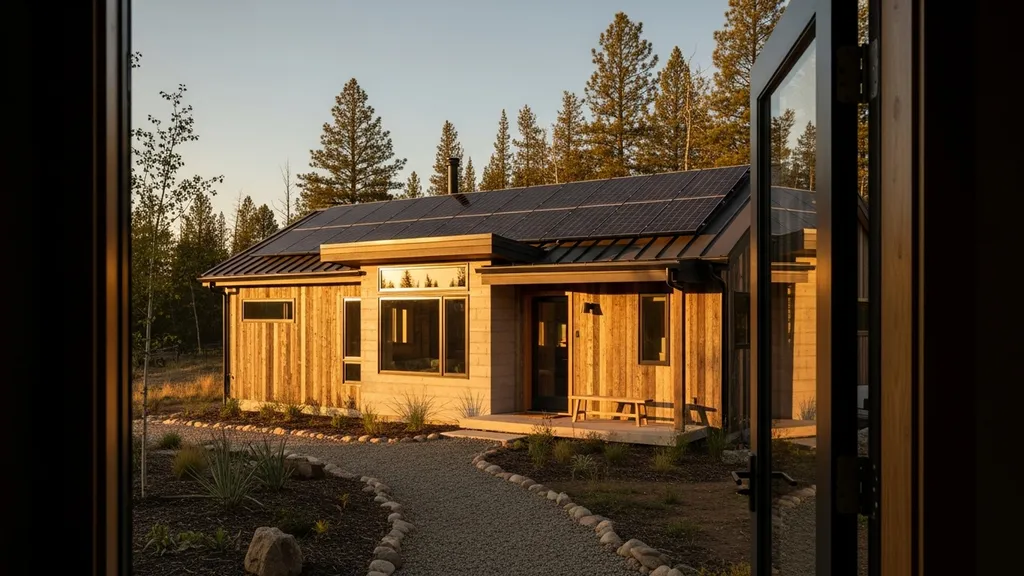
Step-by-step guide to sizing a 3kW off-grid solar system — panels, batteries, inverters, costs, and DIY tips for budget-conscious self-builders.
3KW Solar System for Off Grid Home: Complete Sizing Guide
A 3kw solar system for off grid home is a practical choice for a small, energy-efficient dwelling — think tiny houses, passive cabins, or weekend cottages. This guide shows how to translate real appliance loads into panel counts, battery capacity, inverter choices and realistic monthly production estimates so you can plan a system that meets daily needs without overpaying. Read on to learn how to run a load audit, size panels and batteries, pick an inverter and navigate permits for a 3 kW off-grid install.
TL;DR:
- A 3 kW array typically produces about 9–15 kWh per day in sunny regions (3–5 kWh per kW daily); model location with PVWatts for accuracy.
- Plan battery bank sizing from daily kWh × days of autonomy ÷ usable DoD (for example, 9 kWh daily, 2 days autonomy, 80% LFP DoD → ~11.25 kWh usable → ~14 kWh bank).
- Choose an inverter rated for 3 kW continuous with 25–50% extra surge for motors, pair with MPPT charge control and a 48 V battery bank for efficiency.
Related guides: The Complete Guide to Water-Efficient Plumbing and Moisture Control: Design, Off-Grid and Smart Water Systems, Composting Toilets, and Crawl Space Solutions, 1kw solar system for tiny house complete sizing guide, 1kw solar system for cabin complete sizing guide, and Off grid refrigeration propane vs solar options.
Why choose a 3KW solar system for an off-grid home?
A 3 kW DC array is sized to support low-to-moderate daily loads in efficient buildings. Research shows on average 1 kW of well-sited PV can produce 3–5 kWh/day depending on insolation; that means a 3 kW array will often deliver roughly 9–15 kWh/day in favorable locations. Use the NREL PVWatts tool to get location‑specific monthly estimates and factor in derate losses for a real-world output estimate: PVWatts system calculator.
Who this suits:
- Tiny homes or cabins with LED lighting, efficient appliances and propane/gas backup for high-energy items.
- Off-grid or remote cottages that prioritize water pumping, refrigeration and basic circuits rather than electric heating.
- Budget-conscious DIYers who want smaller upfront costs and simpler installs.
When a 3 kW system is not enough:
- Full-electric heating or large hot-water systems.
- Regular EV charging or high-power workshop tools.
- Homes with many large motor loads or multiple simultaneous HVAC units.
Key points:
- Typical production: 9–15 kWh/day in sunny areas, less in high-latitude or shaded sites.
- Complementary systems: Propane or wood for heating, solar thermal for hot water, or backup generator for extended cloudy periods.
- Upgrade path: Design wiring and battery location to accept additional panels or batteries later.
For a deeper comparison of grid and off-grid tradeoffs, see the grid vs off-grid comparison.
How to estimate your off-grid energy needs for a 3KW system
Start with a detailed load audit. The goal is a list of all electrical devices with wattage and hours of use so you get daily Wh totals.
Step-by-step load audit:
- List every device: Include pumps, fridge, lights, outlets, fans, and chargers.
- Record wattage: Use appliance nameplate or measure with a clamp meter or kill‑a‑watt device.
- Estimate hours per day: Be realistic about seasonal changes.
- Calculate daily Wh: Multiply watts × hours for each device; sum to get total daily Wh.
- Add contingency: Add 10–20% for future or unforeseen loads.
Example spreadsheet row:
- Refrigerator: 120 W average, 10 hours/day (cycles) → 1,200 Wh/day
- LED lights: 100 W total, 4 hours/day → 400 Wh/day
- Water pump: 800 W, 0.5 hour/day → 400 Wh/day
Common example profiles:
- Tiny home (minimal): 2–4 kWh/day — fridge, lights, phone, small pump.
- Small eco-cabin (moderate): 6–10 kWh/day — fridge, lighting, laptop, basic cooking (propane stove), pump.
- Homestead (higher): 12–20+ kWh/day — more appliances, electric tools, possibly electric hot water.
Worked example mapping to 3 kW:
- Daily load = 9 kWh.
- Assume array produces 10 kWh/day on average. That gives slight surplus to charge batteries.
- If daily production is lower in winter, use battery reserve or generator for shortfalls.
Seasonal and backup considerations:
- Heating and cooling are the largest wildcard. If you plan electric heating or heat pump HVAC, scale up or exclude heating from the off-grid system and provide alternate fuel.
- Identify critical circuits (fridge, pump, communications). Use sub-panel or transfer switch so essential loads can run during low production.
For converting your audit into a full plan see the longer off-grid solar design. For accounting water-pump loads and runtime reduction strategies, see our piece on water pump automation.
Solar array sizing and expected production for a 3KW off-grid setup
Panel Count and Configuration
- A 3 kW nominal DC array commonly uses 9–12 panels of 300–335 W each. Example: 10 × 330 W = 3.3 kW (allowing headroom).
- Series wiring increases voltage (Vmp adds); parallel increases current (Imp adds). Match series string Voc to the inverter/MPPT maximum voltage rating.
- For off-grid inverters/charge controllers, a 48 V battery bank with array strings tied to an MPPT is common.
Tilt, Azimuth, Shading and Mount Choices
- Tilt close to latitude for year-round balance. Slightly steeper for winter-focused production.
- Azimuth: true south (in northern hemisphere) is best; small deviations reduce output modestly.
- Shading from trees or chimneys can reduce production dramatically. Do a shade‑path analysis at winter solstice.
- Ground-mounting allows easier tilt adjustment and maintenance but needs secure footing; roof-mounting saves ground space and costs less in racking.
Estimating Monthly Production
- Use a simple derate: nameplate × 0.75–0.85 to approximate real output (accounts for inverter losses, soiling, temperature).
- Example: 3,000 W × 4 sun-hours/day × 0.8 derate → 9.6 kWh/day.
- For location-specific months use NREL PVWatts: PVWatts system calculator — it returns monthly kWh per kW.
Watch this step-by-step guide on size a solar system for your house! examples and calculations:
Panel types and quality
- Monocrystalline: higher efficiency, slightly higher cost per W.
- Polycrystalline: lower cost, lower efficiency.
- For limited roof space favor higher-efficiency modules.
Battery bank sizing and storage options for a 3KW off-grid home
Sizing method (Amp‑hour example)
- Start with daily kWh (example: 9 kWh).
- Choose days of autonomy (1–3). Example: 2 days → 18 kWh storage needed.
- Account for system round-trip efficiency (80–90%). If 85% efficiency: 18 kWh ÷ 0.85 → 21.2 kWh required.
- Apply depth-of-discharge (DoD). For LFP at 80% usable DoD: 21.2 kWh ÷ 0.8 → 26.5 kWh nominal bank.
- Convert to Ah at system voltage. For 48 V: 26.5 kWh ÷ 48 V ≈ 552 Ah.
If using 24 V or 12 V systems, Ah numbers rise accordingly; modern off-grid installs favor 48 V to reduce conductor sizes and inverter current.
Battery Chemistry Comparison
| Chemistry | Typical usable DoD | Cycle life (approx) | Pros | Cons |
|---|---|---|---|---|
| Flooded lead-acid | 40–50% | 500–1,000 | Low upfront cost, simple | Heavy, ventilation, maintenance |
| AGM/Gel | 50% | 600–1,200 | Sealed, less maintenance | Higher cost than flooded |
| Lithium iron phosphate (LFP) | 80–90% | 2,000–5,000+ | High DoD, long life, low maintenance | Higher upfront cost but lower lifecycle cost |
Cost context varies widely by region and market. Industry data and project reports indicate LFP battery pack cost per usable kWh has fallen sharply, making it the preferred choice for DIYers planning long-term systems. For practical charging and care steps, see battery lifespan tips.
Temperature, Aging, and Usable Capacity
- Batteries lose capacity with cold temperatures; locate battery cabinet in a conditioned or insulated space if possible.
- Add 10–20% capacity for aging over expected service life, or plan for replacement sooner if budget constrained.
Inverter, charge controller and balance-of-system (BOS) selection for a 3KW off-grid system
Selecting an Inverter
- Choose a pure sine wave inverter rated at or above 3 kW continuous output. A common choice is a 3–4 kW inverter to provide headroom.
- Surge rating matters for motors and compressors. Select one with 25–50% higher surge capability (for example, 6–8 kW surge for a 3 kW inverter).
- Consider inverter/charger hybrids (e.g., Victron MultiPlus, OutBack Radian, Schneider Conext) that combine inverter, charger and transfer switching.
MPPT Charge Controllers and Array Voltage Matching
- MPPT controllers convert higher array voltage to battery voltage efficiently; match the array Voc to controller maximum input.
- For small systems, a single MPPT with sufficient current rating simplifies design. Split arrays across controllers if shading or separate orientations exist.
Fuses, Breakers, Cabling and Safety Components
- Use appropriately sized DC fuses between array and controller and between batteries and inverter.
- Cable sizes must limit voltage drop to acceptable levels (commonly <3%). For 48 V systems and typical run lengths, larger conductor sizes minimize losses.
- Follow code requirements and include grounding, surge protection and an accessible main disconnect.
Comparison/specs table
| Component | Typical spec for 3 kW system | Notes |
|---|---|---|
| Array | 9–12 × 300–335 W panels (3–3.5 kW) | Array Voc/Vmp per panel determines string design |
| Inverter | 3–4 kW continuous, 6–8 kW surge, pure sine | Hybrid inverter recommended for generator integration |
| MPPT | 60–100 A at 48 V or equivalent | One controller if within current rating |
| Battery bank | 48 V, 300–600 Ah (approx 14–28 kWh) | Chemistry depends on budget and lifecycle goals |
| DC fuses | Rated per string current | Use breaker/fuse at battery and array sides |
For guidance on AC vs DC coupling choices and how they affect inverter and charge controller setup, see the AC/DC coupling guide.
Site assessment, production modeling and real-world examples for a 3KW off-grid install
Shading analysis and structural checks
- Walk the site at solar noon and at sunrise/sunset to spot low-angle shading. Use a smartphone app or a solar pathfinder for detailed shading maps.
- Inspect roof framing to confirm load-bearing capacity for racking and panels. Roof type and orientation constrain panel layout.
Using PVWatts and spreadsheets
- Enter system size, tilt and azimuth into PVWatts. Apply system losses (0.75–0.85 derate) to estimate monthly kWh. PVWatts is NREL’s publicly accessible tool for robust modeling: PVWatts system calculator.
- Combine PVWatts monthly kWh with your load-audit to assess monthly surplus or deficit and size batteries or generator runtime.
Two Short Case Studies
- Sunny site, temperate latitude: 3 kW array, south-facing, tilt equal to latitude. PVWatts predicts ~12 kWh/day average. For a 9 kWh/day load and 2 days autonomy, a 48 V 400 Ah LFP bank (~19.2 kWh nominal) is sufficient with 80% DoD.
- Northern, low-insolation site: 3 kW array, same tilt but lower sun hours. PVWatts predicts ~7 kWh/day average. For the same 9 kWh/day load, either increase array size, add generator backup, or reduce loads. Battery bank needs increase to cover longer low-production stretches.
For authoritative installation and maintenance practices consult NREL’s off-grid solar installation document: Installation, operations, and maintenance of off-grid solar systems (nrel pdf).
Costs, permits, and whether to DIY or hire for a 3KW off-grid installation
Typical cost breakdown (low/median/high, ballpark)
- Panels: $600–$2,000 (3 kW)
- Inverter/charger: $800–$4,000
- Batteries: $1,200–$10,000 (flooded low end; LFP high end)
- Racking, wiring, BOS: $500–$2,000
- Labor/installation: $0 (DIY)–$3,000+
- Total installed (including battery bank): $3,000–$20,000 depending on battery chemistry and labor choices
Permits, Inspections and Code Basics
- Off-grid electrical installations generally require electrical permits and inspections. Check local AHJ rules and NEC requirements; general code guidance is available from the National Fire Protection Association: National Electrical Code (NEC) overview.
- Permit checkpoints include equipment ratings, grounding, battery ventilation (for flooded cells), and safe disconnects.
When to Hire a Pro vs Do-it-yourself (risk Matrix)
- Hire a licensed electrician for main panel changes, grid-interconnect, or if local code requires a licensed installer.
- DIY tasks that experienced homeowners can perform: racking, mechanical mounting, basic wiring under supervision, and system layout — only if comfortable with electrical safety and local regulations.
- Consider a hybrid approach: DIY mechanical install and purchase professional commissioning for the electrical and final inspection.
For detailed permit processes for DIYers, see the building permits guide.
Installation checklist, commissioning, maintenance and troubleshooting
Pre-install Checklist
- Permits: Pull all required electrical and structural permits.
- Safety gear: PPE, insulated tools and lockout/tagout procedures.
- Layout: Panel layout, string design, and labels for each string.
- Battery room: Ventilation for lead-acid, fire-rated cabinet for lithium per local code.
- Conductor sizing: Cable lengths measured; conduit paths mapped.
Commissioning tests
- Verify open-circuit voltages and short-circuit currents per manufacturer specs before connection.
- Check inverter settings for battery chemistry, float charge, and bulk voltage.
- Perform load tests and verify transfer switching behavior between solar, battery and generator.
Maintenance Schedule and Troubleshooting Starters
- Monthly: Visual inspection of racking, connectors, and panel cleanliness.
- Quarterly: Battery voltage logs and specific gravity checks for flooded cells.
- Annually: Inverter firmware updates and full electrical inspection.
- For inverter faults and fixes consult inverter troubleshooting tips.
Short troubleshooting tips
- No charge from array: Confirm PV open‑circuit voltage, check fuses and MPPT input.
- Batteries not charging fully: Check battery temperature compensation, charge profile and cable connections.
- Unexpected inverter shutdowns: Inspect surge loads, check inverter logs for fault codes.
The Bottom Line
A 3 kW solar system for off grid home works well for energy-efficient small homes and cabins when paired with realistic load reduction, a properly sized battery bank and contingency for low-sun periods. Run a load audit, model production with PVWatts and size batteries to cover desired days of autonomy before committing to equipment.
Frequently Asked Questions
How much energy will a 3 kW system produce each month?
Production varies by location and tilt. A 3 kW array commonly yields roughly 9–15 kWh per day in sunny regions, which translates to about 270–450 kWh per month. Use the [PVWatts system calculator](https://pvwatts.nrel.gov/version_5.php/1000) to get month-by-month estimates for your exact coordinates and adjust for a 0.75–0.85 derate for real-world losses.
What size battery bank do I need for a 3 kW off-grid system?
Start with your daily kWh. For example, at 9 kWh/day and 2 days autonomy, aim for ~18 kWh usable. With LFP batteries at 80% DoD and 85% round-trip efficiency, that equates to roughly a 26.5 kWh nominal bank (about 552 Ah at 48 V). If using lead-acid, increase capacity because usable DoD is lower.
Can I run a refrigerator and a water pump on a 3 kW system?
Yes—if you size the array and battery to cover the refrigerator’s duty cycle and pump runtime. Refrigerators have high starting currents but low average draw; ensure the inverter surge rating covers compressor starts. For pumps, reduce run time and consider pressure tanks or timers; see our article on water pump automation for strategies to cut energy use.
Is it better to DIY or hire a pro for a 3 kW off-grid install?
DIY can save labor costs for competent homeowners on non-electrical tasks like racking and panel mounting. Hire a licensed electrician for battery interconnections, main panel work or where local code requires. A hybrid approach—DIY mechanical install plus professional commissioning—often balances cost and safety. Check permit rules in the building permits guide.
What inverter and charge controller should I pick for a 3 kW system?
Choose a pure sine wave inverter rated for at least 3 kW continuous with 25–50% surge headroom for motor starts (many installers use 3–4 kW inverters). Pair it with an MPPT charge controller sized for the array current and compatible with your battery voltage (48 V systems are common). Hybrid inverter/charger units from manufacturers like Victron, OutBack and Schneider simplify integration and generator support.