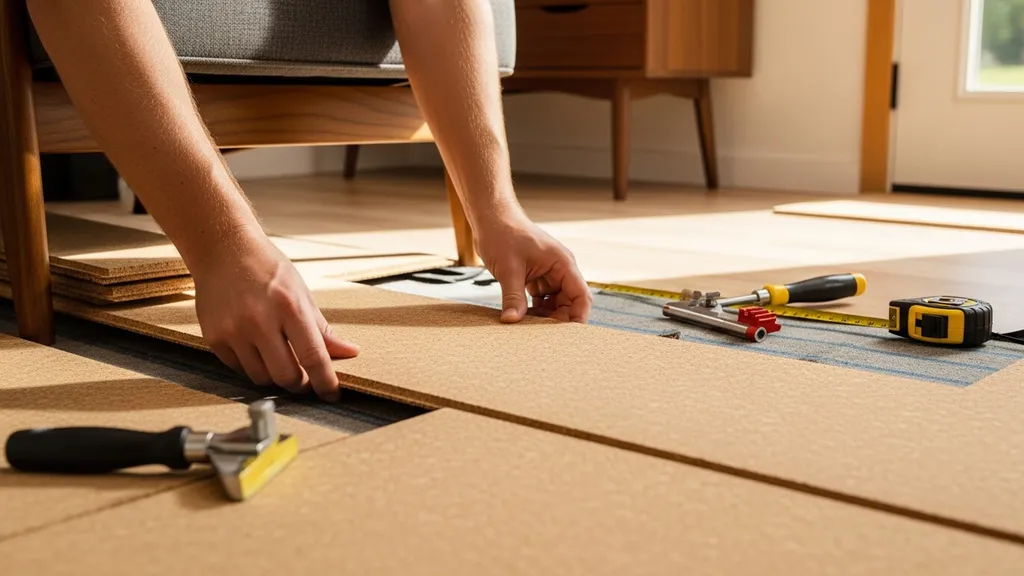
Practical guide to cork flooring and cork insulation — properties, DIY installation tips, costs, and when cork is the right sustainable choice for your home.
Cork Flooring and Insulation: Sustainable Option
Cork flooring is a renewable, low-VOC finish and a practical insulation material that budget-conscious DIYers often consider for small self-builds, cabins, and retrofit upgrades. This guide explains how cork is harvested and processed, compares product formats (tiles, planks, boards), walks through DIY installation for floors, shows where cork works best as insulation, and gives realistic cost and environmental trade-offs so readers can decide whether cork fits their project.
TL;DR:
- Cork provides moderate thermal resistance and strong acoustic damping; use as underlayment or mid-thickness planks for living spaces to cut airborne and impact noise by 3–6 dB in practice.
- For floors, choose floating engineered cork planks or glued cork tiles; acclimatize 48–72 hours, check subfloor flatness within 3/16" over 10ft, and allow manufacturer expansion gaps.
- For insulation, use rigid cork board for slab edges and external continuous insulation, and combine cork with cavity insulation (cellulose/mineral wool) for best thermal and moisture control.
Why Choose Cork for Floors and Insulation?
A homeowner choosing low-carbon materials will find cork attractive for several practical reasons. Cork comes from the bark of the cork oak (Quercus suber). Harvesters strip bark on a multi-year cycle (roughly every 9–12 years) so the tree is not felled; the ecosystem of cork oak woodlands (often called montado in Portugal) supports biodiversity and grazing. Research on cork flooring's visual preference and user response is limited but available; a study catalogues user evaluations of cork surfaces and highlights aesthetic acceptance in domestic settings (see an academic overview here: relationship between visual evaluation and user preference for cork flooring).
Key material attributes for DIYers:
- Renewable source and biodegradable at end-of-life (when untreated).
- Low VOC potential when selecting products with water-based finishes or verified low-emission claims.
- Good compressibility and resilience for standing comfort, which reduces fatigue on concrete or subfloor surfaces.
Certifications and documentation to look for:
- Forest certification such as FSC or PEFC where applicable for responsible harvesting claims.
- Product Environmental Product Declarations (EPDs) for embodied carbon and lifecycle data.
- Manufacturer test sheets that list VOC emissions (carpet and flooring usually reference ISO or ASTM emission tests).
For context on how cork stacks up against other green options, consult a broader overview in the sustainable materials guide. That guide helps place cork among cellulose, hempcrete, and recycled products when making low-carbon decisions.
Types of Cork Products for Homes: Flooring, Underlayment, and Insulation Boards
Cork products arrive in several formats for different roles around the home. Choosing correctly avoids performance surprises.
Cork Flooring Formats: Tiles, Planks, and Engineered Cork
- Cork tiles: Typically glued down, available in 3–6 mm tile faces over backing; used in kitchens, living rooms, and light-traffic areas.
- Cork planks: Engineered floating planks (tongue-and-groove) with a cork wear layer and plywood or HDF backing provide dimensional stability; common thicknesses are 6–12 mm for the cork layer plus backing.
- Solid cork planks: Thicker single-material planks (8–12 mm) that are sanded and sealed on site—less common for DIY due to finishing needs.
Underlayment and Acoustic Cork Layers
- Thin cork underlayment (2–4 mm) is popular under laminate or engineered floors for cushioning and sound isolation.
- Thicker acoustic mats (6–10 mm) reduce impact noise for multi-level dwellings and work well with floating systems.
Expanded Cork and Composite Cork Insulation Boards
- Expanded cork boards are rigid, dimensionally stable, and used for thermal breaks, slab-edge insulation, and some proprietary wall systems. Typical board thickness ranges 20–80 mm for insulation roles.
- Composite cork panels combine cork with polymers or other binders to improve compressive strength for load-bearing floors.
| Product Type | Typical Thickness | Common Uses | Performance Notes |
|---|---|---|---|
| Cork tiles (glue-down) | 3–6 mm | Finished floors, kitchens | Good comfort, must seal edges for moisture |
| Engineered cork planks (floating) | 6–12 mm + backing | Living areas, DIY installs | Stable, easy floating install |
| Cork underlayment | 2–10 mm | Under laminate, sound isolation | Improves acoustics, minor thermal gain |
| Expanded cork board | 20–80 mm | Exterior CI, slab-edge | Rigid insulation, vapor-open, moderate R per inch |
| Composite cork panels | 20–50 mm | Specialty assemblies | Higher compressive strength, variable R |
When deciding between underlayment under a laminate and solid or engineered cork planks as a finished floor, balance comfort, cost, and moisture risk. Also review subfloor material choices—compare with guidance on blandex vs plywood for suitable sheathing under cork.
(For market context on product availability and growth, see the industry report projecting market expansion: global cork flooring market size and trends.)
How Cork Performs: Thermal, Acoustic, Moisture and Fire Behavior
Assess cork's real-world behavior against typical alternatives so design decisions match performance needs.
Thermal Performance and R‑value Considerations
Cork provides moderate thermal resistance. Cork insulation boards and expanded cork give a modest R-value per inch compared with closed-cell foam but outperform thin underlayments. Exact thermal resistance varies by product; always confirm manufacturer R-values. In practice, cork works well as part of a hybrid strategy—use cork board as continuous insulation (CI) outside sheathing while filling cavities with cellulose or mineral wool for higher overall R.
Compare typical attributes across options (qualitative ranges):
| Material | Typical R-value (varies by product) | Acoustic | Moisture susceptibility | End-of-life |
|---|---|---|---|---|
| Expanded cork board | Moderate (lower than polyiso per inch) | Good | Low rot risk; vapor-open | Renewable, biodegradable |
| Cellulose | Moderate–high (loose-fill) | Very good | Susceptible if wet; hygroscopic | Recyclable/reused |
| Fiberglass | Moderate | Fair | Susceptible when wet; dries slowly | Recyclable in some programs |
| Rigid foam (XPS/polyiso) | High | Fair | Low moisture absorption for XPS | Petroleum-based, recycling limited |
For more on how cork compares to cellulose and foam options in carbon and thermal terms, read a detailed comparison in our spray foam vs cellulose article.
Acoustic Benefits and Real-world Sound Reduction
Cork's cellular structure absorbs impact noise and reduces airborne reverberation. Contractors report measurable improvements in both footfall noise and general room acoustics—often a 3–6 dB reduction for impact sound when switching from hard floor to cork underlay/finish. For apartment or multi-level builds this can be a deciding factor.
Moisture Resistance, Rot, and Mold Behavior
Cork is naturally resistant to rot because of suberin (a waxy compound). However, finished cork flooring can absorb water at seams or unfinished edges. In high-humidity or wet rooms, a sealed finish and proper floor transitions are non-negotiable. Use vapor control strategies where cork meets cold slabs or exterior walls, and consult basic vapor guidance in the vapor barrier guidance article.
Fire Resistance and Safety Notes
Cork has a relatively low flame spread compared with some foam plastics, but performance varies with binders and surface finishes. Check manufacturer fire ratings and local code requirements (IECC/IRC) for floor-covering materials. For assemblies seeking Passive House-level airtightness and fire performance, combine cork with tested claddings and comply with local fire codes.
(Industry practitioners and builders discuss cork performance and thickness effects on cushioning on Green Building Advisor: looking for a deep dive on cork flooring.)
Cork Flooring Installation: Step-by-step Guide for Diyers
This section includes a short video that demonstrates acclimation, subfloor prep, and floating vs glue-down techniques. The embedded tutorial helps visualize tapping, transitions, and common mistakes.
A short primer: viewers will see how to prepare the room, test moisture, and install floating planks or glue-down tiles.
Watch this step-by-step guide on installing wicanders floating flooring 2g lock system:
Tools, Materials and Site Prep Checklist
- Tape measure, chalk line, square
- Jigsaw or laminate cutter for planks
- Tapping block, pull bar, rubber mallet
- Moisture meter (concrete and wood)
- Leveling compound or floor patch
- Recommended adhesive (manufacturer-specified) for glue-down
- Primer/sealer and finish (if required)
Site prep steps:
- Acclimatize: Store unopened boxes in the room 48–72 hours at service moisture and temperature.
- Test subfloor moisture: For concrete slabs use a calcium chloride or in-situ probe; for plywood check % moisture content—follow product limits.
- Flatten floor: Repair dips greater than about 3/16" over 10 feet with leveling compound.
- Clean thoroughly: Remove debris and old adhesives.
Floating vs Glued Installation Methods
- Floating installation: Click-lock engineered cork planks work like laminate. Advantages: faster, easier DIY, less moisture sensitivity if subfloor dry. Leave expansion gaps per manufacturer (typically 6–10 mm).
- Glue-down installation: Use recommended adhesive for cork tiles or planks on concrete slabs. Adhesive adds solidity and transfers loads better; good for commercial-grade traffic.
Step-by-step (floating planks):
- Lay underlayment if required and tape seams.
- Snap chalk lines and plan layout to avoid narrow end pieces.
- Install first row with groove toward the wall; use spacers for expansion gap.
- Stagger end joints at least 8–12 inches.
- Cut final row to fit leaving expansion gap.
- Install transitions at doorways and thresholds.
Step-by-step (glue-down tiles):
- Apply adhesive in small areas; back-roll to manufacturer instructions.
- Lay tiles with firm pressure and a seam roller.
- Keep surface clean of adhesive squeeze-out; follow open time rules.
Common pitfalls:
- Installing over a wet slab.
- Skipping leveling and seeing plank rocking.
- Failing to maintain expansion gaps resulting in buckling.
Allow 1–3 days for a medium room; glue-down may need adhesive curing time before traffic.
For installation tips and care instructions, see a practical buying and care guide: Cork flooring 101: pros vs cons, installation, and care tips.
Cutting, Transitions, and Finishing
- Use fine-tooth blades to prevent chipping when cutting cork.
- For wet areas use waterproof transitions and ensure a sealed perimeter.
- Apply water-based polyurethane or manufacturer-recommended sealants; avoid solvent-based finishes that increase VOCs.
Maintenance Tips to Extend Life
- Keep humidity in recommended range (35–55%) to avoid shrink/swell.
- Use felt pads under furniture and a mat at entries.
- Recoat surface finish when wear shows—typically every 5–10 years depending on traffic.
For a complementary DIY installation perspective, see this hands-on installation guide: ultimate guide to cork flooring installation.
Using Cork as Home Insulation: Where and How to Install It
Cork works as insulation in several roles, but detailing and hybrid systems matter most for performance.
Underfloor and Slab-edge Insulation Applications
- Use expanded cork board under slab edges as a thermal break to reduce cold bridging and frost movement.
- For radiant-floor systems, thin cork underlayment can provide sound damping and minor insulating value; confirm compatibility with maximum surface temperatures and manufacturer limits.
Wall and Exterior Insulation Uses (internal Vs. External)
- External continuous cork boards applied over sheathing create a vapor-open CI layer that helps control thermal bridging while allowing walls to dry outward.
- Internal cork panels can work in retrofit scenarios where exterior work isn't possible, but be careful with vapor control. Pair cork with cavity insulation like cellulose or mineral wool for higher overall R-value.
Detailing for airtightness and window junctions is essential for passive-house-style builds; follow airtightness and sealing strategies in how to seal windows for passive-house standards. Cork boards should be taped at seams and sealed at penetrations per manufacturer recommendations to avoid convective loops behind the board.
Roof and Attic Uses: Retrofit and New-build Options
- In attics, cork board can be used as an insulated board layer under roof finishes or as a soffit-to-ridge CI layer.
- For cold-climate off-grid cabins, cork can be combined with loose-fill cellulose for attic cavities; see options in off-grid cold climate insulation.
For DIY-focused methods and installation details on cork insulation specifically, consult this deeper practical guide: cork insulation guide. For small structures and tiny houses compare cork to compact insulation schemes in tiny house insulation options.
Also review wall sheathing and how cork integrates with structural layers in the guide to wall sheathing.
Cost, Availability and Environmental Impact of Cork
Budget-conscious builders need clear cost and sourcing expectations.
Comparing Upfront Costs and Lifecycle Costs
Cork typically costs more upfront than laminate or basic vinyl but less than some engineered hardwoods and high-performance rigid foams. Factors affecting cost:
- Thickness and finish level of planks or tiles.
- Engineered backing (plywood/HDF) versus pure cork.
- Shipping distance—most commercial cork originates from Mediterranean producers.
Lifecycle costs favor cork when low maintenance and indoor air quality are priorities. Seek products with EPDs to make apples-to-apples lifecycle comparisons across materials.
Regional availability: cork is widely available through specialty flooring dealers and green product suppliers but may have seasonal lead times. For buyer guidance on regional procurement and cost comparisons against low-carbon walls, read a lifecycle contrast with other systems: hempcrete vs insulated concrete forms.
Local case studies and dealer pages provide price examples; a practical installation guide includes local considerations and cost guidance: how to install cork flooring: step-by-step.
Embodied Carbon, Renewability and End-of-life
Cork's embodied carbon is typically lower than petroleum-based foams because cork is plant-derived and stores carbon during growth. Renewable harvesting without felling trees improves overall sustainability. End-of-life options include recycling centers (where available) or composting untreated cork. Choose products with documented EPDs when comparing embodied carbon.
Sourcing, Certifications and Supply Chain Notes
- Ask for FSC/PEFC certification where relevant.
- Request product EPDs and VOC emission certificates.
- Look for local distributors to reduce shipping emissions and lead times.
For comparisons to alternative low-carbon materials and reclaimed options, review our guidance on recycled aggregate concrete and explore low-carbon finishes in the sustainable materials guide.
When Cork Isn’t the Best Choice — Limitations and Practical Alternatives
Cork fits many residential uses, but not all.
High-moisture and Heavy-load Situations
Avoid cork as the primary floor in shower stalls, sauna rooms, or where constant wet conditions occur unless products are specifically rated for those uses and methodically sealed. Cork also compresses over time under concentrated heavy loads—industrial equipment, gym weights, or tracked loads are poor matches.
Cost or Availability Constraints
If budget is the dominant constraint, engineered vinyl or basic laminate can mimic wood tones at lower cost. For very low-cost builds that still prioritize sustainability, reclaimed hardwood or durable linoleum may be better fits. Compare sustainable floor tradeoffs in the bamboo vs reclaimed hardwood piece.
Top Alternatives and When to Choose Them
- Bamboo: Lower cost than cork at times, very hard, but watch VOCs and sourcing.
- Reclaimed hardwood: High durability and aesthetics, potentially lower embodied carbon if local reclaimed.
- Engineered vinyl or luxury vinyl plank (LVP): Very moisture resistant, low upfront cost, but petroleum-based.
- Cellulose or mineral wool insulation: Higher cavity R per dollar than cork; pair with cork boards for hybrid assemblies. See the insulation comparison in cellulose vs fiberglass and review safer non-foam options in safer spray foam alternatives.
Quick decision rules:
- Choose cork for moderate residential traffic, acoustic benefits, and low-VOC priorities.
- Avoid cork when constant immersion or heavy point loads are expected.
- Use cork as part of hybrid insulation systems rather than the sole insulation in very cold climates.
Key Points: Quick Guide and Product Checklist
Shopping Checklist (thickness, Density, Finish, Certifications)
- Thickness: Verify plank or tile thickness for wear and cushion (6–12 mm common).
- Density/Compression Rating: Look for compressive strength data if loads will be concentrated.
- Finish Type: Water-based polyurethane or natural oil—confirm recoat procedures.
- Certifications: FSC/PEFC, EPD, low VOC certification (e.g., FloorScore).
- Compatibility: Check compatibility with radiant heating (manufacturer letter).
Installation Checklist (site Prep, Moisture Test, Tools)
- Subfloor flatness: Within 3/16" over 10 ft.
- Moisture testing: Concrete and wood subfloors tested to manufacturer limits.
- Acclimation: 48–72 hours in finished space.
- Expansion gaps: Follow product guidance—usually 6–10 mm at perimeters.
- Adhesives/sealants: Use only recommended products; verify pot life and open time.
When to Call a Pro
- Complex transitions across multiple subfloors.
- Large commercial traffic areas or load-bearing concerns.
- Passive House airtightness detailing or when meeting code fire ratings requires tested assemblies.
At-a-glance room recommendations:
| Room | Product Type | Notes |
|---|---|---|
| Living room | Engineered cork planks (floating) | Good comfort and acoustics |
| Kitchen | Glue-down cork tiles with sealed joints | Watch splash zones; use rugs at sinks |
| Bathroom (floor only) | Waterproofed glue-down tile with sealed perimeter | Avoid in-shower floor unless rated |
| Underfloor heating | Thin engineered cork or manufacturer-approved underlay | Confirm max surface temperature |
The Bottom Line
Cork is a renewable, low-VOC finish and a versatile insulation component that suits mid-weight residential floors and many insulation roles when detailed correctly. It shines for acoustic comfort and modest thermal gain, but confirm moisture compatibility, load needs, and manufacturer R-values before committing. Compare product specs, request EPDs and VOC data, and shop local suppliers to balance cost and sustainability.
Frequently Asked Questions
Is cork flooring durable enough for a family home?
Cork flooring is durable for typical family use when the correct product and finish are selected. Engineered cork planks with a protective wear layer and a water-based polyurethane finish handle daily traffic, pets, and furniture with routine maintenance. High heels and heavy point loads accelerate wear, so use protective pads under furniture and consider a higher-thickness product in entryways or high-traffic zones.
Can cork be used with radiant floor heating?
Yes, many cork products are compatible with electric or hydronic radiant floor systems, but compatibility depends on maximum surface temperature limits set by the manufacturer. Thin engineered cork or specified underlayments are common choices. Always get the manufacturer's written installation instructions and temperature limits for use with underfloor heating.
How does cork insulation compare to fiberglass or foam?
Cork insulation provides a moderate R‑value per inch and excels at acoustic damping and vapor openness. Fiberglass and cellulose typically offer higher R for the same thickness in cavities, while rigid foam boards (polyiso, XPS) give the highest R per inch. Cork's advantages are renewability and lower embodied carbon versus petroleum foams; its trade-off is needing more thickness for the same thermal performance.
For a side-by-side technical comparison, see our detailed insulation comparisons and the spray foam vs cellulose article linked earlier.
Does cork resist mold and moisture?
Cork has natural resistance to rot due to suberin, but finished cork flooring can absorb moisture at joints or unfinished edges. Proper sealing, good transitions, and keeping humidity in a controlled range reduce mold risk. Avoid using standard cork in constantly wet locations unless the product is specifically rated and installed with waterproof detailing.
How do I maintain and repair cork floors?
Routine maintenance includes gentle sweeping, damp mopping with manufacturer-approved cleaners, and keeping humidity stable. For surface damage, spot-sanding and re-coating with compatible finish can restore appearance for minor wear. Deeper gouges may require plank replacement if using floating installations—keep extra boxes for future repairs.