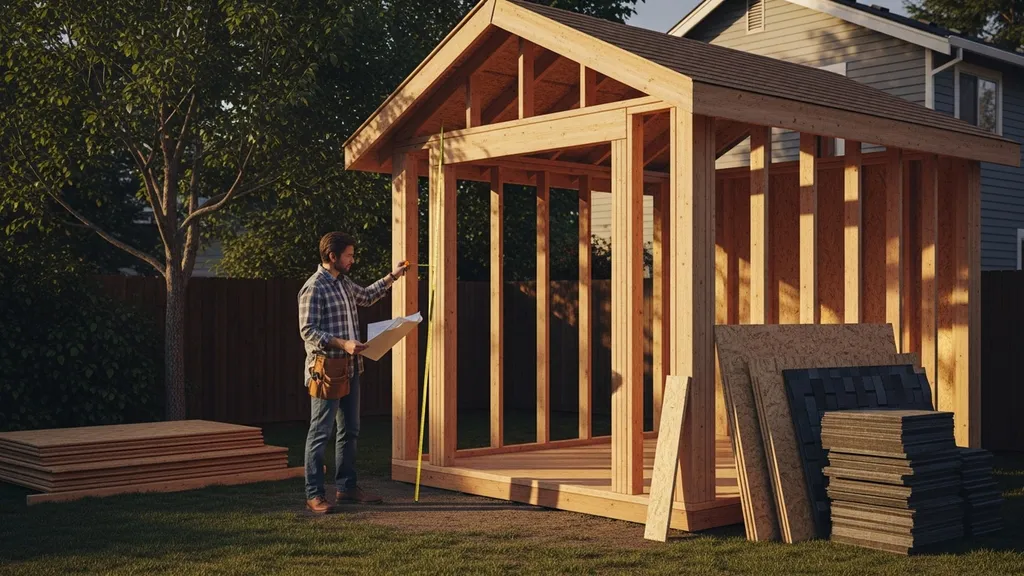
Estimate shed materials and labor costs with a clear calculator-powered breakdown — inputs, examples, and accuracy tips for DIY builders.
Shed Cost Calculator: Materials and Labor
Estimating the true cost of a backyard shed starts with a reliable shed cost calculator that breaks down materials, labor, and contingencies into clear line items. This guide shows exactly what to enter, how assumptions are applied, and how to interpret outputs so you can produce a realistic shed cost estimate and a workable DIY shed budget. Read on for input guidance, per-unit cost ranges, labor productivity rates, worked examples, and accuracy checks.
TL;DR:
- Use these default assumptions: 5–15% waste, labor productivity ranges (framing 0.04–0.08 hrs/sqft, roofing 0.02–0.05 hrs/sqft), and 10–20% contingency for reliable results.
- Expect materials to cover roughly 45–60% of total cost and labor 30–50%; basic sheds often run $25–$70/sqft, insulated workshops $80–$160/sqft depending on finishes and region.
- Run three scenarios (basic, insulated, workshop), include site prep and permit lines, and validate with 2–3 contractor quotes before final budgeting.
Shed Cost Calculator: How to Use It — Inputs, Assumptions, and Outputs
Required Inputs (size, Materials, Finishes)
Start with measurable items. Enter the shed footprint (square feet) and wall height. Then select framing (2x4 at 16" OC, 2x6 at 16" OC), sheathing (OSB or plywood, 4x8 sheets), subfloor type (PT sleepers, 3/4" plywood over joists, or concrete slab), roofing (asphalt shingles, metal panels), siding (T1-11, engineered wood, cedar, fiber cement), insulation level (target R-value), doors and windows (sizes and counts), electrical scope (number of circuits/outlets/fixtures), and interior finishes (paint, shelving, loft). Choose site-prep options: clearing, grading, drainage, and foundation type.
Include these discrete values:
- Footprint (sq ft)
- Wall/roof framing type (2x4/2x6)
- Sheathing per 4x8 sheet
- Roofing by square foot or "square" (100 sqft)
- Siding by linear foot or panel
- Insulation by R-value and material
- Doors/windows by unit
- Electrical (points or circuits)
- Foundation choice (pier, skid, slab)
For efficiency-focused users, the calculator can toggle to a passive-house cost tool to compare high-insulation, low-air-leak scenarios against standard shed inputs.
Default Assumptions (waste, Labor Productivity, Markup)
The shed calculator applies sensible defaults you can override:
- Waste factor: 5–15% by material (10% is a common default)
- Labor productivity benchmarks: framing 0.04–0.08 hours/sqft; roofing 0.02–0.05 hrs/sqft; sheathing 0.03–0.06 hrs/sqft; siding 0.03–0.07 hrs/sqft; insulation 0.01–0.03 hrs/sqft
- Markup/contingency: 10–20% suggested (10% minimal, 20% for uncertain site or custom work)
- Currency/region: choose currency and set a regional multiplier (rural vs urban)
- Labor mode: toggle DIY (show time estimate, set labor $0) or hired labor (apply hourly rates)
The calculator multiplies material quantities × unit cost, then adds waste. Labor hours × hourly rate gives labor totals. Overhead and markup are applied to subtotal to produce the final total and per-sqft numbers.
Understanding Output Fields (total, Per-sqft, Material vs Labor)
Outputs show:
- Total project cost (materials + labor + overhead + contingency)
- Cost per square foot
- Material vs labor percentage breakdown
- Line-item totals (foundation, framing, roofing, siding, insulation, doors/windows, electrical, finishes, site prep)
- Estimated labor hours by trade (carpentry, roofing, electrical)
A clear output helps you compare "remove electrical" or "switch OSB to plywood" scenarios. For foundation inputs, you can export slab details directly from the slab tool; see the foundation options guide for which foundation to choose and how to enter those costs.
For verification against supplier lists and academic examples, compare results with an external shed materials worksheet such as the Shed building material calculator (pdf) to catch overlooked items or unit mismatches.
Shed Cost Calculator: Materials Cost Breakdown
Framing, Sheathing, and Subfloor Costs
Material units used by the calculator:
- Framing lumber: linear foot or board-foot; common input per stud/plate/joist quantity
- Sheathing: 4x8 sheet (OSB or plywood)
- Subfloor: 3/4" plywood sheets, treated sleepers, or slab per sqft
Typical cost ranges (USD, 2025–2026 market bands):
- 2x4 framing lumber: $0.80–$1.80 per linear foot (region and grade dependent)
- 2x6 framing lumber: $1.50–$3.20 per linear foot
- OSB 7/16" sheathing: $12–$25 per 4x8 sheet
- CDX plywood 5/8": $25–$50 per 4x8 sheet
- 3/4" subfloor plywood: $28–$60 per 4x8 sheet
- Treated sleepers for skid foundation: $6–$12 per linear foot
Use the plywood vs OSB comparison when choosing sheathing—durability and moisture resistance affect long‑term costs and maintenance.
Roofing, Siding, and Exterior Finishes
Roofing costs:
- Asphalt shingles: $2.00–$5.00 per sqft installed material cost (bundle prices vary)
- Metal roofing panels: $3.50–$10.00 per sqft (material only)
- Underlayment and flashing: add $0.50–$1.50 per sqft
Siding options and typical bands:
- T1-11: $1.50–$3.50 per sqft (material)
- Engineered wood siding: $2.50–$5.50 per sqft
- Cedar lap: $4.50–$10.00 per sqft
- Fiber cement: $3.50–$8.00 per sqft
Exterior finishes include trim, paint, and sealants; allocate 5–12% of exterior material cost for these items.
Insulation, Doors, and Windows
Insulation options (material cost per sqft of wall/roof coverage, not installed labor):
- Fiberglass batts: $0.40–$1.00 per sqft for R-13–R-21
- Rigid foam board (polyiso, XPS): $0.80–$2.50 per sqft depending on thickness and R-value
- Spray foam (open-cell): $0.80–$1.50 per sqft (closed-cell much higher at $1.80–$3.50)
- Cellulose blown: $0.50–$1.20 per sqft for attic or dense-pack walls
Doors/windows:
- Basic 3'x6' exterior door: $120–$400 (material)
- Insulated steel door: $350–$900
- Small double-pane window (2'x2'): $80–$250
Embodied carbon matters for eco-focused builders; consider recycled siding or reclaimed lumber. Learn more on sourcing options in the recycled materials guide and balance durability with embodied emissions.
Materials comparison/specs table:
| Material | Typical cost (unit) | Life expectancy | R-value/notes |
|---|---|---|---|
| OSB sheathing | $12–$25 per 4x8 sheet | 15–30 years (varies with moisture) | Structural sheathing, lower cost |
| Plywood sheathing | $25–$50 per 4x8 sheet | 25–40 years | Better moisture resistance |
| Asphalt shingles | $2.00–$5.00 per sqft | 20–30 years | Low upfront cost |
| Metal roofing | $3.50–$10.00 per sqft | 40–70 years | Lightweight, recyclable |
| T1-11 siding | $1.50–$3.50 per sqft | 10–20 years | Cheap, uses plywood-like panels |
| Fiber cement siding | $3.50–$8.00 per sqft | 30–50 years | Durable, low maintenance |
| Fiberglass batts | $0.40–$1.00 per sqft | 50+ years if dry | R-13–R-21 typical |
| Polyiso rigid foam | $0.80–$2.50 per sqft | 30+ years | High R per inch |
Link to the vapor barrier guidance when adding insulation layers; the calculator includes vapor barrier line items by wall/roof area.
Shed Cost Calculator: How Labor and Installation Are Estimated
Tasks, Crew Types, and Typical Hours
The calculator breaks the build into tasks and applies productivity rates:
- Site prep and layout: 3–8 hours for small yards; more for rocky or sloped sites
- Foundation: pier/skid 4–20 hours; slab-on-grade variable (use the slab tool)
- Framing: 0.04–0.08 hrs/sqft
- Sheathing: 0.03–0.06 hrs/sqft
- Roofing installation: 0.02–0.05 hrs/sqft
- Siding installation: 0.03–0.07 hrs/sqft
- Insulation: 0.01–0.03 hrs/sqft
- Electrical rough-in and finish: variable—small shed circuits 6–20 hours
- Finishes (paint, trim, shelving): 6–30 hours depending on finish level
Crew types:
- Solo DIYer (time-only estimate)
- Two-person handyman crew
- Professional carpentry crew (3–5 people for speed)
- Specialty subcontractors (electrician, plumber, HVAC tech)
Labor Rates: DIY, Handyman, and Subcontractor
Use realistic hourly rates in the calculator:
- DIY: $0 labor cost but display hours (typical: 40–150 hours total depending on finish)
- Handyman: $30–$60/hr depending on region and skill
- Professional carpenter: $50–$90/hr (higher in major metro areas)
- Licensed electrician: $65–$120/hr
- Concrete crew for slab: $45–$95/hr plus equipment
A contractor-style quote will add overhead and profit; the calculator models this by adding a percentage markup on labor (10–25%) and material (5–15%).
Industry write-ups such as "How Much Does a Shed Cost? A Complete Pricing Guide" provide market ranges for contractor-built sheds and can help you sanity-check the calculator's labor totals: see the pricing overview at Alan's factory outlet.
When to Hire Pros and Which Tasks to Subcontract
Hire licensed trades for any work requiring permits, inspections, or specialized skills: electrical, gas, HVAC, complex foundations, or structural changes. Consider subcontracting:
- Electrical: for permit compliance and code knowledge
- Concrete and slab work: for flatness and reinforcement
- Roofing: for steep slopes or certified warranty installs
- Complex siding (fiber cement) or trim work that needs specialized tools
For routine carpentry and straightforward builds, a DIYer with a friend can handle framing, sheathing, and basic roofing if time permits. Remember to include tool rental days in your budget; see common indirect items in our hidden DIY costs.
Also use the slab-on-grade calculator to generate realistic concrete cost and labor inputs for the foundation line item.
Shed Cost Calculator: Typical Sizes and Example Estimates
Small Storage Shed (8x10) Example
Inputs:
- Footprint: 80 sqft
- Framing: 2x4, OSB sheathing
- Roofing: asphalt shingles
- Siding: T1-11
- No insulation, one basic door, no electrical
- Waste: 10%, Contingency: 12%
Outputs (example mid-2026 prices):
- Materials: $900–$1,500
- Labor (handyman): $800–$1,600
- Total: $1,700–$3,100
- Cost per sqft: $21–$39
- Material share: ~55%, Labor share: ~45%
Medium Shed/workshop (10x12 to 12x16) Example
Compare two finish levels across the same footprint.
Example 1 — Basic 10x12 (120 sqft):
- Materials $1,600–$2,800; labor $1,200–$2,400; total $2,800–$5,200; $23–$43/sqft
Example 2 — Higher-spec 12x16 (192 sqft), insulated but minimal electrical:
- Materials $4,000–$7,000; labor $3,000–$6,000; total $7,000–$13,000; $36–$68/sqft
Workshop shed with Insulation and Electrical Example
12x16 workshop, R-19 walls, R-30 roof, two outlets, LED lighting, single 120V circuit, mini-split prewire (no unit):
- Materials: framing, plywood subfloor, rigid insulation, upgraded door/window: $6,500–$9,500
- Labor: framing, insulation, electrical rough-in, roofing: $4,500–$8,000
- Total: $11,000–$17,500
- Cost per sqft: $57–$91
- Note: Adding a mini-split unit or solar-ready battery will add $1,500–$7,000 depending on size and installer.
Worked comparison table (basic vs insulated vs workshop):
| Size/Spec | Total cost range | $/sqft | Material vs Labor |
|---|---|---|---|
| 8x10 Basic | $1,700–$3,100 | $21–$39 | 55% materials / 45% labor |
| 10x12 Insulated | $3,800–$7,200 | $32–$60 | 50% materials / 50% labor |
| 12x16 Workshop | $11,000–$17,500 | $57–$91 | 60% materials / 40% labor |
If you plan off-grid power or PV-ready roofs, check cooling and system cost interactions in our post on cooling solutions for solar because roof choices and penetrations affect both labor and materials.
Shed Cost Calculator: Customizations, Add‑ons, and Upgrades
Insulation and Energy-efficiency Upgrades
Upgrading insulation raises material cost and sometimes labor hours, but reduces long-term energy use. Typical upgrade costs per sqft of wall/roof area:
- Move from uninsulated to R-13 batts: $0.60–$1.20/sqft installed
- Rigid continuous insulation (CI) outside sheathing adds $1.00–$3.00/sqft but reduces thermal bridging
- Spray foam: $1.80–$3.50/sqft installed for higher R/inch and air sealing
Decide based on use-case: conditioned workshop versus storage. For conditioned sheds, consider continuous insulation and sealing to meet IECC or local code requirements; Industry standards like the IECC are good benchmarks for minimum R-values in conditioned spaces.
See R-value trade-offs in the attic insulation guide.
Electrical, Lighting, and HVAC Considerations
Electrical add-ons:
- Basic 120V circuit and a few outlets: $400–$1,200 installed (permitted)
- Full 240V workshop circuit (for tools): $800–$2,000
- LED lighting: $50–$200 per fixture installed
HVAC:
- Small mini-split (heat/cool) installation: $1,500–$4,500 depending on capacity
- Passive ventilation and gable vents cost much less but won't provide heating
For off-grid setups, estimate battery-ready wiring and PV conduit early; reference off-grid lighting costs when sizing circuits for LED loads and inverters.
Interior Fit-out: Shelving, Lofts, Workbenches
Interior fit-outs are modular: simple shelving $100–$600, built-in lofts $500–$2,000 (materials + labor), custom benches $300–$1,200. These changes may add a few hours to carpentry labor but can be done post-shell to spread costs across phases.
Choose upgrades that match the shed's intended lifespan—spend more where longevity and daily use justify the cost.
Shed Cost Calculator: Accuracy, Regional Adjustments, and Common Mistakes
How Regional Multipliers and Local Labor Rates Change Results
Regional cost variation can shift total budgets by 10–50%. The calculator includes a regional multiplier or presets (rural, suburban, metro) and lets users input local labor rates. For country-specific examples, compare regional indexes such as our guide to regional costs for DIY eco homes in Canada.
Use local supplier quotes to validate unit costs for lumber, concrete, and roofing. For foundations, the slab-on-grade calculator will adjust concrete volume and labor by local pricing.
Common User Mistakes That Skew Estimates
Avoid these frequent errors:
- Forgetting waste: not adding at least 5–10% inflates material shortages
- Using retail vs contractor prices: retail can be 10–30% higher
- Skipping site prep: a sloped or rocky lot takes more time and equipment
- Omitting permit and inspection fees: include these as a line item
- Underestimating tool rental days or delivery charges
Watch for unit mismatches: entering linear feet where the calculator expects sheets will produce wildly wrong totals. Cross-check quantities against checklists like the external shed material worksheet referenced earlier.
Adding Contingency and Checking Realism
Add 10–20% contingency—10% for well-known sites and straightforward designs; 20% for uncertain sites or ambitious custom work. Compare the calculator's totals with at least two contractor quotes; if contractor bids are substantially lower than the calculator, verify that all scope items (permit, cleanup, disposal) match.
This video provides a helpful walkthrough of the key concepts:
Shed Cost Calculator: Key Points and Quick Reference Table
Top 7 Takeaways for Budget Planning
- Get measurements right: Quantity errors are the most common budget killer. Measure twice. Enter exact square footage and wall/roof rise.
- Include waste: Use 5–15% depending on cutting complexity and material type.
- Separate DIY time from cash labor: Show hours for DIY so you can compare opportunity cost versus hiring.
- Expect materials to be 45–60% of total: Labor usually runs 30–50%—exceptions for complex finishes.
- Run three scenarios: Basic, insulated, and workshop to see how specs change cost per sqft.
- Add contingency: 10% minimum; 15–20% for custom or uncertain sites.
- Validate with local quotes: Use 2–3 contractor estimates to sanity-check your calculator output.
Quick-reference Comparison Table: Common Materials and Labor Rates
| Item | Typical cost | Typical life | Recommended use |
|---|---|---|---|
| Handyman labor | $30–$60/hr | N/A | Small installs, non-permitted work |
| Carpenter/contractor | $50–$90/hr | N/A | Structural work, permits |
| Electrician | $65–$120/hr | N/A | Permitted wiring |
| Asphalt shingles | $2.00–$5.00/sqft | 20–30 yrs | Low-cost roofs |
| Metal roofing | $3.50–$10.00/sqft | 40–70 yrs | Long-life, PV friendly |
| Fiberglass insulation | $0.40–$1.00/sqft | 50+ yrs | Budget insulation |
| Polyiso rigid foam | $0.80–$2.50/sqft | 30+ yrs | High R/inch, CI applications |
Use the calculator to compare "cheapest" vs "durable" vs "eco-friendly" scenarios; for reclaimed or recycled options, see the recycled materials guide.
The Bottom Line — Using the Shed Cost Calculator to Plan Your Build
A shed cost calculator turns guesses into actionable budgets: enter footprint, materials, finish level, and site variables, then validate outputs with local quotes and a 10–20% contingency. Save calculator exports and share them with contractors to speed quoting and reduce surprises.
- Next steps: collect site measurements, choose materials and finishes, decide on DIY vs hired labor, and get 2–3 contractor quotes.
- Pre-build checklist: permits, foundation choice, material sourcing, waste allowance, and tool rentals.
Frequently Asked Questions
How accurate is a shed cost calculator?
A good shed cost calculator is accurate to roughly ±10–20% when you provide precise inputs (site conditions, exact footprint, chosen materials, local labor rates). Accuracy drops if you use generic unit prices or skip site prep and permit lines. Include waste factors (5–15%) and contingency (10–20%) to cover unknowns and bring your estimate closer to real-world bids.
For best results, compare calculator outputs with supplier lists or the Shed building material calculator (pdf) and obtain 2–3 local contractor quotes.
What inputs should I never skip when estimating a shed?
Do not skip site preparation, foundation type, waste allowance, permits/inspection fees, and electrical scope (if any). These items frequently double or triple under-budgeted totals. Also include delivery fees and tool rental days. If using a slab, run the slab-on-grade calculator for accurate concrete quantities and labor.
How much does labor typically add to the total shed cost?
Labor commonly accounts for 30–50% of project cost, depending on complexity and finish level. Simple storage sheds lean toward materials being a larger share; insulated workshops with electrical and HVAC push labor share higher due to skilled trades. Enter labor rates that reflect your region—handyman rates can be $30–$60/hr, while carpenters and electricians usually run $50–$120/hr.
Can I use the calculator for off-grid or solar-ready sheds?
Yes. The calculator can add electrical add-ons, PV-ready wiring, and roof material changes (metal vs shingles). For PV and cooling interactions, consult posts like cooling solutions for solar and off-grid lighting costs. Adding solar readiness increases labor for roof penetrations and conduit routing and may change roofing preference to metal panels for easier mounting.
What is a reasonable contingency to include in a DIY shed budget?
Include at least 10% contingency for straightforward builds and 15–20% for custom projects, unknown site conditions, or when using reclaimed materials. Contingency covers change orders, delivery delays, waste beyond estimates, and permit revisions. Track contingency spending separately so you can see where overruns occur and refine future estimates.