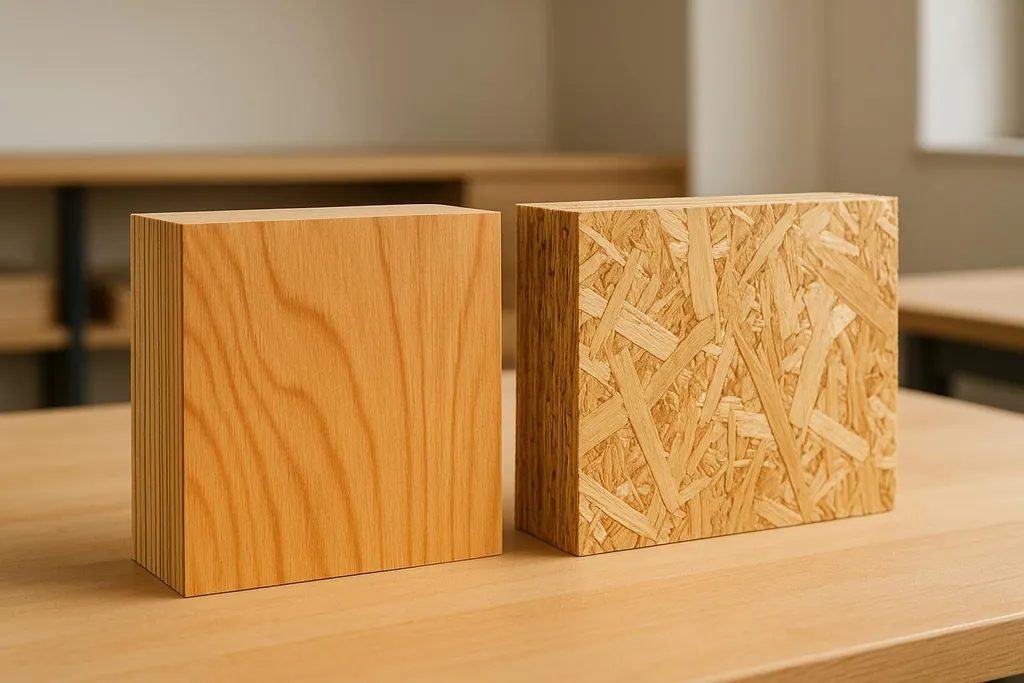
OSB vs plywood compared with 2026 prices per sheet, shear-strength numbers, moisture performance, and where each panel wins for subfloors, walls, roofs, and sheathing.
OSB vs Plywood (2026): Cost, Strength & When to Use Each
Plywood and OSB (Oriented Strand Board) are the top choices for structural panels in construction, but deciding between them depends on cost, strength, and moisture performance. Here's the key takeaway:
- Cost: OSB is 15–30% cheaper than plywood. For a 2,400-square-foot home, this could save around $700.
- Strength: OSB has higher shear strength, making it better for structural uses. Plywood is stiffer, ideal for subflooring and roofing.
- Moisture Resistance: Plywood dries faster and resists swelling better, outperforming OSB in humid or wet conditions.
Quick Comparison
| Feature | Plywood | OSB |
|---|---|---|
| Cost | More expensive ($21.50/sheet) | Cheaper ($16.50/sheet) |
| Shear Strength | Lower (600–1,000 psi) | Higher (1,000–1,500 psi) |
| Stiffness | Higher (better for floors/roofs) | Lower (requires closer joist spacing) |
| Moisture Handling | Dries faster, minimal swelling | Swells significantly, retains water |
| Best Use | Subflooring, visible surfaces, wet areas | Structural sheathing, roofing, budget projects |
If you're prioritizing budget, OSB is your go-to. For durability in wet conditions or where stiffness matters, plywood is worth the extra cost.
::: @figure 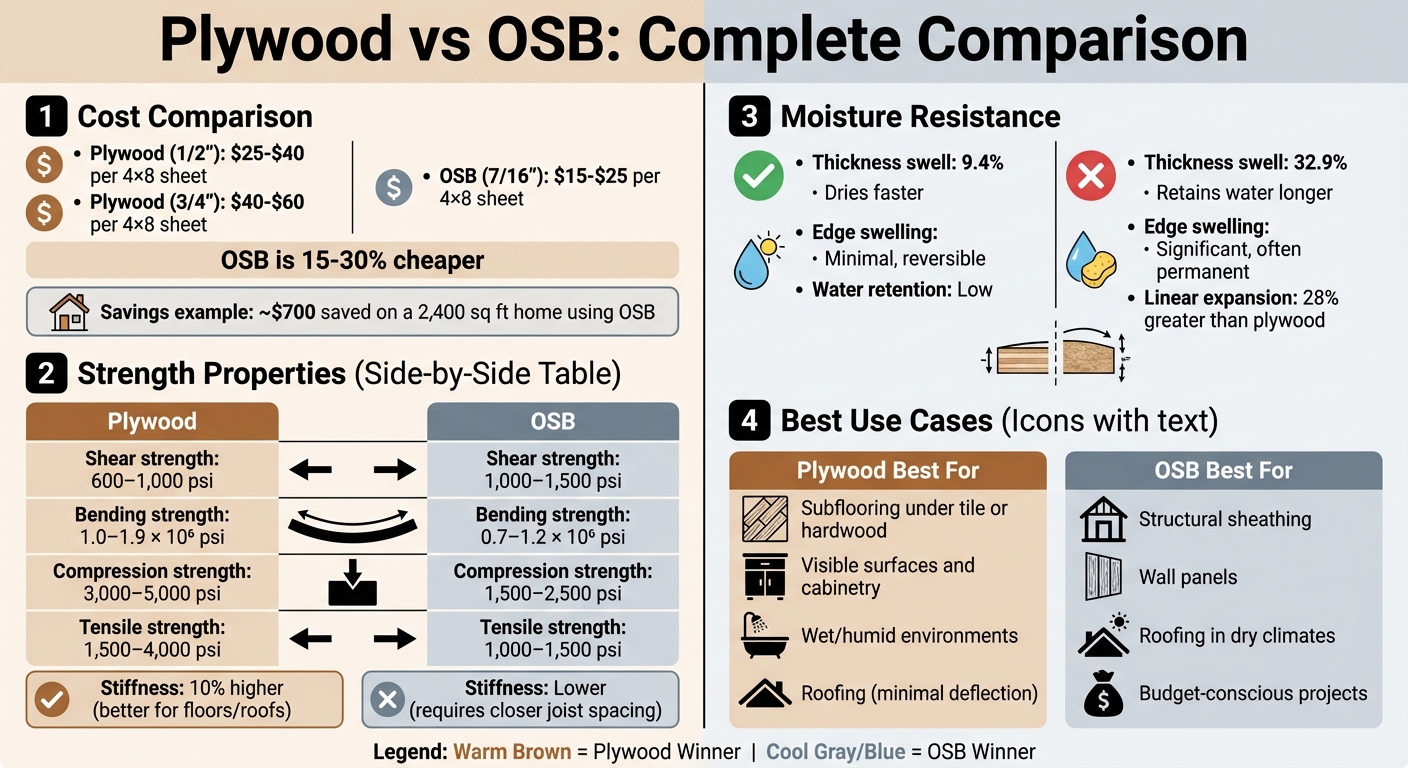 :::
:::
Plywood vs OSB Oriented Strand Board | Everything you need to know!
What is Plywood?
Plywood is an engineered wood product crafted by layering thin sheets of wood, known as veneers, and bonding them with adhesive. These veneers are arranged with their grain at right angles to each other, creating a cross-grain structure. This design gives plywood its strength and stability, making it resistant to warping, twisting, or shrinking over time. The way plywood is constructed directly affects its performance, offering a mix of strengths and limitations.
In the U.S., the standard plywood sheet size is 4 x 8 feet (48 inches x 96 inches), though larger sheets - up to 10 feet long - are also available for utility purposes at most lumber yards. Thicknesses generally range from 1/8 inch to over 1 inch, but due to manufacturing processes, the actual thickness is slightly less. For instance, a nominal 3/4-inch sheet usually measures 23/32 inches.
You can find plywood in home improvement stores, lumber yards, and specialty suppliers across the U.S. While prices depend on the grade and type of wood, plywood is generally more expensive than OSB, with higher-quality grades costing even more.
Benefits of Plywood
Plywood stands out for its strong nail-holding ability, ensuring fasteners stay secure. Its cross-laminated design provides excellent stiffness and stability, reducing flex in structural applications like floors and roofs.
Its smooth, uniform surface makes it ideal for visible projects such as cabinetry, furniture, and other finished surfaces. Unlike some other structural panels, plywood often requires minimal finishing to look great. This combination of strength and aesthetic appeal makes it a top choice when both appearance and performance are important.
Drawbacks of Plywood
One of the biggest downsides of plywood is its cost - it’s typically 15–30% pricier than OSB, which can significantly impact the budget for larger projects.
Another issue is inconsistent quality. Some plywood sheets may have hidden voids, knots, or defects in the inner layers that aren't visible on the surface. These flaws can weaken the material in applications where structural integrity is critical.
What is OSB?
Oriented Strand Board (OSB) is a type of engineered wood made by compressing layers of small wood strands or flakes with adhesives and wax. The strands are aligned in specific directions to enhance the board's strength and stiffness. This layered, cross-directional arrangement creates a uniform and reliable panel.
OSB is typically made from fast-growing trees like aspen, poplar, and southern yellow pine . Using smaller, fast-growing trees makes OSB an efficient option, as it maximizes the use of the entire tree rather than relying on larger, slow-growing timber.
In the U.S., OSB panels are commonly available in 4 × 8-foot sheets, which actually measure about 3′-11 7/8″ by 7′-11 7/8″. Larger sizes, such as 4 × 9 feet and 4 × 10 feet, are also available. Thickness options vary, with 7/16 inch being a popular choice, though other thicknesses are offered depending on structural requirements. The manufacturing process ensures consistent quality, minimizing weak spots or hidden voids. This uniformity, combined with precise dimensions, contributes to OSB's affordability.
In fact, OSB is significantly cheaper than plywood - about 2 to 2.5 times less expensive . By the year 2000, OSB had overtaken plywood in popularity across North America, producing nearly double the volume of plywood in the region . Today, North America produces approximately 706 million cubic feet of OSB annually .
Benefits of OSB
OSB is known for its strong shear strength and uniform construction, which reduces the likelihood of hidden defects. Its lightweight design and efficient production process help lower labor costs and speed up construction . As a result, OSB has become a go-to material for structural sheathing and roofing in both residential and commercial projects where durability and performance matter.
Drawbacks of OSB
Despite its advantages, OSB does have some downsides. It is prone to edge swelling when exposed to moisture and takes longer to recover compared to plywood. Its dense structure can also make clean cuts more difficult, leading to rough edges and quicker wear on saw blades. This can be a drawback for projects requiring precision or for applications where the wood's surface will remain visible. Additionally, OSB's rough, industrial look limits its use in areas where aesthetics are a priority, such as cabinetry or furniture.
Cost Comparison: Plywood vs OSB
When it comes to cost, OSB often has the edge, being 15–30% cheaper than plywood. For a standard 4×8-foot sheet, this price gap is easy to spot across most suppliers .
This price difference stems from how each material is made. OSB relies on fast-growing trees and efficient production methods, while plywood uses larger, higher-quality logs that require more intensive processing. While OSB's lower price is appealing upfront, plywood's better moisture resistance and durability can translate to savings over time, as it may reduce the need for repairs or replacements.
| Material | Typical Price Range (4×8 sheet) | Best Value For |
|---|---|---|
| OSB (7/16″) | $15–$25 | Structural sheathing, roofing, wall panels |
| Plywood (1/2″) | $25–$40 | Subflooring, visible surfaces, moisture-prone areas |
| Plywood (3/4″) | $40–$60 | Heavy-duty subflooring, cabinetry, furniture |
Prices vary depending on thickness, grade, and location. Specialty grades or treated options will usually cost more. It’s also worth noting that while OSB is resource-efficient, its standard formulations may contain formaldehyde. On the other hand, formaldehyde-free plywood has been widely available since 2019, when federal TSCA Title VI emission limits took full effect.
Next, let’s see how these cost differences play out in larger projects.
Cost Savings for Large Projects
For large-scale construction, like sheathing an entire house, OSB's lower upfront cost can lead to noticeable savings. For instance, if you're covering 2,000 square feet of wall sheathing, a $10 per-sheet difference could save you $600–$800, even before accounting for roofing or subflooring.
This makes OSB a smart choice for DIY builders or budget-conscious projects, as the savings can be redirected toward upgrades like better insulation, energy-efficient windows, or even solar panels. However, in regions with high humidity or frequent moisture exposure, plywood’s durability might prevent costly repairs later, offsetting those initial savings. This trade-off leads us naturally into the next topic: strength and moisture performance.
Strength Comparison: Plywood vs OSB
When it comes to shear strength, OSB (Oriented Strand Board) outperforms plywood, with values nearly twice as high . This makes it particularly well-suited for applications like the webs of wooden I-joists, where handling shear forces is critical.
On the other hand, plywood offers about 10% more rigidity in subflooring scenarios . This added stiffness helps plywood resist sagging over wide spans, making it an ideal choice for flooring and roofing where a firm, stable surface is necessary. In comparison, OSB requires closer spacing of floor joists to prevent bending when used as a subfloor due to its lower stiffness .
| Property | Plywood | OSB |
|---|---|---|
| Shear strength | 600–1,000 psi | 1,000–1,500 psi |
| Bending strength (Modulus of elasticity) | 1.0–1.9 × 10⁶ psi | 0.7–1.2 × 10⁶ psi |
| Compression strength | 3,000–5,000 psi | 1,500–2,500 psi |
| Tensile strength | 1,500–4,000 psi | 1,000–1,500 psi |
_Source: Oklahoma State University Fact Sheet FAPC-145 _
Plywood’s crossband veneer layers contribute to its impressive rigidity, making it capable of spanning gaps without sagging. It also resists warping, twisting, and buckling. In contrast, OSB can feel spongier underfoot, which may lead to squeaking and, in some cases, cracking of brittle materials like tile .
Best Uses Based on Strength
Given these characteristics, plywood’s superior stiffness makes it the better choice for subflooring, especially under hardwood or tile. The National Tile Contractors Association strongly advises against using OSB in such applications. According to Executive Director Joe Tarver:
> "OSB is not an acceptable substrate to receive ceramic tile, period!"
For hardwood flooring, however, the National Oak Flooring Association notes that 5/8-inch plywood and 3/4-inch OSB perform similarly in terms of structural support .
When it comes to wall sheathing, both materials perform equally well in nail-holding capacity and racking resistance. Kevin Chung, an engineer with the Western Wood Products Association, confirms:
> "There have been no problems reported from the field. Nail-holding and racking resistance are the same"
For roof sheathing, plywood’s stiffness gives it an advantage by reducing sagging over wide spans . While both materials are approved by the National Roofing Contractors Association, plywood often edges out OSB in applications where minimal deflection is critical. However, OSB’s higher shear strength makes it the go-to material for structural uses like I-joists .
On the interior side of the wall, the sheathing pairs with whichever finish you choose — see our roundup of drywall alternatives if you're considering panels like plaster, wood plank, or fiber-cement instead of standard gypsum.
Moisture Resistance Comparison: Plywood vs OSB
When it comes to handling moisture, plywood takes the lead over OSB. While plywood absorbs water quickly, it also dries faster and nearly returns to its original shape. In contrast, OSB tends to hold onto moisture longer, making it more vulnerable to decay over time.
One of OSB's key weaknesses is edge swelling when exposed to water. Tests reveal that OSB's thickness can increase by around 32.9%, compared to just 9.4% for plywood. And while plywood's swelling is usually temporary and reversible, OSB often suffers permanent edge deformation .
Long-term exposure to moisture can cause delamination in both materials. However, plywood's layered structure and high-quality adhesives make it more resistant to separation. As building scientist Joseph Lstiburek notes, OSB does not breathe or redistribute water as well as plywood, and the National Roofing Contractors Association has raised concerns about OSB's durability, highlighting issues like dimensional instability, ridging, and fastener backout due to fluctuating moisture levels .
| Property | Plywood | OSB |
|---|---|---|
| Thickness swell (oven dry to vacuum soak) | 9.4% | 32.9% |
| Water retention | Dries faster | Retains water longer |
| Edge swelling | Minimal, reversible | Significant, often permanent |
| Linear expansion (across direction) | Lower | 28% greater than plywood |
| Delamination risk | Moderate (higher in untreated) | Moderate to high |
Performance in Humid Climates
The differences in moisture performance become especially important in humid or rainy environments.
For areas with high humidity or frequent rain, plywood is the better choice because of its quick drying and minimal permanent swelling. OSB can be used, but only if all edges are carefully sealed and treated immediately after cutting. Even with protective coatings, OSB still falls short of plywood's natural ability to handle moisture in exterior applications.
Airtightness: Plywood vs OSB for Energy-Efficient Construction
When building an energy-efficient or airtight home, the choice between OSB and plywood for wall and roof sheathing can significantly impact how well your building envelope performs.
Sealing Effectiveness
Plywood's smooth, uniform surface provides an excellent base for air barrier materials. Its edges are less porous, which helps improve tape adhesion and minimizes potential air leakage at panel joints. Additionally, plywood's dimensional stability ensures that seals remain intact, even when the substrate experiences minor movements due to temperature or humidity changes.
OSB's smooth face also adheres well to air barrier materials, but its porous edges can pose challenges, creating potential leakage points at panel joints. To ensure airtightness with OSB, it's crucial to use high-quality adhesives, tape, or sealants at these joints.
Long-Term Air Barrier Performance
A key difference emerges over time: studies suggest that OSB can lose some of its effectiveness as an air barrier after going through repeated wet and dry cycles, while plywood generally holds up better, maintaining its airtight properties. In cold climates, moisture from inside the home can condense on the back of the sheathing, creating a higher risk of mold and rot. In hot and humid climates, outdoor air entering the home may lead to condensation on interior surfaces. Pairing the sheathing with a properly installed interior vapor barrier or smart membrane is what controls that risk.
For passive house projects, which aim for airtightness levels of 0.6 air changes per hour at 50 pascals, plywood's superior dimensional stability often makes it easier to maintain airtight seals over the building's lifespan.
| Airtightness Factor | Plywood | OSB |
|---|---|---|
| Surface quality for tape adhesion | Smooth, consistent surface | Smooth face, but rough porous edges |
| Edge sealing | Less porous, naturally resists leakage | Porous edges, requires careful sealing |
| Dimensional stability over time | Highly stable, maintains seal integrity | Prone to expansion, may weaken seals |
| Climate suitability | Suitable for a range of climates | Best for dry climates with low humidity |
| Installation considerations | More forgiving, standard techniques | Demands precision, extra attention to sealing |
For projects where airtightness is a top priority, plywood tends to deliver superior results with less ongoing maintenance. However, if you're working with a tight budget in a dry climate, OSB might meet your needs -- just don't overlook the added labor and sealing costs.
What About Blandex? Understanding OSB Brand Variants
If you've encountered the term Blandex at a lumber yard, it's important to know that Blandex is simply a brand name for a type of OSB (oriented strand board). The same general OSB vs plywood considerations apply, but there are some Blandex-specific details worth understanding.
Blandex Composition and Specs
Blandex is crafted by bonding long, thin wood strands -- typically from species like lodgepole pine, Southern Pine, and aspen -- with synthetic resin adhesives such as PF, MDI, MUF, and PMDI. During production, wax is added to enhance moisture resistance, while zinc borate and oxine copper are included as fungicides to protect against biological decay. Blandex typically has a density ranging from 600 to 680 kg/m3, which contributes to its strength and load-bearing properties.
According to the European Panel Federation:
> "OSB is an engineered wood-based panel material in which long strands of wood are bonded together with a synthetic resin adhesive. OSB is usually composed of three layers, with the strands of the outer two layers orientated in a particular direction, more often than not in the long direction of the panel."
When to Choose Blandex Over Standard OSB
Some manufacturers like Huber Engineered Woods offer improved OSB panels (including their ZIP System line) with a 50-year warranty, demonstrating their confidence in the material's durability when installed and maintained correctly. If you're considering Blandex or other branded OSB products, look for enhanced moisture-resistant versions with better edge sealing for improved durability.
For structural sheathing, wall panels, floor underlayment, and roof decking, Blandex performs comparably to standard OSB. Where it differs is in indoor applications: Blandex's smooth surface and consistent thickness make it popular for furniture-making, storage solutions, and other indoor projects where the material will be painted or veneered.
Bottom line: For structural outdoor applications where moisture is a concern, plywood still has the edge. For budget-conscious indoor projects or dry-climate structural sheathing, Blandex/OSB is a practical and affordable choice.
Indoor Air Quality: VOCs and Formaldehyde
An often-overlooked factor in the OSB vs plywood debate is the impact on indoor air quality, particularly in tightly sealed, energy-efficient homes where air exchange is limited.
VOC Emissions Comparison
OSB generally emits more formaldehyde and volatile organic compounds (VOCs) than plywood. This is because OSB contains about 10% adhesives and fillers, compared to plywood's 3-5%. The synthetic resin adhesives used in OSB production (phenol formaldehyde and diphenylmethane diisocyanate) can off-gas for extended periods after installation.
Building science expert Fernando Pages Ruiz notes:
> "If you run a BEES analysis between OSB and plywood, the environmental impact of OSB is significantly greater than plywood."
Healthier Alternatives
For healthier indoor environments, several formaldehyde-free plywood options are available:
- PureBond by Columbia Forest Products uses soy-based adhesives
- SoyStrong by States Industries uses similar technology
- WISA plywood features BioBond technology, replacing at least 50% of fossil-based phenol with lignin (a natural bonding agent in wood)
For projects where indoor air quality is a priority, such as passive houses, look for plywood with low-VOC adhesives or certifications like Finland's M1 emission rating. OSB currently doesn't meet this standard, though low-VOC and formaldehyde-free OSB products are gradually becoming available.
Fire Resistance
Fire safety is another consideration when comparing these materials. According to MagMatrixBoards.com:
> "OSB does not possess significant fire-resistant properties, making it potentially hazardous in the event of a fire."
Plywood offers a slight improvement in fire resistance, though neither material is inherently fireproof. Both materials meet basic fire safety standards when installed at the proper thickness. The APA reports that 23/32-inch plywood or OSB panels meet a 15-minute thermal barrier requirement, and 15/32-inch panels are sufficient for roof assemblies. If fire resistance is a top priority, fire-retardant treatments are available for plywood, providing additional protection.
When selecting materials, always check local building codes and consult with inspectors to ensure compliance with fire safety requirements.
Real-World Failures and Lessons Learned
Understanding how these materials fail in practice can be just as valuable as comparing specs on paper.
The Louisiana-Pacific OSB Lawsuit
One of the most notable real-world examples of OSB moisture failure involved Louisiana-Pacific, a building materials company that had to pay $375 million to 75,000 homeowners due to issues with decaying OSB. This case underscores the importance of proper moisture management when using OSB, especially in humid climates.
Ghost Lines on Roof Shingles
A common cosmetic issue with OSB roof decking is the appearance of "ghost lines" on asphalt shingles. When OSB edges swell from moisture exposure, the bloated edges remain visible even after drying, creating visible ridges under the shingles. This issue doesn't typically occur with plywood due to its minimal edge swelling.
Subfloor Considerations: Plywood vs OSB Underfoot
Choosing the right subfloor material affects not just structural performance but also the day-to-day comfort of your home.
Joist Spacing and Stiffness
OSB subfloors are approximately 10% less rigid than plywood and have reduced fastener retention after exposure to moisture. A standard 23/32-inch OSB panel works well with joists spaced 16 inches apart, supporting typical residential loads. If your joists are spaced 24 inches apart, you'll need to ensure the panel is thick enough -- generally 23/32-inch or more -- to maintain proper support.
Tile and Hardwood Flooring Substrates
For subflooring under tile, plywood is strongly recommended. The National Tile Contractors Association strongly advises against using OSB as a tile substrate. For hardwood flooring, the National Oak Flooring Association notes that 5/8-inch plywood and 3/4-inch OSB perform similarly in terms of structural support. However, plywood's extra stiffness can reduce squeaks and floor movement, making it the more dependable long-term choice.
Repeated Fastening Durability
Plywood's cross-grain construction provides multiple layers for screws to grip, making it ideal for projects requiring strong, secure connections. OSB can lose some of its fastener grip when exposed to moisture, and repeated fastening and removal can weaken its hold over time. This matters for renovations or situations where you might need to adjust or replace subfloor sections.
DIY Installation Best Practices
Getting the most out of either material requires proper installation technique. Here are the key tips drawn from professional builders.
Orientation and Placement
- OSB subfloors: Align the strength axis (the longer edge) perpendicular to the floor joists, and install with the rough side facing up for better traction.
- OSB wall sheathing: Position panels either vertically or horizontally. Place the smooth side against the studs and the rough side facing outward.
- Roof decking: Do not mix OSB and plywood within the same project, as variations in thickness could lead to uneven seams and potential leaks.
Cutting and Handling Tips
Plywood is generally easier to cut, producing cleaner edges with less splintering. For OSB, use carbide-tipped blades with a higher tooth count (ATB -- Alternate Top Bevel blades) for the best results. Cut with the smooth side of the OSB facing up, as splintering tends to happen on the underside where the blade exits. For an even cleaner edge, apply painter's tape along the cutting line.
OSB is heavier than plywood -- a 23/32-inch, 4x8-foot sheet of OSB weighs about 78 pounds compared to plywood's 67 pounds. Plan accordingly, especially if working solo.
Protecting Materials During Construction
Store materials under tarps and off the ground to protect them from weather. If panels get wet, allow them to dry completely before installing. Plywood can often bounce back from brief exposure to rain, but OSB is less forgiving -- plan your construction schedule carefully or use temporary weather protection.
Where to Buy and Green Certifications
Retailers
You can find both OSB and plywood at major home improvement stores across the U.S., including Home Depot, Lowe's, and Menards. These retailers stock standard 4x8-foot sheets in a variety of thicknesses. For bulk orders or specialty sizes, local lumber yards are worth checking out -- they often offer competitive pricing and delivery services.
Certifications to Look For
When making eco-conscious material choices, look for these certifications:
- FSC (Forest Stewardship Council): Ensures wood is sourced from responsibly managed forests
- SFI (Sustainable Forestry Initiative): Reflects sustainable forestry practices widely followed in North America
- GREENGUARD: Signals low chemical emissions for better indoor air quality
- Environmental Product Declarations (EPDs): Outline a product's environmental impact across its lifecycle
Both OSB and plywood are available in versions that use alternative adhesives, moving away from traditional formaldehyde-based binders.
When to Use Plywood vs OSB
Both plywood and OSB meet the structural standards required by building codes and the APA . Deciding between them comes down to factors like cost, moisture exposure, and the specific needs of your project.
For a typical 2,400-square-foot home, opting for OSB for subflooring, wall sheathing, and roof decking can save you about $700 compared to using plywood . This cost advantage makes OSB a go-to choice for large-scale builds where budget control is a priority. However, plywood stands out in areas with high humidity or frequent rainfall, thanks to its better moisture resistance.
Think about your project's environment. If you're working in a humid region or have a construction timeline where materials might be exposed to the elements for extended periods, plywood's ability to dry faster and resist swelling is crucial. OSB can still be used in these situations, but you’ll need to seal the edges and shield it from prolonged moisture exposure during the build. Below, we’ll break down where each material shines in terms of appearance, precision, and structural use.
Plywood: Ideal for Appearance and Precision Work
Plywood is the better choice for projects where aesthetics and moisture performance matter. It’s perfect for subflooring under tile or hardwood because its dimensional stability helps reduce the risk of cracking or squeaking. Plus, it’s 15% to 19% lighter than OSB, making it easier to handle during installation .
With 10% greater panel bending stiffness compared to OSB, plywood provides a sturdier feel underfoot and avoids the soft, springy sensation that can occur with less rigid materials . For projects like interior paneling or detailed work requiring precision cuts, plywood’s smooth surface and consistent layers make it the standout option.
OSB: Best for Structural Work on a Budget
If cost is a major factor, OSB delivers strong structural performance without breaking the bank. Its shear strength through the thickness is about twice that of plywood, making it a solid choice for structural applications .
OSB is ideal for wall sheathing, roof decking in dry climates, and other areas where the material won’t be visible. Just be sure to seal the edges to protect it from moisture during construction. For added durability, you can also find enhanced versions of OSB and plywood with improved moisture resistance, which can help prevent damage and reduce costs over time .
Conclusion
When it comes to choosing between OSB and plywood, it ultimately comes down to your specific project needs, budget, and the climate where the material will be used. OSB is a more budget-friendly option, making it ideal for large-scale or cost-sensitive projects. On the other hand, plywood stands out for its moisture resistance, dimensional stability, and polished appearance.
Plywood performs well in wet conditions, thanks to its ability to dry quickly and remain stable. Its smooth surface and reliable strength make it a solid choice for projects requiring precision or where the material will be visible. For areas with high humidity, plywood's durability may justify the higher price. Meanwhile, in drier climates, OSB offers strong structural performance without straining your budget.
The key is to select the material that matches your project's environmental demands and structural priorities. Both options have their strengths - it's all about what works best for your situation.
FAQs
Why is plywood a better choice than OSB in humid climates?
Plywood tends to perform better than OSB in humid climates, thanks to its strong resistance to moisture. It takes in less water, dries out more quickly, and is less prone to swelling or warping when exposed to wet or humid conditions. This durability helps minimize the risk of problems like rot over time.
The way plywood is constructed, with its multiple layers, also gives it added stability. This makes it more dependable in places where moisture levels often change. These features make plywood a solid pick for projects in damp or humid settings.
How does the cost difference between plywood and OSB affect budgets for large construction projects?
When planning large construction projects, the price gap between plywood and OSB can make a big difference to your budget. On average, OSB costs 15–30% less than plywood, which could save you hundreds or even thousands of dollars, depending on the size of your project.
This cost advantage makes OSB a go-to option for tasks like framing, sheathing, and subflooring, especially when keeping expenses in check is a priority. That said, it's equally important to weigh factors like durability and how well each material handles moisture to ensure you're picking the right one for your needs.
What's the best material for subflooring under tile or hardwood: plywood or OSB?
Plywood is often the preferred option for subflooring beneath tile or hardwood because it provides superior moisture resistance, enhanced stability, and stronger fastener-holding ability compared to OSB. These features are crucial for preventing problems like warping or loosening, which is especially important for tile installations that demand a solid, stable base.
Although OSB tends to be more budget-friendly, plywood's durability and overall performance make it a more dependable choice for long-term use, particularly in areas exposed to moisture or heavy foot traffic. For spaces like bathrooms, kitchens, or other moisture-prone areas, plywood is the more reliable option.
What is Blandex, and how does it compare to plywood?
Blandex is a brand name for a type of OSB (oriented strand board). It's made from wood strands bonded with synthetic resins, offering a uniform, consistent panel. Blandex is typically 15-30% cheaper than plywood and works well for indoor projects, furniture, and structural sheathing in dry climates. However, it shares OSB's vulnerability to moisture swelling and is generally not recommended for wet or humid applications where plywood would perform better.
How do OSB and plywood compare for airtight construction?
Both materials can serve as part of an air barrier system, but plywood tends to deliver better long-term airtightness. Its smooth, less porous edges make tape adhesion more reliable, and its dimensional stability ensures seals stay intact over time. OSB's porous edges require extra preparation and high-quality sealants at panel joints. For [passive house](/blog/erv-vs-hrv-ventilation-system-better-home) projects targeting 0.6 [ACH50](/glossary/ach50), plywood is generally the safer choice, though OSB can work well in dry climates with careful installation.
Which material is better for indoor air quality?
Plywood generally emits fewer VOCs and less formaldehyde than OSB, since it contains less adhesive (3-5% vs OSB's 10%). For healthier indoor environments, look for formaldehyde-free plywood options such as PureBond or SoyStrong. If you must use OSB, opt for low-VOC or formaldehyde-free versions and ensure proper ventilation during and after installation.