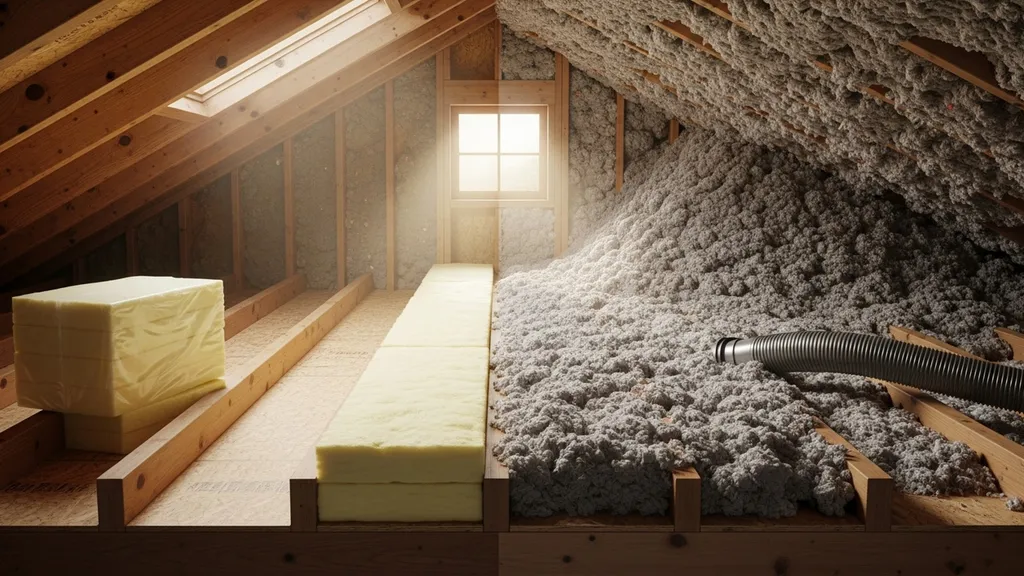
Compare R-38 and R-60 insulation for attics and roofs: performance, thickness, costs, installation tips, and scenario-based recommendations for DIY builders.
R-38 vs R-60 Insulation: Which Do You Need?
Choosing between R-38 and R-60 insulation is a common decision for DIY builders upgrading an attic or planning a roof assembly. This guide on r38 vs r60 insulation explains what those R-values mean, how much material and thickness each requires, and which option makes sense depending on climate, joist depth, and budget. Read on to learn practical installation tips, realistic trade-offs, and scenario-based recommendations so you can pick the right attic R-value for your project.
TL;DR:
- R-38 is often reached with 10–12 inches of blown cellulose or two layers of batts and is best when attic depth or budget is constrained.
- R-60 requires deep fills (16–20+ inches depending on material) or layered systems and gives better thermal buffer for cold climates or low-load homes.
- Prioritize air sealing and proper ventilation before adding insulation; choose R-60 only if joist depth, venting, and payback align with your climate and goals.
Why Compare R-38 vs R-60 Insulation? a Quick Overview
Why R-value Matters for Attic and Roof Performance
R-value measures thermal resistance: higher R-value reduces heat flow through the attic plane. For most wood-framed homes, the attic ceiling is a major area of heat loss in winter and heat gain in summer, so selecting the right attic R-value affects comfort, run time for heating systems, and long-term energy use. The concept is simple, but the right R-value depends on climate, heating fuel, and the rest of the roof assembly.
The U.S. Environmental Protection Agency and DOE provide recommended attic R-values that vary by climate zone — see the Energy Star guide for recommended levels and retrofit targets (recommended home insulation R–values - Energy Star). Those tables explain why R-38 and R-60 are common targets in mixed and cold climates.
Common Misconceptions (thickness Vs. Real-world Gains)
A common mistake is equating thickness with total benefit. Different materials deliver different R-per-inch: typical ranges are fiberglass batts ~R-2.8–3.7 per inch, cellulose ~R-3.2–3.8 per inch, open-cell spray foam ~R-3.6 per inch, and closed-cell spray foam ~R-6–7 per inch. Diminishing returns apply: the first 6–8 inches usually yield the biggest reduction in heat loss; additional inches still help but provide smaller incremental savings. Roof assembly, air sealing, and thermal bridging often influence real-world outcomes more than a few extra inches. For a deeper materials breakdown, consult our attic insulation guide.
Quick Comparison: R-38 vs R-60 (TL;DR and Comparison Table)
| Feature | R-38 | R-60 |
|---|---|---|
| R-value | 38 | 60 |
|Common materials | Fiberglass batts (layered), blown cellulose, open-cell spray foam | Deep blown cellulose, layered batts + blown, thick spray foam, exterior foam + |Approx. thickness (fiberglass) | ~10–14 in | ~16–22 in | |Approx. thickness (cellulose) | ~10–12 in | ~12–18 in | |Approx. thickness (closed-cell spray foam) | ~6–7 in | ~9–10 in | |Performance notes | Meets many minimums in milder zones; easier to install | Better for cold zones and low-load homes; larger thermal buffer | |Relative cost | Lower material and labor volume | Higher material and labor, may require pro for deep fills | |Best uses | Shallow attics, retrofit topping-up, limited budgets | Cold climates, passive/low-load new builds, long-term energy goals |
The table is a quick way to see trade-offs. The Insulation Institute also explains layering batts to reach higher R-values if you prefer batt systems (DOE R-value recommendations - Insulation Institute PDF). Use this comparison with your local climate guidance and fuel costs to judge payback.
R-38 Insulation — Overview, Strengths, Weaknesses, Best For
What R-38 Typically Means in Practice
In many homes, R-38 is achieved with about 10–12 inches of blown cellulose (at ~R-3.2–3.8/in) or roughly two stacked layers of fiberglass batts (for example, an R-19 + R-19 approach trimmed to fit). Closed-cell spray foam can reach R-38 at a much thinner depth (~6–7 inches), but cost and carbon footprint differ. The DOE's insulation guidance lists R-38 among common attic targets for several climate zones (Insulation | Department of Energy).
Strengths: Cost-effectiveness, Easier Installation
- Lower total material volume makes R-38 a frequent DIY choice; blown-in cellulose machines and batt installations are within the scope of many homebuilders.
- Less impact on attic clearance and eave venting compared with very deep fills.
- Good balance of cost and performance in mixed and warm climates where extreme R-values offer smaller gains.
Weaknesses: Lower Thermal Buffer, May Need Topping Up
- In very cold climates or for houses aiming for passive-house level heating loads, R-38 may be insufficient to minimize runtime or allow for much smaller HVAC systems.
- Over time, settled blown insulation or compressed batts may reduce effective R-value; periodic inspection and top-up can be required.
- If air sealing is weak, R-38 cannot compensate for major leakage paths.
Best For: Mild Climates, Retrofit Over Shallow Joists, Limited Budget
R-38 is a sensible target when attic depth is limited, when budget constraints make deeper fills impractical, or when the home uses a moderate-efficiency heating system. If you're choosing between small incremental upgrades, see our R-30 vs R-38 guide and the R-38 vs R-49 comparison for nearby R-value options.
R-60 Insulation — Overview, Strengths, Weaknesses, Best For
What R-60 Typically Means in Practice
R-60 requires significantly more material depth. For cellulose that means roughly 16–18 inches depending on the settled density; for fiberglass blown-in it can be similar or deeper. Layering batts (for example, R-30 + R-19) also reaches R-60 but needs careful installation to avoid gaps and compression. Closed-cell spray foam can reach R-60 with a thinner physical depth (around 9–10 inches) but at a substantially higher cost.
Strengths: Improved Winter Performance, Greater Thermal Buffer
- R-60 provides a larger buffer against outdoor temperature swings and helps reduce peak heating loads in cold climates.
- For low-load or passive-style homes, R-60 can reduce the required size of heating systems and improve occupant comfort.
- Deeper insulation tends to reduce attic temperature swings, which lowers risk of ice damming when paired with good ventilation and air sealing.
Weaknesses: Greater Thickness, Higher Labor/material Complexity
- Deep fills create clearance and venting challenges — soffit vents must stay clear, and attic access becomes harder.
- Installing R-60 by blown methods typically requires a pro or a hired blower truck for even coverage and density control.
- There’s diminishing incremental benefit past R-49–R-60 for some climates; the performance boost depends on whole-house heat loss and heating fuel.
For discussion about whether jumping from low R-values to very high ones makes sense, see the community debate in Green Building Advisor's thread about attic targets (R38 vs R49/60 attic insulation - GreenBuildingAdvisor). Also compare dramatic jumps with our R-19 vs R-60 comparison and R-13 vs R-60 notes.
Best For: Cold Climates, Long-term Energy Savings Goals, Passive or Low-load Homes
If you have a cold-climate site, high heating fuel costs, and the ability to accommodate the thickness (or use exterior continuous insulation), R-60 can be justified. Raise-heel trusses, deeper joists, or exterior foam over roof sheathing are common ways to avoid cramped attic cavities while hitting high R-values.
Cost, Thickness and Performance Trade-offs for R-38 vs R-60
How Thickness Varies by Material
Approximate inches to reach R-38 and R-60 (typical R-per-inch ranges):
- Fiberglass batts (~R-3.0/in): R-38 ≈ 12–13 in, R-60 ≈ 20 in
- Blown cellulose (~R-3.4/in): R-38 ≈ 11 in, R-60 ≈ 18 in
- Open-cell spray foam (~R-3.6/in): R-38 ≈ 10.5 in, R-60 ≈ 16.5 in
- Closed-cell spray foam (~R-6.5/in): R-38 ≈ 6 in, R-60 ≈ 9–10 in
These are rough guides; product datasheets and installed density influence real R-per-inch. When working to an exact R-target, verify manufacturer specs and installed thickness.
Thermal Performance vs Diminishing Returns
Energy savings follow a curve: early inches reduce heat flow the most. Going from R-19 to R-38 often cuts winter heat loss significantly compared with going from R-38 to R-60, which provides smaller incremental savings. That said, if your heating system is oversized or you aim for a net-zero or passive-standard house, every increment can be meaningful. For more on whole-house cost trade-offs, see our passive house cost breakdown.
Impact on HVAC Sizing and Seasonal Comfort
Higher attic R-value lowers design heat loss and can reduce required heater capacity slightly, but down-sizing HVAC requires whole-house heat-loss calculation. In practice, adding insulation alone rarely allows a dramatic reduction in equipment size unless paired with airtightness and window upgrades. However, for retrofit projects where the goal is comfort and lower runtime, moving from R-38 to R-60 can smooth indoor temperature swings and improve overnight stability.
Framing, Ventilation, and Condensation Risks
Deep insulation can push the dew point inward and change moisture paths. Proper air barrier strategy and ventilation remain essential. Use raised-heel trusses or continuous exterior insulation to eliminate cold roof sheathing zones if you plan dense insulation under roof rafters. Advanced framing techniques that increase cavity depth or reduce thermal bridging may help — see our guide on advanced framing techniques. Consider vapor control strategies and consult local building codes or a building scientist if you plan non-standard assemblies.
Installation Considerations for R-38 vs R-60 (includes Video)
Before insulating, seal major attic air leaks, verify soffit-to-ridge venting, and confirm clearance around recessed lighting and chimneys. Measurement comes first: measure cavity depth at multiple points, then compare to material thickness needed.
Common installation paths to reach R-60:
- Blown cellulose: densified fill from a blower truck, ideal for deep fills and for filling irregular spaces.
- Layered batts: install an initial layer over joists, then cross-lay a second layer to eliminate gaps — takes care to avoid compressing batts.
- Spray foam (open- or closed-cell): provides air-sealing while insulating; closed-cell can reach high R with less thickness but costs more.
Practical tips:
- Seal leaks first: top plates, chimney and vent penetrations, and attic hatches are major leakage spots.
- Maintain eave clearances: use baffles or chutes to keep soffit paths open.
- Protect fixtures: use IC-rated boxes or install insulation shields where needed.
- Avoid compressing batts: compressed insulation loses R-value; when adding batts over existing insulation, put the new layer perpendicular to reduce alignment gaps.
Workload and hiring:
- Small batt/top-up jobs may be a 1–2 person DIY weekend.
- Deep blown-in jobs (R-60) often need a blower truck and a 2–3 person crew; renting a blower is feasible but plan for handling and spreading.
- Thick spray foam is usually a pro job due to equipment, safety, and quality-control needs.
Watch this step-by-step guide on beefing up attic insulation:
For material pros and cons when choosing a method to reach higher R-values, see our comparison of spray foam vs cellulose. If you’re considering alternative approaches to avoid very deep cavities, review our complete guide to exterior foam insulation and compare wall/roof systems like ICF vs stick frame. Remember to check your local permit requirements before major work — see the permit checklist.
Which Should You Choose? Scenario-based Recommendations for R-38 vs R-60
Existing Home with Limited Attic Depth
If joist depth is shallow, choose R-38 and concentrate on air sealing. You can attain R-38 with 10–12 inches of blown cellulose or layered batt solutions. Topping up existing insulation and sealing major leaks delivers high ROI versus attempting deep fills that compress or block vents.
New Self-build Aiming for Passive/low-load House
For a new build targeting low heating loads, aim for R-60 or use continuous exterior insulation to meet targets without impractical interior depth. R-60 supports lower system capacity and pairs well with airtight construction and high-performance windows. Also compare Structural Insulated Panels — see our SIPs overview.
Tiny House or Cabin
Tiny houses have different constraints. Deep attic cavities are rare. Instead, prioritize continuous insulation on the exterior, high-performance windows, and airtight construction. For detailed options, read our tiny house insulation options.
Budget Retrofit with Highest ROI
If budget is limited and the attic has moderate depth, upgrade to R-38, seal air leaks, and add targeted measures like insulating the attic hatch. Small energy bills reductions often come fastest from sealing and modest insulation top-ups rather than maximal R-values.
Outbuildings and Sheds
For unconditioned outbuildings, aim for sensible insulation based on use. Heated sheds may perform well with R-38 in the roof or R-13–R-19 in walls. For floor and small structures, see our guide on how to insulate a shed floor.
Decision rule: choose R-60 if your climate zone, heating fuel costs, and ability to accommodate thickness make the investment pay off over time. Choose R-38 when depth, budget, or accessibility limit you — but always fix air leaks first.
The Bottom Line
R-38 is the practical choice for many retrofits and shallow attics; R-60 is justified for cold climates, passive goals, or new builds that can accommodate the depth or use exterior continuous insulation. Prioritize air sealing and proper venting before chasing R-numbers.
Frequently Asked Questions
Is R-60 always worth it?
Not always. The value of R-60 depends on climate, heating fuel, and existing building performance. In very cold zones or for houses aiming for very low heating loads, R-60 can reduce peak heating needs and improve comfort. In milder climates the incremental savings from R-38 to R-60 are smaller, so the extra material and labor may not pay back quickly.
Can I layer different insulation types to reach R-60?
Yes. Layering is common: for example, an initial spray-foam air barrier with blown cellulose on top, or stacked batts plus a blown layer. Layering can combine air sealing and high R-per-inch benefits but requires careful installation to avoid gaps, compression, or moisture traps. Follow manufacturer guidance and consider a pro for complex assemblies.
Will adding insulation cause moisture problems?
Adding insulation can change where the dew point falls and may create condensation risk if vapor control and ventilation are incorrect. Prevent problems by sealing air leaks, ensuring continuous ventilation paths at eaves, and using appropriate vapor controls for your climate. If in doubt, consult building science resources or a local professional.
How do I measure current attic r-value?
Measure the depth of existing loose-fill or batt insulation in several locations and consult R-per-inch values for the material type (e.g., cellulose ~R-3.4/in). Multiply depth by R-per-inch to estimate the attic R-value. For mixed materials or settled insulation, use conservative R-per-inch estimates and consider a professional energy audit or blower-door test for accuracy.
Do I need a permit to add insulation?
Permit requirements vary by location and the scope of work. Small top-ups often do not require permits, but upgrades that change roof assemblies, ventilation, or involve structural changes might. Check your local building department; our permit checklist helps identify common local requirements.