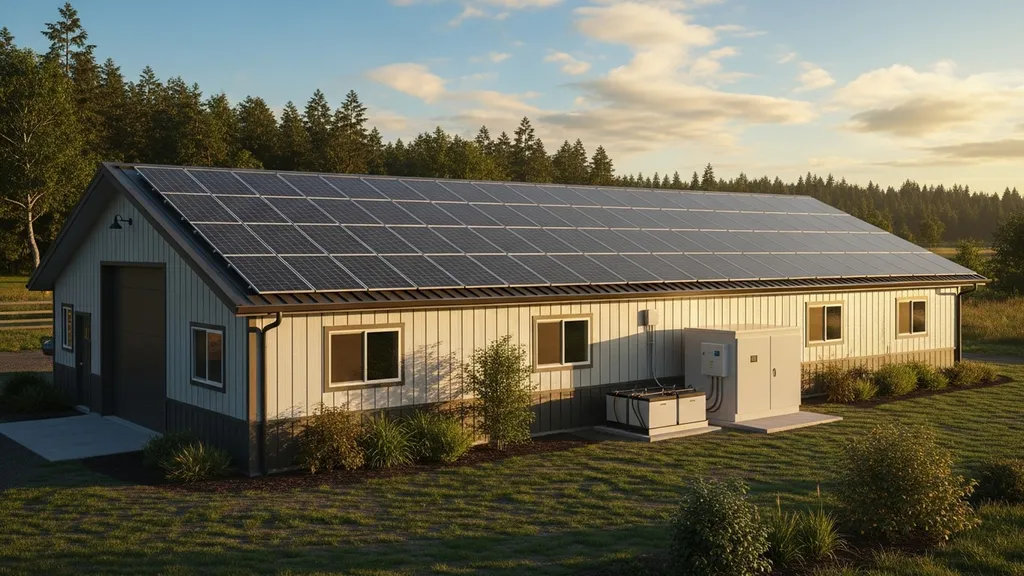
Step-by-step guide to sizing a 10kW solar system for a workshop — loads, panels, inverters, batteries, layout, and cost-saving tips.
10KW Solar System for Workshop: Complete Sizing Guide
A 10kw solar system for workshop is a common choice for medium-sized shops that run multiple power-hungry tools, lighting, and occasional heating or an EV charger. This guide shows how to decide if 10 kW fits your needs, calculate daily kWh and peak loads, size panels and batteries, choose inverters, plan the layout, and reduce system cost by cutting load. Read on for concrete examples, formulas, equipment comparisons, and a step-by-step checklist so a budget-conscious DIYer can get started.
TL;DR:
- A 10 kW array (≈10,000 Wdc) typically requires 20–25 mid-to-high wattage panels and produces roughly 9–17 kWh/day depending on location; design for 10–20% system losses.
- For basic outage backup, add 5–10 kWh of usable battery; for multi-day autonomy aim for 20–40 kWh usable and a hybrid inverter with adequate surge rating.
- Start by measuring daily kWh and peak kW with a clamp meter or energy monitor, then use PVWatts or local insolation data to size panels, inverter, and battery before getting 2–3 quotes.
How to Decide If a 10kw Solar System for Workshop is Right for You
Typical workshop scenarios that fit 10kW
- Small woodworking shop with dust collector, table saw, planer, and lighting often peaks 5–12 kW during heavy use and uses 25–60 kWh/day on active days.
- Metalworking or fabrication shop with MIG/TIG welders, plasma cutter, and an air compressor can see 2–8 kW welding draws plus compressor cycling; a 10 kW array supports daytime production and charging batteries for evening use.
- Hobbyist shop that also charges an EV in the evening can use a 10 kW array to offset charging plus tools; expect higher daily kWh if EV charging is regular.
When 10kw is Overkill or Undersized
- Overkill: a hobbyist bench with only hand tools and LED lighting often uses <5 kWh/day—1 kW systems may suffice; compare approaches using the 1kW workshop guide.
- Undersized: a full-time fabrication shop with plasma cutting, multiple welders, heaters, and continuous compressor use may need larger arrays or a generator-backed hybrid system.
Trade-offs to weigh
- Initial cost rises with panel wattage, inverter rating, and battery capacity. The Department of Energy’s cost benchmarks give context on installed cost trends and are useful when budgeting: solar photovoltaic system cost benchmarks.
- Roof or ground space and permits matter. Remote sites without grid access lean toward off-grid designs; combine solar with water and site systems like rainwater collection for remote workshops (see cross-planning links to water systems).
- If outages are common, battery backup or hybrid systems add resilience but raise complexity and cost.
Compare a 10 kW application to a compact 10kW used for a tiny building in our 10kW tiny-house guide to understand space constraints and different load profiles.
Step 1 — Calculate Your Workshop Load for a 10kw Solar System for Workshop
Tracking Daily Kwh vs Peak Kw Needs
- Peak kW: measure highest instantaneous load (surge plus running). Use a clamp meter on mains or individual circuits to capture motor-start surges and simultaneous tool use.
- Daily kWh: convert each tool’s wattage × run-hours to get kilowatt-hours per day.
Creating a Sample Load Schedule (tool-by-tool)
- Example tool list with typical power draws (approximate):
- Table saw: 1,500–3,000 W
- Dust collector: 1,000–2,000 W
- Air compressor (running): 2,000–5,000 W (start surge higher)
- Band saw: 1,000–2,000 W
- Workshop heater (electric): 1,500–4,000 W
- LED lighting: 200–800 W total
- Worked example: If a shop runs a 2 kW table saw for 3 hours, a 1.5 kW dust collector for 3 hours, and 500 W of lighting for 10 hours: daily kWh = (2 × 3) + (1.5 × 3) + (0.5 × 10) = 6 + 4.5 + 5 = 15.5 kWh/day.
Derating and System Losses to Plan For
- Typical loss factors:
- Inverter efficiency: 95–98%
- Wiring, mismatch, and soiling: 2–6%
- Thermal and PV degradation: seasonal and temp losses (estimate overall 10–20% system losses)
- Formula to convert daily kWh need to required PV kW:
- Required PV kW = (Daily kWh) / (Average daily kWh produced per kW of panels × (1 − system losses))
- Example: A workshop needs 15.5 kWh/day. In a location averaging 4.0 kWh/kW-day and assuming 15% losses: PVkW = 15.5 / (4.0 × 0.85) ≈ 4.56 kW. A 10 kW array would more than cover this and supply EV charging or battery charging.
Measurement and estimation tools
- Measure baseline using a submeter or whole-site energy monitor for 2–4 weeks to capture variability.
- For rough production estimates, industry tools like NREL's PVWatts are recommended; for local rules and system sizing the Australian guidance on sizing is helpful: Size your solar system | energy.gov.au.
- For broader market context and policy, see the Solar Energy Industries Association: SEIA.
For small-system comparisons and load management ideas, see the tiny-house electrical planning notes in tiny-house electrical options.
Step 2 — Solar Array Sizing: Panels, Tilt, and Estimated Production for a 10kw Solar System for Workshop
How Many Panels and Wattage Options
- A 10 kW nameplate PV array means roughly 10,000 Wdc. Common configurations:
- 25 × 400 W panels (25 × 0.4 kW)
- 20 × 500 W panels
- Roof area: mid-to-high watt panels need around 60–80 m² (650–860 sq ft) depending on panel efficiency and spacing. If roof space is tight, higher wattage modules or a ground mount may be necessary—see how to match panels to limited roofs in matching panels to roof.
- Panel formats: PERC mono-crystalline 400–500 W modules are common in 2026; manufacturers like Panasonic, REC, and Jinko are widely used (specifications vary).
Production by Location, Tilt and Orientation
- Expected annual kWh per kW installed ranges widely: roughly 900–1,700 kWh/kW-year depending on solar resource (north-south differences and weather).
- Simple rule: in the Northern Hemisphere aim for a south-facing array; set tilt near the site latitude to maximize year-round production. Flat or low-pitch metal roofs may use flush mounts with slight tilt or rail systems for better winter yield.
- For accurate local production, run PVWatts or a similar simulator; for guidance on panel output by wattage and site, see How to size a solar system: complete guide to panels, inverters....
Shading, Temperature, and Seasonal Variation
- Partial shading reduces output disproportionately. Mitigation options include panel-level power electronics: microinverters (e.g., Enphase) or power optimizers (e.g., SolarEdge).
- Temperature coefficient matters for hot sites—higher temperatures reduce output; check module datasheets.
- Seasonal swings: size with winter shortfalls in mind if workshop use is critical in winter. For remote sites, consider oversizing array relative to average daily use or incorporating a generator.
Also review ENERGY STAR guidelines for equipment efficiency and system compatibility at ENERGY star.
Step 3 — Inverters, Batteries, and Balance of System for a 10kw Solar System for Workshop
Choosing an Inverter: String, Hybrid, or Microinverters
- String inverters: cost-effective for uniform, unshaded arrays. A 10 kW string inverter is common; choose units rated slightly above AC continuous demand if possible.
- Hybrid inverters: combine PV and battery management—handy if planning battery backup. See the wiring specifics in hybrid inverter connection.
- Microinverters: installed at panel level, provide panel-level MPPT and shading resilience; higher per-watt cost but easier troubleshooting.
- Key inverter specs: continuous AC rating, peak/surge capacity for motor starts, max DC input voltage, MPPT inputs, and islanding/backup capability. Some brands: SMA, Fronius, Solis, Enphase.
Battery Sizing: How Many Kwh for Backup and Smoothing
- Sizing approach:
- Backup for critical loads (lighting, controls, small tools): 5–10 kWh usable.
- Full-shift support or light off-grid capability: 20–40 kWh usable.
- Chemistry options:
- Lithium-ion (LiFePO4, NMC): high cycle life, high DoD (80–95% usable), round-trip efficiency 90–97%.
- Lead-acid (AGM/GEL): lower upfront cost but lower usable capacity and shorter life; generally not recommended for frequent cycling.
- Round-trip efficiency and depth-of-discharge (DoD) factor into usable capacity. Example: a 10 kWh nominal Li-ion pack with 90% DoD gives ~9 kWh usable.
- Consider battery inverter pairing—match power rating and continuous discharge rating to workshop surge needs.
Other BOS Items: Combiner Boxes, Charge Controllers, Breakers
- Components to budget: PV breakers, DC combiner box (if parallel strings), AC disconnect, surge protection, conduit, grounding, and metering.
- Charge controller choice matters for small off-grid systems; for large grid-tied arrays MPPT is usually in the inverter.
Example price and spec context
- Typical component costs vary by region and time; Solar Choice provides pricing context: 10kW solar system: price, output & payback.
- For product comparisons include Tesla Powerwall, LG Chem RESU, and smaller modular systems. Compare inverter models (SMA, Fronius, SolarEdge) for surge handling and hybrid features.
| Component | Typical nameplate/spec | Efficiency/notes | Rough cost range |
|---|---|---|---|
| Panels (25 × 400 W) | 10 kWdc | 18–22% module eff. | $2,000–$6,000 (panels only) |
| Inverter (10 kW string) | 10 kW AC | 96–98% | $1,000–$3,000 |
| Battery (10 kWh usable Li-ion) | 12–14 kWh nominal | 90–95% round-trip | $6,000–$12,000 |
| Microinverter array | per-panel microinverters | panel-level MPPT | $3,000–$8,000 premium |
(Prices are illustrative; obtain local quotes.)
Comparison Table — Typical 10kw Workshop System Configurations
| System type | Array size (kWdc) | Inverter type | Battery capacity (kWh usable) | Estimated daily production | Roof/ground area (m²) | Typical use-case | Pros / cons |
|---|---|---|---|---|---|---|---|
| Grid-tied (no battery) | 10.0 | 10 kW string | 0 | 9–17 kWh/day (location dependent) | 60–80 | Daytime offset, export surplus | Lower cost, no backup in outage |
| Grid-tied with backup | 10.0 | Hybrid inverter | 5–10 | 9–17 kWh/day | 60–80 | Keeps critical circuits during outage | Moderate cost, limited nights |
| Off-grid hybrid | 10.0 | Hybrid + generator | 20–40 | 9–17 kWh/day | 60–80 | Remote workshop, extended autonomy | High cost, complex design |
These configurations are illustrative. Local incentives, net metering, and labor rates will change the economics—see local net metering rules and the net metering basics article for how export tariffs affect sizing.
Layout, Mounting and Site Planning for a 10kw Solar System for Workshop
Roof vs Ground Mount: Structural and Shading Checks
- Roof mount pros: lower site prep, shorter conduit runs. Cons: may need roof reinforcement, limited tilt.
- Ground mount pros: optimal tilt, easier maintenance. Cons: higher cost for footing and racking, land use.
- Structural checks: confirm roof framing and sheathing can handle racking wind uplift and snow loads. Older roofs often need reinforcement or re-roofing before install.
Wiring Runs, Conduit and Combiner Placement
- Minimize DC run length to reduce losses. Place combiner boxes and the inverter near the array where practical and code-compliant.
- For long runs, increase conductor size to limit voltage drop. Follow NEC (or local code) for conduit fill and protection.
Site Plan Checklist Before Installation
- Checklist:
- Sunpath check: Confirm array placement avoids morning/evening shading.
- Structural review: Obtain rafter, truss data and roofing condition report.
- Clearances: Provide service panel and inverter clearances per code.
- Maintenance access: Leave walkways or panel access rows for snow clearing and cleaning.
- Permits: Verify building and electrical permit needs.
Also plan for snow-shedding and wind uplift by choosing appropriate racking; metal roofs often use clamp-style mounts while shingle roofs use sealed flashed lag bolts.
Grid-tied vs Off-grid vs Hybrid: Which 10kw Solar System for Workshop Fits Your Goals?
Pros and Cons of Each Configuration
- Grid-tied: lowest upfront cost, allows exporting surplus, requires no battery. Downside: no power during grid outages unless paired with backup system.
- Grid-tied with battery backup: keeps critical circuits running and smooths load, improves resilience during outages. Higher cost but better utility independence for short outages.
- Off-grid: full independence, necessary for remote sites without a reliable grid. Requires significant battery capacity, generator backup, and careful load management.
Net Metering and Selling Back to the Grid
- Net metering policies affect payback and sizing. Where full retail net metering exists, oversizing can make economic sense. Where export credits are low, prioritize self-consumption and battery storage. For policy detail and implications, see net metering basics.
When to Choose True Off-grid for a Workshop
- Off-grid is sensible if grid extension costs exceed system plus generator cost, if frequent long outages occur, or if the site is intentionally remote for autonomy. For designing off-grid autonomy, read the in-depth off-grid design guide and browse the solar off-grid topic page for components and sizing tips.
Hybrid strategies
- Combining a generator with a PV + battery system reduces battery size and handles very large infrequent loads like welders. Stagger operation (run compressor then saw separately) can reduce inverter and battery requirements.
Reduce Your Load — Key Points for Lowering the Size or Cost of a 10kw Solar System for Workshop
- Swap to LED lighting: LED retrofit can cut lighting energy 60–80%, reducing baseline kWh and lowering battery needs.
- Use VFDs or soft-starts: VFDs on large motors and soft-start kits reduce inrush/starting current and allow smaller inverters.
- Stagger heavy equipment use: Schedule saws and compressors so they don't run simultaneously to reduce peak kW.
- Upgrade to efficient compressors and motors: Modern high-efficiency units run less and start smoother.
- Improve insulation and heater controls: For heated workshops, better insulation and zoning can cut heater kWh by 20–40%.
Practical savings examples
- Replacing fluorescent shop lighting with LEDs often drops lighting from 800 W to 250 W—saving ~14 kWh/week in a shop running 10 hours/day, which can reduce battery sizing by several kWh.
- Adding a soft-starter for a 5 HP compressor can cut startup surge by 40–60%, allowing a lower inverter surge rating.
For broader building-efficiency measures that reduce heating and electric demand, consult the passive-house cost analysis in passive house cost breakdown.
Installation, Permits, Safety, and Maintenance for a 10kw Solar System for Workshop
Permit Checklist and Inspection Points
- Typical permit steps: submit electrical one-line, site plan, structural rafter calculation (if roof-mounted), equipment cut sheets, and inverter/battery specs.
- Inspectors focus on clear labeling, rapid shutdown devices, grounding, overcurrent protection, and anchor/penetration flashings. For DIY building permit approaches see the DIY permits guide.
Basic Wiring and Protection Notes for Diyers
- Follow NEC or local electrical code for conductor sizing, disconnects, and rapid shutdown requirements for PV systems.
- For battery systems, observe manufacturer's installation and ventilation rules. Rapid-shutdown and anti-islanding features are required for grid-tied systems in many jurisdictions.
- For foundational electrical knowledge, read electrical basics for DIYers. Final AC interconnection usually must be performed or signed off by a licensed electrician.
Maintenance Schedule and Troubleshooting Tips
- Quarterly: visually inspect racking, look for loose bolts and clear debris.
- Annually: torque checks on electrical connections, check inverter logs for error codes, and clean panels if soiling >5%.
- Battery maintenance depends on chemistry; Li-ion needs monitoring of State of Charge and periodic firmware checks. For battery troubleshooting guidance see solar battery troubleshooting.
When to hire a pro
- Structural roof reinforcement, final AC grid connection, and complicated battery systems typically require licensed professionals. DIYers can handle certain aspects (racking, conduit runs) but must confirm work meets code and passes inspection.
The Bottom Line — Practical Recommendations for a 10kw Solar System for Workshop
A 10kw solar system for workshop is a strong match for medium workshops that see 15–60 kWh/day and peak loads under 12–15 kW. Start by measuring your actual daily kWh and peak kW, use PV production tools like PVWatts to estimate array yield, and prioritize load reductions (LEDs, VFDs, scheduling) before sizing batteries. Next steps: measure energy use, run a PV estimate, get 2–3 local quotes, and check incentives and net metering.
For more reading and next steps, consult the guides hub for deeper how-tos and budgeting tools.
Frequently Asked Questions
Will a 10kW solar system run my workshop heater?
Short answer: it depends on heater size and use pattern. A 10 kW array produces energy only when the sun shines; a 3 kW electric heater running for 4 hours draws 12 kWh, which a sunny 10 kW array can generate during daytime in many locations. If you need heating after sunset, add battery storage sized to your evening heating hours—expect to add roughly 3–6 kWh per hour of electric heater runtime.
For winter heating-heavy shops, consider improving insulation and using efficient heaters or biomass options to reduce battery demand.
How much roof area do I need for 10kW?
Typical area is about 60–80 m² (650–860 sq ft) for 10 kW using modern 400–500 W panels. Exact area depends on panel wattage, tilt, and spacing for access. If roof space is limited, consider higher-watt modules or a ground-mount array. Check shading and orientation before committing.
Do I need batteries with a 10kW system?
No—batteries are optional. A grid-tied 10 kW system without batteries reduces energy bills and can export surplus. Add a small battery (5–10 kWh) for critical-circuit backup, or larger banks (20–40 kWh) for extended off-grid capability. The choice depends on outage tolerance, budget, and net metering terms.
How do motor start surges affect inverter choice?
Motor start surges can exceed steady-state ratings by 3–7×. Choose an inverter with adequate surge capability or use soft-starters/VFDs on large motors to reduce inrush. For heavy intermittent motor loads, a hybrid inverter with a higher peak rating or a separate battery inverter for surge support may be required.
What permits are commonly required?
Permits typically include building/structural and electrical permits, and may require equipment datasheets, a one-line electrical diagram, and roof framing details. Local utility interconnection and inspection are often required for grid-tied systems. Consult the DIY permits guide for steps and common documentation.