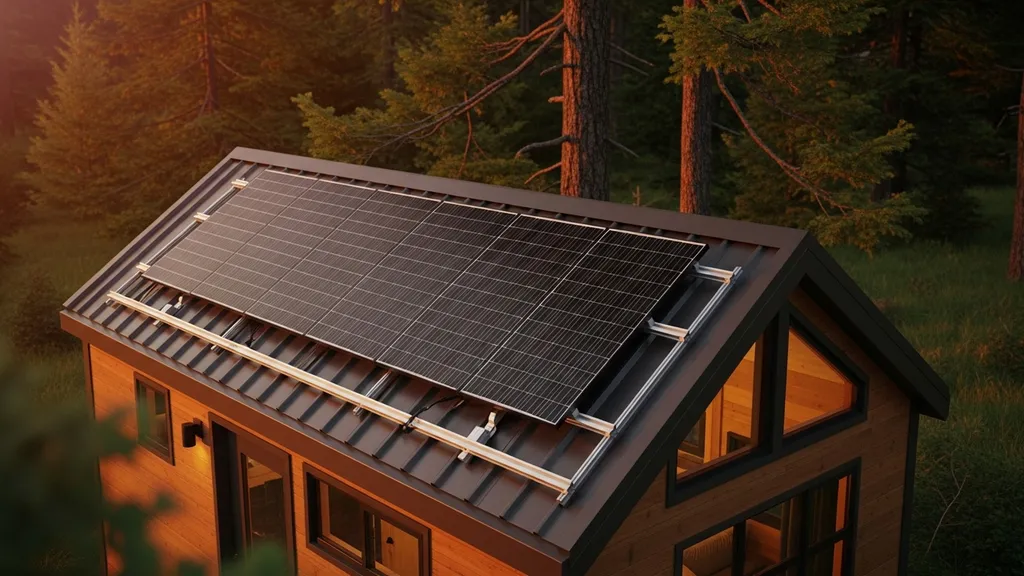
Step-by-step sizing guide for planning a 2kW solar system on a tiny house — loads, panels, batteries, inverters, costs and install scenarios.
2KW Solar System for Tiny House: Complete Sizing Guide
A 2kw solar system for tiny house planning gives a clear starting point for small, efficient homes that prioritize daytime usage, battery-backed essentials, or partial grid offset. This guide walks through what "2 kW" means in practice, how to estimate daily kWh needs, how many panels and batteries to plan for, and realistic production and cost expectations so readers can decide if 2 kW will meet their goals.
TL;DR:
- A 2 kW array typically produces about 6–10 kWh/day (2 kW × 3–5 peak sun hours), before system losses.
- For one-day usable backup, plan ~5 kWh usable battery; for 1–2 days autonomy, plan 10–12 kWh usable or link a generator for winter.
- Typical parts for a 2 kW tiny-house setup: 5–8 roof panels (250–410 W), 2–5 kWh usable battery (minimum), 2 kW inverter (3–4 kW surge), plus MPPT controller and proper racking.
How a 2KW Solar System Fits a Tiny House — Quick Overview
What “2kw” Means in Practice
"2 kW" refers to the array's DC peak rating: the sum of panel nameplate wattage under standard test conditions. It does not mean continuous output. To estimate daily energy, multiply array size by local peak sun hours (PSH). So a 2 kW array × 4 PSH → 8 kWh/day nominal.
System losses reduce that number. Typical derate factors — including inverter inefficiency, wiring, temperature, and soiling — range from about 10% to 25%. Using a conservative 20% derate: 8 kWh/day → ~6.4 kWh/day delivered to loads or batteries.
Industry sources such as the U.S. Department of Energy provide background on solar basics and derate factors; see the Department of Energy's homeowner's guide to solar for more context.
This size suits tiny homes (120–200 ft²) that prioritize efficient appliances, daytime-first use, or grid-tied net metering. For homes relying on electric heat or air conditioning, 2 kW will cover only part of demand unless the building is exceptionally efficient.
Typical Daily Production Range
- Low-sun region (3 PSH): 2 kW × 3 = 6 kWh → ~4.8–5.4 kWh after 10–20% loss
- Moderate-sun region (4 PSH): 2 kW × 4 = 8 kWh → ~6.4–7.2 kWh after losses
- High-sun region (5 PSH): 2 kW × 5 = 10 kWh → ~8–9 kWh after losses
Use NREL's PVWatts or a similar tool to model local production and seasonal swings. If the goal is reliable off-grid performance, model the worst-month production rather than the annual average.
Estimating Daily Energy Needs for a Tiny House
Breakdown of Common Tiny-house Loads
Estimate loads by listing devices, their wattage, and hours of use. Common tiny-house consumption examples:
- Mini fridge: average 40–60 W running (roughly 1–1.5 kWh/day depending on duty cycle)
- LED lighting and small electronics: 40–150 W total → 0.5–2 kWh/day
- Laptop/phone charging: 50–100 W total → 0.2–0.6 kWh/day
- Water pump: 200–400 W when running (short cycles)
- Induction cooktop (occasional): 1,200–2,000 W during use — short bursts add up
- Electric space heater: 1,000–1,500 W average — high consumption, not recommended as primary heat in small arrays
- Portable AC: 800–1,500 W — heavy drain
For water systems and pumps, see the off-grid water systems guide: guide to off-grid water systems for remote properties.
How to Measure or Estimate Your Household Kwh
- Read device nameplate watts: watts × hours ÷ 1000 = kWh.
- Example: A 50 W LED + 4 hours/day → 50 × 4 ÷ 1000 = 0.2 kWh/day.
- For a fridge: use nameplate average or estimate duty cycle. A small 12V fridge averaging 50 W over 24 hours uses 1.2 kWh/day (50 × 24 ÷ 1000).
- Track actual use for 7 days with a plug-in energy monitor, or use a whole-house meter if available.
Research such as the Berkeley tiny-house performance study shows real tiny-home consumption can be well below conventional houses when appliances and envelope efficiency are prioritized; the study provides measured case data for reference: ENERGY and water performance of an off-grid tiny house (pdf).
Three Sample Load Profiles (minimal, Moderate, High)
- Minimal (2–3 kWh/day): LED lighting, phone/laptop, small 12V fridge, water pump occasional. Suitable for a 2 kW array with modest battery.
- Moderate (4–7 kWh/day): Full-size efficient fridge, cooking by propane or occasional induction, few hours of entertainment, small heater. 2 kW works but needs battery sizing for evenings.
- High (8–12+ kWh/day): Electric heating/cooling, frequent cooking on induction, washer, heavy appliance use. 2 kW will struggle unless usage is shifted to daytime and batteries/generator are added.
Industry bodies such as SEIA summarize component energy impacts and typical residential loads: see Solar energy industries association.
Sizing a 2KW PV Array: Panels, Output, and Real-world Yield
Panel Count and Wattage Options
Common ways to reach ~2 kW DC:
- 5 × 400 W panels = 2,000 W
- 7 × 300 W panels = 2,100 W (slight oversize)
- 8 × 250 W panels = 2,000 W
Higher-efficiency modules (e.g., 380–410 W) reduce roof area. If roof space is tight, choose higher wattage panels or premium high-efficiency mono PERC or n-type cells.
Panel dimensions vary, but a typical 300–410 W residential panel occupies roughly 1.6–2.2 m² (17–24 ft²). Check manufacturer datasheets and ENERGY STAR listings: see EPA's energy star program for appliance and efficiency guidance when pairing panels with efficient loads.
Peak Sun Hours, Tilt, Shading and Seasonal Variability
Expected daily kWh = array kW × PSH × (1 − derate). PSH varies by location and season. Shading and suboptimal tilt can cut output significantly. Tilt close to local latitude optimizes annual yield; flatter tilt favors summer; steeper tilt favors winter.
When panels are shaded intermittently, consider module-level power electronics (microinverters or DC optimizers) to limit string losses.
Production Examples for Different Climates
| Panel layout | DC watts | Roof area est. (ft²) | 3 PSH daily kWh | 4 PSH daily kWh | 5 PSH daily kWh |
|---|---|---|---|---|---|
| 5 × 400 W | 2000 | 85–110 | 6.0 (4.8–5.4 after 20% loss) | 8.0 (6.4–6.8) | 10.0 (8.0–9.0) |
| 7 × 300 W | 2100 | 100–130 | 6.3 (5.0–5.6) | 8.4 (6.7–7.0) | 10.5 (8.4–9.5) |
| 8 × 250 W | 2000 | 120–160 | 6.0 (4.8–5.4) | 8.0 (6.4–6.8) | 10.0 (8.0–9.0) |
Numbers above apply before losses; bracketed numbers show expected delivered kWh after typical 20% derate. For a precise site yield, model on NREL PVWatts or a vendor tool.
If roof area is very limited, see the panel selection guide: how to choose solar panels that match your roof. For readers considering larger systems later, compare to bigger tiny-house systems.
Battery and Inverter Sizing to Match a 2KW System
Sizing Battery Capacity for Daily and Autonomy Needs
Decide target usable kWh and days of autonomy. Example:
- One-day usable backup: If average daily use is 6 kWh, plan ~5–6 kWh usable battery (accounting for depth-of-discharge DOD).
- Two-day autonomy: 10–12 kWh usable.
- Add 20–30% buffer for inefficiencies and aging.
Battery chemistry impacts usable capacity:
- LiFePO4: high usable DOD (80–95%), long cycle life (2000–5000 cycles), compact, lower long-term cost per cycle.
- Flooded lead-acid: lower usable DOD (30–50%), maintenance required, bulkier, lower upfront cost.
- AGM/gel: better than flooded for maintenance, still lower cycle life than lithium.
See the off-grid sizing deep-dive for more on multi-day autonomy: off-grid 2kW sizing.
Inverter Sizing: Continuous vs Surge and Pure Sine vs Modified
Match inverter continuous rating to expected running loads and surge rating to motor starts. For a typical tiny house:
- A 2 kW continuous pure sine inverter covers most daytime and light-night loads.
- Fridge or pump motors require surge capacity; select an inverter with 3–4 kW surge or a separate soft-start fridge solution.
- Pure sine inverters are recommended for sensitive electronics and modern appliances.
If planning AC-coupled batteries with a hybrid inverter, check compatibility and whether the inverter supports battery charging, grid export, and generator integration.
Charge Controllers: MPPT Recommendations
Use an MPPT charge controller sized for array current and system voltage. For 2 kW on a 48 V battery bank, array current ≈ 2000 W ÷ 48 V ≈ 42 A before losses. Choose an MPPT rated higher (e.g., 60 A) for headroom. Many hybrid inverters include built-in MPPT functionality — see wiring guide: how to connect solar panels to a hybrid inverter.
Short battery comparison table:
| Chemistry | Usable DOD | Cycle life | Maintenance | Typical cost per kWh |
|---|---|---|---|---|
| LiFePO4 | 80–95% | 2000–5000 cycles | Low | Moderate–High |
| Flooded lead-acid | 30–50% | 300–800 cycles | Regular watering | Low |
| AGM/gel | 40–60% | 500–1200 cycles | Low | Moderate |
For battery troubleshooting and maintenance tips, consult the guide: DIY troubleshooting for solar batteries.
System Components, Layout, and Wiring Basics
Essential Balance-of-system Components
Key items beyond panels, inverter, and batteries:
- Racking and roof attachments (rails, clamps)
- Combiner or junction boxes for parallel strings
- DC fuses and AC breakers (properly rated)
- MPPT charge controller or hybrid inverter with integrated charge function
- Battery management system (BMS) for lithium packs
- Grounding equipment and lightning protection considerations
- AC distribution panel and subpanel for tiny-house circuits
Always follow manufacturer specs for conductor sizing, overcurrent protection, and enclosure ratings. For hybrid wiring and panel connection details, see how to connect solar panels to a hybrid inverter.
Roof Mounting, Rail vs Flush Mount and Penetration Details
Mount options:
- Rail-mounted with clamps: Versatile, common for pitched roofs.
- Flush mount: Lower profile, less ventilation under panels.
- Ballasted or pole mounts: For ground or non-penetrating installations (less common on tiny-house roofs).
Roof penetrations must be flashed correctly and inspected. For small roofs, rail length and panel placement matter; plan around vents, skylights, and chimneys. If roof space is constrained, higher-efficiency panels reduce footprint.
Wiring basics:
- Choose system voltage (24 V vs 48 V) — higher voltage reduces current and allows smaller conductors.
- Wire panels in series to reach inverter/charge controller VOC/Vmp range; parallel strings increase current.
- Place DC fuses close to the battery and array as required by code.
- Use appropriate wire gauge for short runs; consult NEC or local code for exact sizing. When in doubt, hire a licensed electrician for final connections and permit sign-off.
Permits and inspections vary by jurisdiction; a licensed pro may be required for grid interconnection.
Installation Scenarios: Grid-tied, Off-grid, and Hybrid for Tiny Houses
Grid-tied with Net Metering or Export Limits
A grid-tied 2 kW system is ideal for reducing daytime grid consumption. Net metering policies vary; check local rules. For basic rules and background, read about net metering: net metering basics.
Pros:
- Lower battery needs
- Easier interconnection
- Potential export credits
Cons:
- Export limits or time-of-use rates can reduce value
- Not usable during grid outages unless anti-islanding or battery backup exists
Off-grid with Battery Prioritization
Off-grid tiny houses must manage production closely. A 2 kW array can support low-to-moderate daily use and short autonomy if paired with sufficient battery capacity. Practical tips:
- Shift heavy loads (cooking, laundry) to sunny hours.
- Use propane for water/space heating to reduce electrical load.
- Include a generator or alternative charging source for extended low-sun periods.
For a focused design workflow for off-grid systems, see designing off-grid systems.
Hybrid Systems and Generator Integration
Hybrid systems combine grid connection or a generator with batteries and solar. They automate charging and supply prioritization. A small generator (2–3 kW) provides efficient top-off charging in winter. Hybrid setups are flexible for tiny houses wanting partial independence while keeping a backup.
Short checklist when choosing scenario:
- Is grid access available and affordable?
- Do you need full autonomy or partial backup?
- How much roof/ground area is available for panels?
- What's the winter minimum solar yield in your location?
A short walkthrough video shows a real tiny-house 2 kW install, routing, and live production—helpful to visualize constraints and component layout:
Watch this step-by-step guide on sizing a solar system for your house! examples and calculations:
For wiring and architecture options tailored to tiny houses, see tiny house electrical options.
Cost, Savings, and ROI for a 2KW Tiny House System
Typical Equipment Cost Ranges (panels, Inverter, Batteries, Racking)
Costs vary by region, brand, and chemistry. Typical retail ranges (examples for planning only):
- Panels + racking for 2 kW: $700–$2,000 (varies widely by panel brand and mounting complexity)
- Inverter/charger (2 kW): $500–$1,500
- MPPT charge controller: $200–$800 (if separate)
- Battery bank: $800–$6,000+ depending on chemistry and usable kWh (LiFePO4 higher upfront, longer life)
- Balance-of-system (wiring, breakers, enclosures): $300–$1,000
- Installation and permit labor: $500–$3,000 (if hiring pros)
These are planning ballparks, not quotes. For larger-scale comparisons, see planning guides like 10 kW cabin planning.
Sample Payback Scenarios for Different Electricity Prices
Savings = annual kWh offset × utility rate. Example annual production for a 2 kW array at 4 PSH and 20% derate: ~2 kW × 4 × 365 × 0.8 ≈ 2,336 kWh/year delivered. At $0.10/kWh that saves $234/year; at $0.30/kWh it saves $700/year. Payback depends on total installed cost and incentives. Check local incentive databases like DSIRE for rebates and tax credits that change calculations.
If grid-tied with favorable net metering and high retail rates, payback shortens. Off-grid systems value resilience as well as energy savings; monetizing that resilience is personal.
Key Points: Quick Checklist and Component Specs
One-page Checklist for Planning and Installation
- Estimate loads: Make a 7-day log or use plug meters to total daily kWh.
- Model production: Use PVWatts or vendor tools to calculate local PSH and seasonal yield.
- Select panels: Prioritize high-efficiency modules if roof space is limited.
- Choose system voltage: 48 V preferred for battery-inverter efficiency on small systems.
- Size battery: Decide usable kWh for target autonomy (5 kWh = 1-day small backup).
- Size inverter: Match continuous load and ensure surge capacity for motors.
- Plan mounting: Confirm roof fit, tilt, and shading; choose rail or flush mounts.
- Wiring and safety: Place fuses near sources, size conductors per code, install grounding.
- Permits/interconnection: Check local interconnection, net-metering, and permitting rules.
- Get quotes: Obtain 2–3 vendor quotes; compare warranties and installer experience.
For a fuller design workflow, consult designing off-grid systems and the sustainable materials reference: the ultimate guide to sustainable building materials.
Comparison/specs Table: Panels, Inverter, Batteries, Controller
| Component | Typical spec range | Planning notes |
|---|---|---|
| Panel wattage | 250–410 W | 5–8 panels to reach ~2 kW; choose panel thickness and size for roof fit |
| Expected delivered daily kWh | 4.8–9 kWh | Depends on 3–5 PSH and 10–25% derate |
| Inverter continuous | 2,000 W | Look for pure sine, 3–4 kW surge for motor starts |
| Battery usable kWh | 5–12 kWh | 5 kWh = minimal one-day backup; 10+ kWh for multi-day |
| Charge controller | 30–80 A MPPT | Size to array current and system voltage (allow headroom) |
| Estimated roof area | 85–160 ft² | Depends on panel wattage and layout |
Use the table as a shopping checklist and then confirm exact specs on manufacturer datasheets.
The Bottom Line
A 2 kW solar array can reliably support a highly efficient tiny house with modest daily loads, especially when paired with sensible battery sizing and load-shifting. Measure actual loads, model local peak sun hours with PVWatts, and prioritize insulation and efficient appliances to make a 2 kW system practical. For greater autonomy in low-sun months, add battery capacity or a small backup generator.
Frequently Asked Questions
How many kWh will a 2kW solar system produce per day?
On average, a 2 kW system produces roughly 6–10 kWh/day before losses, using the quick formula: 2 kW × peak sun hours (3–5). After typical system derates (10–25%) expect about 4.5–8.5 kWh/day delivered. Use NREL PVWatts for location-specific, month-by-month estimates.
Can a 2kW system run electric heat or air conditioning?
Most electric space heaters and air conditioners draw 800–1,500 W or more; a 2 kW array can run these devices during sunny hours but will struggle for sustained operation without large batteries or a generator. For heating and cooling, propane or high-efficiency heat pumps sized to the envelope are more practical when relying on a small solar array.
How many [solar panels](https://www.jackery.com/blogs/buying-advice/solar-panels-for-tiny-house?srsltid) will fit on a tiny house roof?
Panel count depends on wattage and roof area. Typical options to reach ~2 kW are 5×400 W, 7×300 W, or 8×250 W panels. A tiny roof often has 85–160 ft² available for that range; choose higher-wattage or higher-efficiency panels if space is tight. Consult the roof layout before buying panels.
How large should the battery be for one-day autonomy?
For one-day usable backup, size the battery for roughly equal to one average day's consumption. If daily use is 6 kWh, plan ~5–6 kWh usable capacity (accounting for DOD and conversion losses). For reliable multi-day autonomy, increase usable capacity to 10–12 kWh or more, or include a generator for extended low-sun periods.
Do I need permits and can I sell excess power back to the grid?
Permits and interconnection rules vary by location. Grid-tied systems typically require permits and utility interconnection agreements; some areas offer net metering while others have export limits or time-of-use compensation. Check local rules and incentives before installation. For background on net metering, see the net metering basics guide.