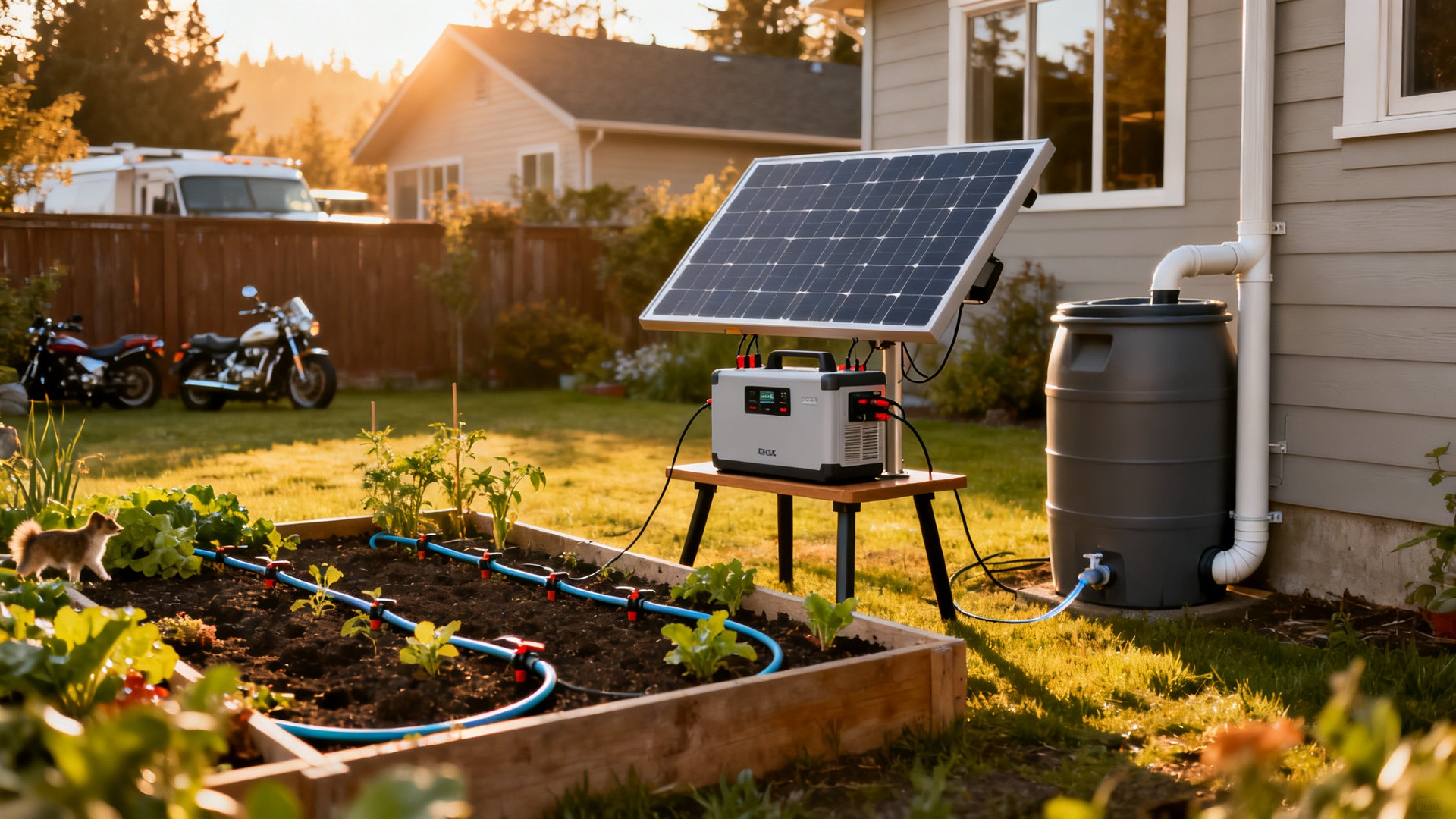
Practical, budget-friendly guide to Sustainable Garden Tech 01132047: solar lighting, smart irrigation, rainwater capture and low-cost eco upgrades for DIYers.
Sustainable Garden Tech 01132047
Sustainable Garden Tech 01132047 is a practical, budget-minded approach to adding low-energy, water-saving systems to a home garden: solar lighting and small PV to run pumps, smart irrigation controllers with sensors, rainwater capture and basic filtration, and low-energy soil-return strategies such as greywater and composting. This guide explains what those systems do, what a beginner DIYer can expect to save in water and night-time grid energy, and which small pilot projects are easiest to install. Readers will learn how to size small PV kits, set up a smart drip system, capture roof runoff with a first-flush diverter, and prioritize purchases to get the largest water or energy return per dollar.
TL;DR:
- Choose a high-impact starter: a smart drip irrigation zone plus moisture sensors typically cuts garden water use most cost-effectively.
- Combine a small PV kit with a low-power pump or solar lighting to remove nightly grid loads; battery sizing is the limiting factor to watch.
- Start small: pilot one raised bed with a rain barrel and controller, monitor water/energy metrics, then scale.
Sustainable Garden Tech 01132047 — What This Guide Covers and Who It’s For
Why the 01132047 Collection is Useful for Budget Diyers
- Target audience: suburban or rural homeowners, first-time self-builders, tiny-house and homestead planners on a tight budget who want lower water and energy bills and healthier soil.
- Practical benefit: the package focuses on low-cost interventions that are easy to DIY: solar garden lighting and small PV to run pumps, sensor-driven drip irrigation, rainwater capture with simple first-flush filters, and basic greywater returns and composting for soil health.
- What this guide does: explain core components, list affordable product types, give step-by-step mini-projects, and present maintenance and performance-tracking advice.
Quick Overview: Systems, Scale, and Expected Gains
- Systems covered: solar lighting and small PV, smart irrigation and moisture sensors, rainwater capture and storage, basic greywater routing and compost returns.
- Typical scale: projects are sized for a garden area from a single raised bed to several hundred square feet; examples show a 100–500 sq ft plot.
- Expected gains (illustrative): switching a small vegetable area from spray to drip irrigation plus a basic controller can reduce water use for that zone by a large margin; pairing solar lighting with minimal batteries removes evening lighting loads from the grid. These numbers are examples for planning, not guaranteed outcomes—actual savings vary by climate, soil, and user behavior.
- Further learning: for planting choices and low-water species that amplify system efficiency, see the water-wise landscaping guide. For longer courses on practical gardening methods, institutions such as the UCLA extension offer structured training on sustainable garden practice. (See Greener Gardens: Sustainable Garden Practice Course.)
Key Components of Sustainable Garden Tech 01132047: Core Systems Explained
Solar-powered Lighting and Low-voltage PV Basics
- What it is: small PV kits include a panel (10–200 W for garden uses), a charge controller, an enclosed battery, and low-voltage LED lights or a pump. For pure lighting, integrated solar garden lights are plug-and-play; for pumping or sensors, a separate PV system with battery storage is typical.
- Sizing concept: estimate load in watts (pump + controller + lights), multiply by hours of operation per day, then add a safety margin. Battery capacity is measured in amp-hours (Ah) and must match the system voltage; battery chemistry options include sealed lead-acid and lithium iron phosphate (LiFePO4), with LiFePO4 offering better cycle life but higher upfront cost.
- Practical note: for night lighting only, choose fixtures with efficient LEDs and motion or dusk-to-dawn controls so battery capacity can be small. For pumps, size panels to meet daily pumping needs and consider a battery if you need night or cloudy-day operation.
- For detailed product sizing and lighting options, consult our solar lighting guide.
Smart Irrigation and Sensor-driven Watering
- Core parts: a controller (timer or smart), zone valves, supply piping, drip tubing and emitters, moisture sensors, and optionally a flow meter.
- How it saves water: drip irrigation applies water at the root zone with lower losses to evaporation than spray sprinklers. A smart controller schedules irrigation based on weather forecasts or on-site moisture sensors to avoid unnecessary runs.
- Sensor placement: place moisture sensors at root depth of the dominant crop and in representative soil types. Use multiple sensors if the garden has different beds or soil textures.
- Comparison: drip vs sprinklers — drip typically reduces applied water by 30–60% for beds (illustrative), while sprinklers suit large turf or irregular layouts but waste more to evaporation and overspray.
- Standards and guides: industry groups like WaterSense publish irrigation-efficiency guidance; consult their recommendations when programming controllers.
Rainwater Capture, Storage and Basic Filtration
- Catchment basics: the roof catchment area multiplied by annual rainfall gives a theoretical collection volume; practical yield is lower due to conveyance losses.
- First-flush diverter: a small device that channels the initial runoff away from the storage barrel to remove debris and contaminants before water enters the tank.
- Storage sizing rule of thumb: match storage to peak dry-period demand; for a small bed, 50–200 gallons often suffices. Label any figures as illustrative; actual sizing requires local rainfall and demand data.
- Filtration: for garden use, a coarse mesh leaf screen on the downspout and a simple sediment filter at the outlet keep water usable. For potable reuse, install certified filtration and disinfection equipment and follow local rules.
Greywater and Compost Returns for Gardens
- What greywater is: gently used domestic water from showers, bathroom sinks, and laundry (check local codes—kitchen wastewater is usually excluded).
- Safe uses: subsurface irrigation for ornamental beds and some drought-tolerant edibles in many jurisdictions; avoid direct contact with edible parts and avoid application to root crops that touch the soil surface.
- Simple separation rules: keep kitchen and heavily soiled lines out; use low-salt, biodegradable detergents; route greywater through mulched basins or subsurface drip to reduce pathogen exposure.
- Compost returns: compost and compost tea are low-energy soil conditioners that improve water retention and microbial life; they complement water-saving hardware by reducing irrigation frequency.
(Additional background on safe greywater systems is available in our greywater reuse guide.)
Sustainable Garden Tech 01132047: Choosing Affordable, DIY-friendly Products
What to Prioritize on a Tight Budget
- Highest water-return per dollar: a basic drip kit (mainline, emitters, a pressure regulator) plus a simple smart timer or sensor-driven controller.
- Best value for energy offset: a modest PV lighting kit with efficient LEDs and a small LiFePO4 battery when long life matters; otherwise sealed lead-acid for the lowest upfront cost.
- Prioritize durable outdoor-rated parts: check IP rating for controllers and fittings; choose UV-resistant tubing and corrosion-resistant fittings for longevity.
- Inspect datasheets for wattage, lumen output, or battery Ah to compare real performance rather than brand claims.
Comparison Table: Typical Product Options and Specs
| Product type | Approx. DIY cost-band | DIY difficulty (1–5) | Eco-impact (qualitative) | Typical lifespan |
|---|---|---|---|---|
| Solar garden light (integrated) | Low | 1 | Low energy offset, high night-light value | 2–5 years |
| Small PV kit (panel+controller+battery) | Medium | 3 | Medium energy offset for pumps/lighting | 5–12 years (battery-dependent) |
| Smart irrigation controller (Wi‑Fi or sensor) | Medium | 2 | High water savings when paired with sensors | 3–8 years |
| Rain barrel + first-flush | Low | 1 | Moderate water capture for garden use | 5–15 years |
| Drip irrigation kit (500 ft²) | Low–Medium | 2 | High water savings vs sprinklers | 5–10 years |
| Pressure-compensating emitters | Medium | 2 | Consistent water to plants, reduces waste | 5–10 years |
Notes: cost bands are illustrative. DIY difficulty factors include simple plumbing and basic electrical work. When buying batteries, compare lead-acid vs LiFePO4 chemistry for cycle life and recycling options.
Reliable Brands vs Value-market Picks (what to Watch For)
- Trusted product names often cited in DIY communities: RainBird, Hunter, Orbit (irrigation controllers); Victron, Renogy, Goal Zero (small PV gear and charge controllers); but always check specs against needs.
- Watch for: unclear battery chemistry, no IP rating for outdoor controllers, and missing documentation for sensor compatibility.
- Compatibility tip: ensure controller supports the communication type of sensors (wired analog vs wireless protocols) and that voltage ratings match.
(Companies House records such as company entries may help check vendor legitimacy; exercise standard seller due diligence.)
Step-by-step DIY Setups for Sustainable Garden Tech 01132047
Small Solar Lighting and Sensor Setup for a Vegetable Patch
Required tools and materials:
- Small PV panel (20–50 W), MPPT or PWM charge controller, 12 V battery (LiFePO4 recommended), 12 V LED fixtures with motion/dusk control, wiring, fuses.
- Time estimate: 3–6 hours for a single small zone (excluding battery charging time).
Steps (high level):
- Mount the panel in a location with unobstructed sun, tilt for your latitude.
- Wire panel to charge controller, controller to battery (observe polarity), battery to fuse box, and fuse to loads (LEDs).
- Install lights on stakes or posts and connect to the fused output; add motion sensors to minimize run time.
Safety cautions: include an inline fuse sized to the circuit and a disconnect; do not exceed battery voltage ratings. If uncertain, consult a licensed electrician for mains-tied work.
Wiring diagram (words only): Panel positive/negative → charge controller input; charge controller battery terminals → battery positive/negative; battery positive → fuse → load positive; battery negative → load negative. Use appropriately sized conductors.
Basic Smart Drip Irrigation Install (controller + Moisture Sensors)
Required tools and materials:
- Mainline tubing, drip tubing with emitters, pressure regulator, backflow preventer, smart controller with sensor input, moisture sensors, barbed fittings, pruning shears.
- Time estimate: 4–8 hours for a 100–300 sq ft garden zone.
Steps:
- Lay mainline from the water source; install a backflow preventer at the tap.
- Fit a pressure regulator to match drip system pressure (commonly 15–25 psi).
- Run drip tubing along rows; puncture and insert emitters or use pre-emitted tubing.
- Place moisture sensors at root depth in representative beds (avoid placing them where sun or shade will bias readings).
- Configure the smart controller: create zones, attach sensors, and set thresholds or allow the controller to use weather data if available.
Common pitfalls: over-pressurizing emitters, placing sensors too close to emitters (causes them to read wet all the time), and forgetting to include a filter at the supply to prevent clogging.
Installing a Simple Rainwater Capture and First-flush System
Required tools and materials:
- Rain barrel (50–200 gallons), leaf screen for gutter, downspout adapter, first-flush diverter (commercial or DIY with T-valve), overflow hose, stand.
- Time estimate: 1–3 hours for a single barrel installation.
Steps:
- Elevate the barrel on a stable stand to provide gravity head for hoses.
- Fit a screen on the gutter outlet to block debris.
- Install the first-flush diverter inline with the downspout so the initial volume bypasses the barrel.
- Connect barrel outlet to garden hose or a gravity-fed drip line; add a fine mesh filter at the outlet.
Safety & legal: check local rules on rainwater harvesting; some municipalities have restrictions or recommended practices.
Video demo: The following clip shows a combined solar + irrigation DIY install, including wiring and placement decisions: (For raised-bed construction used in many of these examples, see the raised bed how-to.)
Maintenance, Troubleshooting and Seasonal Care for Sustainable Garden Tech 01132047
Routine Checks for Electronics and Batteries
- Monthly: inspect panel for dust and bird droppings; wipe with soapy water when needed. Check charge controller for error LEDs.
- Quarterly: measure battery resting voltage and compare to manufacturer state-of-charge tables. Replace batteries that show rapid voltage sag.
- Annually: test all wiring for corrosion; replace any brittle or UV-damaged cables. For controllers, ensure firmware is current where applicable.
Seasonal Irrigation Tuning and Filter Maintenance
- Spring: flush filters and sediment traps, inspect emitters for clogs, and program the controller for higher seasonal demand.
- Summer: check sensor calibration and reduce schedule using sensors to avoid overwatering; monitor pressure to ensure uniform emitter flow.
- Fall/Winter: winterize outdoor lines in freezing climates by draining mainlines and storing sensitive controllers indoors or using frost-rated enclosures.
Troubleshooting Checklist for Common Failures
- No power to controller or lights: check fuse, battery voltage, and solar open-circuit voltage; verify panel connections and charge-controller LEDs.
- No water or low flow: look for clogged filters/emitters, closed zone valves, or pump issues; verify inlet pressure.
- Uneven wetting across beds: check pressure and emitter spacing; ensure mainline is sized correctly to keep even pressure across the run.
Data logging suggestion: track kWh produced (for PV), gallons captured (rain barrels), and days between irrigations to evaluate system performance over a season. Simple spreadsheets or a garden notebook work fine.
(For irrigation efficiency best practices, consult WaterSense guidance; for greywater maintenance details, refer to our greywater reuse guide.)
Performance and Sustainability Metrics for Sustainable Garden Tech 01132047
How to Estimate Water and Energy Savings (illustrative Examples)
- Example water estimate: for a 500 ft² vegetable area using spray irrigation twice weekly for 30 minutes, switching to drip and using a sensor-driven controller might cut applied water for that zone by a large percentage (illustrative only). To compute: note current gallons per minute (GPM) of the sprinkler, multiply by minutes per week, compare to hourly emitter flow rates under drip.
- PV contribution to pumps: estimate pump watts (e.g., a small 12 V DC pump might draw 30–100 W). Multiply watts by hours of pump operation per day to get Wh/day. Divide by average daily solar generation (panel wattage × peak sun-hours × system efficiency) to estimate the necessary panel size. Label any numbers as examples; real values require local insolation and pump performance specs.
Key Metrics to Track: Yield, Water Per Plant, Energy Offset
- Suggested KPIs: gallons captured per month, gallons applied per week, kWh produced per month from PV, battery state-of-charge trends, and crop yield per bed area.
- Record these in a simple log to compare system changes (for example, before and after installing drip).
Lifecycle and Embodied-impact Considerations
- Materials impact: batteries and plastics have embodied impacts; choose recyclable batteries and durable materials to reduce long-term footprint. LiFePO4 batteries generally last longer and have better end-of-life recycling options than generic sealed lead-acid batteries.
- Trade-offs: a plastic rain barrel is lower-cost and lightweight but has higher embodied crude-oil content than a reused metal tank; reclaimed barrels from local reclamation yards often offer a better embodied-impact profile.
- For deeper lifecycle data, consult technical reports from national labs (NREL) and guidance from agencies such as EPA.
Sourcing Materials and Compatible Systems for Sustainable Garden Tech 01132047
Where to Buy and What to Inspect on Delivery
- Seller types: garden centers for tubing and emitters, solar specialty shops for panels and controllers, hardware stores for fittings, and reclamation yards or classifieds for used barrels and tanks.
- On delivery inspect: product datasheets for voltage and current ratings, battery chemistry labeling, IP protection rating for outdoor electronics, and thread or fitting types for pipes. Verify included mounting hardware and warranties.
Local vs Online Sourcing: When to Choose Each
- Buy local when you need fittings quickly, want to match connector sizes, or plan to return items. Local sellers can also advise on regional issues such as frost or high-UV conditions.
- Buy online for specialized PV components or niche sensors where local inventory is limited. When purchasing online, verify seller ratings and return policies.
Compatibility Checklist for Mixing Components
- Voltage match: confirm panel, charge controller, battery, and loads share compatible system voltage (12 V, 24 V, etc.).
- Connector types: check MC4 vs bare wire on PV panels, and have adapters on hand if needed.
- Plumbing sizes: note pipe dimensions (PVC nominal vs poly tubing OD) and buy compatible barbed fittings or threaded adapters.
- Sensors and controllers: match sensor signal type (analog voltage, resistive moisture probe, or wireless protocol like LoRa/Zigbee) to controller inputs.
- For eco-conscious structural materials, consult the sustainable materials guide and choose timber from the sustainable lumber options article when building raised beds or trellises.
Small-project Examples Using Sustainable Garden Tech 01132047
Low-cost Backyard Pollinator Garden with Solar Lighting
- Goals: provide evening-lit path and habitat for pollinators, capture roof runoff for nearby planters.
- Materials: 2–3 integrated solar path lights, 100-gallon rain barrel with first-flush, native pollinator plants, mulching compost.
- Budget range: low (material reuse reduces cost).
- Steps: plant low-water natives, mount solar lights on low stakes, install rain barrel on downspout to supply watering can or gravity-fed drip.
- Maintenance: seasonal check of barrel screen, replace bulbs if needed, refresh mulch yearly.
(For rooftop planting ties to stormwater, see our green roof basics.)
Raised Bed Watering Upgrade with Smart Drip System
- Goals: reduce manual watering, maintain steady moisture for vegetables.
- Materials: raised bed (see raised bed how-to), mainline, drip tubing, smart controller, 2 moisture sensors.
- Budget range: low–medium.
- Steps: retrofit mainline to bed, install pressure regulator and inline filter, lay drip tubing, program controller with sensor thresholds.
- Expected maintenance: flush filters twice a season, swap clogged emitters.
Micro Rain Garden and Permeable Paving Retrofit
- Goals: reduce runoff, recharge soil, capture stormwater for nearby plants.
- Materials: shallow basin lined with permeable soil mix, native wet-tolerant plants, permeable pavers or gravel strip at downspout.
- Budget range: low–medium.
- Steps: regrade a small area to accept downspout flow, install a shallow basin, plant water-tolerant species, replace a small paved area with permeable material.
- Maintenance: annual plant pruning and check for sediment buildup.
- Related reading: see permeable paving options.
The Bottom Line: Sustainable Garden Tech 01132047
When this approach makes most sense: Sustainable Garden Tech 01132047 is a practical pathway for DIYers who want measurable water and energy savings without major construction. Start with a small, sensor-driven drip zone and a rain barrel or two; add a small PV kit for pumps or lighting when battery and panel costs fit your budget. Next steps: assess your garden's water use, prioritize a single pilot zone, and track a few simple metrics before scaling. Check local regulations for rainwater capture and greywater use before installing systems.
Frequently Asked Questions
How much water can I realistically save with a smart drip system?
Exact savings vary by soil, plant type, and climate, but switching a planted bed from spray irrigation to a properly designed drip system with a sensor-driven controller typically reduces applied water for that bed significantly. To estimate for your site, measure current sprinkler GPM and weekly run time to get gallons per week, then calculate drip emitter flow (gallons per hour per emitter) multiplied by runtime and number of emitters. Use those numbers to compare before-and-after consumption and label any results as illustrative until you collect local data.
Can I run a garden pump from a small solar panel without a battery?
Yes, you can run a pump directly from a PV array when the pump operates only in daylight and the panel output matches the pump's voltage and current needs. This is called direct-coupled operation and works best for short, daytime-only irrigation. Adding a battery allows night or cloudy-day operation but increases cost and requires careful battery sizing and charge control. Always match pump specs to panel output and include protection such as a fuse or controller.
Is rainwater harvesting legal where I live?
Regulations on rainwater capture differ widely by jurisdiction. Some places encourage small-scale harvesting, while others have restrictions or permitting requirements. Before installing a barrel or larger cistern, contact your local municipal or county building department to confirm rules and any required backflow prevention or overflow routing. Many regions provide guidance for garden-only use that avoids potable connections.
What maintenance does a first-flush diverter require?
A first-flush diverter typically needs periodic flushing and inspection to remove trapped debris and sediment. Check the diverter after heavy storms and clean or replace seals and screens annually. If your diverter has a settling chamber, empty it when sediment accumulates. Regular maintenance keeps captured water cleaner and reduces the workload on downstream filters and pumps.
Which battery type should I choose for a small garden PV system?
For small garden PV systems, *LiFePO4* (lithium iron phosphate) batteries are a good long-term choice because they offer higher cycle life, better depth-of-discharge, and safer chemistry compared with generic lead-acid. However, they cost more up front. Sealed lead-acid batteries have lower initial cost but shorter life and more frequent replacement. Consider lifespan, recycling options, and total cost of ownership when deciding; always buy from reputable manufacturers and follow disposal rules for used batteries.