Practical guide to Smart Garden Systems 2048249 — components, water-saving strategies, DIY installation, off-grid integration, and buying checklist.
Smart Garden Systems 2048249
Smart Garden Systems 2048249 describe networked controllers, sensors, and actuators designed to automate irrigation, microclimate control, and lighting for home gardens. For a budget-conscious DIY eco-home or small homestead, these systems can reduce watering labor, cut wasted water, and make maintenance easier—especially when paired with rainwater harvesting or off-grid power. This guide explains what these systems include, how they save water and energy, how to pick the right tier for your plot, and a practical DIY-friendly installation and maintenance roadmap.
For external source context, review ProductPlan product management resources.
TL;DR:
- Smart Garden Systems 2048249 automate irrigation and microclimate control using controllers, soil moisture sensors, and valves to cut waste and reduce manual work.
- Start small: pilot one zone, prioritize reliable sensors and valves, and choose systems that allow local control for off-grid use.
- Integrate with rainwater harvesting and low-power solar to keep running costs low and retain functionality when internet access is limited.
What Are Smart Garden Systems 2048249 and Who Should Consider Them?
Definition and Core Purpose
Smart Garden Systems 2048249 are integrated setups that combine a controller or hub, multiple sensors, and actuators (valves, pumps, switches) to automate watering, lighting, and microclimate tasks. Controllers run schedules or respond to live sensor data — for example, triggering irrigation only when soil moisture sensors report dry conditions, or stopping a pump if a flow sensor detects a leak. They can be cloud-connected or local-only; many modern units offer both.
Typical Users: DIY Eco-homes, Homesteads, Tiny-house Gardens
- Small homesteaders who want precise watering for vegetable beds and orchards.
- DIY self-build homeowners with rainwater storage aiming to reduce mains use.
- Tiny-house or container gardeners looking to run systems on batteries and small solar panels.
- Small-scale contractors installing automated irrigation for rental cabins or guest cottages.
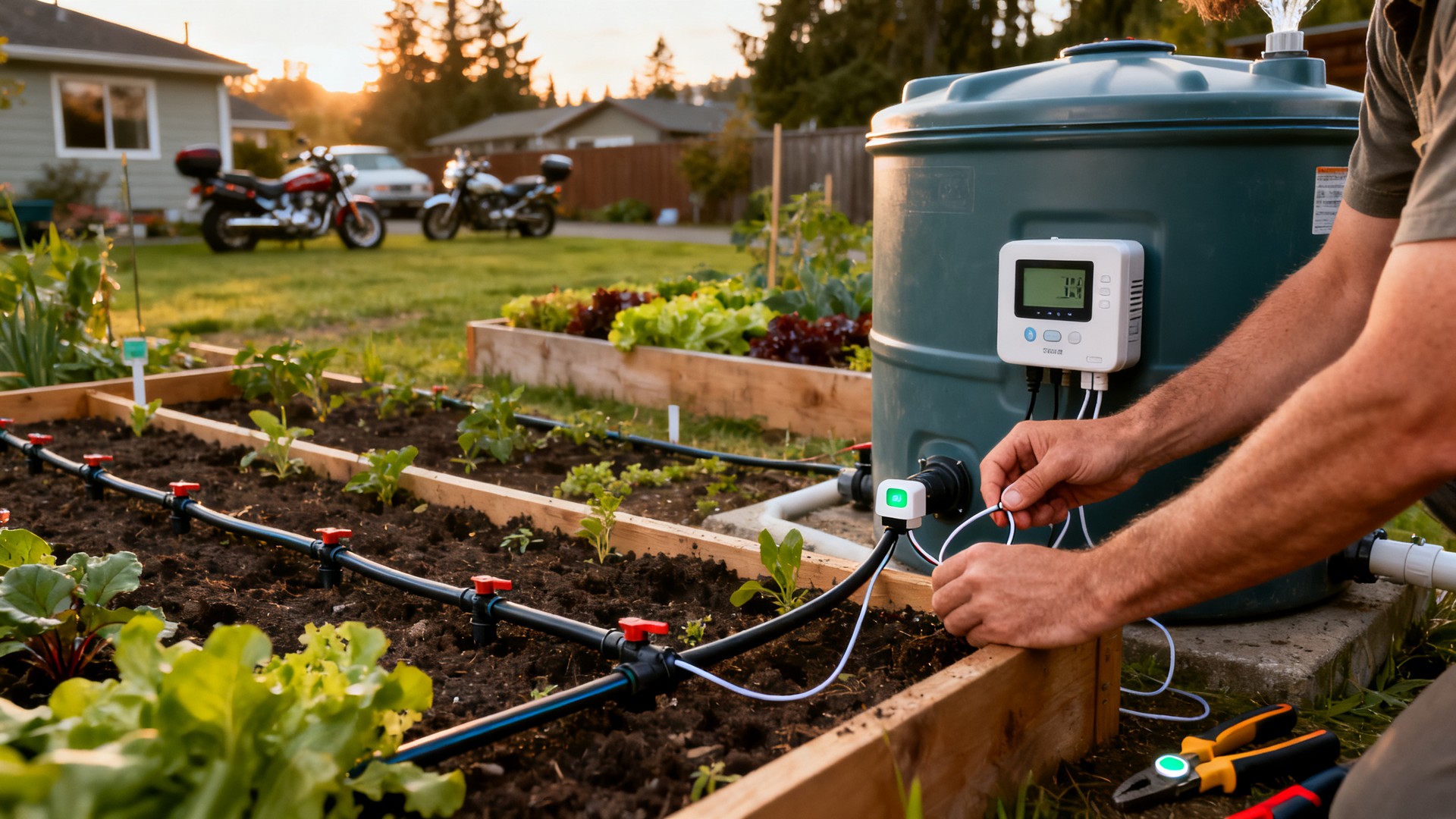
Scenario: a half-dozen raised beds fed from a 500‑gal rain barrel. A controller tied to a soil moisture probe waters only the beds that need it, and a float-switch prevents pump dry-run. The homeowner spends less time hauling hoses and keeps the barrel available for longer dry spells.
Market context and benefits
Industry reports show steady market growth for indoor and small-scale smart gardening hardware; see the Smart indoor gardening system market report 2026 for market sizing and trends. Research and extension services indicate sensor-based irrigation and weather-adjusted scheduling are reliable ways to reduce water use and labor. For a broader view of technologies that pair with smart systems, check the site's coverage of sustainable garden tech.
Core Components of Smart Garden Systems 2048249
Controllers and Hubs (cloud vs Local)
Controllers are the brains. Cloud-based controllers rely on vendor servers and remote apps for scheduling and analytics; local controllers run schedules on-site and expose APIs or local web interfaces. For off-grid or unreliable internet situations, local control is strongly recommended. Look for devices that support open APIs or local HTTP/MQTT interfaces if you plan to integrate with home automation.
Connectivity options commonly include Wi‑Fi, Zigbee, Z‑Wave, and LoRa. Each has trade-offs: Wi‑Fi offers high bandwidth for smartphone apps, Zigbee and Z‑Wave provide resilient mesh networking, and LoRa supports long-range, low-power links for remote plots.
Sensors: Soil Moisture, Rain, Temperature, and Flow
Key sensor types:
- Soil moisture probes: capacitive or resistive. Capacitive sensors resist corrosion and are usually more reliable.
- Rain sensors: tipping-bucket or optical; used to suspend irrigation during storms.
- Temperature/humidity: small weather stations help compute evapotranspiration adjustments.
- Flow meters: paddlewheel or ultrasonic types to detect leaks and log water use.
Typical specs to compare are communication protocol, power source (battery, wired, or solar), probe accuracy, and expected lifespan. Sensor placement matters: probes should sit in the root zone, away from emitter jets, and at representative depths for the crop.
Actuators: Valves, Pumps, and Smart Switches
Actuators perform work: 24V solenoid valves are standard for irrigation zones; for small garden valves 12V or 9V options exist. Pumps for rainwater systems are either submersible, surface-mounted, or diaphragm types; pairing a pump with a controller requires a relay or motor starter sized for the pump's current.
Interoperability and protocols
Open APIs and standard protocols simplify adding devices from different vendors. Systems that support MQTT, local HTTP, or have documented REST APIs are easier to integrate. For a practical guide to linking sensors and controllers to central hubs, see connecting smart water systems. For outdoor lighting and microclimate control that may share power or networks, the smart lighting efficiency guide is useful.
Components comparison/specs table
| Component | Typical connectivity | Power options | Typical spec notes |
|---|---|---|---|
| Controller/hub | Wi‑Fi, Zigbee, Z‑Wave, Ethernet | Mains, battery backup, solar trickle | Check local-control/API support |
| Soil moisture sensor | Wired, LoRa, Zigbee | Battery, wired | Capacitive probes, ±3–5% accuracy typical |
| Flow meter | Pulse output (reed), 4‑20mA, ultrasonic | Wired | Paddlewheel for clean water, ultrasonic for non-contact |
| Valve (solenoid) | Wired (24V common) | Low-voltage controller | 24V AC/DC common; check inrush current |
| Pump | Relay control, float input | Mains or DC | Match relay rating to motor start current |
Trade-offs: battery-powered sensors are cheap and flexible, but need periodic battery planning; wired sensors offer reliability but require trenching or conduit.
How Smart Garden Systems 2048249 Save Water and Energy
Water-saving Strategies (sensor-based Scheduling, Evapotranspiration)
Smart systems reduce waste by irrigating only when and where plants need it. Core strategies:
- Soil-moisture-triggered runs: Irrigation triggers only if probes read below a set threshold.
- Weather-based adjustments: Controllers use local weather or evapotranspiration (ET) data to reduce runtime after rain or cooler spells.
- Flow/leak detection: Flow meters and runtime analytics identify abnormal use immediately.
- Zone-specific schedules: Group plants by water need (deep-rooted vs shallow) to avoid overwatering.
These approaches align with conservation recommendations from extension services and performance benchmarks often cited by programs such as WaterSense. For more on pairing smart controllers with stored water, see the water collection guide.
Energy Considerations (low-power Sensors, Solar Options)
Low-power design is important for off-grid setups. Many sensors draw under 100 µA in sleep mode and spike only during transmissions. Controllers vary: a small local controller might consume tens to a few hundred mA when active. A simple illustrative battery calculation: device draw (mA) × hours of operation = daily mAh; convert to Ah by dividing by 1000. Label this as an example only; measure actual device draw from datasheets before sizing batteries.
Solar trickle-charge systems can keep batteries topped up. For pumps, energy use dominates; choose efficient pump types and install pressure-regulated emitters or gravity-fed drip lines to reduce pump run time.
Rainwater and greywater integration
Smart systems can use tank-level sensors (float or ultrasonic) and suspend irrigation automatically when storage is low. Greywater may be usable with appropriate plumbing and local approvals; confirm regulations before implementing. Using stored rainwater reduces mains reliance and pairs well with sensor-based irrigation to stretch delivery during dry spells.
Choosing the Right Smart Garden Systems 2048249 for a DIY Eco-home
Sizing the System to Garden Area and Plant Types
Match zones to plant water needs and layout. As an illustrative example (not a rule): one zone per 200–500 sq ft of similar plants often works for drip or micro-spray layouts. Container gardens generally need separate, smaller zones than in-ground beds. Label each zone on your map and list emitters, typical runtime, and water source.
Budgeting: Low-cost to Mid-range Options and Where to Spend
- Spend more on accurate soil moisture sensors and quality valves. A faulty valve creates more hassle than a nicer app interface.
- Save on controllers that offer local APIs rather than vendor-locked cloud analytics.
- Choose modular systems so you can add zones gradually.
Compatibility Checklist: Hubs, Sensors, and Plumbing
- Confirm controller supports the valve voltage you have (24V common).
- Ensure sensors speak a protocol your hub accepts or offer a wired option.
- Check spare-part availability and documentation before purchase to avoid vendor lock-in.
Watch a concise setup and review video that shows a DIY controller hookup, sensor placement, and app/local-control behavior to help pick a tier. Viewers will see wiring, valve hookup, and user interface differences.
For a visual demonstration, check out this video on quick and easy raised bed irrigation system -:
What to ask vendors before buying
- Does the controller support local (offline) scheduling and manual overrides?
- Are sensor calibrations documented and are replacement probes sold separately?
- What is the warranty and are replacement diaphragms/solenoids available?
For supplier and market context, business coverage and product features are discussed in outlets such as Forbes, which can help frame vendor selection and ecosystem maturity.
Step-by-step Installation Overview for Smart Garden Systems 2048249
Planning: Mapping Zones, Water Source, and Power
Start with a site map showing beds, containers, slopes, and your water source (mains, tank, or well). Mark sun exposure and plant types. Label potential zone boundaries where emitters can share a valve. Sketch low-voltage wiring paths and on-site controller location; keep the controller sheltered and within radio range of sensors.
Sensor Placement and Calibration
Place soil probes in the active root zone and avoid direct contact with emitters. For trees, use deeper probes; for annuals, shallower. Calibrate sensors per manufacturer instructions: some need dry/wet references, others auto-calibrate with soil type. Sample multiple points per zone to establish baseline readings.
Wiring, Plumbing, and Mounting Best Practices
- Use 18–22 AWG for sensor wiring depending on distance and current; follow datasheets.
- Protect underground wiring in conduit or use direct-burial-rated cable.
- Install backflow prevention where code requires it for irrigation connections.
- Mount valves in valve boxes or weatherproof enclosures and support manifolds securely.
- Use filter screens ahead of drip filters and place shutoff valves for maintenance.
Initial Commissioning and Testing
Commissioning checklist:
- Verify power and battery voltage.
- Manually open each valve and confirm correct zone coverage.
- Check flow meter readings during a known runtime to verify calibration.
- Run a soil-moisture test before and after a short irrigation to confirm sensor response.
- Test float switches and pump relays for tank-fed systems to prevent dry-run.
Safety notes: Use low-voltage equipment for control circuits. For mains-powered pumps or high-voltage wiring, consult an electrician. For an in-depth hands-on installation guide, see the DIY smart irrigation guide.
Integrating Smart Garden Systems 2048249 with Off-grid Water and Power
Connecting to Rainwater Tanks, Pumps, and Gravity Systems
When using stored rainwater, common patterns include:
- Float-switch input to controller or relay to prevent pump run when level is low.
- Relay-controlled pump starter sized for the motor's starting current.
- Gravity-fed drip systems with a solenoid valve at the tank outlet; the valve closes when the controller is off.
Install accessible manual shutoffs and include a pressure regulator if switching between mains and tank supplies. For legal and safety requirements around rainwater use, consult local rules—see the site's rainwater collection rules for state-level guidance and the rainwater harvesting basics overview for technical options.
Power Solutions: Batteries, Solar, and Low-power Design
Small controllers and sensors are usually comfortable on a few amp-hours a day. Example (illustrative): a controller averaging 100 mA running 24 hours uses 2.4 Ah/day. Add sensor draws and radio transmissions to that figure before sizing a battery and solar panel. Use charge controllers matched to battery chemistry and include a fuse or breaker on the battery feed.
Design tips:
- Prefer devices that sleep and transmit intermittently for battery life.
- Use DC pumps if you want a fully DC, solar-friendly loop.
- Keep a manual override or local switch so critical irrigation can run without the controller if battery or cloud services fail.
Cloud dependency warning: Cloud-only controllers may be unusable when offline. For off-grid installations, choose hardware that offers local scheduling and manual control via physical switches or local web interfaces.
Maintenance, Troubleshooting, and Common Pitfalls with Smart Garden Systems 2048249
Routine Checks and Seasonal Maintenance
- Clean inlet filters and strainers monthly during irrigation season.
- Inspect valve diaphragms and replace if leaking.
- Calibrate or replace soil probes annually, more often in corrosive soils.
- Flush lines before winter or follow local freeze protocols.
- Test pump float switches and pressure relief valves seasonally.
Common Faults (sensor Drift, Valve Failure, Connectivity)
- Sensor drift: probes can corrode or develop offset readings. Swap a suspect probe with a known-good unit to isolate.
- Valve failure: deposits cause slow closing or stuck valves. Manually cycle and clean; replace diaphragms if needed.
- Connectivity: mesh networks can drop nodes. Move the hub, add repeaters, or switch protocols if range is insufficient.
Troubleshooting Checklist
- Verify power: check battery voltage, fuses, and AC adapters.
- Verify connectivity: ping the controller or check local web UI.
- Check sensor readings against a handheld meter or manual moisture test.
- Manually activate actuators using controller hard buttons or test switches.
- Replace suspected parts temporarily to isolate the problem.
Firmware and backup
Keep firmware current but test updates on a non-critical controller first when possible. Keep a local backup of schedules and a printed or offline copy of critical settings so the system can be restored quickly in a failure.
Smart Garden Systems 2048249 Product Comparison and Buying Checklist
Side-by-side Specs Table for Typical System Tiers
| Tier | Estimated zone count | Sensors included | Connectivity | Power options | Offline capability | Typical use case |
|---|---|---|---|---|---|---|
| Budget DIY kit | 1–4 | Basic moisture probe, rain sensor | Wi‑Fi or wired | Battery or mains | Limited | Balcony/containers |
| Mid-range modular | 4–12 | Multiple moisture probes, flow meter | Wi‑Fi, Zigbee | Mains + battery backup, solar ready | Yes (local + cloud) | Small yards, raised beds |
| Pro/enterprise | 12+ | Multiple probes, weather station, flow, tank level | Ethernet, LoRa, Zigbee | Mains, robust battery systems | Yes (local control and APIs) | Homesteads, orchards |
Key Points List: What to Prioritize
- Choose local control first: Local scheduling keeps systems running when internet drops.
- Prioritize sensor quality: Accurate soil moisture probes reduce runtime and save water.
- Verify valve compatibility: Confirm voltage and connector types before ordering.
- Plan spare parts: Buy extra diaphragms, seals, and a spare probe on arrival.
- Test in a zone: Pilot one or two zones before scaling the whole garden.
What to test on arrival
- Power stability: Measure idle and active current draw.
- Sensor stability: Log readings over 24–48 hours to identify drift.
- Manual override: Confirm you can run valves without cloud access.
Competitor and platform names worth comparing
- OpenSprinkler, Rachio, Orbit B-hyve, RainMachine, Netro — check whether each supports local control, what sensors they include, and spare-part availability. Use vendor documentation to confirm exact specs.
The Bottom Line
Smart Garden Systems 2048249 suit small homesteads and eco-homes that want to cut manual watering and integrate stored water and low-power systems. The best ROI comes from starting with one zone, using reliable soil moisture sensors and good valves, and choosing hardware that supports local control for off-grid resilience. Pilot, measure, and expand based on real sensor data rather than guesses.
Frequently Asked Questions
How much water can Smart Garden Systems 2048249 realistically save?
Actual savings vary with plant mix, climate, and existing practices, so point estimates are unreliable without a site audit. Studies and extension recommendations show that sensor-based irrigation and weather-adjusted scheduling typically reduce unnecessary runtime compared with fixed timers. For benchmark reports on market trends and technology uptake, see the Smart Indoor Gardening System Market Report 2026.
Can Smart Garden Systems 2048249 work without cloud connectivity or wi‑fi?
Yes—many controllers support local scheduling and manual control. For off-grid installations, choose controllers with documented local APIs or physical overrides. Cloud-only units may lose functionality when internet access fails, so prioritize local-capable models if you plan off-grid operation.
Is it difficult for a beginner to install a Smart Garden Systems 2048249?
Beginner-friendly installations are common for small container gardens and a few zones. Basic plumbing and low-voltage wiring skills help. For stepwise instructions and pictures, consult the site's DIY smart irrigation guide. For any mains electrical work or complex pump wiring, hire a licensed electrician.
How do I integrate a rainwater tank with Smart Garden Systems 2048249?
Use a tank-level float or ultrasonic sensor to inform the controller, and control the pump with a relay sized to the motor's starting current. Include manual shutoffs, a pre-filter ahead of emitters, and a pressure regulator if needed. Check local rules before tying irrigation to stored rainwater by consulting the site's rainwater collection rules and the rainwater harvesting basics.
What sensors are must-haves vs optional for Smart Garden Systems 2048249?
Must-haves: at least one reliable soil moisture sensor per distinct plant zone, a valve or relay for each zone, and a way to manually activate zones. Highly recommended: a flow meter to detect leaks and a tank level sensor for rainwater systems. Optional: full weather stations and multi-depth probes for orchards or larger plots.