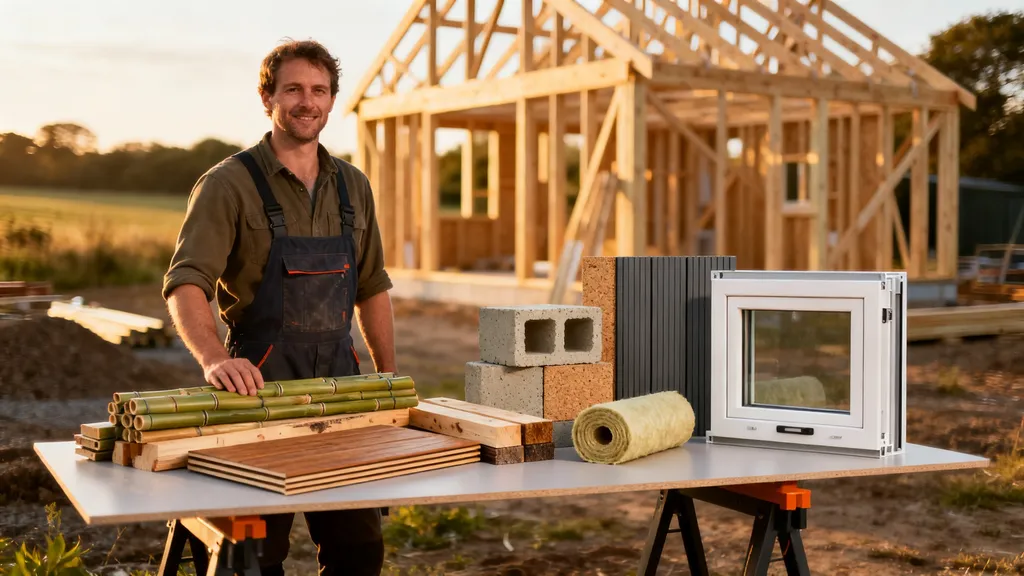
Practical guide to choosing sustainable materials & products for DIY homebuilders—structure, insulation, finishes, sourcing, costs, and selection checklists.
Sustainable Materials & Products
Choosing Sustainable Materials & Products affects upfront cost, long-term energy use, indoor air quality, and the home's environmental footprint. This guide for budget-conscious DIY builders explains how to evaluate sustainable building materials, compare structural and finish options, and make selections that balance embodied carbon, durability, and budget. Readers will learn practical checks, certifications to request, and sourcing tactics that reduce waste and cost while keeping permits and safety in view.
TL;DR:
- Prioritize low-embodied-carbon choices for high-mass assemblies (foundations, structure) and high-performance windows/insulation for operating-energy savings.
- Ask suppliers for EPDs, FSC certification, and low-VOC labels; use reclaimed materials for finishes when structurally acceptable.
- Save budget by sourcing locally, buying surplus, and spending more where lifecycle savings are greatest (insulation, windows, airtightness).
Sustainable Materials & Products: What Counts and How to Evaluate Them
Defining Sustainable Materials & Products for DIY Homes
"Sustainable materials & products" are building components selected to lower environmental harm across their lifecycle—extraction, manufacture, transport, use, and end-of-life—while meeting performance needs. For a DIY self-builder, that means balancing embodied carbon, operational energy use, toxicity, lifespan, repairability, and recyclability. The right choice is often a trade-off: a high-insulation synthetic product might reduce heating energy but carry higher upfront embodied carbon than a natural fiber insulation.
Key Sustainability Claims: Embodied Carbon, Epds, Recycled Content
- Embodied carbon: Total greenhouse-gas emissions from material production and transport. Request illustrative ranges rather than single numbers; many manufacturers now publish Environmental Product Declarations (EPDs) that quantify this.
- EPDs: Standardized documents showing lifecycle impacts for a specific product model. They are useful for apples-to-apples comparison when available.
- Recycled content: Percentage of post-consumer or post-industrial material. Higher recycled content usually reduces embodied impacts but check mechanical and durability properties.
Industry sources encourage life-cycle thinking; the EPA's procurement guidance outlines recovered-material preferences and can be a practical reference for reuse and recycled content practices (see the EPA's Comprehensive Procurement Guideline)[Comprehensive procurement guideline cpg program].
Certifications and Labels to Trust (FSC, EPD, Greenguard, Etc.)
- FSC: Chain-of-custody and sustainable forest management for wood products.
- EPD: Lifecycle impact statements produced to ISO standards.
- GREENGUARD / GreenGuard: Low-emitting products for healthier indoor air.
- Global GreenTag / Declare / Cradle to Cradle: Multi-attribute ecolabels with differing scopes; read what each covers.
- LEED / USGBC credits: Useful benchmarks for material choices when pursuing certification, but the underlying EPDs and chain-of-custody documents are the valuable evidence to request.
Example: Choosing between standard plywood and a recycled composite panel might save embodied carbon if the composite has a certified recycled content and an EPD. On the flip side, a longer-lived natural wood product with FSC certification and durable finish can outperform cheaper, short-lived materials over the building's life.
Sustainable Materials & Products for Structural Elements (foundations, Framing, Mass Timber, Recycled Steel)
Timber Options: FSC, Reclaimed Wood, CLT and Mass Timber
Wood can be a low-embodied-carbon structural choice when sourced and certified correctly. FSC-certified framing ensures responsible harvesting. Reclaimed timber often has lower embodied impacts and attractive finish options, but requires careful inspection for fasteners, rot, and grading. Cross-laminated timber (CLT) and other mass timber panels offer high strength and speed of assembly; CLT typically reduces on-site framing waste and can lower embodied carbon compared with concrete or steel for small-to-medium buildings, though transport and manufacturing processes vary.
Durability depends on species, treatment, and detailing. For exposed elements, specified coatings and design for drainage are essential.
Concrete and Recycled Aggregate: When Recycled Aggregate Concrete is Viable
Concrete remains common for slabs and foundations. Using recycled aggregate concrete replaces natural aggregate with crushed concrete or brick and lowers some embodied impacts. That option is often viable for non-critical structural pours, paving, or as blinding. For structural foundations and slabs-on-grade, consult a structural engineer and local building codes before substitution. For readers wanting a deeper DIY treatment of recycled aggregate mixes, see the recycled aggregate concrete guide.
Recycled Steel, Icfs, and Comparative Embodied Carbon Table
Steel is highly recyclable and often contains significant recycled content, which helps its embodied carbon profile despite energy-intensive smelting. Insulated concrete forms (ICFs) offer durable, airtight wall systems; compare ICFs with hempcrete and other low-carbon in-fill systems via the hempcrete vs ICF discussion.
| Material | Embodied carbon (kg CO2e/m², illustrative) | Durability | Cost tendency | DIY suitability |
|---|---|---|---|---|
| CLT / mass timber | 10–40 (varies) | High with protection | Medium–high | Moderate (panels require lifting) |
| FSC softwood framing | 5–25 | Medium–high | Low–medium | High |
| Reclaimed timber | 2–15 | Variable (inspect first) | Low–variable | High (repairs/fit work) |
| Recycled aggregate concrete | 40–120 | High | Medium | Moderate (mix control needed) |
| Recycled steel | 60–120 | Very high | Medium–high | Low (requires fabrication) |
| ICF concrete walls | 80–150 | Very high | Medium–high | Low (specialized install) |
Notes: Ranges are illustrative; project location, transport distance, and manufacturing mix change results. Always request manufacturer EPDs for comparison.
When to choose which: For small self-builds with tight schedules and low-skilled labor, conventional FSC-certified framing plus good insulation can be the most cost-effective route. For thermal mass or single-panel quick builds, CLT may speed construction but requires crane access. Concrete foundations are standard for load-bearing soils; recycled aggregate is a reasonable lower-impact option if structural engineer approval is obtained.
Permits and engineer sign-off: Any structural substitution—reclaimed beams, mass timber design, or recycled aggregate mixes—requires engineering review and local permit approval. Safety first.
(Research on integrating sustainability into material selection is summarized in academic sources that highlight the benefits of recycled metals and sustainably sourced wood)[Integrating sustainability material selection ethical and strategic obligation].
Sustainable Materials & Products for Insulation, Air-sealing & Thermal Performance
Insulation Options and Carbon/performance Trade-offs
Common insulation choices for DIY builders include:
- Cellulose: Good embodied carbon profile, high recycled content, effective for cavity fills; DIY-friendly with blow-in equipment or dense-pack.
- Mineral wool (rock/slag wool): Non-combustible, good acoustic performance; available in batts or boards.
- Spray polyurethane foam (closed/open cell): High R-value per inch and excellent air-sealing; higher embodied carbon and off-gassing concerns for some products.
- Cork and natural fibers (sheep's wool): Renewable, low-toxicity options with moderate R-values and good moisture buffering.
- Polyiso: High R/inch in warm conditions; insulating boards suit continuous insulation but are petrochemical-derived.
Decide by comparing R-value per inch, installation complexity, moisture performance, and embodied carbon. For a detailed trade-off between spray foam and cellulose, consult the spray foam vs cellulose article.
Air-sealing Supplies and Best Practices
A tight building envelope saves operational energy and allows smaller HVAC systems. Key materials:
- Butyl and acrylic tapes rated for building envelopes
- Gaskets and compression seals for window/door perimeters
- Liquid-applied air barriers and peel-and-stick membranes
- Weatherstripping for operable elements
Best practices: prioritize continuous air barrier surfaces, seal penetrations during rough-in, and test with a blower-door after rough completion. Passive House guidance provides airtightness targets; for typical DIY projects, aim for staged testing ( blower-door at rough and final ) and address leaks iteratively. A practical materials list and toolset can be found in resources focused on air sealing and materials.
Moisture Management and Breathable Assemblies
Moisture control avoids rot and mold. Consider vapor profiles: in cold climates, put the vapor control layer toward the warm interior; in mixed climates, use vapor-open assemblies and rely on exterior continuous insulation to keep sheathing warm. Use rainscreens and ventilated cladding to shed bulk water. Federal acquisition and ecolabel guidance emphasizes multi-attribute and lifecycle standards for material safety and environmental performance; see relevant recommendations on durable, low-emission materials (see the FAR part 23 guidance)[Part 23].
Sustainable Materials & Products for Interiors: Flooring, Paints, and Finishes
Flooring Choices: Bamboo, Reclaimed Hardwood, Cork, Recycled Options
Flooring is a common place to use reclaimed or rapidly renewable materials. Options:
- Reclaimed hardwood: Low embodied impact, attractive patina; requires inspection and milling.
- Bamboo: Rapidly renewable but quality varies; strand-woven products are durable.
- Cork: Renewable, quiet underfoot, adds thermal comfort; see cork flooring and insulation for more.
- Recycled plastic or composite planks: Weather-resistant, good for wet areas or decking; check long-term creep and UV resistance.
Match finish to use: high-traffic zones need harder surfaces or tougher finishes; kitchens benefit from water-tolerant floors.
Low-voc Paints, Stains, and Finish Selection
Indoor air quality depends heavily on finishes. Choose primers, paints, and sealers with low VOC certification such as GREENGUARD or products listed in independent ecolabel databases. For practical product suggestions and application tips, refer to the low-VOC paints guide. Ventilate during application and cure time; final occupant health depends on both product choice and adequate airing.
Durability and Maintenance – Matching Material to Use
Spending a bit more on a durable finish can save on maintenance and replacement costs. Example: a den finished with engineered hardwood and a durable clear finish can outlast a cheaper surface that needs replacement in a decade. For budget builds, reclaimed flooring paired with a high-quality sealer can combine low embodied impact with longevity.
(For comparisons between rapidly renewable and reclaimed floors, the bamboo versus reclaimed hardwood guide offers concrete examples)[/blog/bamboo-flooring-vs-reclaimed-hardwood].
Sustainable Materials & Products for Roofing, Cladding & Exterior Systems
Eco-friendly Roofing Materials and Durability Trade-offs
Roof choices influence longevity and embodied impacts:
- Metal roofing with recycled content: Long life and recyclability.
- Recycled-content asphalt shingles: Lower embodied impacts than virgin shingles in some cases.
- Clay or ceramic tiles: High embodied energy at manufacture but long service life.
- Green roofs: Provide stormwater retention and thermal mass but require structural capacity.
Choose roofing based on expected lifespan and maintenance access. A metal roof often lasts 40+ years and can be recycled, offsetting higher upfront cost.
Siding and Cladding: Reclaimed Wood, Recycled Plastic, Metal
Cladding options that reduce lifecycle impacts include reclaimed siding, fiber-cement with recycled content, recycled-plastic boards, and metal with high recycled content. Reclaimed cladding provides character but needs careful installation for flashings and moisture control. Recycled-plastic boards perform well in wet climates and can reduce maintenance; examples and use-cases are covered in the recycled-plastic building materials overview (see recycled plastic materials).
Water Management, Rain Screens and Longevity
A rainscreen gap and through-wall flashing greatly increase exterior durability and reduce the need for replacement cladding. Designing for repairability—detachable panels or replaceable components—reduces lifecycle impact more than marginal material swaps. The U.S. material-use factsheet from the Center for Sustainable Systems highlights the long-term benefits of choosing longer-lived, maintainable exterior systems (see the U.S. material use factsheet)[Us material use factsheet].
Sustainable Materials & Products: Cost, Sourcing, and Budgeting for DIY Builders
Typical Cost Drivers and Where to Spend vs Save (decision Priorities)
Budget decisions matter. Recommended priorities:
- Spend more on high-impact assemblies: windows, continuous insulation, high-quality air-sealing.
- Save on finishes: use reclaimed materials, surplus, or lower-cost rapid-renewables.
- Consider lifecycle cost, not just purchase price—better insulation reduces heating bills and may permit smaller mechanical systems.
Illustrative example: a higher-performance window may cost more upfront but reduce heating energy and improve comfort; the payback depends on climate and usage.
Sourcing Strategies: Local, Reclaimed, and Retail Channels
Sourcing tactics for lower cost and embodied impact:
- Salvage yards and deconstruction networks: Source doors, windows, and beams at a fraction of new prices.
- Municipal reuse centers: Free or low-cost materials from building demolitions.
- Manufacturer surplus and closeouts: Often near-new materials at deep discounts.
- Local mills and small producers: Lower transport emissions and support local economy.
Practical tips on finding materials and negotiating for bulk or damaged lots are in the guide on how to source local materials.
Permits, Lead Times, and Budgeting Tips
Account for permit timelines and long lead items (windows, specialty cladding). Order with a waste factor—typically 5–10% for finished materials, higher for reclaimed where exact yields are unknown. Check local incentives and rebates for energy-efficiency upgrades; many jurisdictions offer incentives that change project economics. For procurement, request EPDs and technical data before purchase to avoid returns or mismatches.
(Practical advice on sustainable purchasing and office practices may be useful for running small projects; see tips compiled by academic sustainability programs)[Sustainable office tips].
Sustainable Materials & Products: Practical Selection Checklist and Project Workflow
A short walkthrough video below shows how to compare material samples, read an EPD, and use a simple decision matrix before purchase.
Watch this step-by-step guide on building a sustainable house using natural building materials:
Step-by-step Selection Checklist for Each Assembly (walls, Roof, Floor)
- Define performance targets: Set U-value / R-value goals, airtightness target, and durability expectations.
- List required certifications: EPD availability, FSC for wood, low-VOC labels for finishes.
- Shortlist products: Request technical data sheets, EPDs, and samples.
- Test samples: Check color, finish, and handling; install a small mock-up if possible.
- Confirm warranties and lead times: Get delivery windows and return policies in writing.
- Order with waste factor: Add typical overage for cutting and errors.
- Plan for reuse: Identify salvage options for offcuts and prepare for recycling at end-of-life.
Decision Matrix: Performance vs Embodied Impact vs Budget
Create a simple grid:
- X-axis: Operational performance (low → high)
- Y-axis: Embodied impact (high → low)
- Bubble size: Relative cost
Place each candidate product on the grid. Products in the top-right (high performance, low embodied impact) are preferred. If a product is high-performance but high embodied impact, justify it for assemblies where operational savings dominate (e.g., high-performance windows). Ask suppliers for EPDs and life-cycle data to place items accurately.
Shopping List Template and Procurement Tips
Example shopping list items for a small 900–1,200 ft² project:
- Insulation: Type, R-value, area (add 10% overage)
- Framing lumber: species, grade, linear feet (add 5–10% for waste)
- Windows: model, U-value, lead time
- Cladding: linear/square feet, finish
- Interior finishes: flooring type and quantity
- Fasteners, tapes, membranes: list by type and quantity
Procurement tips: consolidate orders to reduce shipping costs, request EPDs during bidding, and specify reclaimed options in bidding documents for contractors.
The Bottom Line: Sustainable Materials & Products — Quick Takeaways for DIY Builders
- Prioritize high-impact assemblies (structure, windows, insulation) for low-embodied-carbon choices and high performance.
- Request EPDs and chain-of-custody certificates before purchase and use reclaimed materials for non-structural finishes when possible.
- Source locally to cut transport impacts and costs, and plan for lead times and permits early.
Frequently Asked Questions
How do I compare embodied carbon between products?
Ask suppliers for an Environmental Product Declaration (EPD) for the specific product model. EPDs follow ISO standards and report cradle-to-gate or cradle-to-grave impacts in CO2e. Compare the same system boundaries (e.g., cradle-to-gate) and watch for transport distance and installation energy, which can change totals. If no EPD exists, use industry-average datasets or pick products with high recycled content and lower energy-intensity manufacturing. See the "what counts" section for further guidance on EPDs and labels.
Are reclaimed materials structurally safe for load-bearing use?
Reclaimed materials can be safe if inspected and regraded by a qualified professional. Structural reuse requires checking for rot, insect damage, correct dimensions, and embedded fasteners. For beams and load-bearing elements, a structural engineer must approve the material and connection details. Reclaimed timber is excellent for non-structural finishes, trims, and some framing when verified.
What are the best low-VOC paint options on a budget?
Budget-conscious low-VOC choices include water-based acrylic latex paints labeled low-VOC or zero-VOC from reputable brands. Look for GREENGUARD or equivalent low-emission certification and choose a primer plus two thin topcoats for durability rather than heavy single coats. Consult the low-VOC paints guide linked in the interiors section for product classes and application tips.
Which insulation is best for tiny homes?
Tiny homes benefit from high R-value per inch and good air sealing. Closed-cell spray foam offers high R/inch and structural adhesion but has higher embodied carbon and possible VOC concerns. Cellulose and mineral wool are lower-embodied-carbon options and perform well when combined with a tight air barrier. Consider space constraints, moisture control, and whether you can achieve continuous insulation. For a more detailed comparison, see the spray foam vs cellulose article referenced earlier.
Where can I find trustworthy product data and certifications?
Request product technical data sheets and EPDs directly from manufacturers. Check certification bodies' databases (FSC for wood, GREENGUARD for emissions). Federal and academic sources can help interpret claims—see the EPA procurement guideline for recovered materials and academic summaries for lifecycle approaches. Keep documentation with project records for permits and future maintenance decisions.