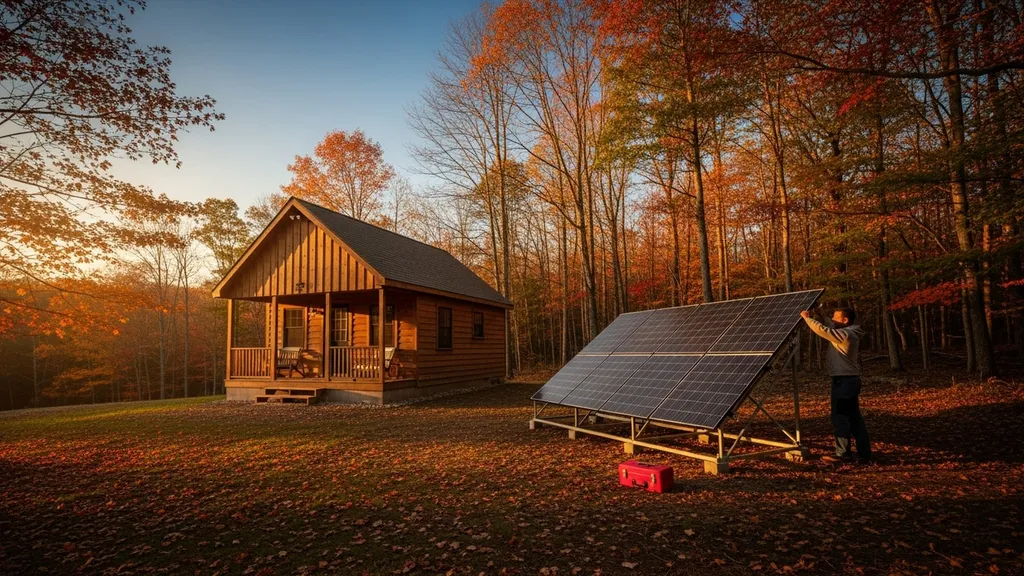
Practical guide to sizing a 1kW solar system for a cabin — output estimates, battery sizing, component choices, costs, and a step-by-step worked example.
1KW Solar System for Cabin: Complete Sizing Guide
A 1kw solar system for cabin is a compact, affordable way to bring reliable daytime power to a small retreat. This guide explains what a 1 kW array will realistically deliver, how to size batteries and controllers, and which appliances are realistic to run. It also walks through a clear worked example so builders can apply the math to their site and lifestyle.
TL;DR:
- A 1 kW array typically produces about 2.5–5 kWh/day depending on location; use array kW × peak sun hours × system efficiency to calculate local output.
- For a 3 kWh/day cabin and 2 days autonomy, plan roughly 7.5 kWh usable battery (3 × 2 ÷ 0.8 for LiFePO4); lead-acid needs much larger bank due to lower usable depth of discharge.
- A 1 kW off-grid system suits weekend cabins or highly trimmed year-round use; choose MPPT charge controllers, a pure sine inverter ~25–40% above continuous expected load, and plan for expansion or a generator for winter.
How a 1KW Solar System Works for a Cabin
A 1KW solar system is named for the nominal DC rating of the PV array — about 1,000 watts of module peak output under standard test conditions. In practice the full system includes panels, a charge controller, a battery bank if off-grid, and an inverter (for AC loads). Energy flow looks like this: panels → charge controller → battery → inverter → loads. That sequence matters because each stage adds losses.
Typical daily and seasonal output range is wide. A 1 kW array in the Pacific Northwest often delivers 2.5–3.5 kWh/day on average, while the U.S. Southwest commonly reaches 5–6 kWh/day. System-level efficiency after derating typically sits around 70–85% depending on equipment and site. Key derating factors include:
- Inverter efficiency (90–98%),
- Temperature losses (panels lose power at higher temps; expect 3–10% in hot climates),
- Wiring and mismatch losses (5–10%),
- Soiling, shading and snow (1–10% depending on maintenance and season).
For accurate planning, treat the 1 kW nominal array as the starting point and apply local solar resource data and real-world efficiency factors. Energy.gov.au offers straightforward definitions and sizing guidance for system designers and homeowners: size your solar system | energy.gov.au.
Calculate How Much Energy a 1kw System Actually Produces
Solar Insolation and Location: Kwh/m²/day
The central figure is peak sun hours (PSH), sometimes called equivalent full sun hours. PSH is the number of hours per day when solar irradiance equals 1,000 W/m². Typical ranges:
- Pacific Northwest: 2.5–3.5 PSH
- Midwest: 3.5–4.5 PSH
- Southwest/desert: 5–6 PSH
Daily kWh = array kW × peak sun hours × system efficiency. Example: 1 kW × 4 PSH × 0.8 efficiency = 3.2 kWh/day.
For a quick local estimate, industry tools like NREL's PVWatts provide site-specific outputs using satellite data and tilt/azimuth inputs. For national guidance and definitions, Statista notes that residential systems are far larger on average (7.2 kW in 2024) — that contrast helps set expectations for a 1 kW cabin array: https://www.statista.com/statistics/1421982/median-size-residential-solar-systems-united-states/?srsltid=AfmBOor9RyBCVh3eN6r-eny75nWHw5DEBNrmn0-W47aU0HA-JX6jytGQ
Derating Factors and Real Output Formula
System efficiency is the product of inverter efficiency, charge/discharge losses, wiring/mismatch, temperature and soiling. Typical contributors:
- Inverter efficiency: 90–98%
- Temperature losses: 3–10% (higher in hot, low-wind locations)
- Wiring & mismatch: 5–10%
- Soiling/shading: 1–5% (season-dependent)
Real output formula (practical): daily kWh = array kW × PSH × (0.70–0.85). Use the lower bound for conservative planning in cloudy or seasonal climates.
Monthly Output Example Table (cold vs Sunny Months)
| Location type | PSH (Winter) | PSH (Summer) | Est. daily kWh (winter) | Est. daily kWh (summer) |
|---|---|---|---|---|
| Low insolation (PNW) | 2.5 | 4.0 | 1.8–2.1 | 2.8–3.4 |
| Medium (Midwest) | 3.5 | 5.0 | 2.5–3.0 | 3.5–4.3 |
| High (Southwest) | 4.5 | 6.0 | 3.2–3.8 | 4.0–5.1 |
These ranges use system efficiency 0.7–0.85. For planners who want precise local numbers, PVWatts or regional insolation maps are recommended.
Sizing Checklist: Match Cabin Loads to a 1kw System
Create a Simple Loads Spreadsheet (essential vs Discretionary)
Start by listing devices, wattage, hours per day, and then compute daily kWh. Break loads into two groups: essential (fridge, pump, critical lighting) and discretionary (space heaters, electric stove, hair dryer). For accurate measurement, use a clamp meter or plug watt-meter to log device consumption before committing to a system.
Helpful internal resources: if cabin layout or occupant behavior is still undefined, consult the guide on how to build a small cabin.
Common Cabin Load Examples and Kwh/day Estimates
Here is a compact sample loads table for quick planning:
- Refrigerator (efficient 12V or modern A++ fridge): 1.0–3.0 kWh/day
- LED lighting & outlets: 0.5–1.0 kWh/day
- Phone/laptop charging: 0.1–0.3 kWh/day
- Water pump (12V DC pressure pump): 0.3–1.0 kWh/day (depends on run time)
- Small inverter coffee maker: 0.5–1.5 kWh per use (one use can blow a small budget)
- Electric space heater: 3–6 kWh/hour — generally unsuitable for 1 kW systems
If the sample cabin uses about 2.8 kWh/day (lights, fridge, pump, charging), a 1 kW array in a medium sun location (4 PSH, 80% efficiency → ~3.2 kWh/day) could cover daytime loads and partially top batteries for night use.
For pump sizing and plumbing impact on electrical demand, see the off-grid water design guide: off-grid water systems. To reduce hot water and pump demand, consider water-efficient plumbing options and natural lighting like install solar tubes to cut lighting loads. Insulation and air-sealing reduce heating and cooling demand; check best shed insulation for material choices.
Key points:
- Determine realistic average daily kWh before sizing panels.
- Identify high-drain appliances and plan alternatives (propane fridge, gas range, wood heat).
- Test actual device draws when possible; use measured data in your spreadsheet.
Battery and Storage Options for a 1kw Cabin System
How to Size Battery Capacity for Autonomy (kwh and Days)
Convert daily energy needs into battery capacity with this formula:
Battery kWh needed = (daily kWh × days of autonomy) ÷ (usable DoD × inverter-roundtrip efficiency)
Example: cabin needs 3.0 kWh/day, wants 2 days autonomy, using LiFePO4 with 80% usable DoD and 90% round-trip inverter/storage efficiency:
Battery = (3.0 × 2) ÷ (0.8 × 0.9) ≈ 8.3 kWh (gross bank), which rounds to a usable ~7.5 kWh LiFePO4 bank.
For lead-acid (AGM/flooded) with 50% DoD and lower cycle life, battery size must be significantly larger to provide equivalent usable capacity.
Battery Chemistry and Practical Pros/cons
- Lead-Acid (flooded/GEL/AGM): Lower upfront cost per battery unit in some markets, heavier weight, limited usable DoD (30–50%), frequent maintenance if flooded, cycle life 500–1,200 cycles. Not ideal if weight or frequent cycling is expected.
- Lithium Iron Phosphate (LiFePO4): Higher upfront cost but far longer cycle life (2,000–5,000 cycles), usable DoD of 80–95%, low maintenance, higher usable energy per kWh. Battery management system (BMS) required.
- Lithium NMC and other lithiums: Higher energy density but more thermal management needed; LiFePO4 is preferred for off-grid residential for safety and longevity.
Charge/discharge C-rate matters. A battery bank must support the inverter's peak draw. Match battery voltage (12, 24, 48 V) to inverter input and charge controller capacity; see the internal guide on match panel and battery voltage.
Battery comparison/specs table:
| Battery size | Chemistry | Usable kWh (typical) | Cycle life (approx) | Cabin use-case |
|---|---|---|---|---|
| 2 kWh | LiFePO4 | 1.6–1.8 | 2,000–3,000 | Minimal lights/chargers, weekend-only |
| 5 kWh | LiFePO4 | 4.0–4.5 | 2,000–4,000 | Small fridge + lighting for limited use |
| 10 kWh | LiFePO4 | 8.0–9.5 | 3,000–5,000 | Longer autonomy or modest heating loads when paired with efficient systems |
| 5–10 kWh | AGM/lead | 2.5–7.5 | 500–1,200 | Lower budget, high maintenance; larger bank needed for similar usable energy |
Note: The table shows usable kWh after accounting for recommended DoD. Cycle life is a rough guide; actual lifespans vary by temperature and how deeply the batteries are cycled.
Inverter, Charge Controller, and Mounting Choices for a 1kw Cabin
Inverter Sizing and Type (pure Sine vs Modified)
Choose a pure sine inverter for sensitive electronics (laptops, variable-speed pumps, AC motors). Rule of thumb: inverter continuous rating ≥ highest expected continuous AC load. Provide surge capacity for motor starts — many small fridges and pumps need 2–4× starting current for a few seconds. For a cabin with expected peak continuous loads around 800–1,000 W, select a 1,200–1,500 W pure sine inverter with surge capacity 2,400–3,000 W.
Popular consumer inverter brands include Victron Energy, OutBack, and Renogy; these are commonly used on small systems. Consult product specs for continuous and surge ratings.
MPPT vs PWM Charge Controllers
MPPT controllers convert higher-voltage PV input down to battery voltage while extracting maximum power — they often yield 10–30% more energy versus PWM under many real conditions. For a 1 kW array, an MPPT controller sized to handle array current at the chosen battery voltage (e.g., 48 V system, 20–30 A MPPT) is recommended. PWM controllers remain an option for very low-budget setups when panel voltage equals battery bank voltage, but they are less efficient.
Mounting Options: Roof, Ground, and Tilt Considerations
- Roof mounting saves ground space and improves aesthetics. Ensure roof structural strength and follow local code for penetrations. For roof constraints and panel size matching, see choosing panels for your roof.
- Ground mounts or small racks are ideal when shading or angle optimization is critical. They allow easier tilt adjustment and maintenance.
- Tilt: For year-round balance, tilt roughly at latitude. If the cabin is used mainly in winter, increase tilt to favor low sun angles. Secure racks for snow/wind loads in exposed sites.
- Consider snow-shedding angles and clearance for snow depth. Use corrosion-resistant hardware in coastal or humid environments.
For troubleshooting inverter problems and maintenance tips, see 5 common inverter issues.
Off-grid vs Grid-tied for a 1kw Cabin: Pros, Cons, and Expansion Paths
When a 1kw System Makes Sense Off-grid
A 1 kW off-grid system fits a weekend retreat or a four-season cabin with strict load management: efficient LED lighting, small efficient fridge or propane refrigeration, conservative hot-water strategies, and limited heating (wood stove or propane). Seasonal variation and long cloudy stretches mean batteries or a backup generator are necessary for reliability.
If the cabin occupant expects electric space heating, an electric range, or frequent high-power appliance use, a 1 kW off-grid setup will be inadequate. In those cases consider a larger system or hybrid arrangement.
Grid-tied or Hybrid Alternatives and Future Expansion
Grid-tied systems remove the need for large batteries; net metering can allow a small array to offset bills without full storage. Hybrid systems combine modest battery backup with grid or generator support for outages.
For a clear plan to grow, start with a 1 kW array and a small battery sized for overnight loads, then add panels or batteries later to reach 2–3 kW if needs increase. For expansion guidance and cost trade-offs when combining grid or generator backup, see the hybrid energy analysis: hybrid energy cost breakdown. For a direct comparison if thinking of a slightly larger baseline, compare a 1 kW plan to the 2 kW shed sizing comparison.
Permitting and interconnection rules vary; consult the local utility and electrical code. For a deeper explainer on the differences and rules, see grid-tied vs off-grid explanation.
System Sizing Worked Example: Step-by-step Calculation (includes Comparison Table)
Define a Sample Cabin Profile and Goals
Sample cabin: weekend retreat used year-round for short stays. Goals: run efficient fridge, LED lights, phone/laptop charging, and a 12V water pump. Target reliability: 1 night of battery backup (overnight autonomy) plus daytime operation on solar.
Measured/estimated daily loads:
- Fridge: 2.0 kWh/day
- Lights & outlets: 0.7 kWh/day
- Pump: 0.3 kWh/day
- Charging/other: 0.2 kWh/day
Total = 3.2 kWh/day
Stepwise Math: From Loads to Panel & Battery Sizing
- Choose desired autonomy: 1 day (overnight) → days = 1.
- Decide battery chemistry: LiFePO4 usable DoD = 0.8; inverter/battery round-trip efficiency = 0.9.
- Battery required = (3.2 kWh × 1 day) ÷ (0.8 × 0.9) ≈ 4.4 kWh → round to 5 kWh usable bank.
- Panel sizing: assume medium sun 4 PSH and system efficiency 0.8.
- Daily energy needed from panels = 3.2 kWh ÷ 0.8 (to account for battery/inverter losses) ≈ 4.0 kWh/day produced requirement.
- Required array kW = 4.0 ÷ 4 PSH = 1.0 kW. So a nominal 1 kW array is the minimum.
- Add headroom for winter and cloudy days. Consider 25–50% headroom for seasonal shortfall. A practical design uses three 330 W panels (~990 W) or four 330 W panels (~1.32 kW) depending on site.
- Inverter sizing: expected peak AC draw likely under 1,000 W, but fridge startup may need surge. Choose a 1,200–1,500 W pure sine inverter with 2,400 W surge.
Panel & Battery Specs Table and Component Checklist
| Component | Example spec | Why chosen |
|---|---|---|
| Panels | 3 × 330 W (990 W) or 4 × 330 W (1.32 kW) | Fit modest roof/ground rack; 3 panels cover average, 4 add winter headroom |
| Charge controller | MPPT 30 A (for 48 V system) or MPPT 60 A (for 24 V system) | MPPT improves harvest vs PWM |
| Battery | 5 kWh usable LiFePO4 (approx 6.5–7.0 kWh nominal) | Provides ~1-day autonomy with margin |
| Inverter | 1,200–1,500 W pure sine, 2,400–3,000 W surge | Handles continuous loads and motor starts |
| Backup | Portable 2–3 kW generator or propane fridge | For prolonged cloudy stretches |
Before installing, consider including a small generator for multi-day outages or planning to expand panels later. Cold-weather efficiency losses (battery capacity can drop at low temps and panel output can be affected by snow cover) should be countered with insulated battery enclosures and panel tilt to encourage snow shedding.
For a visual demonstration, check out this video on how many solar panels to power a house:
Costing, Permits, and Practical DIY Installation Tips
Rough Budget Buckets and Cost-saving Moves
Common budget buckets:
- Panels (hardware, mounting) — panels are usually priced per watt in market listings
- Inverter and charge controller — pick reliable brands with good documentation
- Batteries — often the largest single cost; chemistry choice drives long-term value
- Balance of system (fuses, breakers, wiring, disconnects, racks) — don’t skimp on correct gauge wire and safety devices
- Permits/inspection and possible electrician labor
To save money: test and reduce loads first, buy panels from reputable bulk sellers, and choose a modest battery sized to your real needs rather than overbuilding. For panel shopping, see the internal list of budget-friendly panel options.
Permits, Safety, and Inspection Checklist
- Obtain electrical permits and follow NEC or local code sections for PV installations.
- Install properly rated disconnects and fusing between panels, controller, battery and inverter.
- Ground the array and system per code and use listed equipment.
- If using flooded lead-acid batteries, provide ventilation; lithiums need appropriate BMS and temperature controls.
- Label all circuits and provide a clear single-line diagram for inspectors.
Common DIY Mistakes to Avoid
- Underestimating actual daily loads — always measure.
- Buying undersized wiring and losing power to voltage drop.
- Skipping proper fusing and disconnects — fire risk.
- Mismatching panel voltage to charge controller/battery without checking MPPT input specs.
- Installing batteries in unvented, freezing or overheated locations.
For installation and commissioning steps, NREL offers an authoritative PDF covering off-grid system installation, operations, and maintenance: 6. Installation, Operations, and Maintenance of Off-Grid Solar Systems. Also check local building permits early in the planning process.
The Bottom Line
A 1kw solar system for cabin can reliably support a modest load profile (2–4 kWh/day) if occupants prioritize efficient appliances, lighting, and conservative heating strategies. Expect seasonal swings; size batteries for desired autonomy and choose MPPT controllers and a pure sine inverter to maximize performance. Next steps: measure actual loads, check local peak sun hours, choose battery chemistry, and plan for expansion or backup if needs increase.
Frequently Asked Questions
Can a 1kW system run a refrigerator?
Yes, but it depends on the fridge type and duty cycle. Efficient 12V DC fridges or modern high-efficiency AC fridges that use 1–3 kWh/day can be run from a 1 kW array if panel output and battery sizing match the daily consumption and fridge start-up surge is handled by the inverter.
For extended cloudy periods consider a propane fridge or larger array; see the off-grid refrigeration options for strategies to keep refrigeration within a small solar budget: [off-grid refrigeration options](/blog/off-grid-refrigeration-propane-vs-solar-options).
How big a battery do I need for overnight use?
Calculate: battery kWh = daily kWh × days of autonomy ÷ (usable DoD × round-trip efficiency). For example, 3 kWh/day with 1 night autonomy using LiFePO4 (DoD 0.8, round-trip 0.9) needs about 4.2–4.5 kWh usable, so select a 5 kWh usable bank to have margin.
What happens in winter or on cloudy stretches?
Output drops due to lower peak sun hours and possible snow cover. Battery capacity can also be reduced by cold temperatures. Mitigations include adding panel capacity for winter, tilting panels steeper for low sun, insulating and heating battery enclosures, and keeping a generator or propane backup for extended low-sun periods.
Can I start with 1kW and expand later?
Yes. A common strategy is to install a 1 kW array plus a small battery and design the charge controller and inverter system with capacity for additional panels or batteries. For a direct expansion plan and comparison to a larger base system, see the 2 kW shed sizing guide: 2 kW shed sizing comparison.
Do I need a generator with 1kW off-grid?
Often yes for year-round reliability, especially in cold or very cloudy climates. A small portable generator sized 2–3 kW can recharge batteries during extended low-sun periods and handle loads outside the array’s capacity. Hybrid options and grid connections reduce this need.