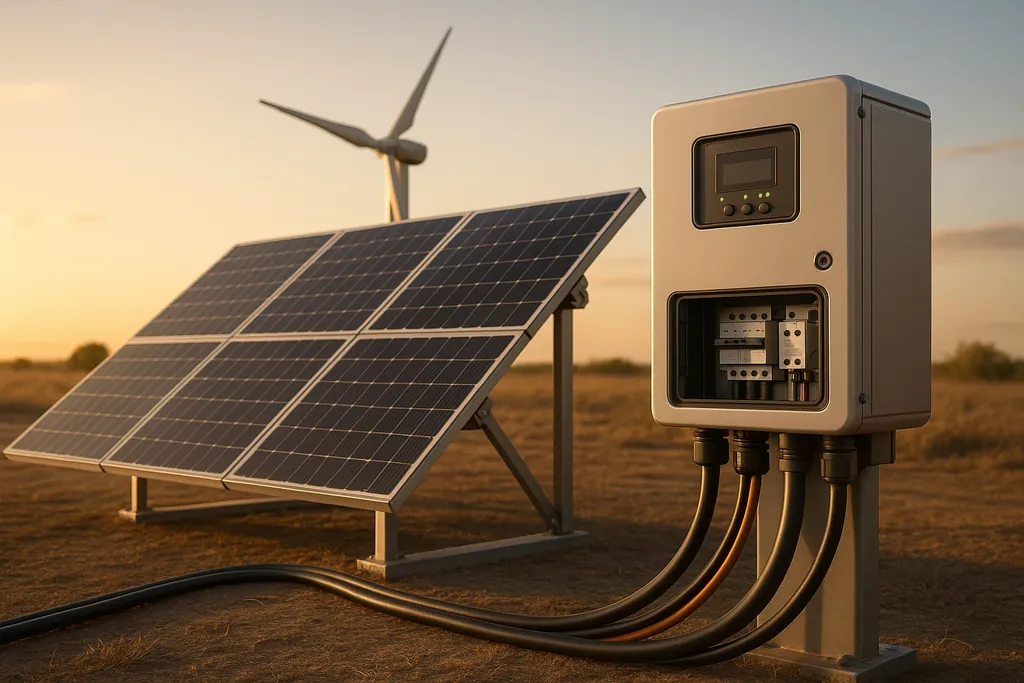
Explore the pros and cons of AC and DC coupling in hybrid energy systems to optimize efficiency, costs, and scalability for your setup.
Ultimate Guide to AC and DC Coupling in Hybrid Systems
Choosing between AC and DC coupling can impact your hybrid energy system's efficiency, cost, and future scalability. Here's a quick breakdown:
- DC Coupling: Best for new installations with higher efficiency (up to 98%) and lower upfront costs.
- AC Coupling: Ideal for retrofitting existing solar systems, offering easier integration and greater flexibility.
Key Differences:
- Efficiency:
- DC coupling achieves up to 98% efficiency with fewer energy conversions.
- AC coupling ranges from 90–94% efficiency due to multiple conversion steps.
- Cost:
- DC coupling is generally 10–15% cheaper for new installations.
- AC coupling is more cost-effective for upgrades or retrofits.
- Flexibility:
- AC coupling supports easier system expansion and integration with existing setups.
- DC coupling may require a complete system overhaul for upgrades.
- Reliability:
- DC systems rely on a single inverter, making them more vulnerable to failures.
- AC systems use multiple inverters, providing redundancy.
Quick Comparison:
| Feature | DC Coupling | AC Coupling |
|---|---|---|
| Efficiency | Up to 98% | 90–94% |
| Installation Cost | Lower for new systems | Lower for retrofits |
| Flexibility | Limited | High |
| System Expansion | Challenging | Easier |
| Reliability | Single inverter risk | Redundant inverters |
Bottom Line:
- Go with DC coupling for maximum efficiency in new systems.
- Choose AC coupling for retrofits or when flexibility and ease of expansion are priorities.
Read on for detailed explanations, benefits, challenges, and installation tips for both coupling methods.
DC Coupled vs. AC Coupled Solar Systems: Find the Best Fit for Your Setup
AC Coupling Explained
AC coupling builds on the basics of hybrid systems by seamlessly integrating battery storage with solar power setups. It manages the flow of electricity between solar panels, batteries, household appliances, and the grid.
AC Coupling Basics
In an AC-coupled system, solar panels produce direct current (DC) electricity, which is processed through three key components:
- Grid-tie PV inverter: Converts solar-generated DC power into alternating current (AC) for use in the home or grid.
- Battery inverter/charger: Manages the flow of power to and from the batteries.
- Battery Management System (BMS): Monitors and controls battery performance.
Here's how it works: Solar panels first supply power to household appliances. Any surplus energy is converted and stored in the battery. When needed, stored energy is converted back into AC power for use at home.
> "In an AC-coupled system, a grid-tied PV inverter is connected to the output of a Multi, Inverter or Quattro. PV power is first used to power the loads, then to charge the battery, and any excess PV power can be fed back to the grid." - Victron Energy
This setup not only supports efficient energy use but also offers notable advantages for homeowners.
Benefits of AC Coupling
AC coupling brings several practical benefits to the table:
| Benefit | Description |
|---|---|
| Installation Flexibility | Can integrate with any inverter type and existing solar systems. |
| Charging Versatility | Allows battery charging from both solar panels and the grid. |
| System Expansion | Easier to upgrade or modify compared to DC-coupled systems. |
| Cost Savings | Reduces installation costs when adding storage to existing solar setups. |
For example, in 2020, homeowners who installed solar panels saved an average of $2,000 annually on electricity bills.
Common AC Coupling Issues
While AC coupling offers numerous benefits, it also comes with some challenges that require careful management.
- Efficiency Losses
Due to multiple energy conversions, AC-coupled systems typically achieve 90-94% efficiency, compared to the 98% efficiency of DC-coupled systems.
- Managing Power During Outages
During grid outages, excess solar production can be tricky to handle. Modern systems address this with frequency-shifting technology:
> "Frequency shifting is used to regulate the output power of a Grid-tie PV Inverter, or Grid-tie Wind inverter, by changing the frequency of the AC. The MultiPlus (or Quattro) will automatically control the frequency to prevent overcharging the battery." - Victron Energy
- Optimizing System Performance
To get the most out of an AC-coupled system, consider the following:
- Enable Rule 21 frequency-watts settings.
- Use a reliable Battery Management System.
- Ensure battery capacity meets your energy needs.
- Explore adding DC-coupled PV systems for supplemental power.
It's worth noting that high-frequency grid-tied PV inverters typically operate at around 98% efficiency, while 48V battery inverters achieve about 96% efficiency. These figures highlight the importance of selecting and configuring the right components for your system.
DC Coupling Explained
DC coupling simplifies the integration of solar panels and batteries, making it an excellent choice for new installations and off-grid setups. By directly connecting solar panels to batteries through charge controllers, this setup ensures optimal efficiency.
DC Coupling Basics
A DC-coupled system connects solar panels to batteries via a charge controller, with a single inverter handling the conversion of stored DC power into AC for household use.
| Component | Function |
|---|---|
| Solar Panels | Generate DC electricity |
| Charge Controller | Regulates battery charging to prevent overcharging |
| Battery Bank | Stores DC power |
| Single Inverter | Converts stored DC power to AC for home use |
> "DC-coupling refers to a co-located battery and solar farm being connected behind a shared inverter - where power is in direct current (DC)." - Modo Energy
This direct DC power flow reduces conversion losses and unlocks several practical advantages.
Benefits of DC Coupling
DC coupling stands out for its efficiency and cost-effectiveness, especially in new systems and off-grid applications:
| Benefit | Details |
|---|---|
| Efficiency | Reduces conversion losses, achieving up to 98% efficiency |
| Lower Equipment Costs | Requires only one inverter, cutting down on additional components |
| Simplified Installation | Speeds up installation and lowers labor costs |
| Enhanced Storage | Increases the ability to store excess energy |
| Dead Battery Recovery | Can recharge fully depleted batteries using solar power |
> "What gives the efficiency of DC systems an edge over their AC counterparts is that power from the solar panels is directly used by the loads without needing conversion, which means the inverter doesn't have to supply as much power and the batteries are cycled less often." - EG4 Electronics
Common DC Coupling Issues
Despite its advantages, DC coupling does come with a few challenges:
- Installation Constraints: The inverter must be installed close to the battery storage, limiting flexibility in component placement.
- System Vulnerability: Since the system relies on a single inverter, a failure can disrupt both solar generation and battery operation.
- Expansion Challenges: Adding capacity to an existing DC-coupled system can be tricky due to:
- Compatibility requirements between components
- Limited flexibility in equipment placement
- Potential need for a complete system upgrade
These concerns have spurred manufacturers to create more standardized solutions for DC-coupled systems.
AC vs DC Coupling: Making Your Choice
Deciding between AC and DC coupling can significantly influence your hybrid system's efficiency and cost-effectiveness over time. Here's a breakdown to help guide your decision.
Power Loss Comparison
The key difference in efficiency between AC and DC coupling lies in the number of power conversion stages. Fewer conversions mean less energy loss, which gives DC coupling an edge:
| Coupling Type | Efficiency Rate | Conversion Steps | Power Loss Factors |
|---|---|---|---|
| DC Coupling | 98% | Single conversion | Minimal loss from one conversion |
| AC Coupling | 90–94% | Triple conversion | Higher losses due to multiple conversion steps |
With AC coupling, the additional conversion processes can lead to noticeable energy losses over time, making DC coupling the more efficient option for most systems.
Price Comparison
The cost of AC and DC coupling depends heavily on whether you're installing a brand-new system or upgrading an existing one:
| Cost Factor | DC Coupling | AC Coupling |
|---|---|---|
| New Installation | 10–15% lower initial cost | Higher component costs |
| Annual Maintenance | $100–200 | $150–300 |
| Retrofit Cost | Higher (requires a new inverter) | Lower (uses existing equipment) |
For new installations, DC coupling often delivers better value due to its lower upfront and maintenance costs. On the other hand, AC coupling can be a more economical choice when retrofitting an existing solar system, as it integrates seamlessly with the current inverter.
System Growth Options
When it comes to expanding your hybrid system, both AC and DC coupling have unique advantages. A notable example is the Cirencester Hybrid Solar Farm in Great Britain, which uses DC coupling to combine 24 MWp of solar capacity with a 10 MW battery storage system.
Here's how each method supports system growth:
| Growth Factor | DC Coupling | AC Coupling |
|---|---|---|
| Solar Expansion | Allows oversizing panels beyond the inverter's capacity | Simplifies adding new arrays independently |
| Battery Addition | Offers seamless integration with batteries | Enables flexible placement of new components |
| System Upgrades | May require significant changes | Allows for easier replacement of individual components |
Both methods have their strengths, but your choice should align with your current setup and long-term goals. Up next, we'll explore the installation and setup process in detail.
Installation and Setup Guide
To ensure your hybrid system is installed safely and operates effectively, follow these detailed guidelines.
Safety Requirements
Adhering to safety protocols is crucial for a successful installation. Here's what you need to know:
| Safety Aspect | Requirements | Important Notes |
|---|---|---|
| Wiring Protection | Use metal conduit for DC wiring | Required for indoor installations |
| Ventilation | Maintain a 20 in (50 cm) floor clearance | Ensure consistent ceiling distance |
| Location | Choose a dry, moisture-free area | Prevents damage to components |
| Risk Assessment | Conduct a professional evaluation | Mandatory before installation |
> "Risk Assessment is used to improve the plant's conceptual design and allows for the reduction of the remaining risks by updating the original risk assessment." - Lettner et al.
Setup Steps
Before diving into the installation, complete system sizing and design calculations. Once that's done, follow these steps:
- Pre-Installation Planning
Prepare a load table that accounts for energy needs during both summer and winter. If you're unsure about calculations, consult a professional system designer.
- Component Installation
Install the hybrid inverter in a location that allows for proper airflow and ventilation. Ensure it meets clearance requirements for optimal performance.
- System Integration
- For AC coupling, connect the battery-based inverter to your existing grid-tied solar inverter.
- For DC coupling, directly link your solar panels to the hybrid inverter. This setup allows for more efficient energy conversion.
Once the system is installed, it's essential to stick to a maintenance schedule to keep everything running smoothly.
Maintenance Guide
Regular maintenance is key to ensuring your hybrid system operates at its best. Here's a quick overview of tasks and their frequency:
| Maintenance Task | Frequency | Action Items |
|---|---|---|
| Visual Inspection | Monthly | Check for signs of wear, damage, or corrosion |
| Performance Check | Quarterly | Monitor voltage, current, and power output |
| Professional Service | Annually | Schedule a technical inspection by a qualified expert |
| Cleaning | As needed | Remove dust and ensure proper ventilation |
Additionally, keep an eye on the inverter's operating temperature and ensure the ventilation system remains unobstructed. Maintain detailed records of all inspections and follow the manufacturer's recommendations for professional servicing. This proactive approach will help extend your system's lifespan and reliability.
Conclusion
Deciding between AC and DC coupling comes down to factors like performance, cost, and the specifics of your energy setup. DC-coupled systems are often the go-to for new installations, boasting impressive battery charging efficiency - around 98% compared to AC coupling's 90–94% range. This efficiency edge makes DC coupling especially appealing for off-grid scenarios.
For those with existing solar systems, ease of integration often takes precedence. As Natalia Opie from RatedPower explains:
> "AC-coupled systems are the preferred option for larger and utility-scale plants... because while AC-coupled systems are slightly less efficient at charging batteries (90–94% vs 98% achieved by DC-coupled), they are far easier to install, especially into an existing system"
AC-coupled setups also shine when it comes to flexibility. They're better suited for system expansions and participating in grid services programs. This flexibility can significantly influence long-term planning and design choices.
Here's a quick breakdown to guide your decision:
| System Type | Best For | Key Advantage |
|---|---|---|
| DC Coupling | New installations | Higher efficiency (98%) |
| AC Coupling | Existing solar systems | Easier integration |
| Hybrid Solution | Complex power needs | Maximum flexibility |
Another factor to weigh is system resilience. AC-coupled systems provide redundancy by using multiple inverters, which can keep the system running even if one fails. On the other hand, DC-coupled systems, while more efficient, rely on a single inverter - making the entire system vulnerable to failure if that inverter goes down.
Ultimately, the right choice depends on your energy requirements, existing infrastructure, and long-term goals. By aligning your decision with these factors, you can balance efficiency, flexibility, and reliability to meet your needs.
FAQs
What should I consider when choosing between AC and DC coupling for a hybrid energy system?
When choosing between AC coupling and DC coupling for a hybrid energy system, there are a few important considerations to weigh:
- Efficiency: DC coupling tends to be more efficient because it typically involves just one conversion - DC to AC - when energy storage is used. On the other hand, AC coupling requires multiple conversions, which can result in energy losses along the way.
- Cost: DC-coupled systems are often less expensive since they need fewer components, like inverters, and are easier to install. That said, the exact costs can vary depending on the specifics of your setup.
- Existing infrastructure: If you're upgrading an already-installed AC system, AC coupling might be the more practical and economical choice. It integrates more seamlessly with components that are already in place.
- Flexibility: AC coupling provides more adaptability, especially for larger grid-tied systems or configurations that require more complex setups.
By taking the time to assess these factors, you can select the option that aligns best with your energy goals and budget. For additional tips on building energy-efficient systems, check out resources like DIY Eco Homes, which offer practical advice for creating affordable and eco-conscious living spaces.
How does choosing between AC and DC coupling impact the scalability and maintenance of hybrid energy systems?
The decision between AC and DC coupling is a critical factor in managing and expanding hybrid energy systems. With DC coupling, solar panels connect directly to batteries, which minimizes energy conversion losses. This streamlined approach not only boosts efficiency but also simplifies system expansion - additional solar panels can be integrated without major modifications. Plus, it helps keep long-term operational costs down.
In contrast, AC coupling provides more flexibility and is well-suited for integrating with existing setups. However, it requires multiple energy conversions between AC and DC, which can slightly lower efficiency and make maintenance a bit more challenging. For those focused on easier system expansions or reducing maintenance complexity, DC coupling tends to be the more practical choice.
What are the challenges of using AC-coupled systems during power outages, and how can they be addressed?
AC-coupled systems have a notable limitation during grid outages: grid-tied inverters automatically shut down to prevent electricity from flowing back into the grid. This safety feature is crucial for protecting utility workers but creates a problem - solar panels can't supply power unless you have a battery backup system. Without a battery-based inverter, your essential appliances will remain offline when the grid goes down.
The solution? Installing a battery-based inverter and a transfer switch. The inverter takes charge by detecting grid outages and seamlessly switching to battery power, ensuring critical appliances stay operational. Meanwhile, the transfer switch disconnects your home from the grid, allowing your solar panels to keep charging the batteries and powering your home during the daytime. Thoughtful planning of which circuits to connect to this backup system is key to making the most of your energy and keeping vital devices running during blackouts.