Practical guide to Roxul (Rockwool) mineral wool insulation—performance, installation, costs, and choosing the right product for DIY eco-homes.
Mineral Wool Insulation: Roxul Rockwool Guide
Mineral wool insulation is a stone- and slag-based product used for thermal, acoustic, and fire-resistive applications. For budget-conscious DIY eco-home builders, understanding mineral wool insulation early—its R-values, moisture behavior, installation techniques, and price trade-offs—avoids costly rework and improves long-term performance. This guide explains how Roxul/Rockwool products fit typical stud-wall, attic, and basement assemblies, shows realistic coverage math, and gives hands-on installation tips so you can choose and install the right product for your project.
TL;DR:
- Mineral wool insulation delivers about R-3.0 to R-4.0 per inch depending on product and density, with non-combustible fire performance and strong acoustic benefits.
- For DIY walls, use cavity batts sized to your stud depth (R-13 for 2x4, R-21–R-23 for 2x6) and add a continuous exterior layer when you need thermal break and passive-house level performance.
- Measure cavity area, avoid compressing batts, install a continuous air barrier, and use PPE (N95, gloves, eye protection) when cutting and fitting batts.
Quick Key Points: What Diyers Should Know About Roxul Rockwool
Top 6 Takeaways
- Mineral wool insulation is made from molten rock or slag spun into fibers; it’s generally non-combustible and often used where fire resistance matters. See the Insulation Institute’s comparison of fiberglass and mineral wool for details: fiberglass & mineral wool guide.
- Typical R-values run roughly R-3.0 to R-4.0 per inch depending on density and product; manufacturers report different R/inch for batts, rigid boards, and loose-fill.
- Mineral wool handles moisture differently than cellulose or fiberglass—many products are treated to be water-repellent, and assemblies generally retain drying potential if detailed correctly.
- Acoustic performance is a major benefit—products like Safe’n’Sound or Comfortbatt are marketed for sound control in partitions and floor/ceiling assemblies.
- Material cost per square foot is often higher than basic fiberglass batts but lower than closed-cell spray foam; labor for DIY batts is manageable for most builders.
- Mineral wool is widely available at specialty distributors and many big-box stores, though SKUs and regional product names may vary.
When to Choose Mineral Wool
- Choose mineral wool when fire resistance and sound control are priorities, or when you want a stone-based product with higher recycled content reported by some manufacturers.
- If you need a low-maintenance, non-combustible insulation in basements, party walls, or around mechanical penetrations, mineral wool is a strong choice.
- If you need the highest R/inch (for tight exterior envelope space) or a true air-sealing foam layer, consider hybrid assemblies combining mineral wool with exterior continuous foam—see the exterior foam options guide for pairing strategies.
What is Mineral Wool (roxul/rockwool) and How It's Made
Raw Materials and Manufacturing Process
Mineral wool is made by melting natural rock (basalt, diabase) or recycled industrial slag and spinning the molten material into fibers. The spinning (or drawing) process creates a mat of fibers that is then bonded with a small amount of phenolic or inorganic binder. Manufacturers report recycled content ranges—some products include substantial post-industrial slag, improving sustainability metrics. The production line controls density and binder content so the same product family can be offered as batts, boards, or loose-fill.
Composition summary:
- Primary feedstock: volcanic rock or blast-furnace slag
- Binding agent: manufacturer-specified resin
- Optional treatment: water repellents or facings for specific applications
Manufacturers commonly sell under brand lines such as Comfortbatt and Safe’n’Sound—useful examples when comparing products but check datasheets for exact specs.
Product Formats: Batts, Slabs, Boards, Loose-fill
- Batts: Friction-fit or faced batts sized for stud cavities. Best for 2x4 and 2x6 walls, and many DIY attic applications.
- Slabs/boards: Denser, often used for exterior continuous insulation, firestopping, or where dimensional stability matters.
- Rigid boards: Higher compressive strength for continuous insulation under cladding or in roof assemblies.
- Loose-fill: Rare for mineral wool in residential retrofits, but available for irregular cavities.
For end-of-life and recycled-content considerations, follow a local reuse/recycling checklist. See our recycling checklist for sourcing recycled-content materials and disposal options.
Thermal Performance and R-values of Roxul Rockwool
Typical R-values by Thickness and Product Type
R-values vary by product density and format. Below is a compact reference table showing common product types and typical R-values. These are representative figures—always check manufacturer datasheets for exact R/inch.
| Product type | Common thickness | Typical density | Typical R/inch |
|---|---|---|---|
| Cavity batt (Comfortbatt-style) | 3.5" (2x4), 5.5" (2x6) | Low-medium | R-3.0–R-3.3 |
| High-density acoustic batt (Safe’n’Sound) | 3.5"–6" | Medium-high | R-3.3–R-3.7 |
| Rigid mineral wool board | 1"–4" | High | R-3.0–R-4.0 |
| Loose-fill mineral wool | Variable | Low | R-3.0–R-3.7 |
Practical examples:
- A 2x4 stud cavity filled with a typical mineral wool batt often targets R-13 (≈3.5" at R-3.7/inch for higher-density products or R-3.3/inch for standard batts).
- A 2x6 cavity filled to depth can reach R-21 to R-23 depending on product.
For mapping common R-values to required stud depths, see our r-value comparison R13 vs R23 article and our attic recommendations in attic insulation choices.
How Mineral Wool Compares to Fiberglass, Cellulose and Foam
- Mineral wool vs fiberglass: R/inch is comparable; mineral wool often has better acoustic and fire properties and slightly higher density. The Insulation Institute discusses differences in thermal and acoustic performance in their comparison of fiberglass and mineral wool: fiberglass & mineral wool guide.
- Mineral wool vs cellulose: Cellulose settles differently; cellulose can provide better cavity fill for odd shapes but may require different moisture management. Performance varies with installation quality.
- Mineral wool vs closed-cell spray foam and polyiso: Spray foam and polyiso offer higher R/inch (closed-cell foam ≈ R-6–R-7 per inch; polyiso rigid boards ≈ R-6 per inch at best). When space for insulation is limited, foam products provide superior R in less thickness, but at a cost premium and different fire/air-barrier behavior.
For installation-sensitive attic choices and mixing layers, our attic guide covers when to combine materials to meet code and performance goals.
Moisture, Fire, and Acoustic Properties of Roxul/rockwool
Water Behavior and Drying Potential
Mineral wool fibers do not absorb water the way cellulose does; many manufacturers apply hydrophobic or water-repellent treatments to help resist bulk water intrusion. That said, mineral wool does not form a vapor or air barrier—assemblies must allow drying toward at least one side. Follow established moisture control strategies and bulk-water detailing in our moisture control guide to avoid locked-in moisture.
Practical rules:
- Keep cladding and flashing details watertight.
- Allow drying to the interior or exterior depending on climate and vapor-control placement.
- Avoid placing impermeable layers on both sides of a filled cavity.
Fire Resistance and Safety Performance
Mineral wool is classified as non-combustible and is widely used for fire-stopping and in rated assemblies. Many mineral wool products carry fire-resistance listings and are suitable where code calls for non-combustible insulation. See product datasheets and relevant ASTM or fire-rating standards for rated assemblies. For practical fire-stopping around penetrations, mineral wool boards and packs are commonly used because they won’t burn and they tolerate high temperatures.
Sound Absorption and Acoustic Use-cases
Acoustic batts like Safe’n’Sound are designed with higher density and fiber structure to improve noise reduction coefficient (NRC) and reduce airborne transmission. Use mineral wool in party walls, floor/ceiling assemblies, and interior partitions when privacy and sound control matter. Denser slabs or double-layer approaches improve low-frequency damping in multi-storey assemblies.
For a third-party perspective on performance trade-offs and comparisons with other insulations, see the contractor guide: Top mineral wool insulation guide 2026.
Choosing the Right Roxul Product for Your DIY Eco-home
Walls: Cavity Batts vs Continuous Insulation
- Cavity batts: Best for standard 2x4 and 2x6 framing. Choose batt thickness to match cavity depth and avoid compressing material.
- Continuous insulation (CI): Use mineral wool boards or pair cavity batts with exterior foam to reduce thermal bridging for passive-house-level performance. Learn more about CI pairing and when to use exterior foam in our exterior foam options guide.
Comparison table (quick buying guide):
| Use case | Product type | Nominal R/inch | Thickness options | Pros for DIY | Cons for DIY |
|---|---|---|---|---|---|
| Stud cavity (standard) | Cavity batt | R-3.0–R-3.7 | 3.5", 5.5" | Easy fit, low skill | Thermal bridging at studs |
| Continuous exterior | Rigid mineral wool board | R-3.0–R-4.0 | 1"–4"+ | Non-combustible, durable | Requires careful detailing |
| Acoustic partitions | High-density batts | R-3.3–R-3.7 | 3.5"–6" | Good sound control | Heavier, pricier |
| Basement walls | Dense board or batt | R-3.0–R-3.7 | Variable | Moisture-tolerant variants | Needs proper drainage/flashing |
Match product choice to your assembly: a double-stud wall or Larsen truss enables more cavity insulation but needs attention to vapor control and airtightness. For SIPs or when comparing alternatives, review the SIPs guide before deciding.
Climate note: In cold climates favor assemblies that keep sheathing warm—adding exterior mineral wool or exterior foam reduces condensation risk on sheathing and helps meet Passive House Institute (PHI/PHIUS) recommendations.
Roofs and Attics: Pitched vs Flat Roof Approaches
- Pitched roofs: Mineral wool is used in rafter cavities or above-ceiling spaces; in retrofit scenarios combine with roof deck venting or an unvented, insulated roof deck assembly using rigid boards.
- Flat roofs: Use boards designed for compression and moisture resistance; ensure vapor control is correct for your climate.
Basements and Floors: Durable Options
Dense mineral wool boards resist crushing and maintain R-value when used on foundation walls or under slab-edge insulation. For small floors and tiny homes, review tiny house insulation advice and our shed floor insulation tips for size-specific recommendations.
Installing Roxul/rockwool: Tools, Techniques, and Safety
Cutting and Fitting Mineral Wool Correctly
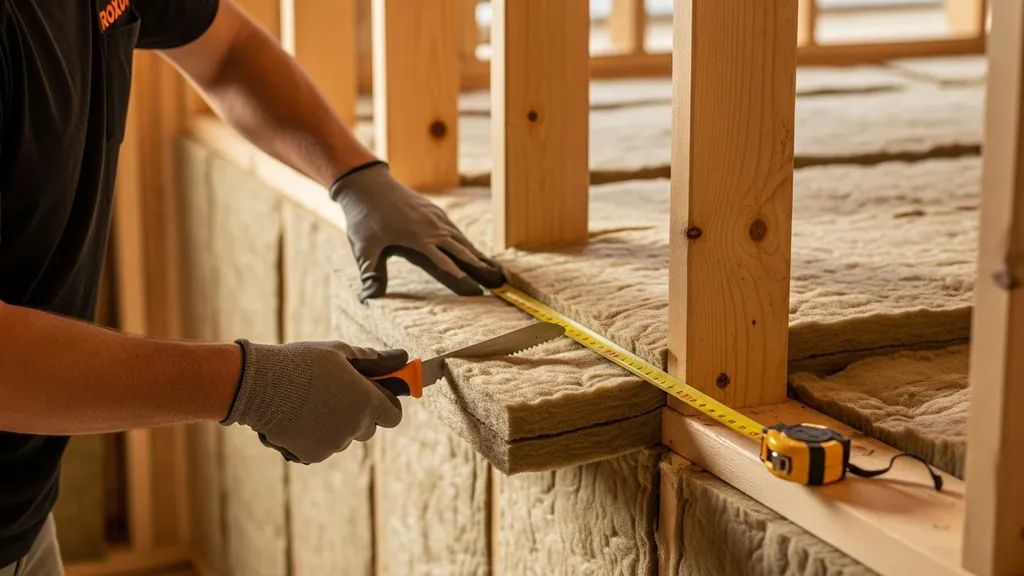
Measure cavity widths and cut batts 1/8"–1/4" wider than cavity for friction fit—do not compress batts to force fit, as compression reduces R-value. Tools: serrated insulation knife, measuring tape, straightedge. For clean edges around windows or electrical boxes, make relief cuts and pack gently; avoid gaps around boxes by using small offcuts to fill voids.
Steps:
- Measure cavity depth and width.
- Cut batt to length with serrated knife on a cutting board or sawhorse.
- Friction-fit into cavity. For faced batts, staple flanges only where specified by manufacturer.
- Trim around penetrations; fill small voids with offcuts.
Air-sealing, Vapor Control, and Interface Details
Mineral wool is not an air barrier. Seal the assembly using continuous membrane, taped sheathing, or interior drywall and tape connections. Where to place vapor control depends on climate; consult our moisture control guide and local code. For advanced framing and reduced thermal bridging, see advanced framing tips and the Larsen truss wall guide for deep-cavity strategies. Cold-climate builders should check cold-climate Larsen truss tips.
Safety Gear and Handling Best Practices
- Respiratory: N95 at minimum; half-mask respirator with P100 filters when cutting large quantities.
- Skin: Work gloves to reduce itching; long sleeves are helpful.
- Eyes: Safety glasses.
- Cleanup: Use a shop vacuum fitted with a HEPA filter or leave debris in bags for disposal; avoid dry sweeping.
Before you watch a short installation demo, note that local code and fire-blocking requirements vary—some installations need specific fasteners or rated assemblies.
This video provides a helpful walkthrough of the key concepts:
For professional-grade specs and installation notes, review the manufacturer spec sections and detailed guides such as the BuildSite mineral wool section: ROCKWOOL afb evo guide.
Cost, Availability, and Alternatives for Budget DIY Builders
Typical Cost Breakdown and Coverage Estimates
Material costs vary regionally. Ballpark ranges:
- Cavity batts (material only): $0.30–$1.50 per sq ft depending on product and density.
- Rigid boards: higher, often $1.50–$3.50 per sq ft.
- Installation time for DIY: filling a standard 10'×12' wall (eight 8' studs) can take a few hours for one person including cutting and fitting.
Coverage math example:
- A 10'×12' exterior wall with 8' studs has ~96 sq ft of wall area. For a 2x6 cavity with 5.5" batts, you’ll need enough batts to cover that area—batts are sold in packs that list coverage per pack on the bag. Check the package to calculate packs required.
Where to Buy and How to Compare Skus
Buy from local lumberyards, insulation distributors, or big-box stores. Compare datasheets for density, R-value per inch, recycled content, and fire ratings. Note: Some Roxul product names and SKUs vary by region—ask suppliers for equivalent product IDs.
When Cheaper Alternatives Make Sense
Basic fiberglass batts are cheaper up-front and fine where fire resistance and acoustics are not priorities. Blown cellulose can be cost-effective for attic retrofits and irregular cavities. For air-seal-driven performance and where space is limited, spray foam may be more cost-effective over the life of the building despite higher material cost. For small projects, review our tiny house insulation advice and shed floor insulation tips.
Common Installation Mistakes and Troubleshooting with Mineral Wool Insulation
Compression and Gaps: Why They Matter
Compression reduces the trapped air volume and lowers R-value. Gaps along stud edges or around fittings create thermal bypass paths. Fixes:
- Use backer strips or thicker batts instead of compressing to fit.
- Cut precise lengths and pack offcuts for small gaps.
- Avoid leaving a continuous gap at top plates—use cut pieces to fill voids.
Moisture and Drying Failures—what to Look For
Signs of moisture problems include discoloration, mold growth, odor, and reduced insulation thickness in localized areas. Troubleshooting steps:
- Inspect flashing and cladding for water entry points.
- Check interior vapor-control placement and continuity.
- Use an infrared camera to spot cold spots that may show thermal bypass or wet insulation, but confirm with moisture probes or visual inspection before repair.
For retrofit issues and when considering replacement versus topping-up, consult our spray-foam vs cellulose comparison guide: /blog/spray-foam-vs-cellulose-insulation and follow airtightness practices in the passive house airtightness tips article.
Retrofitting: Dealing with Settled or Damaged Insulation
- Attics: Add an overlayer of unfaced mineral wool or blown cellulose; ensure ventilation and join to existing insulation correctly.
- Walls: Accessing cavity insulation often requires removal of interior or exterior finishes; consider dense-pack cellulose or injection foam as alternatives where invasive work is limited.
The Bottom Line
Mineral wool insulation is a reliable, non-combustible choice for DIY eco-homes offering good thermal performance (R-3.0–R-3.7 per inch), strong sound control, and better fire performance than many alternatives. For most budget-conscious self-builders, use cavity batts sized to cavity depth, avoid compression, and pair with exterior continuous insulation when reducing thermal bridging is a priority. Next steps: measure your cavity areas, plan continuous air barriers and vapor control, and buy proper PPE before cutting batts. For system-level planning, see our guide on hybrid energy sustainability and consider alternatives such as ICFs if you need different trade-offs: /blog/icf-vs-stick-frame-construction.
Frequently Asked Questions
Is mineral wool better than fiberglass?
Mineral wool and fiberglass have similar thermal performance per inch in many cases, but mineral wool often outperforms fiberglass for fire resistance and acoustic control. The Insulation Institute's comparison explains material differences and performance characteristics in more detail: fiberglass & mineral wool guide.
Cost, availability, and the specific assembly determine which is the better choice for a given project—fiberglass may be cheaper, while mineral wool may save time and money if fire ratings and soundproofing matter.
Can mineral wool get wet?
Mineral wool itself does not support combustion and many products are treated to be water-repellent, but bulk water intrusion can still reduce thermal performance and lead to other assembly failures. Design details that control bulk water and provide drying paths are essential—see the site's moisture control guide for strategies.
Do I need a vapor barrier with mineral wool?
Vapor-control strategy depends on climate and assembly. Mineral wool is vapor-permeable, so place vapor retarders based on regional code and drying considerations—avoid creating impermeable sandwiches. Consult local code and the moisture-control resources linked above for guidance.
Is Roxul safe to handle?
Handling mineral wool requires basic PPE: N95 or better respiratory protection, gloves, and eye protection. Dust and itch are the main handling issues. For large projects, consider a respirator with P100 filters and follow manufacturer safety data sheets for disposal and handling instructions.
How thick should mineral wool be for cold climates?
Cold-climate targets often call for higher total R-values—commonly R-21 to R-23 in walls (2x6 cavity) and R-49+ in attics depending on local code and passive-house goals. Because mineral wool typically provides around R-3.0–R-3.7 per inch, you’ll need deeper cavities or a combination of cavity and continuous insulation to meet cold-climate targets.
Pairing cavity batts with exterior insulation reduces condensation risk and improves whole-wall R. For assembly-specific guidance, consult local code, Passive House standards, and our r-value comparison R13 vs R23 resource.