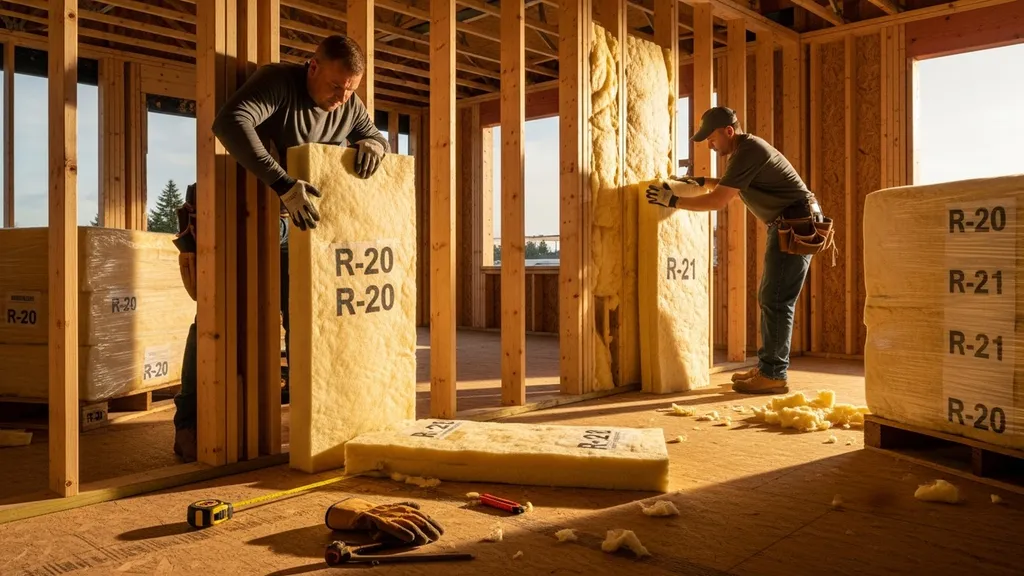
Compare R-20 and R-21 insulation — materials, costs, installation impacts, and which option suits common DIY jobs and climates.
R-20 vs R-21 Insulation: Which Do You Need?
Choosing between R-20 vs R-21 insulation is a common question for budget-minded DIY builders deciding how to fill wall cavities without overspending on materials or losing valuable interior space. This article compares the two R-values, shows typical materials and cavity thicknesses that deliver each, explains how installation quality and thermal bridging affect real-world performance, and gives scenario-based recommendations to help decide which is right for a specific project or climate. The primary topic — r20 vs r21 insulation — appears throughout so readers can quickly compare options for new builds, retrofits, tiny houses, and container conversions.
TL;DR:
- R-20 is commonly achieved with standard 2x6 cavity batts (fiberglass or mineral wool) or a 2x4 plus thin continuous foam; choose R-20 for temperate climates when paired with tight air sealing.
- R-21 is usually reached with high-density 2x6 batts, dense-pack cellulose, or adding modest continuous exterior foam; prefer R-21 for cold climates, high-performance walls, or when thermal bridging is a concern.
- Installation, air sealing, and continuous insulation often matter more than the single-point difference of R-20 vs R-21 for real-world energy savings; see the Energy Star guidance on cost-effective R-values for different climates (example link below).
R-20 vs R-21 Insulation: Quick TL;DR and Comparison Table
Short Answer for Diyers
The short answer: R-20 and R-21 are very close in thermal resistance; the right choice depends on the wall thickness you have, your climate zone, and whether you can add continuous exterior insulation to reduce thermal bridging. If you have full 2x6 cavities and are in a temperate climate, standard R-20 batts plus tight air sealing will often perform acceptably. In colder zones or where framing members cause significant heat loss, the modest extra R of R-21 or adding continuous insulation gives a measurable benefit. Energy Star's recommended R-values by climate zone are a useful baseline when making this decision: https://www.energystar.gov/saveathome/seal_insulate/identify-problems-you-want-fix/diy-checks-inspections/insulation-r-values
Side-by-side Comparison Table
| Feature | Typical materials | Typical cavity/install thickness | Typical R/inch by material | Relative cost | Best-use cases |
|---|---|---|---|---|---|
| R-20 | Fiberglass batt (standard), mineral wool, cellulose in 2x6 | 5.5" cavity (2x6) or 2x4 + 1" CI | Fiberglass 3.0–3.4, Mineral wool 3.0–3.3, Cellulose 3.2–3.8 | Low–Medium | New 2x6 walls in temperate climates, simple retrofits |
| R-21 | High-density batts, dense-pack cellulose, cavity + thin CI | 5.5" hi-density batt or 5.5" dense-pack | Cellulose 3.2–3.8, High-density mineral wool ~3.8 | Medium | Cold-climate walls, where blocking thermal bridging matters |
| Spray foam option | Closed-cell spray foam | 3.5"–4" closed-cell at 6–7 R/in | Closed-cell 6–7 R/in | High | Tiny houses, container homes, limited cavity depth |
| Continuous foam boards | Polyiso, XPS, cork | 1"–2" exterior CI paired with cavity fill | Polyiso 5–6 R/in, XPS 4.5–5 R/in | Medium–High | Reduce thermal bridging on framed walls, new high-performance assemblies |
| Retrofit/Blown-in | Dense-pack cellulose or blown fiberglass | Dense-packed into 2x4 or 2x6 | Cellulose 3.2–3.8 | Low–Medium | Retrofit 2x4 walls to approach R-21 without major framing changes |
Note: R-per-inch ranges vary by manufacturer and compression; the Insulation Institute shows reductions when batts are compressed below labeled thickness: https://insulationinstitute.org/wp-content/uploads/2016/08/Compressed_R_values.pdf
R-20 Insulation — What It Is, Strengths, Weaknesses, and Best Uses
Overview of R-20 Performance
R-20 is a common target for 2x6 wall cavities using conventional batt materials. In practice, R-20 represents moderate thermal resistance; it lowers heating and cooling loads relative to R-13 (typical 2x4 batt) but doesn’t fully eliminate conductive losses through studs and plates. For many temperate climates and modest energy goals, R-20 in the cavity paired with careful air sealing delivers good value.
A simple example calculation: using a conservative fiberglass batt R/inch of 3.3 (manufacturer specs vary), a 5.5" 2x6 cavity yields about 3.3 × 5.5 ≈ R-18.2. Some batt products are labeled R-20 for 2x6 cavities because manufacturer R-values reflect product testing; always check the product spec sheet. Adding 0.5"–1" exterior foam board or a tight air barrier can bring the effective wall assembly closer to labeled R-20 performance.
Strengths (cost, Availability, Options)
- Readily available and low cost for fiberglass and mineral wool batts.
- Many DIYers are comfortable installing batts in new framing and some retrofits.
- Acceptable for moderate climates when combined with basic air sealing.
- Compatible with standard electrical and plumbing work; minimal framing changes.
Refer to the Department of Energy's insulation primer for basics on how insulation reduces heat flow: https://www.energy.gov/energysaver/insulation
Also see product details on different batt constructions at the fiberglass batt types tool page.
Weaknesses (thermal Bridging, Space Constraints)
- Studs and plates significantly reduce whole-wall R; a 2x6 wood-framed wall with R-20 cavity may have a lower effective R when studs are included.
- Compressed batts lose R/inch; overstuffing or compression in retrofit situations reduces performance (see Insulation Institute data).
- In cold climates, R-20 without continuous exterior insulation often underperforms compared with higher-R assemblies.
Best For: Situations and Assemblies
- New 2x6 walls in temperate climates where budget is a factor.
- Retrofit situations where cavity depth allows standard 2x6 batts and adding exterior foam is impractical.
- Builders seeking low material costs who will invest in air sealing and proper installation.
R-21 Insulation — What It Is, Strengths, Weaknesses, and Best Uses
Overview of R-21 Performance
R-21 provides a modest increase in thermal resistance over R-20. It’s commonly achieved with higher-density batts specifically manufactured for 2x6 cavities, dense-pack cellulose, or by combining cavity insulation with a thin layer of continuous exterior foam. Because R-values are additive, layering cavity insulation with exterior foam board is an effective path to R-21 and beyond.
Wikipedia's definition of R-value and the additivity of layers is a useful quick reference: https://en.wikipedia.org/wiki/R-value_(insulation)
Strengths (higher Cavity Fill, Better in Cold Climates)
- Slightly better resistance to heat flow; in cold climates, that small improvement can reduce heating loads enough to matter.
- Dense-pack cellulose and high-density mineral wool can reduce convective loops inside cavities and resist settling better than low-density batts.
- In assemblies where studs create significant bridging, pairing R-21 cavity fill with exterior continuous insulation reduces whole-wall heat loss.
Weaknesses (cost, Thicker/high-density Requirements)
- High-density batts and dense-pack installations cost more than standard batts and may require professional equipment.
- In retrofit scenarios where wall depth is limited (2x4), achieving R-21 requires higher-R materials (spray foam) or adding exterior foam, which adds cost and complexity.
- If installation and air sealing are poor, the incremental benefit of R-21 over R-20 shrinks.
Best For: Situations and Assemblies
- Cold-climate new builds where every R-value step reduces heating demand.
- Projects that can accommodate high-density batts or dense-pack cellulose in 2x6 cavities.
- High-performance retrofits where adding continuous exterior foam isn’t possible, but dense-pack can be installed from the interior or via blown-in ports.
For cavity-fill basics and common pitfalls, see the cavity insulation basics glossary entry.
Common Materials and Assemblies That Deliver R-20 or R-21
Fiberglass and Mineral Wool Batts
- Typical R/inch: Fiberglass ~3.0–3.4 R/in, Mineral wool ~3.0–3.3 R/in.
- To reach around R-20 in a 5.5" cavity, many standard R-20 batts use fiberglass or mineral wool sized for 2x6. Compressed batts or overstuffing will reduce labeled R.
- DIY pros: Batts are straightforward to cut and fit; watch for gaps around wiring and plumbing.
- Vapor/moisture note: Neither fiberglass nor mineral wool is a vapor barrier. Use a separate vapor/air barrier strategy appropriate to climate.
Link to the Insulation Institute compressed-batt guidance for realistic R-values: https://insulationinstitute.org/wp-content/uploads/2016/08/Compressed_R_values.pdf
Dense-pack Cellulose and Blown-in Options
- Typical R/inch: Cellulose ~3.2–3.8 R/in.
- Dense-pack cellulose can reach R-21 in a 2x6 cavity and is commonly used in retrofits where batts can’t be installed intact. It resists settling when installed correctly.
- DIY pros: Renting a blower and following the dense-pack cellulose tool instructions can be cost-effective; however, correct density and baffle sealing matter.
- Moisture note: Cellulose is hygroscopic and requires careful moisture control and drying paths.
Open-cell and Closed-cell Spray Foam
- Typical R/inch: Open-cell ~3.5–3.7 R/in, Closed-cell ~6–7 R/in.
- Closed-cell at 2–3" can deliver R-12–R-18 in tight cavities, making it attractive where thickness is limited (tiny houses, containers).
- DIY pros: Small projects can use DIY kits for open-cell and some closed-cell foams, but professional application yields best results.
- Carbon and cost: Spray foam has higher embodied carbon and cost compared to cellulose; see our comparison of spray foam vs cellulose for lifecycle trade-offs.
Link to the closed-cell and open-cell tool pages: closed-cell spray foam, open-cell spray foam.
Continuous Exterior Foam Boards (XPS, Polyiso, Cork)
- Typical R/inch: Polyiso ~5–6 R/in, XPS ~4.5–5 R/in, Cork varies (see product spec).
- Adding 1" polyiso (about R-5) over a 2x6 cavity with R-16–R-18 cavity fill can push whole-wall performance up to and beyond R-21 while reducing thermal bridging.
- DIY pros: Foam boards are easy to cut and attach; seams must be taped or sealed to act as continuous insulation.
- For eco-focused builds, consider cork board options or natural-fiber continuous products.
More on foam board choices: XPS foam board, and for natural fibers see natural fiber options.
Hybrid Assemblies (cavity + Continuous Foam)
- Combining cavity insulation (R-13–R-18) with 1"–1.5" exterior polyiso or XPS is an effective way to reach R-21 performance without changing stud depth.
- Advantages include reduced thermal bridging and improved moisture control when detailed correctly.
- For retrofit thinking, this is often the most practical high-performance upgrade without reconstructing framing.
For a comparison of R-15 vs R-21 options and how cavity depth changes choices, see the R-15 vs R-21 guide.
How Installation and Detailing Change Whether R-20 or R-21 is Enough
Thermal Bridging and Framing Factor
Framing members like studs, plates, and headers conduct heat. A wall with R-20 cavity but 16-inch on-center wood studs can have an effective whole-wall R much lower than the cavity R. Strategies to reduce this include adding continuous exterior insulation, using advanced framing (24" o.c. or staggered studs), or installing thermal breaks.
For practical guidance on thermal bridging and design, the Whole Building Design Guide provides clear notes on why continuous insulation matters: https://www.wbdg.org/resources/thermal-bridging
Air Sealing and Why It Can Beat Raw R-value
Air leaks create convective heat loss that R-value alone doesn’t capture. A well-sealed R-20 wall can outperform a poorly sealed R-21 wall. Work areas to seal include top plates, electrical boxes, rim joists, and gaps around windows. The Department of Energy emphasizes air sealing as a priority alongside insulation: https://www.energy.gov/energysaver/insulation
A short checklist for DIYers:
- Seal gaps at top plates and sill plates with foam or caulk.
- Install gaskets or sealed electrical box inserts.
- Insulate and seal rim joists with appropriate foam or batt + spray foam.
- Ensure continuous air barrier at window and door rough openings.
Moisture Control, Vapor Profiles, and Cavity Drying
Selecting materials that match your climate’s vapor drive is necessary. Cellulose can handle some moisture but needs drying paths. Closed-cell spray foam acts as a vapor retarder and can reduce drying potential if used on the interior in cold climates without proper exterior drying layers. Review climate-specific vapor guidance before choosing materials.
When Continuous Insulation is a Better Investment
If thermal bridging dominates heat loss (common with metal studs or heavy framing), a modest layer of exterior foam (1"–2") provides higher returns than squeezing a little more R into cavities. For many DIYers, adding continuous foam is easier than changing framing or installing higher-density batt products.
Watch this step-by-step guide on installing ceiling insulation in a basement or crawlspace & why you should. r30, r21, r19, r13.:
For attic-transition and roof-to-wall junction details, consult practical attic guidance at the attic insulation options.
Cost, Carbon, and Practical Trade-offs Between Choosing R-20 or R-21
Material and Labor Cost Comparison (ballpark Factors)
- Fiberglass batts: lowest material cost; DIY install keeps labor low.
- Mineral wool: slightly higher cost, better fire and moisture performance.
- Dense-pack cellulose: moderate material cost; blower rental or contractor fees add labor.
- Closed-cell spray foam: highest cost per board-foot and often requires pros for quality installation.
- Continuous foam board: material cost moderate; installation labor depends on siding sequence.
Moving from R-20 to R-21 in a 2x6 cavity often adds modest material cost if using high-density batts or dense-pack. But costs rise if framing alterations or exterior foam and siding adjustments are required.
Embodied Carbon and Lifecycle Considerations
- Cellulose (recycled paper) generally has low embodied carbon compared with foam products.
- Closed-cell spray foam contains petrochemical components and has higher embodied carbon; consider lifecycle energy savings versus upfront carbon.
- Mineral wool has moderate embodied carbon and strong fire/sound performance.
See the spray foam vs cellulose comparison for a deeper lifecycle discussion.
When Extra R-value Returns Energy Savings
Extra R-value pays off fastest in cold climates and where heating fuel is expensive. For temperate climates, the marginal energy savings from R-20 to R-21 may have a long payback unless combined with continuous insulation or improved air sealing.
A simple payback check:
- Estimate annual heating/cooling cost.
- Model a 5–10% improvement from R-20 → R-21 (varies by climate).
- Calculate energy cost savings and compare to incremental material/labor cost.
Retrofit vs New-build Trade-offs
- New-builds: easier to specify continuous foam, advanced framing, and high-density batts during construction.
- Retrofits: blown-in dense-pack or adding exterior foam over existing cladding may be required; weigh disruption and siding replacement cost.
Tiny houses and container conversions often prioritize R-per-inch and air barrier quality over slight increases in cavity R. See the tiny house and container pages for project-specific tips: tiny house insulation, container home insulation.
Which Should You Choose? Scenario-based Recommendations for Diyers
New 2x6 Wood-framed Home (moderate Climate)
Recommendation: Use R-20 cavity batts installed to manufacturer spec, plus focus on continuous air sealing. Add 1" polyiso exterior foam if budget allows to reduce thermal bridging. This delivers good performance at moderate cost.
Retrofit 2x4 Walls on a Budget
Recommendation: Dense-pack cellulose blown into existing 2x4 cavities can push effective R toward R-15–R-18; to approach R-21, add 1" exterior foam where siding replacement is planned. For strictly interior work, consider 1" interior rigid foam plus new drywall where feasible.
See options compared in the R-15 vs R-21 guide.
Tiny House or Container Conversion
Recommendation: Prioritize high R/inch materials such as closed-cell spray foam for metal containers, or use a hybrid of closed-cell interior spray foam plus exterior foam board. Watch condensation risk on metal surfaces; insist on a continuous air barrier and a vapor-control strategy.
Further reading: tiny house insulation and container home insulation.
Cold Climate / High-performance Build
Recommendation: Aim for R-21 or higher in cavities and add at least R-5 continuous exterior insulation. Consider dense-pack cellulose or high-density mineral wool in cavities, plus exterior polyiso for improved whole-wall R and moisture control.
Also review regional code requirements (IECC or local amendments) and run a simple energy model if the project budget supports it.
Final Quick Decision Checklist
- Climate: Cold? Choose R-21 + CI. Temperate? R-20 may suffice if sealed.
- Wall thickness: 2x6 favors R-20/R-21; 2x4 requires higher-R materials or CI.
- Air sealing: If you can seal well, cavity R is more effective.
- Moisture risk: For containers/metal or humid climates, prefer closed-cell or fully detailed drying paths.
- Budget: Balance material cost vs labor and disruption (siding removal, blower rental, pro foam install).
To prioritize attic vs wall upgrades, consult the attic R-value guide.
The Bottom Line
Small differences between r20 vs r21 insulation matter most when paired with good detailing. For many temperate-zone DIY builds, R-20 installed correctly and paired with airtight construction performs well; in cold climates or where studs cause heavy thermal bridging, R-21 or adding continuous exterior insulation is the smarter choice.
Frequently Asked Questions
Is R-21 worth it over R-20?
Sometimes. The energy savings from R-21 over R-20 are modest per square foot, but in cold climates or on walls with significant thermal bridging the extra R can shorten heating payback periods. The decision hinges on climate, whether you can add continuous insulation, and the cost to achieve R-21 (high-density batts, dense-pack cellulose, or exterior foam).
Can I get R-21 in a 2x4 wall?
Not with standard low-density batts. A 2x4 cavity (about 3.5") would need very high-R materials such as closed-cell spray foam or a combination of cavity fill plus exterior foam to reach R-21. For retrofits, dense-pack options and a thin layer of continuous foam are common approaches.
Does spray foam make R-20 obsolete?
No. Spray foam changes the assembly options because of its higher R/inch and air-sealing properties, but it has trade-offs: higher cost and greater embodied carbon than cellulose or mineral wool. For many DIY projects, properly installed batts or dense-pack cellulose plus CI are more cost-effective than spray foam.
How does continuous insulation change the choice?
Continuous exterior insulation reduces thermal bridging and increases whole-wall R more effectively than marginal increases in cavity R. Adding 1"–1.5" of polyiso or XPS can be a better investment than moving from R-20 to R-21 in the cavity alone, especially in framed walls with many studs.
What mistakes to avoid when choosing an R-value?
Avoid relying on labeled R-values without checking installation conditions: compressed batts, gaps, and poor air sealing all cut real performance. Also avoid selecting materials without a climate-appropriate vapor and drying strategy. Finally, compare whole-wall performance, not just cavity R, and consider embodied carbon if that matters for your build.