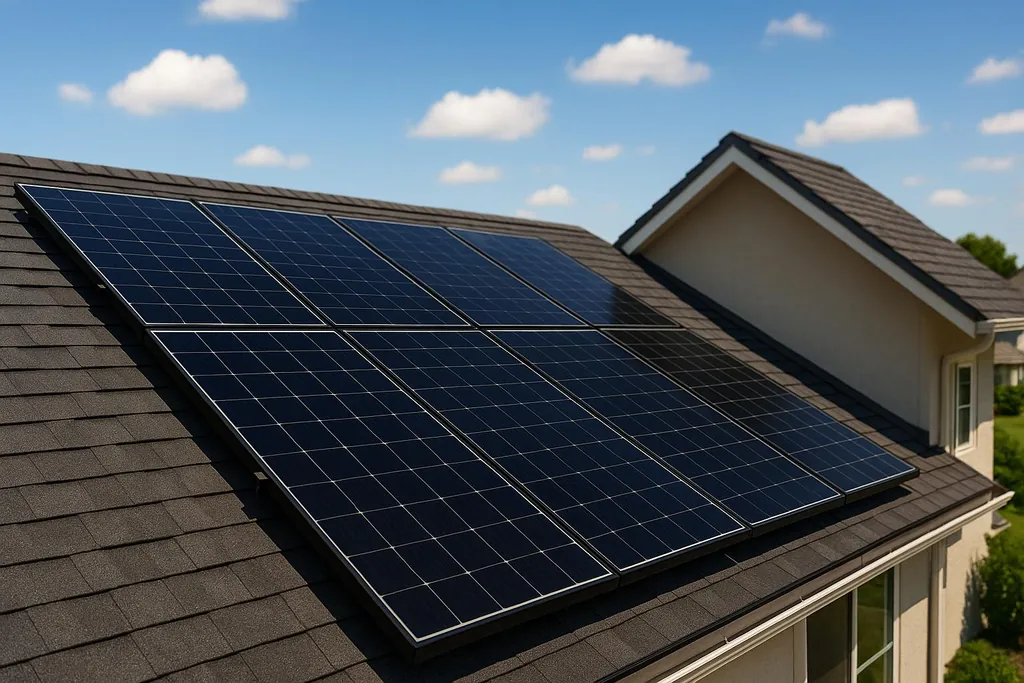
Explore solar panel efficiency ratings to maximize energy output, understand key factors, and compare top models for your home.
How to Compare Solar Panel Efficiency Ratings
Looking to maximize your solar energy output? Here's the key: Solar panel efficiency determines how much sunlight a panel converts into electricity. Higher efficiency panels save space, reduce installation costs, and generate more power, but they often come at a higher price. Here's what you need to know:
- Efficiency Range: Most residential panels are 15%–22%. Monocrystalline panels lead with up to 24% efficiency, while polycrystalline and thin-film panels are less efficient but cheaper.
- Key Factors: Efficiency depends on solar cell type, temperature, shading, and real-world conditions like dust or climate. Panels lose 0.3%–0.5% efficiency per degree above 77°F.
- Cost vs. Performance: Higher efficiency panels cost more but can save money over time, especially for small or shaded roofs.
- Top Models in 2025: Aiko Solar Neostar 2P (24.3% efficiency) and Maxeon 7 (24.1%) are market leaders. For budget-friendly options, Canadian Solar TOPHiKu6 offers strong performance at $2.73 per watt.
Quick Comparison Table
| Panel Type | Efficiency Range | Cost Per Watt | Best For |
|---|---|---|---|
| Monocrystalline | 17%–24% | Higher | Limited space, high output |
| Polycrystalline | 15%–17% | Lower | Budget-friendly, ample space |
| Thin-film | 10%–13% | Lower | Flexible or portable setups |
Tip: Use tools like NREL’s PVWatts Calculator to estimate energy output for your location and compare costs per watt to find the best value for your needs.
What Is Solar Panel Efficiency and Why Does It Matter?
How Efficiency Is Defined
Solar panel efficiency measures how well a panel converts sunlight into usable electricity. It’s calculated as the ratio of the electrical output to the solar energy input . To ensure consistency across manufacturers, the industry uses Standard Test Conditions (STC) for evaluations. These tests are conducted with a cell temperature of 77°F (25°C), a solar irradiance of 1,000 watts per square meter, and an air mass of 1.5 .
Several factors influence a panel's efficiency, including the type of solar cells, how the cells are arranged, and the panel's overall dimensions. Different technologies produce varying efficiency levels, as shown in the table below:
| Solar Cell Type | Efficiency Range |
|---|---|
| Polycrystalline | 13–16% |
| Monocrystalline | 18–24% |
| Thin film | 7–13% |
| Transparent | 1–10% |
| Solar tiles | 10–20% |
| Perovskite | up to 27% |
Monocrystalline cells lead the pack in efficiency due to their higher purity . Most panels available today fall within the 15% to 22% efficiency range , with a theoretical maximum of 33.7% . However, advanced lab techniques have managed to achieve efficiencies as high as 47.6% .
This standardized definition and testing framework lay the groundwork for understanding the real-world advantages of efficient panels.
Why Efficiency Matters for Homeowners
Higher efficiency panels generate more electricity per square foot , making them especially valuable for homes with limited roof space or partial shading. With efficient panels, homeowners can produce the energy they need even with fewer panels installed. This can lower upfront installation costs and lead to greater long-term savings .
For households with high energy demands - whether due to electric vehicles, heat pumps, or simply larger family sizes - efficiency becomes even more critical. It ensures sufficient power generation without requiring a massive array of panels. Most residential panels today provide efficiencies between 18% and 24%, and many experts suggest choosing panels with at least 18% to 20% efficiency for a good balance of cost and performance .
Efficient panels also expand solar energy's accessibility. They make it possible for homes with smaller or partially shaded roofs to generate meaningful amounts of electricity, opening up solar power to more people.
These considerations set the stage for a detailed comparison of efficiency ratings in the upcoming guide.
What Are The Most Efficient Solar Panels You Can Buy?
Main Factors That Affect Solar Panel Efficiency
When comparing the efficiency of solar panels, it's essential to distinguish between lab-rated performance and how panels actually perform in real-world conditions. While the efficiency ratings on spec sheets reflect ideal laboratory settings, several factors influence how well solar panels work once they're installed on your roof. Let’s dive into how panel types and technology play a role in these differences.
Types of Solar Panels
The type of solar panel you choose is a key factor in determining overall efficiency.
- Monocrystalline panels are known for their high efficiency, typically ranging from 17% to 22%. Many models even exceed 22%, producing over 400 watts of power . These panels are made from pure silicon crystals, enabling better electron flow, which translates to smaller, more efficient panels.
- Polycrystalline panels are a more cost-effective option, with efficiency ratings between 15% and 17% . While they’re less efficient than monocrystalline panels, their lower upfront cost makes them appealing for budget-conscious installations.
- Thin-film panels offer flexibility, with efficiency ratings of 10% to 13% . Though less efficient, their adaptable design is ideal for unconventional setups, like curved surfaces or portable systems.
Here’s how these panel types compare:
| Solar Panel Type | Efficiency Range | Power Output | Best Applications |
|---|---|---|---|
| Monocrystalline | 17–22%+ | 300–400+ watts | Limited roof space, high efficiency needs |
| Polycrystalline | 15–17% | 250–350 watts | Budget-friendly, ample roof space |
| Thin-film | 10–13% | Varies widely | Flexible or portable installations |
In addition to these basic types, advanced technologies can further enhance efficiency. PERC (Passivated Emitter and Rear Cell) technology, for instance, reflects light back into the cell to improve electron flow. MBB (Multiple Busbars) reduces current loss by shortening the distance electricity travels within the cell. Similarly, IBC (Interdigitated Back Contact) cells position all electrical contacts on the back of the panel, maximizing the sunlight absorbed by the front surface .
While these technologies lay the foundation for efficiency, the actual conditions where the panels are installed play a crucial role in their performance.
Actual Operating Conditions
Solar panels often face challenges in real-world environments that affect their efficiency. One of the biggest factors is temperature. Panels generally lose about 0.3% to 0.5% efficiency for every degree Celsius (1.8°F) above 25°C (77°F) .
> "Solar panels work best in direct sunlight, but they can still produce electricity during the fall and winter when overcast days are more common. A drop in temperature can even be beneficial to solar panels - too much heat can have a negative impact on their efficiency." > > - Boston Solar
Different panel technologies handle heat differently. For example, crystalline silicon panels lose about 0.45% efficiency per degree Celsius, while thin-film panels are less affected, losing only about 0.25% per degree . Cadmium Telluride (CdTe) panels are particularly well-suited for hot climates, with temperature coefficients as low as -0.24% to -0.26% per degree Celsius .
Other factors, like shading, can drastically reduce output. Even a small shadow on a single panel can impact the performance of an entire string of panels. Similarly, dust and debris can have a major effect. In desert regions, for example, dust accumulation can cut output by up to 60%. Even lighter dust levels (10–30 grams per square meter) can reduce efficiency by around 20% .
Weather conditions also play a role. Cloud cover can lower capacity factors by 50% in parts of Northern Europe, while the reduction is typically 15–30% in the U.S. and China . Atmospheric aerosols, depending on the region, may reduce capacity factors by up to 20%.
Installation factors are equally important. Roof-mounted panels often operate at higher temperatures than ground-mounted systems due to limited air circulation . Additionally, the orientation and tilt of the panels, local climate, and geographical location all influence how effectively they convert sunlight into electricity.
Real-world examples provide valuable insights. A floating solar farm in Japan achieved 11% higher efficiency than a comparable land-based system because the water beneath the panels kept temperatures roughly 10°C (18°F) cooler during summer . Meanwhile, a solar array at a ski resort in the Alps consistently produced 10–15% more power than its rated capacity during bright, cold winter days .
How to Compare Solar Panel Efficiency Ratings Step-by-Step
Building on the factors that influence solar panel efficiency, here’s a step-by-step guide to help you compare options and choose the right panels for your home.
Step 1: Collect Panel Specifications
Start by gathering the technical details from the datasheets of the solar panels you’re considering. These documents contain all the essential performance data, and focusing on the most relevant specifications will help you make an informed decision.
Here’s what to look for:
Power and Efficiency Metrics:
- Power output (Pmax or PMPP): The maximum power the panel can generate under ideal conditions.
- Module efficiency (%): The percentage of sunlight converted into electricity.
- Voltage at Maximum Power (Vmp): The operating voltage when the panel is at peak performance.
- Current at Maximum Power (Imp): The operating current during peak performance.
Temperature Performance:
- Temperature coefficient (%/°C): Shows how the panel’s performance changes with temperature fluctuations.
- Nominal Operating Cell Temperature (NOCT): The panel’s expected temperature during standard operating conditions.
Physical Specifications:
- Dimensions: Length, width, and thickness, typically listed in inches or feet.
- Weight: Important for ensuring your roof can handle the load.
Pay special attention to power output since it reflects the panel’s energy production capacity, with efficiency already factored in. If you live in a hot climate, the temperature coefficient becomes even more critical - panels with coefficients closer to zero perform better in high temperatures (above 77°F or 25°C). Compare both STC (Standard Test Conditions) and NOCT ratings to understand how the panel performs in both ideal and real-world situations. Once you’ve gathered this information, you can estimate the energy output for your location.
Step 2: Calculate and Compare Output
Next, estimate how much energy each panel will produce in your area. This step goes beyond efficiency percentages and gives you a realistic production estimate.
Basic Output Calculation: Use this formula:
Daily Energy Output = Panel Wattage × Peak Sun Hours × System Efficiency
For example, a 400-watt panel in a location with 5 peak sun hours and a system efficiency of 80% would generate approximately 1.6 kWh daily (400 W × 5 hours × 0.8 = 1,600 Wh). With 20 panels, the total daily output would be around 32 kWh.
> "Each factor is essential to ensure your solar power systems will be able to deliver enough power to your facility - and be able to sustain that without question." > – Kyle Bolger, Applications Engineer at 60Hertz Energy
Real-World Adjustments: Account for real-world factors like temperature, dust, shading, and cloud cover, which can reduce output. Installers often use a system efficiency range of 75–85% to account for these conditions.
Comparing Panel Types: To maximize energy production, calculate the energy output per square foot. For instance, a 400-watt monocrystalline panel measuring 6.5 × 3.25 feet produces about 19 watts per square foot, while a 350-watt polycrystalline panel of the same size generates around 16.6 watts per square foot.
Tools like NREL’s PVWatts Calculator can also provide location-specific energy production estimates . Once you have these estimates, compare them to panel costs to find the best value.
Step 3: Compare Cost vs. Efficiency
Finally, evaluate the cost-effectiveness of each panel option to ensure you’re getting the best value for your budget and space.
Calculate Cost Per Watt: Divide the total system cost by the total wattage to determine the cost per watt ($/W). This metric allows you to compare panels fairly. Panels that balance efficiency and cost often provide the best value.
Here’s a comparison of some popular 2025 panels:
| Panel Model | Cost Per Watt | Efficiency | Best For |
|---|---|---|---|
| REC Alpha Pure | $2.49 | ~22% | Best balance of specs and affordability |
| Panasonic Evervolt | $2.69 | ~21.7% | Premium quality with good warranty |
| Canadian Solar TOPHiKu6 | $2.73 | ~21.5% | Reliable mid-range option |
| Jinko Solar Tiger Neo | $2.82 | ~22.3% | High efficiency at competitive price |
| Maxeon 6 | $3.05 | ~22.8% | Highest efficiency, premium cost |
Consider Space Constraints: If your roof space is limited, investing in higher-efficiency panels may be worth the extra cost since they generate more power per square foot. On the other hand, if you have ample space, slightly less efficient panels can still meet your energy needs at a lower price.
Factor in Long-Term Costs: Don’t just focus on upfront costs. Consider installation expenses, maintenance needs, and the expected lifespan of the panels. While cheaper panels may save money initially, they might have shorter lifespans or less reliable warranties. Opting for panels from well-known manufacturers often results in better long-term savings.
Making the Final Decision: For those with sufficient roof space and a tight budget, slightly less efficient panels from reputable brands can still deliver adequate energy. However, if space is a constraint or maximizing energy production is a priority, higher-efficiency panels are usually the better choice.
Top Residential Solar Panels for 2025: A Comparison
Now that you're familiar with how to evaluate solar panels, let’s dive into the top-performing residential models available in 2025. These models showcase how advancements in solar technology have pushed efficiency to remarkable levels. Aiko Solar has now overtaken Maxeon in residential efficiency rankings, signaling a shift in the market. Most leading manufacturers are now leveraging advanced N-type technologies like heterojunction (HJT), TOPcon, or back-contact cells, which help minimize power loss in high-temperature conditions .
Comparison Table of Leading Models
Here’s a breakdown of the top residential solar panels for 2025, comparing efficiency, power output, and other key metrics:
| Rank | Manufacturer | Model | Power Output | Efficiency | Technology | Cost Per Watt |
|---|---|---|---|---|---|---|
| 1 | Aiko Solar | Neostar 2P | 485W | 24.3% | N-type HJT | N/A |
| 2 | Maxeon | Maxeon 7 | 445W | 24.1% | Back-contact IBC | $3.05 |
| 3 | Jinko Solar | Tiger NEO | 515W | 23.8% | N-type TOPcon | $3.03 |
| 4 | Recom Tech | Black Tiger Series | 460W | 23.6% | N-type | N/A |
| 5 | SPIC | Andromeda 3.0 | 460W | 23.6% | – | N/A |
| 6 | Longi Solar | Hi-Mo 6 Scientist | 455W | 23.3% | N-type TOPcon | N/A |
| 7 | Huasun Solar | Himalaya G12 | 450W | 23.0% | – | N/A |
| 8 | Canadian Solar | TOPHiKu6 | 470W | 23.0% | N-type TOPcon | $2.73 |
| 9 | Winaico | WST-NGX-D3 | 450W | 23.0% | – | N/A |
| 10 | Trina Solar | Vertex S+ | 455W | 22.8% | N-type TOPcon | $2.94 |
Key Takeaways from the Data
- Efficiency Leader: Aiko Solar’s Neostar 2P tops the list with an impressive 24.3% efficiency, closely followed by Maxeon’s Maxeon 7 at 24.1% .
- Highest Power Output: Jinko Solar’s Tiger NEO delivers a massive 515W, thanks to its larger panel size (often exceeding 1900 mm), making it ideal for homes aiming for maximum energy production .
- Best for Budget: Canadian Solar’s TOPHiKu6 balances strong performance (23.0% efficiency) with affordability, priced at around $2.73 per watt. Trina Solar’s Vertex S+ is another cost-effective option at $2.94 per watt .
- Premium Option: Maxeon panels remain a favorite for their durability and high performance, though their premium pricing - about $3.05 per watt - reflects this focus .
- Future Innovations: Trina Solar recently set a world record in June 2025 with a 30.6% efficient perovskite-silicon tandem panel. While not yet commercially available, this milestone hints at what’s ahead .
- Hot Climate Performance: Advanced N-type panels like those from Aiko, Maxeon, and Jinko perform exceptionally well in hot climates, making them a smart choice for regions with high temperatures.
When choosing a solar panel, consider your roof space and budget. For limited roof space, high-efficiency models like Aiko or Maxeon are ideal. If you’re balancing cost and performance, Canadian Solar or Trina Solar offer great value. For those prioritizing maximum energy output, Jinko Solar’s Tiger NEO is a standout option.
Extra Considerations for US and Canadian Homeowners
Homeowners in the United States and Canada encounter specific factors that influence the performance and financial appeal of solar panels. Being aware of these regional elements can help you get the most out of your investment.
Federal Incentives That Impact Solar Economics
Government incentives in North America significantly enhance the appeal of high-efficiency solar panels. In the United States, the federal solar tax credit (ITC) allows homeowners to claim 30% of their solar system's cost as a credit on their federal tax return through 2032 . On average, this tax reduction saves U.S. homeowners around $10,000, and those using the EnergySage Marketplace save an additional $8,808 when taking advantage of the ITC .
> "The federal solar tax credit, officially known as the Residential Clean Energy Credit, has been a driving force behind the growth of solar energy in the U.S." – GreenLancer
In Canada, the Clean Energy Investment Tax Credit provides a 30% refundable tax credit, while the Canada Greener Homes Loan offers up to $40,000 in interest-free financing . However, U.S. homeowners should note that the ITC will reduce to 26% in 2033, 22% in 2034, and expire entirely in 2035 . These financial incentives, combined with climate-specific performance factors, make solar panels an attractive investment.
How Climate Affects Solar Efficiency in North America
Geography plays a key role in how efficiently solar panels perform. Cooler temperatures generally enhance panel efficiency, while overheating can reduce output. High-quality panels are designed to shed snow naturally and can still generate 10–25% of their rated output even on cloudy days .
In warmer states like Arizona, Texas, or southern California, where temperatures can soar, panels with better temperature coefficients are crucial. Heat can lower efficiency by 10% to 25%, making advanced technologies like the Aiko Solar Neostar 2P or the Jinko Solar Tiger NEO a smart choice for these regions .
Local Incentives That Boost Solar Appeal
Regional incentive programs further improve the financial case for high-efficiency panels. For instance, homeowners in Banff, Canada, can receive $750 per kW (up to 20 kW) through the Solar PV Program in 2025 . When paired with federal credits, such local incentives make premium panels even more appealing. Additionally, many U.S. states and Canadian provinces offer net metering, which credits homeowners for excess energy their systems generate, increasing the value of panels that produce surplus power.
Building Codes and Installation Standards
Compliance with regional building codes is a critical part of solar panel installation. In the U.S., the National Electrical Code (NEC), particularly Article 690, governs solar installations and is updated every three years . All electrical components must carry the UL symbol for safety certification. In Canada, electrical systems must meet CSA or ULC standards . For roof-mounted systems using ballast mounting, structural engineering approval may be required, costing roughly CAD $900 per rooftop . However, CSA-approved racking systems often bypass the need for additional structural stamps. Fire safety codes also require specific spacing between panels to ensure clear access for emergency responders .
Practical Tips for Installation
For Canadian homeowners dealing with heavy snow, ground-mounted systems offer distinct advantages, such as easier maintenance and adjustable angles for year-round performance . While DIY enthusiasts can handle certain aspects like mechanical mounting, final electrical connections should always be completed by a licensed electrician familiar with both AC and DC wiring . Additionally, smart monitoring solutions are invaluable for tracking performance, especially after weather events that could temporarily impact output .
Conclusion: Making the Best Choice for Your Home
Choosing the right solar panels means striking a balance between efficiency, cost, and your specific energy needs. While efficiency ratings provide a helpful starting point, they’re just one piece of the puzzle.
The most efficient panel isn’t always the ideal choice for every home. If you’re working with limited roof space or aiming to maximize energy production, higher-efficiency panels might justify their higher upfront cost. On the other hand, if you have plenty of roof space, panels with slightly lower efficiency can often give you more value for your money.
Your location also plays a big role in determining the best panels for your situation. For example, in hot states like Arizona or Texas, panels with strong temperature coefficients will perform better under intense heat, maintaining higher efficiency when the mercury rises.
Federal incentives and long-term savings often tip the scales in favor of higher-quality panels. With a 30% federal tax credit and potential savings ranging from $31,000 to $120,000 over 25 years, solar panels - which account for just 12% of the total installation cost - are a financially smart choice .
To make the most informed decision, gather multiple quotes and compare key factors like efficiency ratings, warranties, degradation rates, and real-world performance data. Think about your household’s current energy usage and how it might change in the years ahead.
FAQs
How can I choose the most efficient solar panels for my home and energy needs?
To find the best solar panels for your home, focus on models with an efficiency rating of 20% or higher. The top-tier panels can even achieve up to 24% efficiency. These high-efficiency options are perfect if you have limited roof space or need to meet higher energy demands, as they generate more electricity from the same amount of sunlight.
Take into account factors like your roof's sun exposure, local weather conditions, and your energy usage habits. For instance, if you live in a sunny area, slightly less efficient panels might still meet your needs. On the other hand, if your roof is shaded or space is tight, investing in the most efficient panels can make a big difference. By assessing these details, you can choose panels that deliver the best energy output and savings for your home.
What are the long-term financial advantages of choosing high-efficiency solar panels, even with their higher upfront costs?
Investing in high-efficiency solar panels might feel pricey upfront, but the long-term benefits can outweigh the initial expense. These panels produce more electricity over their lifetime, which means lower energy bills and a faster return on your investment.
On top of that, they can boost your home's resale value and might make you eligible for federal or state tax credits, adding even more financial perks. Opting for high-efficiency solar panels isn’t just about cutting costs - it's a forward-thinking choice that combines environmental responsibility with smart financial planning.
How do temperature and shading impact the real-world performance of solar panels?
The actual energy output of solar panels can be heavily influenced by factors like temperature and shading, often resulting in lower performance than their efficiency ratings might indicate.
When temperatures rise above 77°F, solar panel efficiency begins to drop. For every degree Fahrenheit over this threshold, panels can lose between 0.3% and 0.5% of their efficiency. In regions with consistently high temperatures, this reduction can lead to noticeable decreases in energy production. Shading poses an even bigger challenge. Even partial shading can slash energy output by as much as 90% in extreme cases. Over the course of a year, shading can cause energy losses ranging anywhere from 5% to 25%, depending on how much and how long the panels are shaded.
To get the most out of your solar panels, it’s crucial to factor in your home’s location, the local climate, and any potential sources of shade when planning and installing your system.