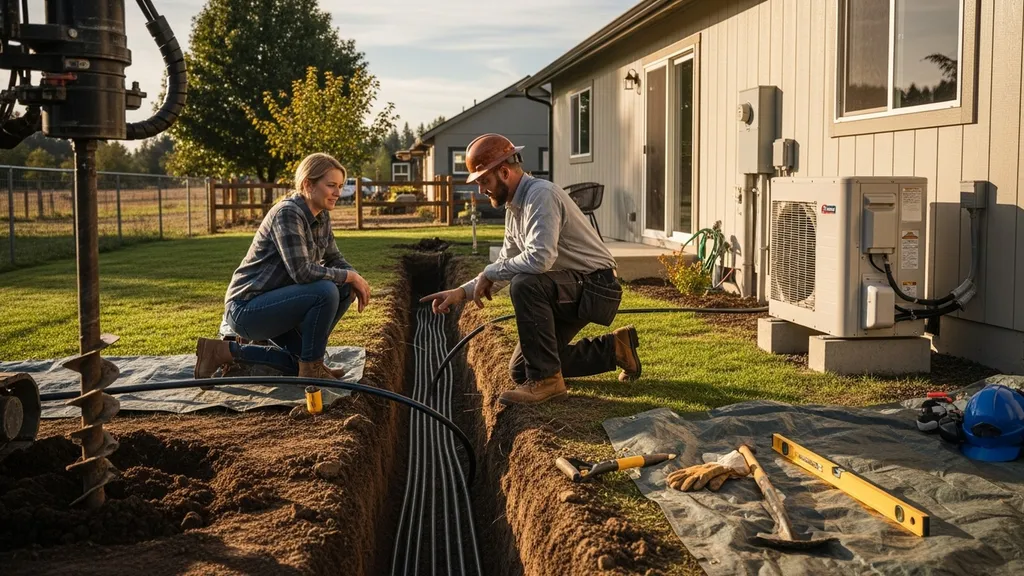
A clear, DIY-friendly explainer on ground source (geothermal) heat pumps: how they work, costs, installation options, and when they make sense for self-builders.
Ground Source Heat Pumps: Geothermal Explained
Ground source heat pumps are heating and cooling systems that move heat between a building and the ground using a buried loop of pipe and a refrigerant-driven heat pump. For DIY eco homes, a properly designed ground source heat pump can cut winter heating bills by two-thirds compared with resistive electric heating and deliver steady performance in cold weather. This article explains what a ground source heat pump is, how the ground loop and heat pump work together, the main system options (horizontal trench vs vertical bore), planning and budget considerations for self-builders, and routine maintenance you can handle yourself.
TL;DR:
- Ground source heat pumps typically deliver a seasonal COP of about 3–5, saving roughly 40–70% on heating energy versus gas or electric resistance.
- Choose horizontal loops for low-cost land-rich sites and vertical boreholes for small lots; expect installed costs commonly in the $15,000–$40,000 range depending on drilling and loop type.
- For DIY self-builds, combine contractor-led drilling or loop install with owner-supplied mechanical hookup and integration to PV/battery systems for cost savings.
Related guides: How to automate existing water pumps on a budget, How to Automate Existing Water Pumps on a Budget (2026), and How to source local materials for DIY homes.
What Are Ground Source Heat Pumps? a Clear Definition
Short Plain-language Definition
A ground source heat pump (GSHP) is a mechanical system that transfers heat between a building and the shallow ground using a closed or open fluid loop plus a refrigerant heat pump. In heating mode it extracts stored solar energy from the earth and concentrates it to deliver warm water or warm-air distribution inside the home; in cooling mode it rejects heat into the ground.
Common Types: Closed-loop (horizontal & Vertical) and Open-loop
- Closed-loop (horizontal trenches): HDPE pipe laid in trenches 1–2 meters deep. Lower drilling cost but needs more land area.
- Closed-loop (vertical boreholes): U-shaped pipe in boreholes 50–200+ meters deep. Smaller surface footprint, higher drilling costs.
- Open-loop: Uses groundwater pumped through the system then returned to a discharge or reinjection point. Site-specific and often subject to stricter permitting.
Analogy: the Earth as a Rechargeable Battery
Think of the ground as a big rechargeable battery that stores summer heat and winter cold at relatively constant temperatures below the frost line. A GSHP doesn't create heat like a boiler; it moves heat. That makes it more efficient: the system’s coefficient of performance (COP) commonly falls in the 3–5 range depending on climate, loop design, and distribution temperatures. Seasonal COP (sometimes reported as SCOP) adjusts COP for real-world variations over a heating season.
Local ground temps vary by climate band — shallow soils often sit between about 4.5°C and 21°C (40°F–70°F). For sizing, designers reference heating load and local heating degree day data to determine required borehole length or trench area. For further practical guidance on operation and component basics, the Pacific Northwest National Laboratory explains best practices for GSHP operation and maintenance.
Why Ground Source Heat Pumps Matter for DIY Eco Homes
Energy Efficiency and Long-term Running Cost Benefits
Ground source systems convert low-grade ground heat into useful indoor heat with several units of heat delivered per unit of electricity consumed. That means lower operating bills compared with resistive electric heating and predictable performance in cold snaps — a valuable trait in off-grid or near-off-grid self-builds. Studies and agency guidance suggest lifecycle savings depend heavily on electricity cost, initial install cost, and the home’s heat demand; but homeowners often see payback periods in the 7–20 year range depending on incentives and local energy prices.
Environmental Impact: Emissions and Fuel Independence
Using a GSHP reduces on-site combustion and can dramatically lower CO2 emissions when paired with low-carbon electricity (solar + battery or grid with high renewable share). For remote properties, pairing a GSHP with PV and storage reduces diesel or propane dependence. The system’s long-lived ground loop (often 50+ years) also spreads embodied-carbon benefits over many seasons, provided the building is insulated and airtight.
When Gshps Are a Good Match (site & Budget Considerations)
GSHPs fit projects that meet these conditions:
- Land availability: Enough area for horizontal trenches or access for a drill rig for boreholes.
- Budget flexibility: Higher upfront cost but lower operating cost. For guidance on insulation and airtightness that reduce heating load — improving GSHP economics — see the passive house airtightness guide.
- Heating load: Lower heating loads (well-insulated homes) reduce loop size and system cost.
Example case: A 1,200 ft² rural self-build with good soil and 0.5 acre of yard is a candidate for horizontal loops and may save more over 15 years than a similar urban retrofit where vertical drilling is mandatory and costs spike.
Decision checklist for DIYers:
- Land area and access: Trench length vs bore depth.
- Soil/rock type: Thermal conductivity and rock hardness affect drilling and loop sizing.
- Budget and incentives: Check local rebates.
- Heating load estimate: Use heating degree day data and aim for a tight building envelope.
ASHRAE’s design guidance and NYSERDA materials are helpful resources when evaluating lifecycle trade-offs.
How Ground Source Heat Pumps Work (components & Performance)
Main Components: Ground Loop, Heat Pump Unit, Distribution System
- Ground loop: HDPE pipes buried horizontally or vertically, filled with antifreeze solution (propylene glycol or similar).
- Heat pump unit: Compressor, refrigerant loop, evaporator/condenser and control board — these move heat between the ground loop and house.
- Distribution system: Hydronic radiators, underfloor heating, or forced-air coil connected to ducting or fan coils. For distribution choices, compare ducted vs ductless heat pumps.
Performance Metrics: COP, SCOP, and What Affects Them
- COP (coefficient of performance): Instantaneous ratio of heat delivered to electricity used. Typical COPs for GSHPs are 3.0–5.0.
- SCOP: Seasonal adjusted COP that accounts for varying load and ground temperature.
Factors that reduce COP include high distribution temperatures (e.g., legacy radiators), undersized ground loops, low flow rates, and poor system commissioning. Higher ground conductivity and stable ground temperatures improve performance.
Loop Types and How Soil Geology & Hydrology Change Design
- Vertical boreholes: Pros: small surface footprint, stable temps, length per kW generally shorter. Cons: drilling cost, need for drilling rig access.
- Horizontal trenches: Pros: lower cost per meter of loop, straightforward for owner-builds with excavation equipment. Cons: requires more land and careful backfill to ensure thermal contact.
- Open-loop systems: Pros: high efficiency when groundwater is abundant. Cons: water quality, permitting, and reinjection requirements.
Pros/cons list:
| Loop type | Typical cost factor | Best for |
|---|---|---|
| Horizontal trench | Lower materials, higher land requirement | Rural builds with space |
| Vertical borehole | Higher drilling cost, smaller footprint | Small urban lots |
| Open-loop | Variable; depends on well and permitting | Sites with abundant clean groundwater |
NYSERDA’s best-practice document provides design recommendations and thermal conductivity testing procedures for loop design: https://www.nyserda.ny.gov/-/media/Project/Nyserda/Files/Programs/ground-source-heat-pumps/Best-Practices.pdf
Comparison: GSHP vs Air-source Heat Pump
GSHPs usually maintain higher COPs in cold climates because ground temps stay moderate, while air-source heat pumps (manufacturers include Mitsubishi Electric and Daikin) face falling efficiency at low outside-air temps. Upfront cost for GSHP tends to be higher due to excavation or drilling, but operating costs can be lower. For many DIY eco-home projects, a hybrid approach — GSHP for base load plus small backup ASHP or electric resistance — balances installation cost and performance.
How to Plan and Apply a Ground Source Heat Pump on a DIY or Self-build Project
Site Assessment: What to Check (land, Soil, Water, Access, Permits)
Start with these steps:
- Gather heating load data: Use heating-degree days and calculate a preliminary load estimate.
- Check site access: Confirm drill rig access or space for trenching equipment.
- Soil and water testing: Order a thermal conductivity test or request a geotechnical report if drilling is likely.
- Locate underground utilities: Contact local utility locating services before digging.
- Permitting: Check county or state requirements for boreholes, wells, and open-loop discharge.
- Environmental constraints: Wetlands, protected recharge zones, or setback rules can limit options.
System Sizing Basics and Who to Consult
System sizing is driven by the home’s heat loss and ground thermal properties. Industry bodies such as IGSHPA provide sizing protocols and the Department of Energy offers practical guidance; homeowners should hire a qualified GSHP designer or HVAC engineer for final sizing. That said, owner-builders can provide accurate heat-loss worksheets and site plans to the designer to keep costs down.
Loop Installation Options for Budget Builders (hybrid Approaches)
Options to reduce upfront cost:
- Shared contracting: Hire a drill contractor for boreholes while doing trench backfill and mechanical connections yourself.
- Partial GSHP: Install a smaller GSHP sized for typical days, with a backup ASHP (or resistive element) for peak loads.
- Phased install: Install loop field in advance of building completion when heavy equipment access is easier.
Integration: Pairing Gshps with PV, Thermal Stores, and Ventilation
Pairing a GSHP with PV and batteries improves carbon outcomes and can lower operating cost volatility. For integration strategies — including AC and DC coupling with PV and storage — see the guide to AC and DC coupling. In tight, low-load homes, combine GSHP with balanced mechanical ventilation to ensure fresh air without heat loss; see our article on balanced ventilation design.
DIY vs Hiring Specialists: Realistic Split of Tasks
- Specialist tasks: Borehole drilling, pressure testing the loop, refrigerant work on the heat pump (requires certified technicians in many jurisdictions), and final commissioning.
- DIY-friendly tasks: Site prep, trenching with rented equipment if comfortable, pipe connections between manifold and heat pump (if not refrigerant-side), routing hydronic piping, installing distribution (underfloor heating) if competent with plumbing. For hydronic work, the plumbing basics guide is a helpful primer.
A sensible approach is to get fixed quotes for the specialist parts and plan DIY labor for tasks that don’t void warranties or violate local code.
Watch this step-by-step guide on installing a ground source heat pump:
Common Misconceptions, Risks, and Maintenance for Ground Source Heat Pumps
Myths: "too Complicated for DIY", "ground Loops Last Forever", "no Maintenance Needed"
- Myth: GSHPs are impossible for DIYers. Reality: Many owner-builders handle trenching, manifolds, and hydronic hookup; drilling and refrigerant work normally require pros.
- Myth: Ground loops last forever. Reality: Loops are durable (often 50+ years) but fittings, manifolds, and antifreeze can need attention.
- Myth: No maintenance required. Reality: Pumps, filters, pressure, and antifreeze concentration should be checked periodically.
IGSHPA’s FAQ notes GSHPs are highly efficient but do need proper design and commissioning: https://igshpa.org/frequently-asked-questions/
Risks: Poor Loop Design, Undersized Systems, Drainage and Frost Issues
Common pitfalls:
- Undersized loop: Causes short-term thermal depletion and lower COP.
- Poor backfill: Reduces thermal contact with soil and harms performance.
- Site drainage or frost heave: Improper trench placement or inadequate drainage can damage pipes.
Commissioning tests like flow verification and static pressure checks catch many installation faults. Industry guides from ASHRAE and NYSERDA document testing and commissioning steps for reliability.
ASHRAE’s design manual is a resource for design professionals and builders weighing trade-offs: https://www.ashrae.org/technical-resources/bookstore/geothermal-heating-and-cooling-design-of-ground-source-heat-pump-systems
Maintenance Checklist and Troubleshooting Basics
Routine checks a DIYer can handle:
- Visual inspections: Check manifolds, pumps, and piping for leaks.
- Flow and pressure: Monitor system flow rates and closed-loop pressure annually.
- Filter changes: Replace filters for hydronic or air handlers per manufacturer schedule.
- Antifreeze concentration: Test freeze-point and replace if degraded (every 5–10 years depending on chemistry).
If you notice low flow, reduced COP, or unusual compressor noises, check the circulation pump and flow meters first; call a certified technician for refrigerant or compressor faults. For cross-disciplinary troubleshooting (PV/inverter issues when GSHP is grid-tied), our guide on how to troubleshoot solar power systems is useful.
For a broad comparison of maintenance requirements and operational characteristics relative to air-source systems, consult the WBDG overview on geothermal heat pumps: https://www.wbdg.org/resources/geothermal-heat-pumps
The Bottom Line
Ground source heat pumps offer high seasonal efficiency, steady performance in cold climates, and long-lived ground loops that pair well with tight envelopes and renewables; they make most sense where land or drilling access matches budget. For DIY-friendly projects, combine contractor-led drilling or loop installation with owner-handled mechanical and integration work to control costs.
Frequently Asked Questions
How much space does a GSHP loop need?
Space depends on loop type: horizontal trenches typically need 400–800 ft² of yard per ton of heating capacity, while vertical boreholes use much less surface area but require drilling depths often 50–200+ meters per bore. Exact numbers vary with soil thermal conductivity and the home’s heating load; designers use heating-degree-day data for final sizing.
Can I install one on a tiny lot?
Yes—vertical boreholes are the usual solution for small lots because they minimize surface footprint, but they increase drilling cost. A hybrid option (smaller GSHP plus backup air-source heat pump) can reduce upfront drilling while still improving operating efficiency.
How noisy are ground source heat pumps?
GSHPs are quieter than many outdoor air-source units because the noisy heat exchange happens underground; indoor components like circulation pumps and the compressor produce modest noise levels similar to conventional HVAC equipment. Proper mechanical-room layout and vibration isolation reduce noise further.
Are GSHPs compatible with off-grid solar?
Yes. GSHPs can run from PV and battery systems, but they draw significant power for pumps and compressors. Plan PV and storage sizing with peak and average loads in mind; our guide on AC and DC coupling helps match system components and solar cost calculators estimate required arrays and batteries.
What permits are commonly required?
Permits vary by location but often include drilling or well permits for vertical boreholes, water use permits for open-loop systems, and building/HVAC permits for connecting heat pump equipment. Check local codes early; contacting the authority having jurisdiction before work starts avoids costly rework.