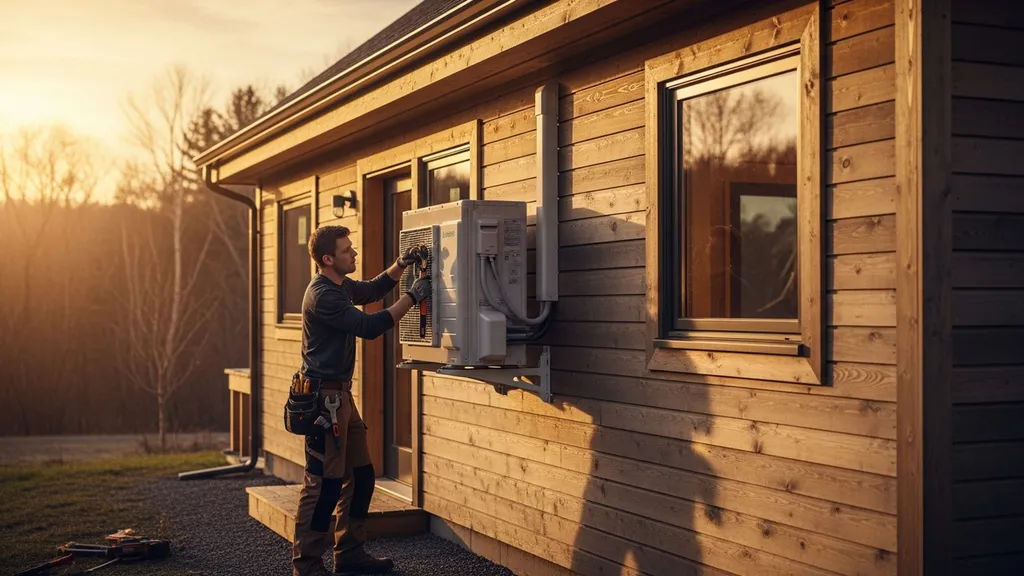
Clear, practical guide to SEER, HSPF and COP for heat pumps — what the numbers mean, how they affect costs, and how to choose the right unit for an eco DIY home.
Heat Pump Efficiency Ratings: SEER HSPF COP Explained
Heat pump SEER HSPF numbers are the quick shorthand homeowners and DIY builders use to compare efficiency. Understanding those ratings helps predict running costs, size solar or battery systems, and choose a heat pump that suits a tight, well-insulated eco home. This guide explains what SEER, HSPF and COP actually mean, how they’re measured, how temperature and installation affect real performance, and how to use the numbers when selecting equipment for an off-grid or passive-ish build.
TL;DR:
- Higher SEER/HSPF and a larger COP mean lower energy use — expect 15–40% lower bills upgrading from standard to high-efficiency models.
- Use HSPF/COP for heating-focused decisions and SEER for cooling; COP tells instantaneous efficiency while SEER/HSPF are seasonal averages.
- Match ratings to climate and envelope tightness, and plan for 10–30% real-world performance loss from poor installation when sizing solar or batteries.
Related guides: Ground source heat pumps geothermal explained, How to automate existing water pumps on a budget, Build update 5 roof trusses sheathing, and How to Automate Existing Water Pumps on a Budget (2026).
What SEER, HSPF and COP Mean for Heat Pump Efficiency
Quick definitions: SEER, HSPF, COP
- SEER (Seasonal Energy Efficiency Ratio): The seasonal cooling performance metric used in the U.S., reported as BTU per watt-hour over a standardized cooling season. Higher SEER = less electricity to move a given amount of heat during cooling months.
- HSPF (Heating Seasonal Performance Factor): The seasonal heating equivalent, also BTU per watt-hour, averaged across a defined winter season. Higher HSPF = less electricity to provide the same seasonal heat.
- COP (Coefficient of Performance): A unitless, instantaneous ratio of heat output to electrical input (kW out ÷ kW in). COP is useful for predicting performance at a specific outdoor temperature.
Example conversion: A heat pump with COP 3.5 produces 3.5 kW of heat for every 1 kW of electricity. Since 1 kW = 3,412 BTU/hr, COP 3.5 equates to roughly 11,942 BTU per kWh of electrical input.
Analogy: miles per gallon for heating and cooling
Think of SEER and HSPF like seasonal miles-per-gallon for a car. A SEER of 16 will use less electricity across the cooling season than a SEER of 12, just as a 35 mpg car uses less fuel across a trip than a 25 mpg car. COP is like instantaneous fuel economy shown on the dashboard — it changes with speed, temperature, and load.
Typical metrics at a glance
| System type | Typical SEER range | Typical HSPF range | Typical COP (operating) |
|---|---|---|---|
| Basic air-source split | 14–16 SEER | 7–8.5 HSPF | 2.5–3.2 (cold to mild) |
| High-efficiency air-source (variable speed) | 18–24+ SEER | 9–11 HSPF | 3.0–4.5 (mild) |
| Cold-climate air-source | 16–22 SEER | 9–10+ HSPF | 2.5–3.5 at -10°C (manufacturer dependent) |
| Ground-source (geothermal) | N/A (usually rated by COP) | N/A (seasonal performance high) | 3.5–5+ (stable ground temps) |
For airtight, low-load builds such as passive-house retrofits, the absolute number matters less than matching capacity to the small load; see the passive-house retrofit tips for reducing loads prior to buying.
For official definitions and guidance on HSPF, the U.S. Department of Energy’s guide to home heating and cooling provides the regulatory context and test definitions: the Department of Energy's guide to home heating and cooling.
How SEER, HSPF and COP Are Measured and What the Numbers Mean
Test conditions vs. real homes
SEER and HSPF are calculated from standardized test cycles that simulate a typical season. Those cycles assume specific indoor setpoints, outdoor temperature bins, and run-times. Manufacturers test in labs under steady, controlled conditions. Real homes differ — occupant behavior, thermostat setbacks, duct losses, and varying temperature swings all change seasonal efficiency.
The Florida Solar Energy Center has analyzed submetered data showing how operational behavior (setback, cycling) alters seasonal performance in actual installations: Climate impacts on HSPF and operational performance.
Key standards and organizations
- AHRI (Air-Conditioning, Heating, and Refrigeration Institute) maintains certification directories and test protocols. See AHRI’s residential heat pump info for current minimum standards and SEER2/HSPF2 shifts: Residential heat pumps | ahri.
- ENERGY STAR sets performance thresholds for qualification and publishes partner specs; check their program requirements for qualified units: ENERGY STAR central air conditioner/heat pump specification.
- ISO and other bodies define lab test procedures used by manufacturers.
Typical rating ranges for common systems
Modern variable-speed air-source heat pumps commonly list SEER 16–24 and HSPF 8.5–11. Ground-source systems don’t use SEER/HSPF the same way; they often quote COP or EER in specific conditions and show very strong seasonal performance because ground temperature is stable.
The Northwest Energy Efficiency Alliance explains the variety of available ratings and why variable-speed systems produce higher seasonal numbers: Heat pump and air conditioner efficiency ratings explained.
Cold-climate performance and cold-weather ratings
COP and HSPF decline as outdoor temperatures fall. High-performance cold-climate models keep useful COP at subzero temperatures by using inverter compressors, larger heat exchangers, and enhanced defrost strategies. Some manufacturers publish performance curves down to -15°C or lower, showing COP and capacity at each temperature. When choosing a model for a northern build, look for manufacturer-supplied cold-weather performance data and independent test lists like NEEP’s cold-climate lists (see industry summaries at building-performance.org).
Keep in mind: lab-rated SEER/HSPF assume correct refrigerant charge, airflow, and duct configuration. Field studies find installation errors can cut seasonal performance by 10–30%.
Why SEER, HSPF and COP Matter for DIY Eco Homes: Real-World Performance and Cost Examples
Simple annual energy-cost calculation (worked example)
Compare two air-source units for a 1,200 sq ft small home with modest insulation: Unit A (SEER 14 / HSPF 8), Unit B (SEER 20 / HSPF 10). Assume annual heating need of 6,000 kWh-equivalent and cooling need of 1,800 kWh-equivalent if using electric resistance (this is a simplified proxy). Use electricity at $0.15/kWh.
- Heating: Higher HSPF reduces kWh. If the base pattern would use 6,000 kWh at HSPF 8, upgrading to HSPF 10 reduces seasonal electricity by 8/10 = 0.8 factor, so 6,000 × (8/10) = 4,800 kWh (approx). Savings: 1,200 kWh × $0.15 = $180/yr.
- Cooling: SEER 20 vs 14 reduces cooling energy by 14/20 = 0.7 factor. If base cooling used 1,800 kWh, upgraded unit uses 1,260 kWh. Savings: 540 kWh × $0.15 = $81/yr.
- Total annual saving ≈ $261. If the higher-efficiency unit costs $2,500 more, simple payback ≈ 9.6 years (not counting incentives, maintenance, or varying fuel prices).
This is simplified. Use actual load calculations (Manual J) for precise sizing. Research and case data in Florida show usage patterns and thermostat behavior can swing these estimates considerably: FSEC field study on heat pump performance.
Impact on sizing, run-time and battery/solar pairing
Higher COP/HSPF cuts instantaneous and seasonal electrical demand. For off-grid or hybrid systems, that can reduce the required solar array and battery capacity substantially. Example: a heat pump averaging 2.5 kW draw for space heating will consume 2.5 kW × 24 h = 60 kWh/day at continuous run; a COP-improved system averaging 1.5 kW saves 30 kWh/day — a major change in solar sizing.
For solar pairing guidance, see the solar sizing basics. When planning batteries, consult battery design guidance such as the battery enclosure guide for safe storage sizing. For hybrid economics (grid + solar), review our breakdown of hybrid energy costs.
Case study: tiny house vs small passive-ish home
- Tiny house (well-insulated, 250 sq ft): heat pump runs short bursts. A modest ductless mini-split at HSPF 9 will typically supply heating with low annual kWh — upgrading to HSPF 10 often gives small absolute savings; oversizing may create short-cycling that negates gains.
- Small passive-ish home (1,200 sq ft, tight envelope): heating loads are low and steady. A right-sized high-COP unit reduces required solar and often lowers lifecycle costs despite higher upfront price.
Sizing matters: in low-load homes, a high-SEER unit that’s physically large can short-cycle. That lowers effective SEER/HSPF in practice. Conversely, variable-speed inverter units scale capacity and maintain efficiency across partial loads, which matters in a low-load eco home.
How SEER, HSPF and COP Are Measured and What the Numbers Mean
Test conditions vs. real homes
(See previous section.) In situ results depend on ductwork, airflow, refrigerant charge, and controls. Distribution losses for ducted systems can be 10–20% unless ducts are inside conditioned space or well-sealed.
Refer to the comparison between ducted vs ductless options when weighing distribution losses and how they affect effective SEER/HSPF.
Key standards and organizations (AHRI, ISO, ENERGY STAR)
AHRI and ENERGY STAR set test and qualification standards. AHRI recently supported the move to SEER2/HSPF2 metrics in updated federal minimums; for current regulatory context, see AHRI's residential heat pump overview.
Typical rating ranges for common systems
(See the table earlier.) Ground-source systems typically deliver higher COPs because ground temperatures are stable; however, they have higher installation costs and site constraints.
Cold-climate performance and cold-weather ratings
A handful of manufacturers publish rated capacity and COP down to -15°C or lower. Look for manufacturer seasonal performance curves and independent test lists when evaluating cold-weather claims. ENERGY STAR lists and manufacturer data sheets help validate cold-climate performance: ENERGY STAR program requirements.
How to Use SEER, HSPF and COP When Choosing a Heat Pump for an Eco DIY Build
Matching ratings to climate and building envelope
- Cold climates: Prioritize HSPF and cold-weather COP curves. A model that keeps useful capacity at -10°C is preferable.
- Mixed climates: Balance higher SEER for summer and higher HSPF for winter; variable-speed units often deliver both.
- Hot-humid climates: Focus on SEER and integrated dehumidification controls for comfort.
For air-source specifics and model choices, see the in-depth air source heat pump guide.
Choosing between ducted, ductless, and ground-source based on ratings
- Ductless mini-splits avoid duct losses and often show higher in-home efficiency for small buildings.
- Ducted systems can serve multiple rooms with a single unit but require ducts inside conditioned space or very tight seals to avoid losses.
- Ground-source offers high COP and stable performance but has higher site and excavation costs.
Sizing tips: when ratings matter most
- Use a Manual J load calculation for best results. In tight, low-load homes, small differences in capacity and modulation matter more than raw SEER.
- Avoid oversizing. Oversized units short-cycle and lose effective seasonal efficiency.
- Inverter-driven variable-speed compressors maintain better COP at part-load — helpful in passive builds with low peak loads.
Installation quality is as important as the rating. Field studies show mischarge, wrong airflow, and duct leakage can reduce performance by 10–30%. Always verify final refrigerant charge, measure airflow, and ensure correct line-set sizing.
Incentives, warranties and installation quality
Check local rebates and incentives — many utilities and state programs pay for higher HSPF/SEER units. Search ENERGY STAR lists and local utility pages for eligible models: ENERGY STAR program requirements.
When planning installation, ask installers for:
- Proof of Manual J and duct design.
- Commissioning checklist (charge, airflow, defrost behavior).
- Manufacturer-authorized warranty and documented service records.
This video explains the fundamentals:
Common Misconceptions About SEER, HSPF and COP (and How to Avoid Mistakes)
Higher number always better? Not always
Higher SEER or HSPF typically reduces energy use, but only if the unit is correctly sized and installed. In a very small, highly insulated home, an oversized high-SEER unit that short-cycles can perform worse than a modest right-sized unit. Also, very-high-SEER models may cost significantly more; calculate payback using local electricity prices and expected run-hours.
Label reading pitfalls and inconsistent units
- Remember: SEER/HSPF are seasonal, CIF-based averages; COP is instantaneous and temperature-dependent.
- Some manufacturers publish SEER2/HSPF2 numbers or European seasonal metrics (e.g., SCOP). Compare apples to apples: use AHRI directories or ENERGY STAR lists to verify lab-certified numbers: AHRI residential heat pump standards.
- Marketing claims sometimes highlight peak COP or best-case lab numbers. Ask for full performance curves and seasonal tests for your climate zone.
A quick checklist to avoid mistakes:
- Ask for manufacturer seasonal curves for your climate.
- Verify installer commissioning and post-install performance measurements.
- Confirm location of ducts (inside conditioned envelope is better).
- Use a Manual J load calculation for proper sizing.
The Bottom Line
Heat pump SEER HSPF and COP provide complementary views: SEER and HSPF estimate seasonal performance, while COP tells you instantaneous efficiency at a given temperature. For eco DIY homes, prioritize matching ratings to climate and envelope, ensure high-quality installation, and factor ratings into solar and battery sizing decisions.
Frequently Asked Questions
How do I convert COP to kWh or BTU?
Convert COP to useful heat per kWh by multiplying COP × 3,412 BTU (per kW). For example, COP 3.5 × 3,412 = about 11,942 BTU per kWh of electricity. To find kW heat from electrical input: heat kW = COP × input kW. So 1 kW electrical at COP 3 gives 3 kW of heat.
Is SEER relevant if I mainly heat my home?
SEER is a cooling-season metric and matters primarily if you need air conditioning. If heating is the dominant load, focus on HSPF and COP values, plus cold-climate performance curves. That said, if summer comfort is occasional, SEER still affects total annual energy use.
Can a heat pump work off-grid with solar?
Yes; high COP units reduce the electrical demand and therefore the size of the required solar array and battery bank. When planning off-grid, calculate typical daily heat energy (kWh) using COP and expected hours, then size PV and storage accordingly. See our solar sizing basics for a practical starting point.
How much can I expect to save with a higher hspf?
Savings depend on hours of use, local electricity prices, and climate. A jump from HSPF 8 to HSPF 10 can reduce seasonal heating electricity by roughly 20–25% under similar loads. In dollar terms, that could be a few hundred dollars per year for a typical small home; calculate payback including upfront cost and available incentives.
Do I need a special installer for cold-climate heat pumps?
Installers experienced with cold-climate models and inverter systems are recommended. Look for technicians who can perform Manual J, verify refrigerant charge, measure airflow, and provide a commissioning report. Manufacturer-authorized installers are often required to keep warranties valid.