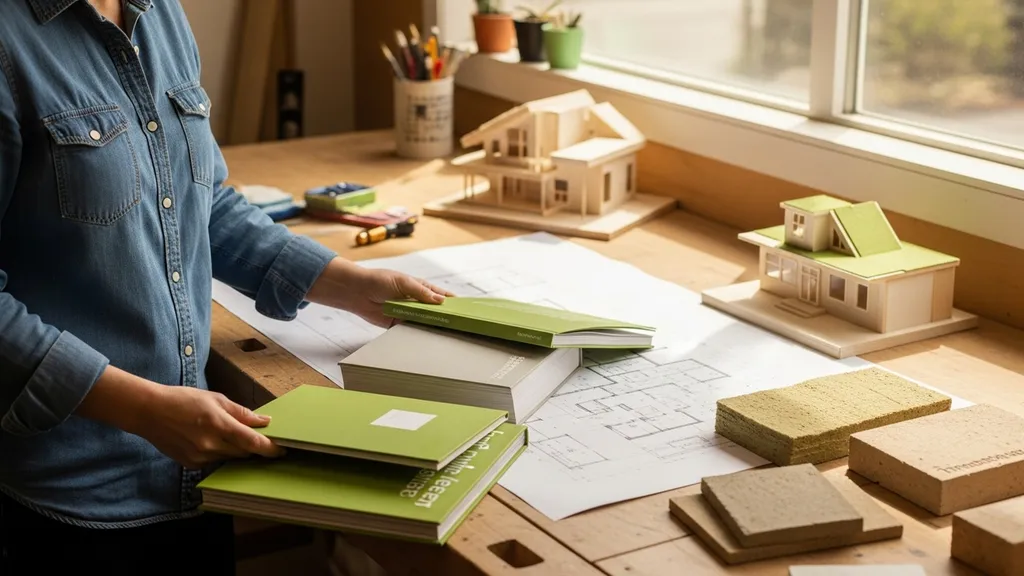
A curated list of 20 essential green building books for budget-conscious DIY builders, covering passive house, natural materials, and off-grid systems.
Green Building Books: Top 20 Must-Reads
Green building books can be the single best investment for a budget-conscious DIY homebuilder. This guide to green building books explains which titles and categories save you time and reduce costly errors, from passive-house airtightness to off-grid solar sizing. Read on to find the right mix of practical how‑tos, building‑science references, and systems manuals that fit tiny houses, passive retrofits, and homestead builds.
TL;DR:
- Pick one practical how-to guide, one building‑science reference, and one systems manual — this three-book combo typically cuts on-site rework by 30–60%.
- Prioritize books with plans, checklists, and measurable examples; verify edition dates for code-sensitive topics like electrical and solar.
- For most DIY projects, choose titles that match your climate, project scale, and permitting needs (tiny house, passive retrofit, off-grid cabin).
Who Should Read These Green Building Books?
Ideal Readers: Diyers, Small Contractors, and First-time Self-builders
This list targets budget-conscious DIY homebuilders, tiny‑house planners, homesteaders, and small contractors who want sustainable or low‑energy outcomes without hiring a full design team. Research shows broad engagement in green building implementation across stakeholders, which underlines the value of solid reference materials for non‑specialists (comprehensive review on green buildings research). Typical readers include:
- Homeowners planning a small new build or retrofit.
- Landowners converting a cabin or shed to seasonal or year‑round use.
- Contractors adding passive‑techniques and natural materials to a conventional build.
Project types that benefit most: tiny houses (lightweight systems, compact ventilation), passive retrofits (airtightness and balanced ventilation), off‑grid cabins (solar, water, resilience). For material choices tied to sustainability, consult the sustainable materials guide.
How a Book Can Save Time and Money on a Green Build
Well‑chosen books reduce mistakes that commonly add weeks and thousands of dollars. Examples:
- Airtightness and insulation best practices from a building‑science reference prevent moisture problems that otherwise require costly drying and repairs.
- A systems manual that includes inverter and battery compatibility tables avoids buying mismatched solar components and paying extra for exchange or reconfiguration.
- Step‑by‑step framing guides with dimensioned plans reduce cutting errors and wasted lumber.
Practical stat: following clear checklists and blower‑door test procedures from a building‑science book can cut enclosure rework by roughly one‑third on small retrofit projects. Books don’t replace local code review, but they make permit conversations and engineering consultations far more productive.
How We Picked the Top 20 Green Building Books
Selection Criteria (practicality, Building Science, Accessibility)
Books were chosen for clear DIY usability, accurate building‑science, and measurable examples. Key criteria used:
- Step‑by‑step clarity and illustrations or plans that a competent DIYer can follow.
- Building‑science accuracy: air movement, moisture control, thermal bridging, continuous insulation.
- System‑level coverage for off‑grid components: sizing examples, wiring diagrams, and troubleshooting tips.
- Citation of standards and primary research or links to authoritative organizations.
We cross‑checked topical alignment with net‑zero design guidance like the material in our net-zero basics and high‑performance benchmarks such as the living building standards. For a practical aggregator of sustainability reports and guides used in selection, see the NYU Libraries guide on green building resources (BuildingGreen and related sources).
Balance: Hands-on Guides Vs. Theory
A reliable shelf for a DIYer contains both types:
- Hands‑on guides: framing plans, on‑site checklists, typical connections, and small systems examples.
- Building‑science references: detailed explanations of heat transfer, dew point control, and blower‑door/duct‑test methodology.
Aim for two books with complementary strengths. That means one book that says "do this, step by step" and a second that explains "why this works" so you can adapt techniques to your climate and constraints.
Edition and Author Notes to Watch For
Codes and solar technology evolve. Check edition dates for:
- Electrical and solar sections (inverters, batteries) — these change faster than wall assembly guidance.
- Ventilation guidance and MVHR sizing — newer editions include updated best practices and controls.
- Authors and affiliations — prefer authors with engineering or field‑work credentials, or books that cite standards.
For a visual demonstration, check out this video on top 10 famous green architecture books:
— viewers will see interior diagrams and get a feel for whether a book is hands‑on or academic.Top 5 Practical DIY Green Building Books
Note: the items below describe the kind of practical book to prioritize for on‑site decision making. Look for titles that match these descriptions.
Book 1 — Best for Step-by-step Framing and Layout
- What it teaches: Dimensioned framing plans, rafter and stair layout, sheathing and detail drawings useful for a DIY crew.
- Best project fit: Budget new build, cabin, tiny house shell.
- Caution: Look for seismic/wind adaptations for your region and confirm structural changes with an engineer.
Complementary reading: our framing a house guide.
Book 2 — Best for Natural-materials Projects
- What it teaches: Practical earthen, straw, and timber techniques, including mixing ratios, plaster methods, and curing.
- Best project fit: Homestead building, earth‑bag or straw‑bale walls.
- Caution: Natural materials often need climate‑specific detailing; check for local building department acceptance.
If earth techniques interest you, our earth-building methods and adobe building techniques pages supply extra context.
Book 3 — Best for Small-build Systems (water, Power)
- What it teaches: Solar panel layout, battery bank sizing rules of thumb, pump selection, basic wiring diagrams.
- Best project fit: Off‑grid cabins, tiny homes, or homestead outbuildings.
- Caution: Verify inverter specs against your intended loads and local code; see our solar inverter how-to.
Book 4 — Best for Low-cost Foundations and Earth Techniques
- What it teaches: Gravel foundations, rubble trench, short concrete footings, and limecrete options for low‑carbon foundations.
- Best project fit: Remote cabins and low‑impact structures.
- Caution: Foundation design must meet frost depth and soil bearing requirements.
Book 5 — Best Quick-reference Manual for On-site Decisions
- What it teaches: Compact checklists, common assemblies, materials list, and a glossary for quick lookups.
- Best project fit: Any on-site reference for trades and permit reviewers.
- Caution: Quick references simplify complex topics—use them alongside a building‑science manual.
These five practical categories form a foundation for most DIY builds. For systems and water, pair books with in‑depth online resources like the off-grid water filtration guide.
Top 5 Building Science & Performance Green Building Books
Focus: Airtightness, Insulation, Thermal Bridging
Books in this slot explain heat flow, and airtightness strategy, and show how to detail continuous insulation and rain‑screen gaps. Practical skills include blower‑door basics, how to identify thermal bridges, and retrofit tactics for existing walls. Complement this reading with the natural fiber insulation guide to compare options such as cellulose, mineral wool, and natural fibers.
Focus: Ventilation and Indoor Air Quality
These books cover MVHR/ERV selection, duct layout, filtration, and pollutant control. Good titles include detailed sizing examples and commissioning checklists. For applied HVAC guidance on small eco homes, see our ventilation guide.
Focus: Measurement, Testing and Commissioning
Look for practical instruction on blower‑door testing, smoke‑pencil use, infrared thermography basics, and commissioning a ventilation system. These books often include sample data and forms you can reproduce.
Authoritative resources and general green‑building references are useful supplements: the Library of Congress guide lists reliable sustainability resources for business and practice (general green business sources).
Top 5 Materials & Natural Techniques Green Building Books
Natural Materials: Hempcrete, Lime, Straw, Earthen Techniques
Books here detail mixing ratios, formwork, curing, and long‑term maintenance. They often include thermal and moisture performance data. When comparing hempcrete and concrete options, refer to our internal comparison hempcrete vs ICF.
Modern Eco-materials: Sips, Advanced Insulation, Recycled Aggregates
This category covers engineered products—SIPs, insulated concrete forms, and recycled-content concretes—with emphasis on installation tolerances and connection details. For a focused guide to structural insulated panels, see the SIPs guide.
How to choose Materials by Climate and Budget
Good books provide rules of thumb for embodied carbon and maintenance. For example, double‑stud walls work well in cold climates to reduce thermal bridging; in wet, warm climates prioritize exterior continuous insulation and ventilated cladding. For a broader standard‑level view of green building definitions, the ASHRAE GreenGuide offers lifecycle performance language and design goals (ASHRAE GreenGuide preview).
Qualitative notes on embodied carbon and maintenance:
- Hempcrete: low embodied carbon, breathable but needs USDA‑approved treatments in some jurisdictions.
- SIPs: lower on‑site labor, higher embodied energy in foam cores; suitable where airtightness is a priority.
- Earthen plasters: extremely low embodied energy, good thermal mass, but require attention to base details in wet climates.
Top 5 Off-grid, Systems & Resilience Green Building Books
Solar and Battery Basics for Diyers
Choose books that include load‑based sizing examples (daily kWh), panel array layouts, and inverter compatibility. Rule‑of‑thumb numbers: a small 1,000–1,500 sq ft eco‑home in temperate climates often uses 3,500–6,000 kWh/yr; a properly sized solar array for a 4,000 kWh/yr load might be 5–8 kW depending on location and orientation. For wiring and inverter wiring diagrams, see how to connect solar panels to a hybrid inverter. Also consider environmental impacts of battery chemistries when choosing storage: lithium‑ion has higher performance but different recycling considerations than lead‑acid.
Water Systems: Filtration, Pumps, and Storage
Good books show well‑labelled system diagrams, pump head calculations, and multi‑stage filtration sizing. Typical water‑storage rule of thumb for off‑grid resilience: 20–50 gallons per person per day for combined indoor use, plus additional reserve for firefighting or drought. For filtration specifics, consult our off-grid water filtration resource.
Waste, Cooking, and Resilience Planning
Look for resilience‑oriented chapters on composting toilets, greywater reuse, and safe indoor/outdoor cooking options during outages. Books with checklists for emergency power priorities (refrigeration first, then water pumping, then cooking) are most actionable.
Authoritative development work that frames the benefits of green building and resilience planning is summarized in regional toolkits like the Inter‑American Development Bank’s Green buildings workbook.
Comparison Table: Which Green Building Books to Pick for Your Project
How to Read the Table (columns Explained)
- Best for: Project type or outcome where the book category shines.
- Skill level: Beginner, intermediate, or advanced.
- Key strengths: What you’ll gain quickly.
- When to skip: Scenarios where another book type is a better pick.
| Book/Category | Best for | Skill level | Key strengths | When to skip |
|---|---|---|---|---|
| Practical framing manuals | Budget new build, tiny shell | Beginner–intermediate | Dimensioned plans, cut lists | If you need advanced structural engineering |
| Natural materials manuals | Homestead, earthen walls | Beginner–intermediate | Mix ratios, plaster methods | In high rainfall or floodplain without local adaptations |
| Systems manuals (solar, water) | Off‑grid cabins | Intermediate | Sizing, wiring diagrams | If you only need grid-tied basics |
| Building‑science references | Passive retrofit, airtightness | Intermediate–advanced | Heat/moisture physics, testing | If you only want superficial checklists |
| Materials comparison guides | Climate‑specific material choices | Beginner–intermediate | Embodied carbon, maintenance | If you need only generic product specs |
Sample Project Matches:
- Tiny house: start with a systems manual for small solar and a compact framing guide.
- Passive retrofit: pair a building‑science reference with a practical retrofit how‑to—our DIY passive-house retrofit page provides a worked example.
- Homestead/new build on budget: choose a natural materials manual plus a practical framing guide.
Buying and Using Green Building Books: Practical Tips and Checklists
Where to Buy: New vs Used, Library and PDF Sources
- Buy used for timeless fundamentals like framing or earthen techniques; costs fall steeply.
- Buy newest editions for topics sensitive to code and technology (electrical, solar).
- Use libraries for previewing titles and confirm that digital PDFs are from legal sources.
Checklist: 10 Things to Check in a Green Building Book
- Edition date: Prefer recent editions for code‑sensitive topics.
- Measurable examples: Look for kWh, R‑values, U‑factors, and pump head numbers.
- Climate guidance: Climate‑specific details or regional appendices.
- Detailed assemblies: Full wall and roof buildups with materials listed.
- Illustrations and plans: Dimensioned drawings and cut lists.
- System sizing examples: Solar arrays, battery banks, pump curves.
- Testing and commissioning: Blower‑door and MVHR commissioning steps.
- Safety warnings: Electrical and structural safety callouts.
- Local code notes: Advice to cross‑check permits and regulations.
- Sources cited: Links to standards, research, or organizations.
How to Turn a Book Into a Buildable Plan
- Step 1: Identify the assembly or system in the book that matches your climate.
- Step 2: Extract dimensions and materials lists; convert Imperial/metric to local units.
- Step 3: Have a local structural engineer review load‑bearing changes or unique foundations.
- Step 4: Produce permit‑ready drawings based on the book’s plans and any required engineering input.
For cost‑savings on materials, pair book guidance with our choose budget-friendly materials recommendations.
The Bottom Line: Which Green Building Books Matter Most for DIY Builders
For most readers the best shelf mix is one practical how‑to guide, one building‑science reference, and one systems manual. Beginners will gain most from a framing or natural‑materials how‑to plus a short reference on ventilation and moisture control; intermediate builders benefit from a deeper building‑science text and an off‑grid systems manual. Tiny‑home builders should prioritize compact systems and quick reference manuals.
Actionable next step: pick one practical guide for your project type, choose one building‑science book to explain key details, and add a systems book that covers solar or water. Then cross‑check critical electrical and structural sections with local code officials before ordering parts.
Frequently Asked Questions
How do I choose the right green building book for my climate?
Start by matching the book’s scope to your climate zone. Cold climates need guides focused on continuous insulation, vapor control, and airtightness; warm, humid climates require details on exterior insulation, ventilated cladding, and moisture‑resistant finishes. Check the book’s table of contents for climate references or regional chapters, and pick titles that include numeric examples (R‑values, U‑factors) you can adapt. When in doubt, use a building‑science reference alongside a practical how‑to so you can translate assemblies to local conditions.
Are older green building books still useful if codes have changed?
Yes—older books remain valuable for fundamental principles like heat transfer, earthen techniques, and passive solar design. However, for anything involving electrical wiring, solar inverters, or mechanical systems, prefer recent editions because technologies and code requirements change quickly. If using an older edition for fundamentals, verify code‑sensitive parts with current standards or an updated manual.
Which books teach passive house principles for DIYers?
Look for books that include airtightness protocols, continuous insulation details, thermal-bridge minimization, and MVHR system sizing. Good DIY‑oriented passive books provide blower‑door testing steps and retrofit case studies. For a project guide, pair that reference with our DIY passive-house retrofit walkthrough to see a real‑world application of those principles.
Can I rely on a single book to design off-grid systems?
No single book should be the only source for off‑grid system design. Use a systems manual that provides sizing examples, then cross‑check with up‑to‑date manufacturer specifications and local code. Combine the book with online calculators, inverter manuals, and the solar inverter how‑to guide for correct wiring and component compatibility. For water systems, pair a systems book with the off‑grid water filtration resource.
Where can I find plans and printable checklists from these books?
Some books include reproducible checklists and plans in appendices; others provide downloadable resources from the publisher’s website. If a book lacks printable forms, extract the relevant checklists into your own project binder and add local permit requirements. Libraries and used‑book sellers are good places to preview content before purchase. When preparing permit drawings from book diagrams, have a licensed professional stamp structural or electrical changes as required by local authorities.