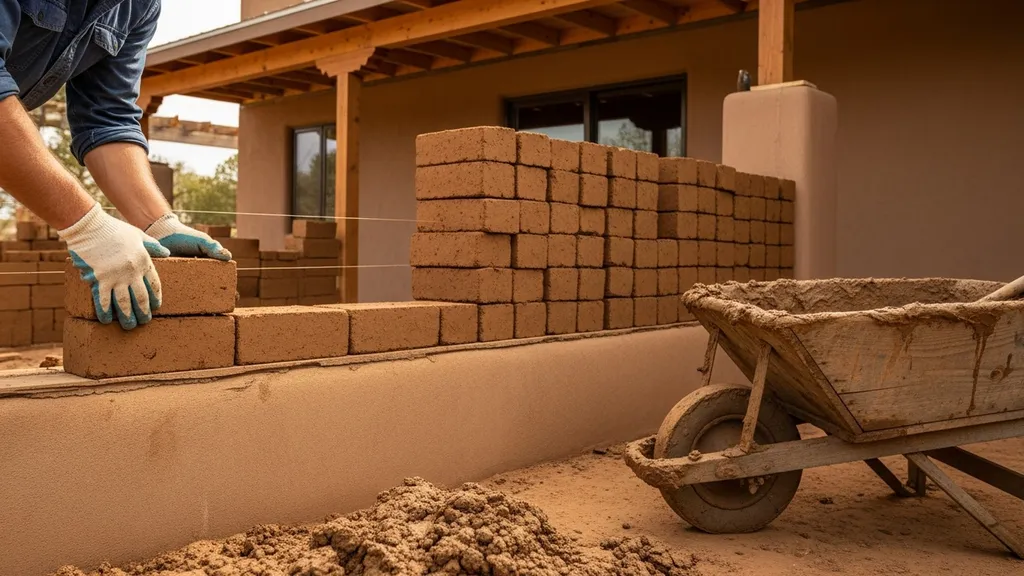
Practical guide to adobe construction: materials, traditional methods, modern hybrids, DIY workflow, maintenance, costs, and sustainability.
Adobe Building: Traditional and Modern Techniques
Adobe construction is the practice of making load-bearing walls and structural elements from sun-dried earth bricks; it can cut embodied carbon dramatically while offering very high thermal mass for diurnal climates. This guide shows how adobe works, step-by-step DIY workflows for hand-formed bricks and stabilized systems, modern hybrid assemblies that meet code, and practical maintenance and permitting advice. Readers will learn soil testing methods, mixing ratios, protection and drainage details, and realistic cost and labor tradeoffs for building small homes or outbuildings.
TL;DR:
- Adobe construction can reduce embodied carbon by using on-site soil and requires low-cost materials but high labor; unstabilized adobe compressive strength is typically 1–3 MPa (145–435 psi).
- Stabilized adobe or compressed earth blocks (CEBs) improve moisture resistance—typical stabilizer content is 5–10% cement or lime—and hybrid assemblies add insulation to meet modern energy codes.
- For durable builds, prioritize foundations and drainage (6–12 in clearance from grade, robust eaves), test trial bricks, and consult an engineer for seismic or multi-story designs.
Related guides: Log cabin building modern techniques, Flood resistant building elevated construction, Earth bag building low cost construction method, Checklist for recycling construction materials, Recycled steel in construction benefits and uses, and Living building challenge beyond LEED.
What is Adobe Construction? Origins, Materials, and Performance
Adobe construction refers to walls made of sun-dried mud bricks—usually a mix of clay, sand, silt, straw (or other fiber) and water—that are stacked and mortared with similar earthen mixes. The method dates back millennia; intact adobe structures exist in Peru, North Africa, and the U.S. Southwest, with Pueblo and colonial-era buildings in New Mexico lasting centuries when properly maintained. Research and technical manuals describe adobe as an accessible low-embodied-carbon option when local soils are used; for an authoritative technical primer see the USDA Forest Service guide on adobe design and construction (Adobe architecture: its design and construction).
Key materials and definitions:
- Clay, sand, silt: Soil texture dictates brick behavior. Clay binds; sand reduces shrinkage and cracking; silt fills voids.
- Straw or fiber: Short fibers improve tensile strength of bricks and reduce shrinkage cracks.
- Mortar: Earthen mortar (same basic mix) keeps joints compatible and breathable.
Typical physical properties:
- Brick size and weight: Common hand-formed bricks are roughly 10–14 in by 14 in by 4 in and weigh 20–35 lb depending on moisture and density.
- Compressive strength: Unstabilized adobe commonly ranges 1–3 MPa (145–435 psi); stabilized adobe can reach 3–12+ MPa depending on mix and compaction.
- R-value: Earthen materials have low R per inch (roughly 0.2–0.5 per inch depending on density). Adobe’s benefit is thermal mass—it evens out indoor temperature swings in dry, high-diurnal climates rather than providing high insulation.
Performance note: adobe excels in arid regions with big day-night temperature swings because walls store heat during the day and release it at night. Compared with concrete and steel, adobe typically has much lower embodied carbon when local soil is the primary material. For preservation-focused guidance on historic adobe, consult resources like the National Park Service’s preservation brief on adobe buildings (Preservation of historic adobe buildings).
Traditional Adobe Building Techniques
Hand-forming and curing adobe bricks
A practical sequence for hand-making bricks:
- Soil testing: Do a jar test (mix soil and water, let settle) to estimate clay:sand:silt proportions and perform a shear test for cohesion.
- Mix ratios: Start with trial mixes. Common starting ranges are 20–30% clay, 60–75% sand, remainder silt, plus 1–3% straw by dry volume. Adjust until test bricks cure without excessive cracking.
- Forming: Use simple wooden molds (10–14 x 14 x 4 in). Tamp the mix firmly, remove the mold, then stack bricks with spacers for air circulation.
- Curing: Dry bricks 1–4 weeks depending on climate; protect from rain and frost during cure. Rotate stacks to allow even drying.
- Quality checks: Break a test brick to inspect internal texture and make note of shrinkage, cracks, and strength.
For step-by-step instruction and reference reading, the Adobe in Action “Essential Reading” list provides recommended books for owner-builders (Essential Reading - Adobe in Action).
Cob, adobe block laying and common bond patterns
- Cob: A monolithic method where wet earth is sculpted without molds; best for curved walls or sculptural features.
- Block laying: Use earthen mortar (same mix) so joints remain compatible and breathable. Bond patterns vary; stretcher bond and header-stretcher combinations are common. Typical load-bearing adobe wall thickness ranges from 12–24 in depending on structural needs.
- Lintels and openings: Use timber or steel lintels sized by span and load; protect junctions with flashing and a breathable wrap to avoid concentrating moisture.
Earthen plasters and natural finishes
Compare common finishes:
- Earthen plaster: Highly breathable, low embodied energy, easy to repair. Reapply every 5–20 years depending on exposure.
- Lime plaster: More moisture tolerant than pure earthen plasters; adds durability while maintaining breathability when used correctly.
- Cement stucco: Strong and durable but less vapor-permeable. On adobe, cement renders can trap moisture and cause deterioration of earthen masonry—use with care and expert guidance.
Basic tools for traditional work: wooden molds, mixing troughs, shovels, wheelbarrows, tamps, plastering trowels, and protective covers. Owners restoring historic structures should consult local preservation best practices and building officials.
Modern Adaptations and Hybrid Methods
Modern adaptations address moisture resistance, strength, and energy-code requirements. Three common modern approaches are stabilized adobe, compressed earth blocks, and hybrid wall assemblies.
Stabilized adobe and additives
Stabilizing additives increase compressive strength and reduce erosion. Typical stabilizer dosages:
- Cement or lime: 5–10% by dry weight is common for modest stabilization. Higher percentages increase strength but raise embodied carbon and can alter breathability.
- Bitumen or asphalt emulsions: Used for water resistance in some climates but reduce permeability.
Industry guidance from New Mexico State University provides practical steps for beginners on soil analysis and stabilization (ABCs of making adobe bricks | nmsu).
Compressed Earth Blocks (CEBs) and mechanical compression
CEBs are machine-pressed blocks with higher density and uniformity. Brands and technologies include block presses such as Hydraform and interlocking systems. CEB characteristics:
- Densities: Machine-pressed densities typically exceed hand-formed adobe, improving compressive strength.
- Strength: CEBs commonly range 5–12 MPa depending on compaction and stabilizer content.
- Ease of DIY: Small presses allow owner-builders to produce consistent blocks but require investment in equipment and a learning curve.
Hybrid assemblies: insulated cores, framed ties, SIP/adobe combos
Because adobe’s R-value is low, hybrid assemblies combine the mass benefits of adobe with modern insulation:
- Interior insulation: Add continuous insulation (rigid foam or natural fiber boards) on the interior face; ensure vapor control is appropriate for the climate.
- Insulated cavity walls: Build an outer adobe wythe and an inner insulated framed wall tied together with stainless steel ties.
- SIP/adobe combos: Structural insulated panels reduce perimeter heat loss while adobe provides thermal storage.
Comparison/specs table:
| Type | Typical compressive strength | Moisture resistance | Typical wall thickness | Typical cost per sq ft (materials only) | Ease of DIY |
|---|---|---|---|---|---|
| Unstabilized adobe | 1–3 MPa (145–435 psi) | Low, needs good protection | 12–24 in | $3–$8 | High (manual labor) |
| Stabilized adobe (5–10% cement) | 3–8 MPa | Improved | 12–18 in | $6–$15 | Moderate |
| Compressed earth blocks (CEB) | 5–12 MPa | Good with stabilization | 8–12 in (denser) | $8–$18 | Moderate (equipment) |
| Rammed earth | 4–12+ MPa | Very good with proper compaction | 8–14 in | $10–$25 | Low DIY (needs formwork) |
Notes: Cost ranges vary widely by region and whether soil is on-site. Moisture resistance depends heavily on detailing—flashing, eaves, and foundations matter more than lab strength alone. Choose based on rainfall, freeze-thaw exposure, and labor availability.
Design Principles for Durable Adobe Homes
Foundations, drainage, and moisture control
Good foundations and drainage are non-negotiable for longevity. Practical rules:
- Raised foundation: Use rubble trench or concrete footings with a damp-proof course where code requires it. Maintain a minimum wall-to-ground clearance of 6–12 in above grade; in rainy climates favor 12 in or more.
- Capillary break: Insert a capillary break (gravel layer or damp-proof membrane) between footing and adobe wall to prevent rising moisture.
- Site grading: Slope site drainage away from walls at least 5% for the first 10 ft.
For technical detail on vapor-control layers, see the guide on vapor barrier installation for walls.
Roof design, wide eaves and water-shedding detailing
Roof and eave design protect adobe from rain:
- Eaves: 18–36 in overhangs are common; increase overhang in rainy climates.
- Roof slope and flashing: Use steep-enough slopes to shed water quickly and install flashing at wall intersections. Clay tile roofs pair well with adobe when installed with proper underlayment and flashing; see the clay tile roofing guide for compatible installation methods (How to install clay tile roofing: step-by-step guide).
- Sacrificial skirts and plinths: Consider a mud or stone plinth at the base of walls to take direct splash and abrasion.
Wall geometry, openings, and passive-solar orientation
- Wall thickness and openings: Thick walls support smaller openings by proportion; keep large glazed areas to the south in passive solar designs and use shading to prevent summertime overheating.
- Window sizing rules of thumb: Limit south glazing to roughly 5–7% of floor area for heavy-mass walls in hot climates, or increase thermal control with operable shading devices. For specific window orientation strategies related to thermal mass, see the passive solar window guide.
- Seismic detailing: In seismic zones, include reinforced bond beams, continuous lintels, and engineered ties. Always consult an engineer for multi-story or code-required seismic designs.
Step-by-Step: A DIY-Friendly Adobe Construction Workflow
Site prep and simple soil testing (jar test, shear test)
- Select site and orientation: Favor a site with good drainage and solar access.
- Soil sampling: Collect multiple samples across the build footprint; perform jar tests and a manual shear test to estimate clay, sand and silt.
- Trial batches: Make small trial bricks to observe shrinkage and cracking.
Allow about 1–2 weeks for site prep including excavation, leveling and temporary storage for soils.
Mixing, forming, curing bricks, and quality checks
- Mixing: Combine soil, sand, and fiber to match trial ratios. For stabilized adobe, add cement or lime (5–10% by weight) uniformly.
- Forming: Fill molds, tamp, remove, and stack with spacers for airflow.
- Curing: Protect bricks from rain and frost; turn stacks periodically. Production for a small house might take several weeks to months depending on workforce and weather.
Tips:
- Record mix ratios and label trial bricks by date.
- Protect fresh bricks with tarps and raised pallets during rain.
- Perform a simple compressive test with a car jack and plates for sample bricks if strength verification is needed.
Laying courses, lintels, bond beams, and finishing steps
- Foundation: Prepare a foundation suitable for the soil and climate—slab-on-grade or raised footings. For slab guidance, consult the slab-on-grade foundation guide.
- First course: Lay the first course on a level bed of earthen mortar; use a straightedge and string lines for alignment.
- Bond beams and lintels: Install reinforced bond beams at the top of walls and over large openings; use treated wood or steel lintels sized per span.
- Plastering: Apply an earthen base coat, allow adequate cure time, then finish with lime or earthen topcoat as climate dictates.
Safety and when to hire professionals:
- Hire an engineer for seismic zones, multi-story walls, or when local code requires engineered details.
- Use PPE for mixing and cutting operations; eye protection, gloves, and dust masks are advised when working with dry mixes and cement.
Watch this step-by-step guide on making adobe strong enough to build a house:
Materials list (approximate per 100 sq ft of wall face at 12 in thick):
- On-site soil: ~3–5 cubic yards
- Straw or fiber: 1–2 bales (small bales)
- Portland cement (for 5% stabilization): 40–80 lb
- Timber for lintels and forms: variable
- Plaster materials: 0.5–1 cubic yard of finishing mix
Maintenance, Repairs, and Common Problems
Diagnosing moisture damage and repair strategies
Common failure modes include rising damp, base erosion, and failed plaster. Signs to watch for:
- Softened base of wall or powdering
- Vertical or stepped cracking near foundation
- Erosion of plaster and visible wet spots after rain
Repair approaches:
- Fix drainage first: Correct grading and extend downspouts.
- Rebuild eroded base: Remove damaged adobe and replace with compatible new bricks; reinstall capillaries and plinths as needed.
- Use breathable finishes: Replaster with earthen or lime plaster rather than cement stucco to allow moisture to move.
For historic repair best practices and material compatibility guidance consult the NPS preservation brief mentioned earlier (Preservation of historic adobe buildings) and general construction texts (Catalog Record: Adobe construction methods).
Crack repair, repointing, and re-plastering
- Crack stitching: Fill structural cracks with compatible earthen mortar and insert stainless steel staples if needed; for large structural issues consult an engineer.
- Repointing: Use the same earthen mortar composition as original walls to maintain breathability.
- Plaster reapplication: Scratch coat → brown coat → finish coat; allow proper drying times between coats to avoid trapping moisture.
Long-term maintenance schedule and seasonal checks
- Annual visual inspection: After wet seasons or major storms, check base, eaves, and plaster.
- Every 5–15 years: Replaster exterior walls depending on exposure.
- After freeze-thaw or flood events: Conduct structural inspection and repair immediately.
For eco-friendly protective coatings and breathable exterior renders consult the eco-friendly exterior coatings guide. To reduce waste during repairs and small-scale brickmaking, follow the guidance in 10 ways to reduce construction waste.
Cost, Sustainability, Permits, and When to Choose Adobe
Embodied carbon, lifecycle benefits, and material sourcing
Adobe can offer low embodied carbon when soil is on-site and minimal cement is used. Lifecycle advantages include reparability, long useful life when maintained, and low-energy manufacture (sun-drying vs firing). That said, adding cement for stabilization increases embodied carbon; designers must balance durability with carbon goals. For broader context on sustainable materials and embodied carbon comparisons, see the sustainable materials guide.
Approximate cost comparisons and labor tradeoffs
- Material costs: Material-only costs can be low—$3–$15 per sq ft of wall surface depending on stabilization and if soil is free on-site.
- Labor costs: Labor is the major expense. Hand-forming bricks is labor-intensive; mechanical CEB production reduces labor per block but requires equipment investment.
- Tradeoffs: Owner-builders save on material costs but must invest substantial time; hiring skilled craftspeople raises project costs but reduces construction time and risk.
Permits, building codes, and insurance considerations
- Permits and codes: Many jurisdictions require engineered details for structural walls or for seismic zones. Energy code compliance (IECC) may dictate insulation and U-factor requirements—hybrid solutions often help meet these rules.
- Insurance and financing: Mortgage and insurance availability vary by region and lender. Insurers may require engineered foundations or specific moisture protections for adobe structures.
Businesses and regulatory bodies recommend early contact with local building departments and, when needed, an engineer familiar with earthen construction.
When to choose adobe:
- Good fit: Dry, diurnal climates, on-site soils available, owners comfortable with manual work, and small to medium single-story projects.
- When to avoid: Very wet climates, frequent freeze-thaw cycles, high-rise or heavily seismic sites without expert engineering.
Key Points: Quick Reference Checklist
- Soil test first: Perform jar tests and trial bricks to dial mix proportions.
- Protect from moisture: Design foundations, eaves, and grading to keep walls dry.
- Consider stabilization: Use 5–10% cement or lime when extra strength or moisture resistance is required.
- Plan for thick walls: Account for reduced interior floor area and opening framing.
- Schedule curing: Brick production and curing can take weeks to months—plan labor.
- Consult engineers when needed: Hire for seismic zones, multi-story, or complex lintel/bond beam designs.
- Use breathable finishes: Prefer earthen or lime plasters; avoid rigid cement renders unless detailed for compatibility.
- Budget labor: Labor may be 50–80% of build cost for owner-builder projects.
- Test small: Build a prototype wall or small shed to validate mixes and techniques before scaling up.
The Bottom Line
Adobe construction offers a low-embodied-carbon, DIY-viable route to durable homes in suitable climates; modern stabilization and hybrid assemblies broaden where adobe can be used but raise costs and complexity. For most owner-builders the best approach is to test soils and mixes on a small scale, prioritize foundation and moisture-control details, and consult professionals for engineered elements.
Frequently Asked Questions
What climates are best for adobe?
The short answer: arid or semi-arid climates with large diurnal temperature swings are ideal because adobe’s thermal mass evens out temperature extremes. Areas with high annual rainfall or frequent freeze-thaw cycles require heavy stabilization and robust detailing; in those places consider hybrid systems or alternative materials.
How long do adobe bricks take to cure?
Hand-formed adobe bricks typically cure in 1–4 weeks depending on temperature, humidity and stack ventilation; drier, warmer conditions speed curing. For consistent results, make trial bricks and allow prolonged protection from rain and frost during the first several weeks.
Is stabilized adobe necessary?
Stabilization is not always required; unstabilized adobe works well in dry, sheltered locations. Stabilizers (commonly 5–10% cement or lime) are recommended where increased moisture resistance or higher compressive strength is needed, but they increase embodied carbon and can change permeability.
Do adobe walls need insulation?
Adobe walls have low R-value per inch, so insulation is often required in cold climates to meet energy codes. Many builders use hybrid assemblies—insulated framed walls, interior insulation layers, or continuous exterior insulation—to combine thermal mass with effective resistance to heat loss.
Can I get a mortgage or insurance for an adobe house?
Mortgage and insurance availability vary by lender, insurer, and region. Lenders and insurers typically look for engineered foundations, documented building practices, and evidence of proper moisture protection—early consultation with them and with the local building department is recommended.