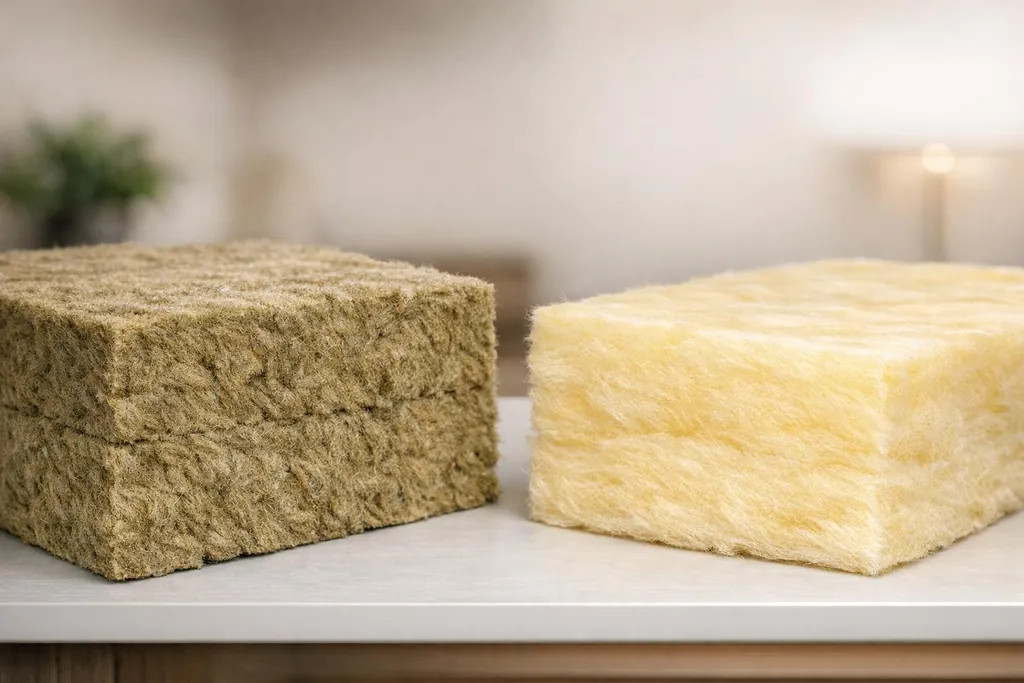
Rockwool vs fiberglass compared room by room: R-value, fire resistance, moisture handling, soundproofing, and cost for walls, ceilings, and floors.
Rockwool vs Fiberglass: Which Insulation Is Best for You?
When choosing insulation, Rockwool and fiberglass are two of the most popular options. Here's a quick breakdown:
- Rockwool is denser, fire-resistant (up to 2,150°F), and offers better soundproofing and moisture control. It has a higher R-value (3.0–4.1 per inch) and lasts longer (30+ years). However, it costs more upfront ($1.50–$2.00/sq. ft. installed).
- Fiberglass is lightweight, affordable ($0.60–$1.20/sq. ft. installed), and easier to install. Its R-value is lower (2.2–2.7 per inch), and it may lose efficiency over time (10–25 years lifespan).
Quick Comparison
| Feature | Rockwool | Fiberglass |
|---|---|---|
| R-value per inch | 3.0–4.1 | 2.2–2.7 |
| Fire resistance | Up to 2,150°F | Melts at ~1,100°F |
| Moisture resistance | High | Moderate (can absorb) |
| Soundproofing | 10–15 decibels reduction | 4–10 decibels reduction |
| Cost (installed) | $1.50–$2.00/sq. ft. | $0.60–$1.20/sq. ft. |
| Lifespan | 30+ years | 10–25 years |
If you're looking for long-term performance, Rockwool is the better choice. For budget-friendly and simple DIY projects, fiberglass works well.
::: @figure 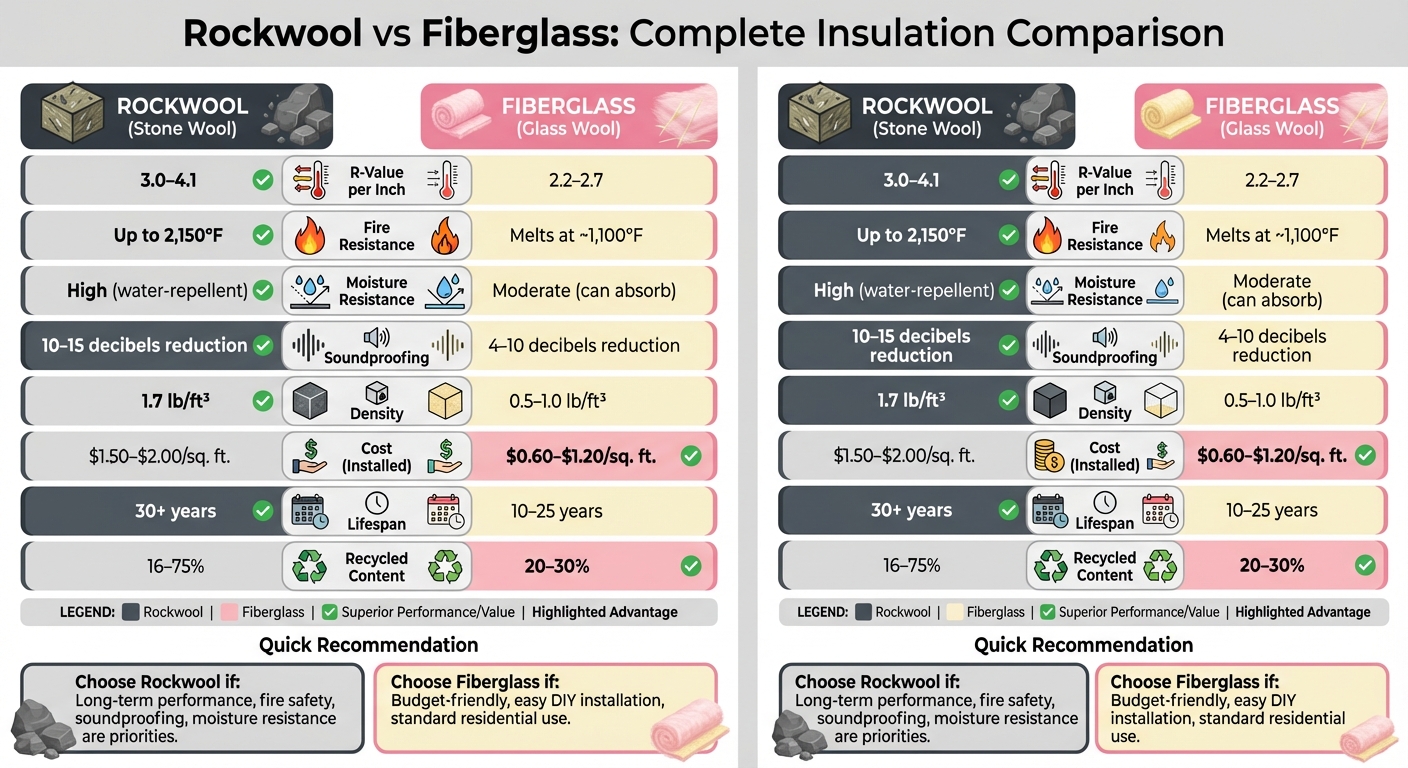 :::
:::
Mineral wool vs fiberglass insulation | everything you need to know
What Are Rockwool and Fiberglass Insulation?
The way these materials are made significantly impacts how they perform. Both Rockwool and fiberglass have been used for years in homes and commercial buildings, but their distinct manufacturing processes give them unique qualities.
Rockwool Insulation Explained
Rockwool is made by melting basalt and diabase - types of volcanic rock - along with slag, a recycled byproduct from steel production. This mixture is heated to over 2,900°F and spun into fine, wool-like fibers. These fibers are then compressed into dense mats, which are available as batts, rolls, or loose-fill insulation, with binders and oil added to hold everything together .
Because its production eliminates organic materials, Rockwool naturally resists mold and mildew . Its dense structure traps air efficiently, providing an R-value between R-3.0 and R-4.1 per inch . At about 1.7 lb/ft³ , Rockwool also outperforms fiberglass in noise reduction, cutting sound by 10–15 decibels .
> "The resulting product, Rockwool, is dense and durable with excellent thermal resistance." - Do it Best
Rockwool’s rock-based composition makes it highly fire-resistant, withstanding temperatures between 1,832°F and 2,150°F without melting or emitting toxic smoke. Independent ASTM E84 testing confirms a flame spread index of 0 and smoke developed index of 0 for Rockwool ComfortBatt, with non-combustibility verified under ASTM E136. This makes it a preferred choice for areas like interior walls, floors, ceilings, attics, and even spaces like home theaters, music studios, bathrooms, and kitchens, where fire safety and soundproofing are critical .
Fiberglass Insulation Explained
Fiberglass insulation is crafted from fine glass fibers, with 40% to 60% of its content typically made from recycled glass. According to the U.S. Department of Energy, fiberglass is one of the most common blanket and loose-fill materials used for residential walls, attics, and floors. It is lightweight, with a density ranging from 0.5 to 1.0 lb/ft³ , and is easy to cut and install.
The glass fibers trap air, creating thermal insulation with an R-value per inch of R-2.2 to R-2.7 . Standard fiberglass batts offer R-13 to R-15 for 2x4 walls and R-19 for 2x6 walls . While fiberglass is non-combustible, it starts to melt at around 1,100°F, offering less fire resistance than Rockwool .
Fiberglass is commonly used in unfinished walls, foundation walls, floors, ceilings, and attics in residential construction . Its availability and compatibility with standard stud and joist spacing make it a go-to choice for improving energy efficiency . Blown-in fiberglass is also ideal for insulating tricky spots, like attic corners and edges .
Next, we’ll dive into a side-by-side comparison of these materials based on key performance factors.
Performance Comparison: Rockwool vs Fiberglass
Let’s break down how Rockwool and fiberglass stack up in terms of key performance metrics.
R-Value and Heat Retention
Rockwool delivers better insulation per inch, with an R-value ranging from 3.0 to 4.1 . Fiberglass, on the other hand, offers a lower R-value of 2.2 to 2.7 per inch . This makes Rockwool a more effective choice for tight spaces where maximizing insulation is crucial.
Another advantage of Rockwool is its ability to maintain consistent thermal performance over time . Fiberglass, while effective initially, tends to lose efficiency as the years go by . For homeowners planning to stay in their property long-term, Rockwool’s stability means more predictable energy costs and a comfortable indoor environment year after year.
| Feature | Rockwool | Fiberglass |
|---|---|---|
| R-value per inch | 3.0–4.1 | 2.2–2.7 |
| Heat retention stability | Stable over lifetime | Degrades over years |
| Thermal efficiency | Higher per inch | Moderate |
Now, let’s explore how these materials compare in fire safety, moisture control, and noise reduction.
Fire Safety, Moisture, and Mold Resistance
Rockwool is built to handle extreme conditions. It can resist temperatures up to 2,150°F without melting or producing toxic smoke . Fiberglass starts to melt at around 1,100°F .
> "Rockwool is made from lava rock - it's built to withstand temperatures exceeding 1,000°C (1,832°F) without melting or giving off toxic smoke fumes." - Do it Best
When it comes to moisture, Rockwool’s inorganic makeup gives it a clear advantage. It is both water-repellent and vapor-permeable . This means liquid water drains away, but the material still allows airflow, reducing the risk of trapped moisture. Since it contains no organic material, it’s naturally resistant to mold and mildew growth — independent fungi resistance testing per ASTM C1338 confirms stone wool does not promote mold growth. Fiberglass, however, can absorb moisture if not properly installed, which may lead to material degradation and potential mold issues .
Sound Blocking Performance
Density plays a key role in sound absorption, and Rockwool’s structure is up to the task. At 1.7 pounds per cubic foot, it reduces noise levels by 10 to 15 decibels . Fiberglass, which weighs significantly less at 0.5 to 1.0 pounds per cubic foot, offers a more modest noise reduction of 4 to 10 decibels .
This difference is especially important for spaces like media rooms, recording studios, or multi-family housing units . If noise control is a priority, Rockwool's superior sound-dampening ability can make it worth the investment. For more detail on stone wool's acoustic performance, see Rockwool's acoustic resource library. For general residential use, where moderate noise reduction is enough, fiberglass remains a cost-effective option .
Rockwool's non-directional fiber structure traps sound waves in tiny air pockets, absorbing over 90% of the sound energy it encounters. For a more detailed comparison, here's how insulation materials stack up on standard acoustic metrics:
| Material | Noise Reduction Coefficient (NRC) | Sound Transmission Coefficient (STC) |
|---|---|---|
| Mineral Wool (Rockwool) | 1.0 (Perfect) | 43 |
| Fiberglass | 1.0 | 43 |
| Spray Foam | 0.75 | 37–39 |
| Cellulose | 0.75 | Not specified |
While fiberglass can match Rockwool's NRC and STC ratings in lab conditions, Rockwool's denser structure and friction-fit installation reduce gaps where sound can leak in real-world applications. Even a small gap -- just 1% of a wall's surface area -- can lead to a 50% increase in noise leakage. For optimal soundproofing, cut batts slightly larger than the space they'll fill, and seal gaps around electrical outlets and plumbing with acoustic sealant.
> "ROCKWOOL insulation can reduce the perceived noise level coming from floors above -- including footsteps or furniture movements -- up to a factor of eight." -- Riccardo Gandolfi, Acoustic Knowledge Manager, ROCKWOOL
DIY Installation: What to Expect
Taking on insulation installation yourself can be a cost-effective option, but it’s essential to understand how the materials differ and the proper techniques for handling them. Knowing these details will help you tackle your project with confidence.
Cutting and Positioning Each Material
Fiberglass is lightweight and flexible, making it easier to work with in tight spaces. To cut it, use a utility knife paired with a straight edge for precision . Because of its flexibility, you may need to secure it in place using staples or tack nails. A simple tack nailer or staple gun - both reasonably priced - will do the trick .
Rockwool, on the other hand, is denser, weighing about 1.7 pounds per cubic foot . This density means you’ll need sturdier cutting tools, such as a serrated knife, an insulation saw, or even a wood saw . One advantage of Rockwool is its semi-rigid structure, which allows it to stay securely in place without additional fasteners . When cutting Rockwool, make the batts slightly larger - about ¼ to ½ inch wider than the cavity - for a snug, friction-based fit .
Installation Tips for DIYers
Before you start, prioritize safety. Always wear goggles, gloves, a mask, and long sleeves, and work in a well-ventilated area to avoid irritation from fibers .
When installing Rockwool, press the batts firmly into the cavity to ensure they fill the space completely without compressing. Compression can lower its insulating efficiency, known as the R-value . Fiberglass, however, requires a gentler touch to avoid sagging or damage over time . For tricky corners or hard-to-reach spots, consider using blown-in or loose-fill insulation, which is available for both materials .
> "DIY installation is straightforward when you work methodically... You can easily save money here doing some DIY work, and you might even end up with a better install when you're done since you're likely to be more careful than a pro." -- Bill Wichers, Green Building Advisor
Essential Tools and Safety Gear
Having the right tools makes installation smoother. Essential items include:
- A serrated insulation knife (around $10) or a long-bladed bread knife for precise cuts.
- A tape measure for accurate sizing.
- A stapler if you're adding a vapor barrier.
- Expanding foam or caulk to seal gaps before installing the batts.
- A HEPA vacuum for cleanup -- avoid using compressed air, as it can spread fibers into the air.
Safety should be a top priority when working with either material. Wear a NIOSH-certified N95 dust respirator to protect your lungs, along with safety goggles, gloves, and long-sleeved clothing to minimize skin irritation. If you're working overhead, a headcover can keep fibers out of your hair. To reduce airborne particles, skip using compressed air to clean up dust -- instead, go for a vacuum or damp cleaning methods.
Common Installation Mistakes to Avoid
Even after carefully following installation steps, certain missteps can undermine your insulation's performance:
| Mistake | Impact | Solution |
|---|---|---|
| Over-Compression | Reduces R-value; lowers thermal performance | Cut batts 0.4" wider; use notch cuts for obstacles |
| Gaps Between Pieces | Creates thermal bridges; increases energy loss | Stagger joints by at least half a batt's width; seal gaps with fire-resistant foam |
| Blocking Attic Vents | Traps humidity; damages roof structure | Install vent baffles; maintain a 1" air gap between insulation and roof deck |
| Skipping Air Sealing | Allows drafts; reduces thermal efficiency | Seal all penetrations with caulk or foam before installing batts |
Air sealing is a critical but often overlooked step. While insulation slows heat transfer, it doesn't block air movement. The U.S. Department of Energy calls air sealing one of the most cost-effective ways to cut heating and cooling costs. Seal all penetrations using caulk or foam to prevent drafts. In colder climates, add a vapor barrier on the warmer side of the insulation to stop condensation from forming inside wall cavities. Avoid using non-breathable paints or coatings over Rockwool; instead, choose vapor-permeable options like mineral or silicone-based finishes.
This practical advice will help you get started and lay the groundwork for the upcoming discussion on cost and durability.
Cost and Longevity Comparison
When weighing insulation options, it's essential to consider both upfront costs and how long each material lasts. While fiberglass is generally cheaper at the outset, Rockwool's durability could make it a better long-term investment.
Price Per Square Foot
Fiberglass is a more budget-conscious choice. Installed fiberglass batts cost between $0.60 and $1.20 per square foot . If you're tackling a DIY project, the material alone will set you back about $0.30 to $1.50 per square foot . For blown-in fiberglass, installation costs range from $1.00 to $2.80 per square foot .
On the other hand, Rockwool comes with a higher price tag. Installed Rockwool batts typically cost $1.50 to $2.00 per square foot , while buying just the material costs between $1.40 and $2.50 per square foot . Blown-in Rockwool is even pricier, with installation costs landing between $1.90 and $4.20 per square foot .
For a 1,000-square-foot project, the cost difference becomes clear: fiberglass ranges from $600 to $1,200, while Rockwool falls between $1,500 and $2,000.
| Insulation Type | Installed Cost (per sq. ft.) | Material Only (per sq. ft.) |
|---|---|---|
| Fiberglass Batts | $0.60–$1.20 | $0.30–$1.50 |
| Rockwool Batts | $1.50–$2.00 | $1.40–$2.50 |
| Fiberglass Blown-In | $1.00–$2.80 | $0.30–$1.10 |
| Rockwool Blown-In | $1.90–$4.20 | $1.20–$2.50 |
Now, let’s look at how each material's lifespan impacts its overall value.
Expected Lifespan and Durability
When it comes to longevity, Rockwool takes the lead. It retains its structure and thermal performance for 30 years or more , with some estimates suggesting it can last up to 65 years . Its resistance to moisture, mold, and fire makes it less likely to sag or lose effectiveness over time .
Fiberglass, in contrast, typically lasts between 10 and 25 years . Over time, it can settle and absorb moisture, leading to a 10–30% reduction in its R-value and shortening its lifespan .
This durability gap is a key factor in determining long-term value. While Rockwool's higher upfront cost might give you pause, its extended lifespan means you’re less likely to face replacement costs. Fiberglass, on the other hand, may need to be replaced one or more times during the same period, making Rockwool a smart choice for those planning to stay in their homes for the long haul or aiming to minimize future expenses .
Environmental Impact and Recyclability
When considering insulation for a [sustainable home](/), its environmental impact is just as important as its performance and cost. Both Rockwool and fiberglass offer eco-conscious benefits, but they differ in their materials and long-term performance.
Rockwool shines with its recycled content. Made from natural basalt rock and diabase, it also incorporates recycled steel slag - a byproduct from the copper and steel industries that would otherwise go to waste . Depending on the product, Rockwool typically contains 16%–40% recycled materials, with some mineral wool insulation reaching up to 75% recycled content . In comparison, fiberglass insulation, which is primarily made from glass fibers, generally includes about 20%–30% recycled material .
Durability is another factor that ties into sustainability by reducing waste. Rockwool has a lifespan of over 30 years, meaning fewer replacements and less waste compared to fiberglass, which lasts around 25 years and can lose effectiveness in high-humidity environments . While both options improve energy efficiency by lowering heating and cooling needs, Rockwool's superior moisture resistance helps it retain its thermal performance over time, further enhancing its eco-friendly appeal .
For DIY builders focused on long-term sustainability, Rockwool's higher recycled content and durability make it an excellent choice, even if it comes with a higher upfront cost.
Best Insulation by Location: Walls, Ceilings, and Floors
The ideal insulation choice depends heavily on where you're installing it. Here's a location-by-location breakdown.
Walls: Exterior and Interior
For a standard 2x4 wall, Rockwool offers an R-value of R-15, while fiberglass provides R-11 to R-13. In 2x6 walls, Rockwool achieves R-23, compared to fiberglass's R-19. Beyond insulation value, Rockwool is water-repellent, maintains its shape even in damp conditions, and its higher density excels at blocking noise, making it a strong choice for both exterior and interior walls.
Rockwool also handles heat exceptionally well, withstanding temperatures up to 2,150 degrees F. Its rigid structure allows for precise cuts around obstacles, reducing gaps -- a common issue with the more flexible fiberglass. When paired with fire-rated sheathing, Rockwool can create a one-hour fire-rated wall assembly. The International Residential Code (IRC) recognizes Rockwool as a fireblocking material for concealed spaces in walls and floors, and some insurance companies even offer discounts of up to 15% for homes that use fire-resistant materials.
Ceilings and Attics
For overhead spaces, fiberglass is often the go-to option for budget-conscious projects, with costs ranging from $0.50 to $0.60 per square foot. However, Rockwool, priced at $0.62 to $0.80 per square foot, offers a friction-fit design that's especially effective in overhead installations, providing better soundproofing between floors.
> "If you've ever installed fiberglass batts on ceilings, you know that they'll fall out if you don't add support. Not so with mineral wool batts. Just push them into place and walk away." -- Family Handyman
This feature eliminates the need for additional supports like wire mesh or staples, saving both time and effort. For attic installations, the U.S. Department of Energy's climate-zone R-value tables recommend R-30 to R-60 depending on your climate zone. In northern states (Zones 7 or 8), you'll need insulation with an R-60 rating in your attic. In cathedral ceilings, ensure there's at least a 2-inch air gap between the insulation and the roof deck to allow proper ventilation and prevent moisture buildup. For vented attics, install baffles to keep insulation clear of soffit vents.
Floors and Crawlspaces
For insulating floors and crawlspaces, Rockwool's hydrophobic properties shine. It resists sagging, prevents mold growth, and retains its R-value even in damp conditions. Additionally, its density makes it more effective at reducing impact noise -- like footsteps on upper floors -- compared to fiberglass. For northern climate zones (7 or 8), the Department of Energy recommends R-38 insulation in floors.
While the upfront cost of Rockwool is higher, its durability and performance in moist environments make it a more economical choice over time. Rockwool's dense, fibrous structure is also naturally resistant to pests -- rodents and insects can't nest in it or damage it, thanks in part to its steel slag content.
| Application | Best Choice | Key Requirement | Critical Detail |
|---|---|---|---|
| Exterior Walls (2x4) | Rockwool (R-15) | Friction fit; 0.5"--1" over-width cut | Water-repellent; maintains shape in damp conditions |
| Exterior Walls (2x6) | Rockwool (R-23) | Friction fit | 22--37% better thermal performance than fiberglass |
| Interior Walls | Either | Sound control priority | Rockwool for soundproofing; fiberglass for budget |
| Cathedral Ceilings | Rockwool | 2" minimum ventilation gap above batt | Prevents moisture buildup; friction fit stays in place |
| Attic Floors | Fiberglass (budget) / Rockwool (performance) | R-30 to R-60 per DOE guidelines | Fiberglass is lighter; Rockwool won't sag |
| Floors / Crawlspaces | Rockwool | Moisture resistance critical | Pest-resistant; won't degrade in humidity |
Using Rockwool and Fiberglass Together
Combining Rockwool and fiberglass can help you achieve the best of both worlds -- performance and cost savings. Use Rockwool in areas where its strengths shine, like bedrooms for better soundproofing, exterior walls for moisture resistance, and around heat sources for added fire protection. Meanwhile, fiberglass is a budget-friendly option for large, dry spaces like attic floors. Both are also a healthier choice than spray foam in most assemblies, since neither requires re-occupancy waits or releases isocyanates during install.
For optimal results, think vertically. Use Rockwool between floors to reduce impact noise, and fiberglass in attics to save on costs. Before installing either material, seal air leaks with foam or caulk to prevent airflow from reducing thermal efficiency.
Passive House and Off-Grid Applications
Rockwool is particularly well-suited for passive house construction and off-grid living. Its high R-value, ranging from 4.1 to 4.3 per inch, allows builders to meet passive house standards with thinner wall designs. Moreover, Rockwool's vapor permeability helps regulate moisture, preventing condensation and mold while maintaining its thermal performance -- especially important for homes in humid or coastal areas.
Another advantage is its ability to address thermal bridging -- areas where heat escapes through structural elements like framing. As Joseph Lstiburek of Building Science Corporation notes, thermal bridging through steel studs and slab edges can throw away a large fraction of a wall's nominal R-value. Thermal bridges can account for up to 30% of total heat loss, but Rockwool effectively minimizes this issue — especially when paired with continuous exterior rigid foam outside the sheathing. A notable example is The House at Cornell Tech in New York City, which became the world's largest and tallest Passive House building in November 2017. By using Rockwool insulation, the project achieved ambitious CO2 reduction goals.
For off-grid homes, Rockwool's insulation reduces heating and cooling demands, allowing homeowners to install smaller and more cost-effective solar or wind energy systems. Additionally, in wildfire-prone regions, Rockwool's non-combustible nature adds an extra layer of safety without sacrificing energy efficiency.
> "Properly installed insulation can act to reduce energy consumption by up to 70 percent." -- ROCKWOOL Group
The energy used to produce Rockwool is typically offset within just 6 months to 2 years of use, and ROCKWOOL stone wool building insulation avoids 85 times the greenhouse gas emissions that result from its manufacture.
Which Insulation Should You Choose?
Now that we've looked at performance, installation, and cost, let's break down how each insulation type fits different project needs.
If keeping costs low and ensuring easy installation are your main priorities, fiberglass is a solid option. As noted earlier, fiberglass is more affordable upfront. Its lightweight and flexible design make it easier to work with, especially for standard spaces. This makes it a popular choice for basic DIY projects like insulating attics or walls.
On the other hand, if you're focused on long-term performance, Rockwool stands out. It's more durable and offers better fire resistance, tolerating temperatures over 1,832°F. Plus, it provides about 22–37% greater thermal efficiency . Rockwool also excels in soundproofing, reducing noise by 10 to 15 decibels, and resists moisture effectively, making it ideal for basements, exterior walls, or humid environments.
For spaces where noise control is a priority - like home theaters or bedrooms - Rockwool's higher density (1.7 pounds per cubic foot, over three times that of fiberglass) makes it a superior choice for absorbing sound. Its rigid structure ensures it stays in place over time, unlike fiberglass, which can sag.
While Rockwool does come with a higher upfront cost, its energy efficiency, fire safety, and use of recycled materials (up to 75% in some products) offer excellent long-term value. Weighing these factors will help you decide which insulation aligns best with your DIY goals and project needs.
FAQs
What makes Rockwool a better choice than fiberglass insulation?
Rockwool stands out as an insulation option for several reasons. First, it offers superior thermal performance. With an R-value per inch that's roughly 20-30% higher than fiberglass, it provides better energy efficiency using less material. Its dense composition also resists compression, ensuring it maintains its insulating abilities over time - even in damp environments.
Beyond keeping your home warm, Rockwool is fire-resistant and non-combustible, adding an extra layer of safety. It’s also a top choice for soundproofing, thanks to its high density, which effectively minimizes noise transfer between rooms. On top of that, it’s an environmentally friendly option, as around 70% of its content comes from recycled materials - far more than fiberglass.
If you’re prioritizing durability, energy savings, and a greener approach, Rockwool is a compelling choice that offers lasting benefits.
Is Rockwool insulation worth the higher cost compared to fiberglass?
When it comes to cost, Rockwool insulation tends to be pricier upfront - around $0.80 per square foot, compared to fiberglass, which averages $0.60 per square foot. However, this higher initial expense comes with notable long-term advantages. For starters, Rockwool has a higher R-value, offering approximately 22–37% better thermal resistance, which can help lower energy bills over time.
Beyond energy savings, Rockwool stands out for its durability. Its fire-resistant and moisture-proof qualities mean it’s less likely to degrade, reducing the chances of needing repairs or replacements down the road. Factoring in its efficiency and lifespan, the higher upfront cost often balances out, making Rockwool a practical option for those looking to save money and improve performance in the long run.
Which type of insulation is better for reducing noise and preventing moisture issues?
Rockwool insulation outperforms fiberglass when it comes to reducing noise and resisting moisture. Thanks to its dense composition, it does a fantastic job of absorbing sound, creating a quieter and more peaceful environment. On top of that, Rockwool is naturally water-repellent, which helps protect against mold and mildew, making it a sturdy option for spaces prone to high humidity or occasional water exposure.
What safety steps should I follow when installing insulation?
When handling Rockwool or fiberglass insulation, prioritize your safety. Wear safety glasses, gloves, and long-sleeve clothing to shield your skin and eyes from potential irritation. Additionally, use a certified dust mask, such as an N95, and ensure the area is well-ventilated -- especially in confined spaces or when cutting the material.
To reduce airborne particles, skip using compressed air to clean up dust. Instead, go for a HEPA vacuum or damp cleaning methods. If you're cutting with power tools, double-check that they are in good working condition and have proper guards in place to prevent debris from posing a risk.
Can Rockwool and fiberglass insulation be used together in the same project?
Combining Rockwool and fiberglass can be an effective strategy if you use each material in areas where it excels. Rockwool is a great option for spaces needing higher fire resistance, moisture durability, or enhanced soundproofing -- think around fireplaces or in basements. On the flip side, fiberglass shines in places where flexibility and affordability are key, such as standard interior wall cavities or attic floors.
Using both materials strategically allows you to craft an insulation plan that's efficient and tailored to your specific needs while balancing performance with budget.
Can Rockwool insulation be used in areas with high humidity?
Rockwool insulation works well throughout the home, even in areas with high humidity like bathrooms, basements, and kitchens. Thanks to its water-repellent nature, it resists moisture while staying breathable, which helps prevent problems such as mold and mildew. This makes it a dependable option for both dry and damp spaces, unlike fiberglass which can absorb moisture and lose effectiveness over time.
Which insulation is best for walls vs ceilings vs floors?
The best choice depends on the location. For exterior walls, Rockwool's [moisture resistance](/blog/cost-strength-moisture-resistance-plywood-vs-osb-showdown) and higher R-value per inch (R-15 in 2x4 walls vs R-11 to R-13 for fiberglass) make it the stronger performer. For ceilings and attics, fiberglass offers a budget-friendly option, though Rockwool's friction-fit design means it stays in place overhead without supports. For floors and crawlspaces, Rockwool is the clear winner due to its hydrophobic properties and pest resistance. Many builders use a hybrid approach -- Rockwool in moisture-prone and high-priority areas, fiberglass in large dry spaces.