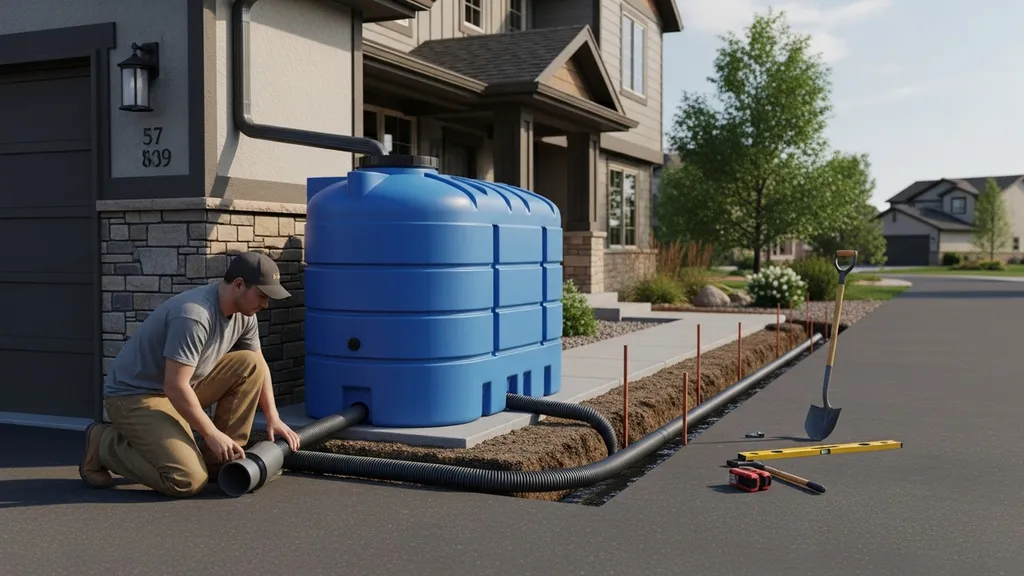
A practical, state-by-state guide to U.S. rainwater collection legal requirements — permits, potable-use rules, equipment standards, incentives and penalties.
Rainwater Collection Legal Requirements by State
A DIY builder planning a 1,000-gallon cistern needs to know the rainwater collection legal basics before digging or buying equipment. Residential water use averages about 300 gallons per day in the U.S., so capturing rain can cut utility bills and strain on municipal systems — but rules vary widely. This guide explains rainwater collection legal status across states, how permits and plumbing codes affect designs, equipment standards to meet, and a practical checklist so a homeowner or self-builder can approach permitting with confidence.
TL;DR:
- Most states allow some form of residential capture; roughly 75% explicitly permit or encourage rainwater harvesting for non-potable uses.
- If you plan indoor potable use, expect treatment, regular testing, and a permit in many states — plan for filtration, disinfection, and cross-connection devices.
- Start with the state table, confirm local rules, and follow a simple permit workflow: schematic → submit to AHJ → install → inspection.
Related guides: Water Collection Guide, Passive solar shading winter vs summer, and HERS rating home energy score explained.
Related guide: How to build a greenhouse.
Overview of Rainwater Collection Legal Requirements by State
Why State Laws Differ
State approaches to rainwater capture are shaped by historic water-rights systems, regional water scarcity, and stormwater management needs. Western states with prior appropriation doctrines sometimes have tighter rules because capturing runoff can affect downstream users. Other states encourage capture to reduce municipal stormwater loads and conserve potable supplies. Federal guidance exists, but implementation is local: state statutes, county or city ordinances, and health or utility rules all matter.
Common Legal Themes: Ownership, Potable Use, and Stormwater
Three legal concepts repeat across jurisdictions:
- Right to capture runoff: Some states treat rainfall as private property once it reaches your roof; others consider it part of public water rights if it would naturally flow to a stream.
- Potable vs non-potable distinctions: Non-potable uses (irrigation, toilet flushing) are often allowed with minimal oversight. Potable use (drinking, cooking) usually triggers treatment, testing, and permits.
- Stormwater and drainage obligations: Municipal stormwater codes may require overflow routing or limit impervious surfaces. Rainwater systems must not increase flood risk or illicit discharges.
Authoritative references include EPA guidance on rainwater harvesting and model plumbing codes such as the International Code Council (ICC) standards, the Uniform Plumbing Code (UPC), and the International Plumbing Code (IPC). For practical stormwater design guidance see Maryland’s state handbook on rainwater harvesting Stormwater design guidance – rainwater harvesting.
State-by-State Summary of Rainwater Collection Legal Requirements
How to Read the Quick-reference Table
The table (and downloadable CSV) lists every state plus DC with these columns:
- Legal status: encouraged / allowed / restricted / prohibited
- Permit required: yes / no / only for potable
- Potable use allowed: yes / no / conditional
- Typical local triggers: tank size, plumbing connection, potable tie-in
- Common agency: state health or environmental department
- Incentives: rebate or tax credits (if available)
Top-level Categories Used in the Table
- Encouraged: State policy or codes promote capture; incentives may exist.
- Allowed: No state ban; local rules determine details.
- Restricted: Specific limitations at state or major-city level (often due to water rights).
- Prohibited: Very rare; indicates state statute bans certain uses or requires permits that are effectively proscriptive.
The table counts show that a majority of states fall into the "allowed" or "encouraged" categories. The EPA’s municipal stormwater handbook provides useful background on how codes can be applied and is a helpful companion when interpreting the state table: Rainwater harvesting policies - EPA.
Last-checked timestamp: laws change frequently. The table includes a “last-checked” date and each entry links to primary statute or agency guidance — verify those sources before construction.
Regional Trends in Rainwater Collection Legal Requirements by State
Western States and Water Rights Impacts
Western states sometimes impose limits rooted in prior appropriation water law. Colorado historically limited rooftop capture that could reduce stream flows, though many western states now have explicit statutes permitting limited residential capture. Policy is often conditional on whether capturing runoff affects downstream rights.
Southeast and Growth-driven Stormwater Rules
Fast-growing regions in the Southeast balance development with flood control. Rules may require that overflow be routed to retention areas or that system size doesn't increase site runoff. Some cities offer incentives to reduce municipal stormwater loads.
Midwest and Northeast Approaches
Midwestern and Northeastern states often permit residential capture with minimal state-level restrictions, leaving specifics to local plumbing and health departments. Cooler climates focus on freeze-protection and tank insulation in regulations.
Notable State Examples to Watch
- Colorado: historically restrictive but has updated rules — check state statutes for current potable-use conditions and permits.
- Texas: generally permissive and often encouraging capture for irrigation.
- Oregon: supportive of small-scale harvesting with local guidance.
A hypothetical 1,000-gallon system: In the West, it may require a permit or proof it won’t affect downstream rights; in the Southeast, plans may need to show overflow routing to pervious areas; in the Midwest, the installation often proceeds with local building permit review. For more on how rainwater systems fit into broader energy and water planning, see the net-zero planning guide: how to build a net-zero home.
For beginner-friendly primers on capture and practice, see Robin Greenfield’s rainwater guide: Rainwater harvesting guide for beginners.
Permits, Codes, and Potable Use Rules by State
When Do You Need a Permit?
Common permit triggers include:
- Connection to the building’s potable plumbing.
- Tank capacity above a local threshold (often 250–1,000 gallons).
- Installation in public right-of-way or where structural safety is a concern.
- Systems serving multiple units or community shared systems.
Regulatory thresholds vary by jurisdiction. Research from Pacific Northwest National Laboratory summarizes state regulations and shows permit triggers often align with plumbing connections or volume thresholds: Rainwater harvesting state regulations and technical resources.
How Plumbing Codes (UPC/IPC) Affect Rainwater Systems
If a system ties into indoor fixtures, most jurisdictions require compliance with the UPC or IPC as adopted locally. These codes address:
- Cross-connection control
- Backflow prevention
- Labeling non-potable piping
- Fixture isolation and allowable uses for reclaimed water
For guidance on routing non-potable systems into household plumbing safely, consult our article on water-efficient plumbing. Also review state health department bulletins and adopted code amendments.
Potable Use: Treatment, Testing, and Labeling
When jurisdictions permit potable use, they usually require:
- Multi-stage filtration (sediment, carbon) and disinfection (UV or chlorination)
- Periodic water quality testing (often quarterly or semiannually)
- Clear labeling and dedicated piping for treated rainwater versus municipal supply
- An approved operations plan and maintenance schedule
Testing requirements and accepted treatment methods differ by state. Industry experts often recommend a minimum of 0.5–1 micron filtration followed by UV for residential potable systems. The PNNL report above and EPA materials provide technical baselines.
Cross-connection and Backflow Control Requirements
Cross-connection control is frequently enforced. Typical devices include reduced-pressure zone (RPZ) valves or double-check assemblies. Some jurisdictions accept pressure vacuum breakers for hose bibs but require RPZ for indoor potable ties. Model plumbing codes and local health departments set the specific device types and installation standards. For parallel guidance on alternative fixtures and sanitary rules, see our piece on meeting toilet regulations.
System Design, Equipment Standards, and How They Affect Legal Requirements by State
Tank Types and Material Standards (comparison Table)
| Tank type | Pros | Cons | Typical lifespan | Cost range (USD) |
|---|---|---|---|---|
| Polyethylene (aboveground) | Lightweight, UV-resistant, low cost | Susceptible to damage if exposed to chemicals, limited sizes | 15–25 years | $200–$2,000 |
| Fiberglass | Corrosion-resistant, strong | Higher upfront cost, brittle if struck | 20–30 years | $1,000–$5,000 |
| Concrete (buried) | High durability, large capacities | Heavy, needs base, higher install cost | 50+ years | $3,000–$15,000 |
| Steel (corrugated) | Large sizes, durable | Corrosion risk if not lined, may need coatings | 25–40 years | $1,500–$8,000 |
Note: Brand examples include polyethylene tanks from Norwesco and larger modular tanks from Graf; these are market options homeowners often encounter. Local permitting may require material certifications or engineering for buried concrete tanks.
Required components: overflow, first-flush, screens, backflow prevention Nearly every jurisdiction expects minimum components:
- Leaf screens and debris guards at downspouts to reduce contamination.
- First-flush diverters to exclude initial roof runoff that carries higher pollutant loads.
- Overflow routing to prevent nuisance drainage to neighbors or to direct excess to pervious areas.
- Backflow prevention devices where the system connects to potable plumbing.
Some municipalities require overflow to route to stormwater retention features rather than the sewer. The NCBI study on water quality of harvested rainwater highlights the value of first-flush devices and disinfection for potable use: Sustainability of rainwater harvesting system.
Sizing, Placement, and Stormwater Rule Interactions
Sizing balances roof catchment area, rainfall patterns, and demand. Typical residential cisterns range from 500 to 5,000 gallons. Stormwater codes may limit cistern placement in floodplains or require engineered foundations for large buried tanks. If municipal stormwater credits are available, routing overflow to infiltration features can earn incentives. Equipment choices affect legal classification: a system with only irrigation outputs is often treated less stringently than one tied to indoor potable lines.
For guidance on combining rainwater capture with graywater systems and avoiding cross-connections, read the graywater integration guide: integrating gray-water systems with composting toilets.
How to Navigate Local Rainwater Collection Legal Requirements: Action Checklist and Permitting Workflow
Step-by-step Checklist for DIY Builders
- Identify jurisdiction: Determine the state, county, and city AHJs for your property.
- Find the state statute or health guidance: Look for explicit rainwater harvesting rules.
- Check local ordinances: Search municipal codes for stormwater and plumbing amendments.
- Confirm permit triggers: Ask whether your planned tank size or potable tie-in requires a permit.
- Draft a simple system schematic: Show roof area, tank, piping, treatment, overflow routing, and backflow device.
- Collect spec sheets: Tank manufacturer, pump, filters, disinfection units, and backflow devices.
- Submit application: Include site plan, equipment specs, and operations/maintenance plan.
- Schedule inspection: Arrange for plumbing and/or structural inspection.
- Keep records: Maintain testing logs if potable, and service records for backflow assemblies.
Sample Questions to Ask Your Building/health Department
- "Does my planned 1,000-gallon cistern require a building or plumbing permit?"
- "If I connect treated rainwater to toilet flushing, what testing and labeling are required?"
- "What backflow device is accepted for a potable tie-in?"
- "Are there incentives or stormwater credits for routing overflow to infiltration?"
How to Document and Submit Plans
Submit a concise package: site plan with roof catchment and tank location, plumbing diagram showing isolation valves and backflow prevention, tank spec sheet, and a brief operations plan (filtration schedule, disinfection method). If the jurisdiction follows the ICC standard for rainwater harvesting, include references to the applicable ICC guidance. The ICC has published updates on rainwater harvesting standards useful during plan review: Updated rainwater harvesting standard: conserving water for the long run.
Video walkthrough The short video below shows how to find state statutes, lookup local ordinances, and draft a permit-ready system schematic. Viewers will learn where to search official sites and the exact documents to request from their AHJ.
This workflow mirrors state-by-state regulatory guides used for other technologies; see our state regulations guide for a comparable approach to permits and documentation.
Costs, Incentives, and Penalties for Rainwater Collection by State
Common Incentives and Rebate Programs
Incentives vary. Municipal or utility rebates can cover part of cistern cost, often for systems that reduce stormwater runoff or municipal potable demand. Search the DSIRE database for state and local rebates; municipal conservation programs sometimes give rebates of $100–$1,000 for rain barrels and larger credits for cisterns tied to stormwater programs.
Typical cost ranges
- Basic rain barrel setup: $100–$500 installed.
- Small cistern system (500–1,000 gallons) with pump and basic filtration: $1,500–$5,000.
- Larger cistern (3,000–5,000 gallons) with treatment for limited indoor uses: $5,000–$20,000 depending on material and site work.
Compare these with alternative water-saving measures such as composting toilets. For context on off-grid sanitary options and relative costs, see composting toilet systems costs and installation guide.
Fines, Enforcement and Insurance Implications
Noncompliance ranges from stop-work orders and civil fines to forced system modifications. Enforcement intensity varies; many cases are resolved by bringing the system into compliance. Homeowner insurance providers may require disclosure of buried tanks or water systems; failure to disclose can affect coverage. When in doubt, ask the insurer if a cistern increases liability exposure or requires an endorsement.
Cost-benefit thinking Irrigation-only systems often have the shortest payback: typical savings on outdoor water use can reduce bills by a few hundred dollars per year, depending on landscape irrigation needs. Potable conversions add capital cost for treatment and testing, stretching payback beyond a homeowner’s typical ownership horizon unless potable water rates are high.
The Bottom Line
Check the state table first, confirm local rules, and follow the checklist before you buy equipment or excavate. Prioritize basic compliance items — backflow prevention, overflow routing, and clear labeling — and consult your building and health departments early to avoid costly rework. Rainwater collection legal requirements by state change, so verify statute texts and AHJ guidance before installation.
Video: How To Install Rainwater Collection Barrels
For a visual walkthrough of these concepts, check out this helpful video:
Frequently Asked Questions
Can I collect rainwater in my state without a permit?
The short answer: it depends. Many states allow rooftop capture for outdoor uses without a permit, but tying the system to indoor plumbing or installing larger tanks often triggers building, plumbing, or health permits. Check your state's statute and the local building or health department for size thresholds and permit triggers. The Pacific Northwest National Laboratory compiled state-level summaries that help locate the applicable rule for your state: https://www.pnnl.gov/main/publications/external/technical_reports/pnnl-24347.pdf.
Is collected rainwater legal to drink?
Collected rainwater is sometimes allowed for potable use, but most jurisdictions require specific treatment (filtration and disinfection), periodic testing, and a permit. If potable use is permitted, expect mandatory labeling, segregation of piping, and accepted backflow devices. Consult local health department guidance and follow model plumbing codes (UPC or IPC) if you plan to use rainwater for drinking.
Will a rainwater system trigger additional inspections?
Yes, systems that connect to indoor plumbing or exceed local thresholds usually require inspections — plumbing, structural, and sometimes health inspections. Plan the inspection schedule into your timeline: submit plans, install per approved documents, and request inspections. Proper documentation and manufacturer spec sheets streamline the process.
Are there state rebates or tax incentives for rainwater systems?
Some states, utilities, and municipalities offer rebates for rain barrels or cisterns, particularly when the system reduces stormwater runoff. Search the DSIRE database and local utility programs. The EPA’s guidance on municipal green infrastructure lists examples of incentive programs in cities that offset installation costs for systems that help stormwater management: https://www.epa.gov/sites/default/files/2015-10/documents/gi_munichandbook_harvesting.pdf.
What happens if I install a system that violates local rules?
If a system violates local codes, the AHJ can issue a stop-work order, require corrective action, or impose fines. Most disputes are resolved by updating the installation to meet plumbing or stormwater requirements — for example adding required backflow prevention or rerouting overflow. To avoid enforcement, confirm requirements with the AHJ and submit a permit application before work begins.