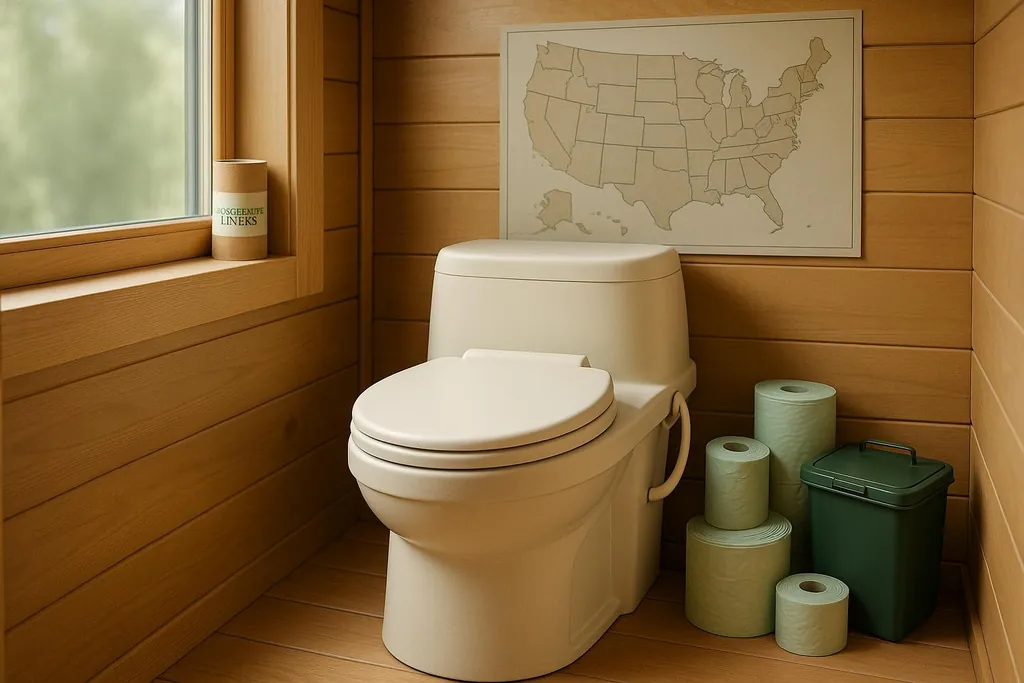
Are composting toilets legal in your state? Permit requirements, inspection rules, and NSF/ANSI certification standards for all 50 states.
Composting Toilet Inspection Rules by State
Composting toilets are a growing choice for water-saving and eco-conscious waste management in the U.S., especially for off-grid living. However, regulations for their installation and inspection vary widely by state, making compliance a key challenge. Here's what you need to know:
- Certification Requirements: Most states require composting toilets to meet NSF/ANSI Standard 41 certification.
- Permits and Inspections: Some states mandate permits and regular inspections, while others have more flexible or undefined rules.
- State-Specific Rules: Regulations can include soil tests, setbacks from water sources, and restrictions on waste disposal methods.
- Greywater: In many states, greywater from sinks and showers must be treated separately.
- Local Oversight: Some states delegate regulatory authority to local health departments, leading to varying rules even within the same state.
Quick Tip: Always check with your local health department before installing a composting toilet to ensure compliance with state and local laws.
This article provides a detailed breakdown of inspection rules and requirements for composting toilets across all 50 states, helping you navigate the complexities of installation and operation.
VT Compost Toilet Legislation Webinar - Feb 17, 2023
1\. Alabama
In Alabama, composting toilet regulations are managed by several state agencies. The primary authority is the Alabama Department of Environmental Management (ADEM) Land Division, which oversees composting operations. If you're planning to receive, store, or process compostable waste, you'll need a permit from this agency .
For more information, you can reach out to Jason Wilson at the Solid Waste Engineering Section. Contact details:
- Mailing Address: PO Box 301463, Montgomery, AL 36130-1463
- Phone: (334) 271-7755
- Email: JWilson@adem.alabama.gov
Additionally, the Alabama Department of Public Health is another resource for residents considering composting toilet installations .
Certification/Approval Requirements
Alabama mandates that composting toilets meet specific certification standards. They must be certified by NSF or an organization accredited by ANSI to assess compliance with the relevant NSF Standard .
> "A composting toilet shall be certified by NSF or an organization that is ANSI-certified to judge compliance with the appropriate NSF Standard." – Ala. Admin. Code r. 420-3-1-.29
Historical Regulatory Context
Historically, Alabama did not have specific regulations for composting toilets until December 23, 1998 . Before installing a composting toilet, homeowners and installers should confirm the latest requirements with state authorities.
2\. Alaska
Alaska offers a regulatory framework that provides both opportunities and hurdles for those looking to install composting toilets. While the state allows for some flexibility, certain rules and approval processes must be followed.
Regulatory Authority
The Alaska Department of Environmental Conservation (ADEC) is the main agency responsible for overseeing composting toilet installations in the state . This falls under 18 AAC 72, which governs wastewater disposal, including composting toilets .
For specific questions or guidance, homeowners can reach out to the ADEC Domestic Wastewater Program, which provides up-to-date requirements and assistance .
Unique State Rules
Alaska’s approach to composting toilets is shaped by its broader wastewater disposal guidelines. As of April 1, 1999, there were no specific regulations tailored to composting toilets. Instead, they are managed under general wastewater rules .
However, prior approval is required for the beneficial use of solid waste . Systems designed to treat less than five tons of waste daily or 10 tons in a single batch are generally exempt from Alaska’s standard regulations. The only exceptions arise if the system poses a threat to public health, harms the environment, or becomes a nuisance .
These details set the stage for understanding the approval process for composting toilet installations.
Certification/Approval Requirements
Alaska permits homeowners to install their own wastewater systems, including composting toilets, but there are specific steps to qualify as an "approved homeowner" :
- Complete a training lesson and pass a test.
- Assess the on-site soil conditions.
- Take photos of the completed installation.
- Submit a Documentation of Construction form.
While homeowners can usually install conventional septic systems themselves, alternative systems like composting toilets often require a certified installer . ADEC reviews and approves these alternative systems on a case-by-case basis, ensuring they meet the necessary standards for the specific site .
For detailed guidelines, homeowners should consult Chapter 18 AAC 72, which outlines the state’s wastewater system requirements .
3\. Arizona
Arizona has developed a regulatory framework that strikes a balance between effective waste management and protecting natural resources. The state even offers a free permit system for approved composting toilets, making it easier for residents to adopt eco-friendly solutions.
Regulatory Authority
The Arizona Department of Environmental Quality (ADEQ) is the main body responsible for overseeing composting toilet permits and inspections in the state . ADEQ operates under AAC R18-9-A301, which governs Alternative Onsite Wastewater Treatment Facilities as part of the Type 4 General Aquifer Protection Permit . Back in 2016, ADEQ approved two composting toilet designs created by the Watershed Management Group (WMG): one using a 55-gallon barrel system and another using a masonry chamber system. These designs provide homeowners with tested, reliable options . For specific guidance on permits, residents should reach out to their local county health department .
Certification/Approval Requirements
Arizona enforces strict standards to ensure composting toilets meet safety and sanitation requirements. Toilets must comply with National Sanitation Foundation (NSF 41) standards and carry the NSF certification seal . The state also allows composting toilets under a 4.03 General Permit, provided the system is designed for less than 3,000 gallons per day . By definition, a composting toilet in Arizona is a waterless system that uses an aerobic composting chamber to break down human waste, reducing its volume and neutralizing harmful microorganisms . ADEQ offers a detailed guide to help residents navigate these permitting requirements .
Unique State Rules
Arizona has some specific rules for composting toilets that set it apart. For example, the composting chamber must be watertight, durable, vector-proof, and designed to seal out odors and toxic gases .
> "Arizona offers a FREE permit for an approved composting toilet. If you use scrap material, you can build and permit the entire system for free." > > - Frugal Off Grid
Inspections in Arizona focus on technical details, such as ensuring the toilet lid is sealed with a gasket, vents are netted to keep insects out, and the lid height is between 12 and 16 inches above ground . Setback distances for composting toilets are less restrictive than standard requirements, reduced to no less than one-quarter of standard setbacks, but always at least 5 feet. However, wells must maintain a minimum 100-foot separation . These systems are rated for up to 50 daily users and are intended to process only human waste unless the manufacturer specifies otherwise .
Wastewater from composting toilets must be handled through a subsurface system, and an interceptor is required to filter out grease, fibers, and solids before dispersal. Regular maintenance of this interceptor is also mandatory . The environmental impact is substantial, as waterless toilets can save 10–20 gallons of water per day per person, compared to flush toilets that use 1.6 to 2.2 gallons per flush .
4\. Arkansas
Arkansas has stringent rules for composting toilets, managed by the state's health department. Only systems that meet specific standards are approved for use.
Regulatory Authority
The Arkansas Department of Health (ADH) oversees composting toilets through its Onsite Wastewater Program . This program sets the rules for all on-site wastewater treatment systems in the state. If you're a homeowner looking for detailed information on permits or installation, your first stop should be your county's health unit, where an Onsite Environmental Specialist can assist . These rules ensure that composting toilets meet strict certification and disposal standards.
Certification/Approval Requirements
According to Arkansas ACT 402 OF 1977, only pre-manufactured composting toilets with NSF 41 certification and approval from the Health Department are allowed. DIY systems are not permitted . Installation involves several steps, including obtaining separate construction and operation permits, conducting a soil test, and using a certified system design . Additionally, anyone installing a septic system must pass an exam and become a licensed installer .
Unique State Rules
Arkansas has embraced composting toilet technology, even incorporating these systems in its state parks . However, the state enforces strict rules for waste disposal. Stabilized compost must either be buried onsite or taken to an approved sanitary landfill . Using ground-level composting bays to finish processing is prohibited, and homeowners are not allowed to use the processed compost for ornamental plants or above-ground vegetables .
5\. California
California's approach to composting toilet regulations is as varied as its landscape. Instead of a uniform statewide system, oversight is managed locally, with rules differing across counties and municipalities. This patchwork approach means standards can vary significantly depending on where you live.
Regulatory Authority
In San Francisco, the Department of Building Inspection's Plumbing Inspection Division oversees composting toilet installations. Meanwhile, the State Water Resources Control Board and Regional Water Quality Control Boards handle systems that could impact state waters. These agencies may require waste discharge reports or issue permits with specific conditions to protect water quality . This localized governance sets the tone for the rest of California, where county-specific regulations are the norm.
Certification/Approval Requirements
Since there are no unified statewide regulations, homeowners must navigate local rules. California encourages residents to reach out to their local or county agencies for detailed certification requirements . For instance, in Sonoma County, waterless toilets must meet NSF 41 standards, obtain NSF certification, and secure an operational permit (OPR) to manage waste disposal .
In San Diego County, the Department of Environmental Health oversees wastewater treatment systems in unincorporated areas under the authority of the Regional Water Quality Control Boards .
Unique State Rules
California also enforces broader operational standards. As of January 1, 2022, a state law mandates the separation of organic waste from regular trash, aiming for a 75% reduction in organic waste sent to landfills by 2025 compared to 2014 levels . Additionally, the State Water Resources Control Board has established General Waste Discharge Requirements for Composting Operations. These include distinct standards for Tier 1 and Tier 2 facilities, depending on factors like feedstock type, material volume, and site conditions. Agricultural sites that compost on-site materials may qualify for exemptions under certain conditions .
For homeowners, it's crucial to check with local government offices to determine if special permits are needed .
California's regulatory framework may seem complex, but it reflects the state's commitment to reducing waste and conserving water, while accommodating the diverse needs of its communities.
6\. Colorado
Colorado has a two-tiered system for regulating composting toilets. At the state level, the Colorado Department of Public Health and Environment (CDPHE) sets the overarching standards. Meanwhile, local authorities manage the permitting process and may impose additional requirements. This system reflects the need for statewide consistency while allowing flexibility for local conditions.
Regulatory Authority
The CDPHE oversees composting toilets under Regulation 43, which governs on-site wastewater treatment systems (OWTS). Specifically, the CDPHE handles the initial review and approval of systems, including composting toilets. Local counties then take charge of issuing permits for systems designed to handle flows of 2,000 gallons per day or less. Each county health agency enforces rules that meet or exceed the standards set by Regulation 43, ensuring a balance between uniformity and local adaptability .
Certification/Approval Requirements
Colorado requires a two-step process for composting toilet approval. First, the CDPHE conducts a state-level review under Regulation 43. Once that approval is secured, homeowners must apply for a permit from their local county to install and operate the system . This dual review ensures that both state and local requirements are met.
After approvals are granted, strict operational guidelines are enforced to regulate the use and maintenance of these systems.
Unique State Rules
Colorado has specific rules that limit where composting toilets can be used. They are not allowed on properties where a traditional on-site wastewater treatment system (OWTS) can be installed . This effectively restricts composting toilets to locations where conventional septic systems are impractical.
The design of composting toilets in Colorado must accommodate feces, urine, and biodegradable household waste without relying on water for dilution. Additionally, they must adhere to capacity and maintenance standards. For example, the receptacle must be appropriately sized for the number of users, and once it reaches 75% capacity, the waste must be disposed of following proper solid waste management practices .
Some counties in Colorado have introduced their own specific guidelines. In one case, a county requires that properties with composting toilets also have at least one flushing toilet connected to an approved septic system .
7\. Connecticut
In Connecticut, the regulation of composting toilets is handled at the local level. Instead of a centralized state agency, the local director of health oversees the approval process. This decentralized approach sets Connecticut apart from states with more uniform statewide systems.
Regulatory Authority
In Connecticut, the local director of health is the key figure in regulating composting toilets. While the Connecticut Department of Public Health provides guidance, it does not directly regulate these systems. This means that the specific requirements and approval processes can vary depending on the municipality.
Certification/Approval Requirements
Approval from the local director of health is necessary for certain types of composting toilets, particularly large-capacity or heat-assisted systems. These are typically used to replace old privies, fix failing systems, or in specific single-family applications. Before approval, the property lot must undergo testing to confirm its suitability for a subsurface sewage disposal system, as outlined in Section 19-13-B103d of the regulations. Additionally, both the property owner and occupant must submit an application acknowledging their roles and responsibilities. Connecticut's approach highlights the importance of local oversight and site-specific evaluations.
Unique State Rules
Connecticut mandates that all waste from composting toilets must be disposed of by burial or other methods approved at the local level. Disposal practices are tailored to the conditions of each area, with local health officials determining the most appropriate solutions. These requirements fall under Section 19-13-B103f of the Regulations of Connecticut State Agencies, which governs non-discharging sewage disposal systems, including composting toilets.
Connecticut's regulations primarily limit composting toilet installations to specific situations, such as addressing failing systems or upgrading outdated facilities. They are not widely used as a general waste management option in the state.
8\. Delaware
Delaware takes a flexible stance when it comes to composting toilet regulations. The state doesn’t have specific rules solely for composting toilets, which can be both an opportunity and a challenge for those exploring sustainable waste management options.
Regulatory Authority
In Delaware, the Department of Natural Resources and Environmental Control (DNREC) is the main agency responsible for overseeing composting-related activities . Within DNREC, the Division of Waste and Hazardous Substances handles composting regulations . Homeowners seeking guidance on composting facilities can reach out to Zack Taylor at DNREC for assistance . This structure provides a clear path for navigating the approval process.
Certification/Approval Requirements
Although Delaware doesn’t have dedicated composting toilet regulations, approval hinges on submitting a detailed operation plan to DNREC . This plan must show that the facility owner and operators understand proper composting practices, ensure the facility won’t harm public health or the environment, and include a statement outlining how the compost will be used . Importantly, individual household composting is exempt from permit requirements . Beyond this, the state encourages environmentally conscious practices through various programs.
Unique State Rules
Delaware offers a recycling grant and loan program, which could include future support for composting initiatives . The state highlights the environmental advantages of composting, noting that it can reduce landfill waste by 20% or more when done correctly . For those new to composting, DNREC provides a Backyard Composting guide, offering practical tips and foundational knowledge .
Delaware’s approach strikes a balance between environmental goals and regulatory flexibility, creating room for innovative solutions in waste management while safeguarding public health and the environment.
9\. Florida
Florida faces unique challenges when it comes to managing its water and waste systems, especially in areas prone to flooding. These conditions have shaped the state’s specific approach to composting toilet regulations, aiming to address environmental concerns and ensure public health is protected.
Regulatory Authority
The Florida Department of Environmental Protection (DEP) is the key agency responsible for overseeing onsite sewage treatment and disposal systems, including composting toilets. Their role involves reviewing applications, assessing sites, issuing permits, and conducting inspections. This process ensures systems are properly designed, installed, and maintained to avoid contamination of groundwater and surface water while safeguarding public health.
> "It is the intent of the Legislature that proper management of onsite sewage treatment and disposal systems is paramount to the health, safety, and welfare of the public." – Florida Statutes 381.0065[32](a)
Once a permit is issued, regular inspections are conducted to confirm that systems continue to meet Florida’s strict standards.
Inspection Frequency
Annual inspections are mandatory for buildings or facilities using aerobic treatment units or generating commercial waste. These inspections help ensure compliance with permit requirements and confirm the ongoing effectiveness of the systems.
Certification/Approval Requirements
To construct, repair, modify, abandon, or operate an onsite sewage treatment system in Florida, a permit from the DEP is required. Additionally, only composting toilets that meet American National Standards Institute (ANSI)/National Sanitation Foundation (NSF) standards are approved for use. The DEP maintains a list of these approved units. The agency also reviews applications for temporary facilities, such as holding tanks, privies, and portable toilets, which are often used on construction sites or for other temporary purposes.
Unique State Rules
Florida has specific rules that go beyond standard permitting. For example, the state requires an annual operating permit for waterless, incinerating, or organic waste composting toilets. The fees for these permits range from $15 to $30, as outlined in Florida Statute 381.0066[33](h). Additional guidelines are detailed in Florida Statutes and Regulations Chapter 64E-6.
One key environmental factor driving these regulations is water conservation. In a typical Florida household, 35 to 45% of potable water is used just for flushing toilets. Composting toilets offer a practical solution to reduce water usage, which is becoming increasingly critical as the state faces growing challenges in managing its water resources.
10\. Georgia
Georgia has adopted a decentralized approach to waste management, combining environmental safeguards with practical solutions, particularly in areas where traditional septic systems can’t be installed.
Regulatory Authority
Three main agencies oversee composting toilet regulations in Georgia:
- The Environmental Protection Division (EPD) handles composting operations.
- County Boards of Health issue construction permits for on-site sewage systems.
- The Department of Public Health (DPH) certifies septic system installers and pumpers.
> "EPD encourages the composting of acceptable organic materials as a means of diverting organics from landfills. Under the Georgia compost rules, backyard composting is exempt from state regulation." – Georgia Environmental Protection Division
Certification/Approval Requirements
Georgia requires all composting toilets to have NSF certification. Units must either meet the current NSF standard or be verified by the manufacturer as compliant with a nationally recognized standard. In areas where space for conventional septic systems is limited, composting toilets are a practical alternative. However, homeowners should keep in mind that greywater - such as water from laundry, bathing, and kitchens - must still be treated using traditional methods. Water conservation efforts can reduce the size of absorption fields by up to 35%.
Unique State Rules
Georgia has specific guidelines for handling composted waste. It must be removed as per the manufacturer's instructions, buried under at least six inches of soil, and cannot be used as fertilizer for crops meant for raw consumption. The state also highlights water-saving benefits: while standard flush toilets use between 1.6 and 2.2 gallons per flush, waterless toilets can save around 10 gallons of water per person daily.
For larger-scale operations, additional permits are required. For example, community gardens accepting food scraps from off-site need a permit-by-rule (PBR) under Chapter 391-3-4.16. Facilities handling over 500 tons of material monthly must obtain both a full solid waste permit and a collection PBR. Permit applications can be submitted electronically through the Georgia EPD Online System (GEOS). These comprehensive rules reflect Georgia's effort to balance public health and environmental responsibility, offering clear pathways for both small-scale and large-scale composting initiatives.
11\. Hawaii
Hawaii’s island setting calls for a well-rounded approach when it comes to managing waste systems, including composting toilets. These are categorized under Individual Wastewater Systems (IWS), and the state ensures compliance through clear certification and installation standards.
Regulatory Authority
The Hawaii Department of Health (HDOH) Wastewater Branch oversees all Individual Wastewater Systems, including composting toilets . This centralized system handles everything from reviewing initial plans to granting final approvals. The process involves several steps: reviewing and approving IWS plans, requiring final construction inspection reports, and issuing an approval-to-use letter once the systems meet state standards . For residents who need assistance with language, the HDOH Non-Discrimination Coordinator is available .
Certification/Approval Requirements
To gain approval in Hawaii, composting toilets must meet NSF Standard 041 certification . Counties allow any commercially available compost toilet with this certification to be used as a replacement for traditional flush toilets in permitted homes . Approved models include the Biolet XL, several Clivus Multrum models (M-1, M-2, M-12, M-15, M-18, M-22, M-25, M-28, M-32, M-35, M54ADA), the Scotch Carousel, and the Sun Mar Excel . These products undergo NSF testing procedures and must receive approval from the director . Hawaii generally favors commercially available compost toilets for approval . However, specific design requirements for these systems are reviewed and approved individually by the director, as outlined in the Hawaii Administrative Rules . Beyond certification, additional operational guidelines ensure these systems function properly within the state’s integrated framework.
Unique State Rules
Hawaii’s rules make a clear distinction: composting toilets handle only toilet waste, while shower and kitchen wastewater (greywater) must be treated and disposed of separately . This means homeowners installing a composting toilet also need a plan for managing greywater. If replacing a cesspool or septic system with a composting toilet, the process involves hiring a Hawaii-licensed civil engineer to create IWS plans for review by the Wastewater Branch. Once the plans are approved, a licensed contractor (A, C-9, C-37, C-37a, or C-43) handles the installation. The engineer oversees the construction and submits a final inspection report, which is required before the state issues an approval-to-use letter .
12\. Idaho
Idaho has established a structured system involving both state and local agencies to regulate and approve composting toilet systems. These regulations ensure clear definitions and require explicit permissions before installation.
Regulatory Authority
In Idaho, oversight of septic systems and alternative waste disposal methods, including composting toilets, is shared between the Idaho Department of Environmental Quality (DEQ) and the state’s seven public health districts. The "Individual/Subsurface Sewage Disposal Rules" (IDAPA 58.01.03) set minimum standards for design, construction, siting, and usage of these systems. While the DEQ provides design guidelines and approves simple modifications, the public health districts handle permitting, site evaluations, and inspections (for a fee) . This collaboration forms the foundation for Idaho’s regulations and approval processes.
Certification/Approval Requirements
Before installing a composting toilet, residents must obtain approval from the Idaho Health Department. This is a strict requirement, as the plumbing code prohibits their use without prior authorization .
Unique State Rules
Idaho defines composting toilets as systems located within a dwelling that use bacterial decomposition to treat human waste and small amounts of household garbage . According to Idaho Administrative Code r. 58.01.03.009(d), these toilets are classified as "proprietary non-discharging systems" . However, they are permitted only in homes with pressurized water and where either a public sewer or another approved on-site disposal method is available. This cautious approach ensures that residents have access to conventional plumbing as a backup for waste management needs .
13\. Illinois
Illinois takes a dual-approach to regulating composting toilets, combining statewide certification standards with some flexibility for local municipalities to set additional rules.
Regulatory Authority
The Illinois Department of Public Health (IDPH) is the main authority overseeing composting toilets and other private sewage systems across the state. Before construction, IDPH reviews and approves plans for private and alternative sewage systems . Around 90 local health agencies also play a role, reviewing plans either under their own local regulations or as representatives of the state. This ensures that local needs are taken into account . IDPH's oversight includes systems that don't discharge to the surface (like septic tanks and seepage fields) and those that release treated effluent - up to 1,500 gallons per day - onto the ground surface .
Certification/Approval Requirements
Illinois requires composting toilets to meet strict certification guidelines. Every unit must comply with NSF International/ANSI Standard 41 and display a seal from NSF International or another approved certification agency . These toilets are approved for managing human waste in private sewage systems, provided they are installed according to the manufacturer's instructions for expected use . These certification standards also lay the groundwork for additional state-specific rules.
Unique State Rules
While composting toilets are allowed for human waste, other household wastewater - like that from laundry, baths, or kitchens - must be handled through conventional systems. The state allows a 25% reduction in the size of the conventional system when a composting toilet is used, but septic tanks must still hold at least 750 gallons . The Illinois Administrative Code lists approved alternative systems, including privies, portable toilets, recirculating toilets, incinerator toilets, and composting toilets .
However, local municipalities can enforce stricter regulations. For instance, the Village of South Barrington prohibits composting toilets, along with other systems like privies and incinerator toilets, under its amended Private Sewage Disposal Code (Section 905.130(g)) .
Homeowners are also responsible for maintaining their composting toilets and disposing of waste properly, as outlined in Section 905.170 of the Illinois Private Sewage Disposal Code. Approved disposal methods include municipal sewers, sludge lagoons, incinerators, or sanitary landfills .
14\. Indiana
Indiana has a notably strict approach to alternative waste management systems, enforcing dual-agency oversight and banning standalone composting toilets. These regulations reflect the state's cautious stance on unconventional methods.
Regulatory Authority
The Indiana Department of Environmental Management (IDEM) is responsible for overseeing composting facilities and managing septage. This includes setting rules for the removal, transport, storage, treatment, and disposal of waste from sewage systems . However, IDEM does not permit individual septic systems for residential use.
> "IDEM does not permit septic system (septic field). Please contact Indiana State Department of Health (ISDH) or your local health department for information."
For residential permits, homeowners must work directly with the Indiana State Department of Health (ISDH) or their local health departments. This division of responsibilities contributes to the state's strict certification and permitting processes.
Certification/Approval Requirements
Every composting toilet in Indiana must comply with ANSI/NSF Standard 41 certification. Additionally, homeowners are required to obtain a permit, which includes a mandatory site inspection .
Unique State Rules
Indiana enforces several additional restrictions that make its regulations stand out. Standalone composting toilets are outright banned . Instead, composting toilets must be integrated with conventional onsite sewage systems, which limits their practicality for off-grid living.
The state also has stringent rules for waste disposal:
- Liquids from composting toilets must be directed into an onsite sewage system and cannot be released onto the ground .
- Solids must be disposed of in approved landfills and cannot be repurposed as compost .
Another key rule is the mandatory connection to municipal sewage systems if the property is within 300 feet of such infrastructure . This requirement often takes precedence over composting toilet installations, especially in areas with expanding municipal services.
Additionally, outhouses are generally prohibited, except in specific cases such as homes without running water, properties on rugged terrain, or locations where soil conditions make septic tank installation impossible .
These rules collectively make Indiana one of the more restrictive states when it comes to alternative waste systems.
15\. Iowa
Iowa doesn’t have state-specific regulations for composting toilets, which gives homeowners a lot of flexibility but also presents some challenges.
Regulatory Authority
In Iowa, regulatory responsibilities are split across several agencies. The Iowa Department of Natural Resources (DNR) is the main authority overseeing composting facilities statewide . When it comes to private sewage systems, both county health departments (County Sanitarians) and the Iowa DNR are involved in issuing permits. This requires coordination between the two entities . Additionally, Iowa Administrative Code 567 Chapter 105 lays out rules for organic material composting facilities, but these mostly focus on commercial operations rather than individual residential composting toilets .
Certification/Approval Requirements
There’s no formal certification or approval process for residential composting toilets. The general permit requirements under Iowa Administrative Code 567 Chapter 105 don’t apply to these installations .
Unique State Rules
One standout feature of Iowa’s regulations is the "Permit by Rule" exemption. This means you don’t need a permit to compost yard waste or household organic waste, as long as it’s composted and used on the same property . Additionally, the Iowa Composting Council (IACC) promotes participation in the US Composting Council’s Seal of Testing Assurance (STA) Program .
Overall, while Iowa doesn’t have specific rules for residential composting toilets, its regulatory framework offers homeowners a lot of freedom to manage their own systems.
16\. Kansas
Kansas takes a hands-off approach when it comes to composting toilet regulations. There are no specific statewide rules, giving homeowners plenty of flexibility. However, this also means compliance with local regulations can vary depending on where you live.
Regulatory Authority
In Kansas, the Kansas Department of Health and Environment (KDHE) oversees composting facilities across the state. However, when it comes to composting toilets, the responsibility shifts to local county health departments. These departments operate under the guidelines of the Model County Sanitary Code, also referred to as the "Administrative Authority" . The KDHE provides a framework through the Model County Sanitary Code, which allows counties to establish their own rules for onsite wastewater systems, including composting toilets .
Certification/Approval Requirements
Kansas does not have specific state-level certification or approval requirements for composting toilets. If regulations are introduced in the future, they would likely fall under KAR Chapter 25, Article 5 . For larger composting operations, a tiered permitting system is in place. Facilities under ½ acre only need to register, while those covering ½ acre or more must obtain a permit . Permit requirements depend on the type of material being composted, such as yard waste, manure, livestock waste, source-separated organic waste, or solid waste .
Unique State Rules
Kansas law strictly prohibits any surface discharge from composting toilets. All liquid byproducts must be properly contained and managed to prevent contamination of surface waters . The KDHE provides additional guidance through Bulletin K-3, which addresses water-conserving toilets, including composting toilets. Bulletin 4-2 offers general recommendations on setback distances and sizing requirements, though these are not specific to composting toilets .
Because Kansas lacks detailed statewide regulations for composting toilets, it's crucial to reach out to the Kansas Department of Health and Environment for the latest updates . Additionally, check with your local county health department, as individual counties may have their own rules or restrictions .
17\. Kentucky
Kentucky takes a slightly different route when it comes to composting toilet regulations. The Kentucky Department for Environmental Protection oversees the rules, making it the central authority on this topic. For larger operations, a "permit by rule" is required under 401 KAR 47:110. Special waste facilities, on the other hand, must secure a full operating permit by completing forms DEP 7021A, DEP 7094D, and DEP 7094J . This structured system sets Kentucky apart from other states.
Certification and Approval Requirements
If you're installing a composting toilet for residential use, there’s no need for certification. However, if you’re running a special waste landfill, landfarm, or composting facility, the requirements are stricter. Operators must apply at least 30 days before their training session and complete a course that remains valid for five years .
Unique State Rules
Kentucky has some additional rules that stand out. While composting toilets are allowed, they must be paired with an approved onsite wastewater system - most commonly a septic system - to handle greywater. Even outhouses are required to connect to septic systems .
The state also offers incentives for using approved nonwater carriage toilets, such as composting toilets. Properties that rely solely on these systems - whether they’re composting, incinerator, or oil carriage toilets - may qualify for a reduced daily design flow unit. This could mean smaller and more cost-effective septic systems . However, as in many other states, integrating these systems with septic solutions remains a key requirement.
18\. Louisiana
Louisiana's regulations for composting toilets are among the more intricate in the country. While they are legally allowed, the stringent rules surrounding waterless systems often make their use impractical.
Regulatory Authority
The oversight of wastewater management in Louisiana involves several agencies. The Louisiana Department of Health and Hospitals (DHH) handles wastewater regulations for land camps and residential properties . Meanwhile, the Louisiana Department of Environmental Quality (LDEQ) oversees the use and disposal of sewage sludge and biosolids, as outlined under Title 33 Environmental Quality, Part VII, Solid Waste, Subpart 1, Chapter 7 . Parish sanitarians often assist property owners in identifying suitable waste disposal systems, and additional resources are available through organizations like the Louisiana Sea Grant Extension and the Louisiana Department of Wildlife and Fisheries . However, this multi-agency approach creates a regulatory landscape that can be challenging to navigate, especially for composting toilet installations.
Certification/Approval Requirements
Louisiana does not have specific state certifications or regulations for composting toilets . This lack of clear guidelines can lead to uncertainty for homeowners interested in these systems. For detailed information on installation requirements, it's best to contact the Louisiana Department of Health and Hospitals, Office of Public Health, Sanitation Services .
Unique State Rules
In Louisiana, composting toilets are classified as "waterless systems." These systems are only permitted when a state health officer determines that traditional options, like connecting to a sewer system or using pressurized water, are not feasible . This means that unless a property is extremely remote and lacks running water, it’s unlikely that a composting toilet will be approved as the sole waste management solution .
Additionally, graywater, including urine, must be treated or disinfected under a limited-use sewerage system permit. Such permits may allow minimal wastewater usage, but only under strict conditions. For example, the home must be occupied fewer than four days a week and produce less than 100 gallons of sewage per day. Even then, approval depends on the discretion of the local health officer .
Louisiana’s approach reflects concerns about the environmental impact of human waste, including risks like eutrophication, the spread of pathogens, and economic harm to the state’s waterways . As a result, homeowners are often left with two main options: store waste in containers for proper disposal or install an approved on-site treatment system . Without defined certification processes, Louisiana's ambiguous regulations make it especially difficult to implement composting toilets effectively.
19\. Maine
In Maine, composting toilets fall under the jurisdiction of several agencies. The Department of Environmental Protection (DEP)'s Bureau of Remediation and Waste Management oversees composting operations. Meanwhile, the Maine CDC's Division of Environmental Health and the Department of Health and Human Services handle subsurface sewage disposal and plumbing. Additionally, the Department of Agriculture, Conservation and Forestry, in collaboration with the University of Maine Cooperative Extension, provides composting training opportunities. Together, these agencies create a framework that supports Maine's efficient permitting process for composting toilets .
Certification/Approval Requirements
Installing an alternative toilet in Maine requires a permit unless the unit is portable. The permitting process depends on factors like the facility's size, the type of material being composted, and the composting method. Maine offers some flexibility through exemptions for smaller systems, which is a departure from stricter regulations in other states. For example, under Chapter 410 of the Maine Solid Waste Management Rules, facilities receiving less than 10 cubic yards of Type IA residuals or 5 cubic yards of Type IB/IC residuals within 30 days may qualify for an exemption. Additionally, toilets that do not discharge excreta directly onto or into the soil are not subject to site evaluations . Once a permit is granted, Maine enforces specific design and operational standards for these systems.
Unique State Rules
Maine has a broad definition of alternative toilets, covering chemical, privy, composting (with leachate discharge), incineration, pit, and vault toilets, but excluding temporary portable units. Design standards emphasize features like fly-tight, self-closing doors, toilet seat covers, and venting systems that are either gas-tight or mechanically screened to prevent insect access. Only non-discharging toilets that treat or stabilize waste are approved for permanent on-site use. When the storage capacity of a toilet is reached, the stabilized compost must be removed and disposed of properly. Any liquid overflow must be directed to either a primitive or conventional disposal field. Setbacks based on toilet type must also be maintained, and contents must be disposed of in compliance with legal requirements .
In Knox County, composting toilets that include a grey water system may meet plumbing inspection standards, offering additional options for homeowners .
20\. Maryland
Maryland keeps things simple when it comes to composting toilet regulations, thanks to the Maryland Department of the Environment (MDE) taking charge as the sole regulatory authority. This centralized system makes the approval process much easier by cutting out the need to deal with multiple local agencies.
Regulatory Authority
The Maryland Department of the Environment oversees all regulations related to composting toilets. By having a single authority in charge, the process becomes more straightforward, sparing homeowners from navigating through various local rules.
Certification/Approval Requirements
Maryland's streamlined approach focuses on NSF approval. According to the MDE:
> "The Maryland Department of the Environment does not prohibit the use of any NSF approved composting toilet for use anywhere in the State."
This means that as long as a composting toilet meets NSF standards, it can be installed anywhere in Maryland without needing additional state-specific certifications. This policy aligns with how several other states handle composting toilet regulations.
Unique State Rules
Maryland offers a 36% design flow reduction for residential properties that use NSF-approved composting or waterless toilets. This makes it easier for homeowners to plan and manage wastewater systems .
Beyond regulations, Maryland supports broader sustainability efforts. For instance, the state hosts the Maryland DC Composting Committee, a local chapter of the US Composting Council. Additionally, Prince George's County provides a composting program for residents who receive trash and recycling services from the county .
Benefits and Drawbacks
The state-by-state review above highlights varying inspection rules, so let’s break down the key benefits and challenges of these regulations. Understanding both sides can help homeowners make smarter decisions about installing composting toilets. Regional differences also play a big role in shaping how these regulations affect people.
Advantages of Following State Requirements
Safety and Environmental Protection Meeting state standards ensures waste is handled safely, protecting both human health and the environment. Composting toilets can reduce waste to just 10% to 30% of its original mass, leaving behind nutrient-rich material that can be used as fertilizer for trees and landscaping.
Legal Compliance and Peace of Mind Knowing your system meets all legal requirements eliminates the worry of code violations. States like Washington, Arkansas, Texas, Montana, Colorado, Idaho, Florida, and Massachusetts allow composting toilets as alternatives to traditional systems, provided they meet the necessary standards. This legal approval ensures homeowners can rely on their systems without fear of penalties or usability issues.
Optimal System Performance State guidelines often include technical requirements to ensure the system works efficiently. These include maintaining proper moisture levels, ventilation, temperature, and a balanced 30:1 carbon-to-nitrogen ratio. Following these rules helps the system run smoothly and effectively.
Challenges of Stricter Regulations
Higher Costs and Complexity Strict regulations can drive up costs and limit DIY options. Commercial composting toilets can range from $1,500 to $8,000, compared to the $100 to $2,000 price tag for traditional toilets. Some states also require NSF-certified units, which can add to the expense.
Time-Consuming Permitting Processes In some states, homeowners face lengthy permitting procedures with specific standards that can delay projects and increase costs. These requirements can make the process feel overwhelming for those eager to install a system quickly.
Regulatory Confusion Outdated or unclear building codes often leave homeowners guessing. Local permitting offices may lack specific guidance for composting toilets, leading to frustrating approval processes. Zoning laws can also restrict their use, especially in urban areas where regulations are typically stricter and upfront costs higher than in rural locations.
These challenges often depend on local priorities, reflecting the unique environmental and regulatory needs of each region.
Regional Patterns
Regional differences further highlight these contrasts. As Roxolar explains:
> "You encounter varying composting toilet laws across states because local environmental conditions, water availability, and community needs create unique challenges that demand customized regulations."
For instance, East Coast states like Vermont and Massachusetts are generally more supportive of composting toilets, while New York and New Jersey impose stricter rules. In California, water conservation goals - such as reducing residential water use by 50% by 2030 - encourage policies supporting composting toilets, even though the approval process can be complex.
Success Stories
Oregon offers a great example of progress. The grassroots group ReCode successfully worked to legalize site-built composting toilets by drafting a code for review by IAPMO. This effort led to the inclusion of these systems in the 2017 Water Efficiency Standard. The result? Homeowners gained more options while maintaining safety and regulatory standards.
Conclusion
Composting toilet regulations can vary significantly across the United States, so it's crucial to familiarize yourself with the specific codes in your area. These differences create both challenges and opportunities for homeowners and builders.
Permitting requirements differ by state, county, and even municipality, making thorough research essential for staying compliant. Generally, rural areas tend to allow more flexibility compared to urban regions, where higher population densities and established infrastructure often impose stricter rules. Additionally, existing homes might face fewer restrictions than new construction projects, offering an edge to those retrofitting their properties.
These systems can conserve water by as much as 50% and reduce waste volume to just 10–30% of its original mass. In states like California - where residential water use accounts for about 40% of the total supply - composting toilets align perfectly with water conservation efforts.
For those navigating this process, DIY Eco Homes provides helpful resources, including step-by-step guides, detailed cost analyses, and practical tips to meet regulatory standards. By emphasizing sustainable materials, efficient building methods, and transparent budgeting, they make it easier to achieve compliance while creating affordable, energy-conscious homes. Whether you're installing a composting toilet in a new build or retrofitting an existing property, understanding your local inspection requirements is the key to a successful and compliant setup.
FAQs
What certifications are typically required for composting toilets in the United States?
In the United States, composting toilets must often meet certain certification standards to align with state regulations. One of the most widely recognized certifications is NSF/ANSI, which ensures the system adheres to health and safety guidelines. Additionally, some states may require these systems to be tested and approved by independent agencies to confirm they function properly and meet safety standards.
Because many states only permit the use of certified systems, it’s important to research your state’s specific regulations before installing a composting toilet. This step can help you avoid compliance issues down the line.
How do state regulations affect the use of composting toilets?
State regulations heavily influence how composting toilets can be installed and maintained. These rules typically address permit requirements, safety protocols, and approved practices to ensure they align with environmental standards. For instance, while some states permit composting toilets in residential homes without any restrictions, others might require specific permits or limit their use to particular scenarios.
These laws affect not only the setup process but also the ongoing care of these systems. Homeowners need to adhere to local guidelines to ensure their composting toilet operates safely and complies with regulations. It’s essential to review your state’s specific requirements before installation to avoid potential legal or environmental complications.
What should homeowners know about local composting toilet regulations?
Homeowners need to reach out to their local health department to get a clear understanding of the rules, permits, and guidelines related to composting toilets in their area. These requirements can differ significantly from one state or county to another and may address things like the toilet's design, how waste is handled, and ways to manage odors.
Make sure to check if inspections or official approvals are needed before starting the installation. Taking these steps early can save you from potential fines or expensive adjustments down the road.