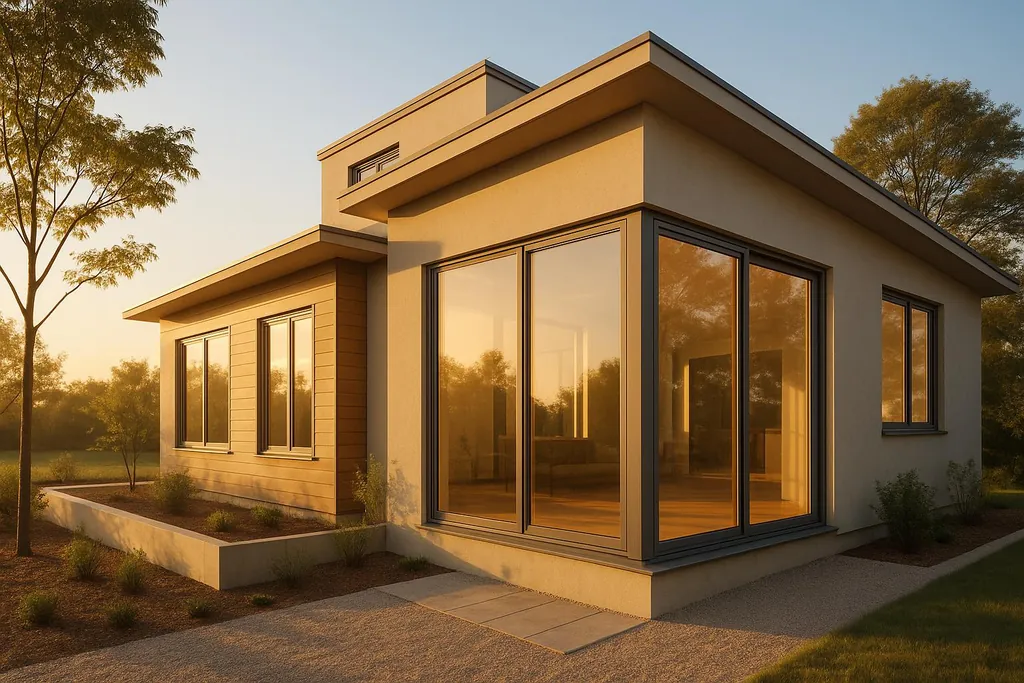
Learn how window orientation for passive solar design can cut heating and cooling costs by up to 85%. A practical guide to positioning windows.
Window Orientation for Passive Solar: Basics Explained
Use the Window U-Factor Comparison to test how south-facing fraction changes annual heating cost — the same window product can save hundreds of dollars per year just by being oriented south instead of east or west.
Want to save up to 85% on heating and cooling costs? The secret lies in smart window orientation. Passive solar design uses the sun's natural path to heat, cool, and light your home - no fancy tech needed.
Here's the quick takeaway:
- South-facing windows capture maximum winter heat and light.
- East-facing windows bring in gentle morning light.
- West-facing windows face overheating challenges in the afternoon.
- North-facing windows offer consistent light but minimal heat gain.
For best results:
- Position windows within 30° of true south for optimal solar gain.
- Use shading (like roof overhangs) to prevent summer overheating.
- Adjust window size and placement based on your local climate.
This simple strategy can make your home more comfortable and energy-efficient year-round while cutting energy bills by up to 90%. Keep reading for practical tips and design insights.
Why Do Stitt Homes Have So Many South-Facing Windows?
Basic Principles of Window Orientation
Getting window orientation right starts with a few basic principles. These guide how much solar energy your home captures and when, shaping decisions about window placement and size to maximize energy efficiency.
True South Orientation in the Northern Hemisphere
In the U.S., aligning with true south is central to effective passive solar design. This orientation ensures steady and advantageous solar exposure throughout the year.
> "Typically, windows or other devices that collect solar energy should face within 30 degrees of true south and should not be shaded during the heating season by other buildings or trees from 9 a.m. to 3 p.m. each day." [\[2\]](https://www.energy.gov/energysaver/passive-solar-homes)
Here's why this works: In winter, the sun stays low on the southern horizon, making south-facing windows perfect for capturing warmth when it's needed most. During summer, the sun rises higher, naturally reducing direct sunlight through those same windows.
To find true south, you'll need to account for magnetic variation, as magnetic north differs from true north depending on your location. You can use publicly available maps or smartphone apps designed to track the sun's movement in your area [\[4\]](https://www.nachi.org/building-orientation-optimum-energy.htm).
For optimal results, aim to design your home with an east–west ridgeline. This layout maximizes the southern wall's length, creating more space for well-placed windows. Rooms like kitchens and living areas, which benefit most from natural light and warmth, should be positioned along the southern side [\[4\]](https://www.nachi.org/building-orientation-optimum-energy.htm). Once true south is established, adjust your strategy to suit your local climate.
Climate-Specific Adjustments
Your local climate plays a significant role in fine-tuning window orientation. What works in a cold region like Minnesota might not suit a hot desert area like Arizona.
- Colder northern climates (zones 7–8): The goal is to capture as much winter sunlight as possible through south-facing windows.
- Hot, dry climates (zones 4–6): Balance is key - maximize winter warmth while using roof overhangs and landscaping to limit summer overheating.
- Hot, humid climates (zones 1–3): The focus shifts to reducing direct sunlight on all sides of the building while enhancing natural ventilation and cooling breezes [\[3\]](https://www.yourhome.gov.au/passive-design/orientation).
> "Good orientation can significantly improve your comfort and reduce your heating and cooling needs. The best orientation for your home is the one that suits your climate zone." [\[3\]](https://www.yourhome.gov.au/passive-design/orientation)
The size of south-facing windows also depends on climate. In colder regions, they should account for 7% to 15% of the floor area, with larger percentages in the coldest areas. In warmer regions, smaller window areas help avoid overheating [\[6\]](https://www.pmcarchitects.com/sustainability-information-blog-content/windows-and-overhangs-in-passive-solar-heating).
Impact of Deviations from Ideal Orientation
Small deviations from true south - up to 15° east or west - have little impact on performance. This flexibility can accommodate lot constraints, views, or other design priorities [\[1\]](https://greenpassivesolar.com/passive-solar/building-characteristics/orientation-south-facing-windows).
Larger deviations, however, start to compromise efficiency. East- and west-facing windows can cause excessive summer heat gain, making cooling more challenging. They also lose much of their potential for solar heat gain during the winter.
North-facing windows are the most challenging in the Northern Hemisphere. They contribute little to no solar heat, making them less useful in passive solar designs. While they provide consistent, indirect light and help keep rooms cooler in summer, they generally lose heat during the colder months [\[6\]](https://www.pmcarchitects.com/sustainability-information-blog-content/windows-and-overhangs-in-passive-solar-heating).
When ideal orientation isn't possible, compensating with other design features becomes essential. Options include better insulation, higher-quality windows, or adding thermal mass to store and release solar energy more effectively. In a Passive House-grade build, passive solar gains are folded into the PHPP energy model alongside the envelope and ventilation budget — orientation done right can shave thousands off the heating system spec.
Shading is especially important when orientation isn't perfect. Roof overhangs, awnings, and thoughtful landscaping can help block unwanted heat during warmer months while still allowing winter sunlight to warm your home [\[2\]](https://www.energy.gov/energysaver/passive-solar-homes).
Seasonal Effects of Window Orientation
Adjusting your window orientation to align with the sun's seasonal movements can greatly enhance the efficiency of a passive solar design. The sun's position in the sky changes significantly throughout the year, and designing your windows to complement these shifts is essential for maintaining a comfortable and energy-efficient home.
Maximizing Winter Solar Gain
Winter is when passive solar design truly shines. With the sun sitting lower in the southern sky, south-facing windows become a powerful tool for capturing heat during the colder months. Materials like concrete or brick, known as thermal mass, absorb this heat during the day and release it at night, helping to reduce your reliance on traditional heating systems.
To make the most of this, keep south-facing windows unobstructed during winter. Direct gain systems, which allow sunlight to enter and heat the interior directly, are particularly effective - capturing 60–75% of the sun's energy that hits your windows[\[7\]](https://sustainability.williams.edu/green-building-basics/passive-solar-design). Once winter heat capture is optimized, attention shifts to managing summer heat.
Preventing Summer Overheating
While winter strategies focus on capturing heat, summer strategies aim to keep it out. The higher sun angle during summer months can turn those same south-facing windows into a source of unwanted heat, making cooling more challenging.
East- and west-facing windows are often the trickiest to manage, as they receive intense, low-angle sunlight in the mornings and afternoons[\[3\]](https://www.yourhome.gov.au/passive-design/orientation). To counter this, combine roof overhangs, thoughtful landscaping, and cross-ventilation to block the high-angle summer sun and improve airflow. Planting deciduous trees on the south side is a natural solution. Their full summer canopy provides shade, while in winter, their bare branches allow sunlight to pass through. This dual-purpose shading, along with the cooling effect of evapotranspiration, can lower surrounding air temperatures by up to 6°F, with areas directly under trees feeling up to 25°F cooler than nearby paved surfaces[\[8\]](https://www.energy.gov/energysaver/landscaping-shade).
When these seasonal strategies are applied effectively, passive solar homes can cut heating and cooling energy use by as much as 90% compared to conventional buildings[\[9\]](https://buildpass.co.uk/blog/the-5-fundamental-principles-of-passive-house).
Window Orientation by Direction
Windows facing different directions play unique roles in managing solar heat and light. Their placement and design significantly impact energy efficiency and comfort throughout the year.
South-Facing Windows
South-facing windows are central to passive solar design, capturing the most winter sunlight while posing a risk of overheating in summer. This balance can be managed with energy-efficient glazing and shading solutions.
For optimal performance, the window area on the south side should ideally range from 7% to 15% of the floor area. Keeping it under 10% is generally recommended to minimize overheating, unless you're in a colder climate where additional solar heat is beneficial [\[5\]](https://roloxhomeservice.com/the-role-of-windows-in-passive-solar-design).
These windows provide excellent natural light all day, making them perfect for living areas and even nurturing indoor plants [\[10\]](https://lakewashingtonwindows.com/east-west-north-south-facing-windows). However, without proper shading, they can cause summer overheating, higher cooling costs, glare, and UV damage to furniture and flooring [\[11\]](https://www.windowscanada.com/whitepages/advantages-and-challenges-of-south-facing-windows.html).
To address these challenges, consider thermal blinds or blackout curtains to manage light and heat. Landscaping with small trees or flowering plants can also help filter intense sunlight [\[11\]](https://www.windowscanada.com/whitepages/advantages-and-challenges-of-south-facing-windows.html).
East- and West-Facing Windows
East- and west-facing windows bring their own set of challenges. East-facing windows welcome bright morning sunlight, warming spaces like kitchens or breakfast areas early in the day before cooling off by midday [\[10\]](https://lakewashingtonwindows.com/east-west-north-south-facing-windows). On the other hand, west-facing windows receive strong afternoon and evening sun, which can lead to overheating in summer but provide welcome warmth during cooler months [\[10\]](https://lakewashingtonwindows.com/east-west-north-south-facing-windows).
According to the Department of Energy, about 30% of residential energy use is due to heat transfer through windows [\[13\]](https://www.gotchacovered.com/blog/2023/february/energy-efficiency-and-your-home-in-2023). To manage these windows effectively, use energy-saving treatments like cellular shades, solar shades, or shutters [\[13\]](https://www.gotchacovered.com/blog/2023/february/energy-efficiency-and-your-home-in-2023). For west-facing windows, UV-blocking films or external shades can help reduce heat and glare [\[10\]](https://lakewashingtonwindows.com/east-west-north-south-facing-windows). Opting for vinyl or fiberglass window frames can also limit heat loss [\[10\]](https://lakewashingtonwindows.com/east-west-north-south-facing-windows).
In winter, opening window treatments during sunny periods allows for natural warmth, while closing them at night improves insulation. Even basic draperies can reduce heat loss by as much as 10% [\[13\]](https://www.gotchacovered.com/blog/2023/february/energy-efficiency-and-your-home-in-2023).
North-Facing Windows
North-facing windows function differently in passive solar design. They provide consistent natural light throughout the day without significant heat gain [\[12\]](https://f9productions.com/best-windows-for-passive-solar-homes). In the Northern Hemisphere, these windows are known for steady daylight with minimal solar heat, though they can contribute to heat loss during colder months. For this reason, passive solar principles suggest keeping north-facing windows to a minimum [\[6\]](https://www.pmcarchitects.com/sustainability-information-blog-content/windows-and-overhangs-in-passive-solar-heating).
Despite their limitations for heat gain, north-facing windows are ideal for spaces like home offices or studios that benefit from even, glare-free lighting [\[12\]](https://f9productions.com/best-windows-for-passive-solar-homes). To optimize their performance, focus on energy-efficient features such as high-performance glazing with a low U-value and Low-E coatings to block UV rays while improving insulation [\[5\]](https://roloxhomeservice.com/the-role-of-windows-in-passive-solar-design). Adding gas fills and multiple glazing layers can further enhance their insulating properties [\[6\]](https://www.pmcarchitects.com/sustainability-information-blog-content/windows-and-overhangs-in-passive-solar-heating).
The goal with north-facing windows is to strike a balance - use them selectively for consistent daylight while minimizing their size to reduce heat loss.
Design Considerations and Practical Tips
To make the most of passive solar energy, it's essential to consider window orientation alongside room layout, material choices, and ventilation strategies. Here's how to bring these elements together for a more energy-efficient home.
Room Placement Based on Window Orientation
Where you place each room in your home matters. For example, living areas should ideally be on the south side to take advantage of winter sunlight, while spaces like bathrooms, storage rooms, and garages are better suited for the north side, where heat loss is less of a concern [\[12\]](https://f9productions.com/best-windows-for-passive-solar-homes). Positioning windows lower can help transfer heat effectively to thermal mass materials inside.
East-facing windows can brighten your mornings. Kitchens and breakfast areas benefit from the gentle warmth of the morning sun, while bedrooms with east-facing windows provide natural light to help you wake up without the harsh heat of the afternoon. For home offices or studios, consider north-facing windows - they offer consistent, glare-free light throughout the day, which is easier on the eyes and reduces the need for blinds or curtains.
Once room placement is set, the next step is choosing energy-efficient materials.
Material Selection for Energy Efficiency
Windows are a major factor in heating and cooling, accounting for 25–30% of energy use [\[15\]](https://www.buildwithrise.com/stories/passive-house-windows). Choosing the right ones can make a big difference.
Start with ENERGY STAR certified windows. Look for double or triple-glazed options with low-emissivity (low-E) coatings. These coatings reflect heat back into your home while still letting in natural light [\[14\]](https://energysavingtrust.org.uk/advice/windows-and-doors)[\[15\]](https://www.buildwithrise.com/stories/passive-house-windows). For better insulation, ensure the space between glass panes is filled with argon or krypton gas. Triple glazing can boost efficiency by 20–30% compared to standard double-glazed windows [\[15\]](https://www.buildwithrise.com/stories/passive-house-windows).
For homes using passive solar heating, south-facing windows should have a high Solar Heat Gain Coefficient (SHGC) and low U-factors to maximize heat retention [\[16\]](https://www.wbdg.org/resources/windows-and-glazing). In areas where air conditioning is heavily used, opt for windows with low SHGC values (below 0.40) [\[16\]](https://www.wbdg.org/resources/windows-and-glazing).
Thermal mass materials, such as concrete, tile, or brick, are key for regulating indoor temperatures. They absorb sunlight during the day and release the stored heat as temperatures drop, reducing the need for mechanical heating or cooling. Frame materials also matter - uPVC frames are low-maintenance and insulate well, wooden frames are long-lasting and eco-friendly, and aluminum or steel frames offer durability with a sleek design [\[14\]](https://energysavingtrust.org.uk/advice/windows-and-doors).
With materials in place, optimizing airflow can further enhance your home's energy performance.
Improving Airflow and Natural Ventilation
Good natural ventilation can reduce cooling costs by 10–30% [\[18\]](https://hutterarchitects.com/natural-ventilation-house-design). The trick is thoughtful window placement.
Cross-ventilation works by placing windows on opposite or adjacent walls at varying heights, creating pressure differences that help air flow through the house. For effective cross-ventilation, aim for operable windows that total at least 5% of your floor area. In cases of single-sided ventilation, this may need to be closer to 10% [\[18\]](https://hutterarchitects.com/natural-ventilation-house-design).
Different window styles offer unique benefits. Casement windows, for instance, can open up to 90%, maximizing airflow [\[18\]](https://hutterarchitects.com/natural-ventilation-house-design). Awning windows allow ventilation even during light rain, while double-hung windows provide both high and low openings for improved circulation [\[18\]](https://hutterarchitects.com/natural-ventilation-house-design).
The stack effect is another way to boost airflow. By using low inlets and high outlets, cooler air is drawn in while warmer air is pushed out. Even a slight air movement of about 160 feet per minute can make a room feel up to 5°F cooler without actually lowering the temperature [\[18\]](https://hutterarchitects.com/natural-ventilation-house-design).
> "The effectiveness of the buoyancy effect increases as the temperature differences between different sections of the building increase. Increased height between lower and higher apertures leads to better displacement and superior ventilation." - Moffitt, ventilation specialist [\[18\]](https://hutterarchitects.com/natural-ventilation-house-design)
Tailoring strategies to your climate can make ventilation even more effective. In hot-dry regions, try night flushing - open windows after sunset to let in cooler air. In hot-humid areas, focus on maximizing cross-ventilation and consider raised living spaces to catch breezes [\[18\]](https://hutterarchitects.com/natural-ventilation-house-design).
Small design features can also help. Transom windows above interior doors maintain airflow while preserving privacy. Internal courtyards or atria can break up large spaces and create multiple ventilation zones, particularly in bigger homes [\[18\]](https://hutterarchitects.com/natural-ventilation-house-design).
Lastly, don't overlook landscaping. Trees, shrubs, and windbreaks can guide cooling breezes toward your home or shield windows from unwanted winds, further improving energy efficiency [\[17\]](https://www.energy.gov/energysaver/natural-ventilation). By combining thoughtful design with smart material choices and ventilation strategies, you can create a home that stays comfortable year-round with less energy use.
Pros and Cons of Different Window Orientations
This section delves into the strengths and weaknesses of various window orientations, helping you make informed decisions when designing a passive solar home. Each direction offers specific benefits and challenges that can influence your home's comfort and energy efficiency. Below, you'll find a breakdown of these trade-offs, along with a handy table for quick reference.
South-facing windows are the cornerstone of passive solar design. During December and January, they bring in about 3.5 times more light and solar heat per square foot compared to east- or west-facing windows [\[19\]](https://www.greenbuildingadvisor.com/article/a-quantitative-look-at-solar-heat-gain). This makes them highly efficient during colder months, reducing heating needs. However, in summer, they can cause overheating and glare if not properly shaded.
> "South-facing windows are the unsung heroes of home design, capturing the sun's warmth and natural light throughout the day, making them a cornerstone for energy efficiency, indoor comfort, and creating a vibrant, inviting space that other window orientations simply can't match." - Tony Wong, Project Manager [\[11\]](https://www.windowscanada.com/whitepages/advantages-and-challenges-of-south-facing-windows.html)
East-facing windows are perfect for letting in soft morning light, which can gently warm your home when it's naturally at its coolest. They are particularly well-suited for spaces like kitchens and breakfast nooks. As Robert Opaluch explains, "East-facing windows provide sunlight early in the morning when a house interior is the coolest, so they are more useful than west-facing windows" [\[19\]](https://www.greenbuildingadvisor.com/article/a-quantitative-look-at-solar-heat-gain). On the downside, shading these windows effectively can be tricky [\[20\]](https://archexteriors.com/energy-efficient-windows-guide).
West-facing windows, while offering bright afternoon and evening light, are the least energy-efficient option. They tend to absorb intense heat during the hottest part of the day, which can lead to higher cooling costs. However, adding strategic shading - such as an awning covering the top two-thirds of the window - can cut heat gain by up to 77% [\[20\]](https://archexteriors.com/energy-efficient-windows-guide).
North-facing windows provide steady, soft light throughout the day without direct sunlight, making them ideal for spaces like home offices or art studios. That said, they contribute little to solar heating and can lead to increased heat loss during the winter months [\[6\]](https://www.pmcarchitects.com/sustainability-information-blog-content/windows-and-overhangs-in-passive-solar-heating).
To summarize, here's a quick comparison of the advantages and disadvantages of each orientation:
Comparison Table of Window Orientations
| Orientation | Advantages | Disadvantages |
|---|---|---|
| South | • High solar heat gain in winter<br />• Reduces heating/cooling costs by up to 85% [\[1\]](https://greenpassivesolar.com/passive-solar/building-characteristics/orientation-south-facing-windows)<br />• 3.5× more solar heat gain than east/west in winter [\[19\]](https://www.greenbuildingadvisor.com/article/a-quantitative-look-at-solar-heat-gain)<br />• Great for living spaces and plants | • Risk of overheating in summer without shading<br />• Causes glare<br />• UV damage to interiors<br />• Heat loss during winter nights without proper insulation |
| East | • Gentle warmth in the morning<br />• Natural light for waking up<br />• Ideal for cooler morning hours<br />• Perfect for kitchens and breakfast spaces | • Hard to shade effectively [\[20\]](https://archexteriors.com/energy-efficient-windows-guide)<br />• Limited light in the afternoon |
| West | • Bright light in the afternoon and evening | • High heat gain during peak temperatures [\[20\]](https://archexteriors.com/energy-efficient-windows-guide)<br />• Least energy-efficient orientation<br />• Increased cooling costs in summer<br />• Difficult to shade effectively |
| North | • Consistent, soft lighting<br />• Minimal glare and overheating<br />• Great for offices and studios<br />• Keeps rooms naturally cooler | • Little solar heat contribution [\[6\]](https://www.pmcarchitects.com/sustainability-information-blog-content/windows-and-overhangs-in-passive-solar-heating)<br />• Significant heat loss in winter<br />• Higher heating expenses<br />• Limited natural warmth |
This breakdown highlights how each orientation plays a role in creating a comfortable and energy-efficient space, depending on your needs and the season.
Conclusion
The placement and technology of windows play a key role in the success of passive solar design. Thoughtful window orientation is a straightforward yet effective way to create an energy-efficient home. Since heat gain and loss through windows account for 25%–30% of residential heating and cooling energy use [\[22\]](https://absolutewindowllc.com/architectural-windows-for-green-homes-style-sustainability), understanding how to work with the sun's natural path can significantly reduce the need for artificial heating, cooling, and lighting.
Passive solar design offers impressive results, with homes meeting 20%–90% of their heating needs directly from sunlight [\[21\]](https://hutterarchitects.com/passive-solar-home-design). Additionally, upgrading from single-pane windows to energy-efficient models can lead to annual savings of $200 to $600 on energy bills [\[22\]](https://absolutewindowllc.com/architectural-windows-for-green-homes-style-sustainability). As Marc Rosenbaum, a building expert, explains:
> "A well-designed passive solar home can receive 4.7 kWh/m²/day in winter but block unwanted gain in summer" [\[21\]](https://hutterarchitects.com/passive-solar-home-design).
These figures highlight how smart design choices can directly impact energy efficiency and cost savings. For those building or retrofitting homes with a focus on sustainability, incorporating passive solar principles during the planning stage can yield long-term financial and environmental benefits.
By optimizing south-facing windows, using roof overhangs for summer shading, choosing windows with the right Solar Heat Gain Coefficients, and integrating natural ventilation, you can create a home that naturally regulates its temperature. This approach not only enhances comfort but also reduces energy costs.
Whether you're designing a new home or improving an existing one, understanding window orientation is a critical step toward building a sustainable and efficient living space. These strategies align with nature's rhythms, helping you save money while contributing to a healthier planet.
FAQs
How do I find true south to maximize passive solar design for my home?
To determine true south for your home in the U.S., you'll need either a physical compass or a compass app on your smartphone. Don't forget to account for magnetic declination - the difference between magnetic north and true north - which varies depending on your location. Most modern apps handle this adjustment for you, but you can also find your local declination online if needed.
For optimal passive solar benefits, position your home's windows within 15–30 degrees of true south. If you're aiming for pinpoint accuracy, it's worth consulting a professional surveyor. Aligning your home correctly allows you to make the most of sunlight during the winter while minimizing heat buildup in the summer, improving both energy efficiency and indoor comfort throughout the year.
How can I reduce heat from east- and west-facing windows during summer?
To keep your home cooler during summer, focus on limiting heat from east- and west-facing windows. One effective approach is using external shading like awnings, overhangs, or strategically planted trees and shrubs. These block sunlight before it even hits the glass.
Inside, consider reflective window films or insulated curtains and blinds to further cut down on heat transfer. If you're in the design phase of building or renovating, reducing the size of windows on these sides can also make a big difference. Combining these methods can help maintain a cooler home while lowering the need for air conditioning.
How can I design my window orientation for better energy efficiency in different U.S. climate zones?
To make the most of passive solar design in the U.S., you need to align your window orientation strategy with the climate zone you live in. Here's how to approach it:
In colder climates (Zones 4–7), the goal is to harness as much sunlight as possible during winter. This means prioritizing south-facing windows, which let in sunlight and help naturally heat your home. At the same time, keep east- and west-facing windows to a minimum to avoid unnecessary heat loss and limit overheating during summer months.
In hot or humid climates (Zones 0–3), the focus shifts to keeping your home cool. Shade is your best friend here. Use overhangs, shades, or even landscaping to block sunlight, especially for east- and west-facing windows, as they tend to let in the most heat during the day.
No matter the zone, selecting windows with the right [U-factor](/glossary/u-factor) (which measures insulation) and [Solar Heat Gain Coefficient](/glossary/shgc) (SHGC) (which measures how much heat from sunlight passes through) plays a crucial role in energy efficiency. By tailoring window placement and specifications to your region, you can lower energy bills and stay comfortable throughout the year.