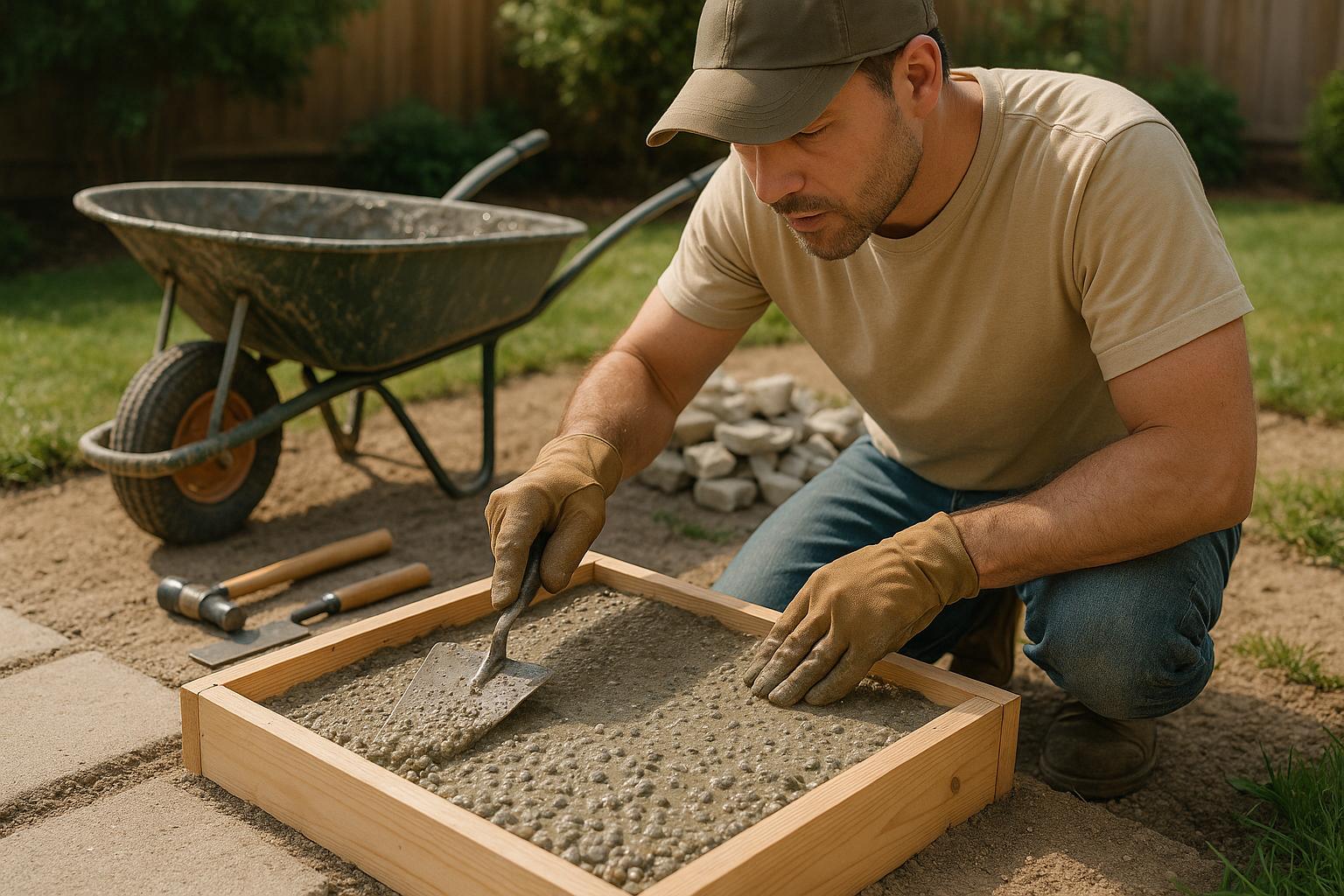
Explore the benefits and applications of recycled aggregate concrete for eco-friendly DIY building projects, offering cost savings and sustainability.
Ultimate Guide to Recycled Aggregate Concrete for DIY Builders
Recycled Aggregate Concrete (RAC) is a cost-effective and eco-friendly alternative to traditional concrete. It uses materials like crushed concrete and bricks from construction waste, reducing landfill use and conserving resources. RAC is ideal for DIY projects such as walkways, garden beds, and retaining walls. Here’s what you need to know:
- Cost Savings: Recycled aggregates are cheaper, typically ranging from $14 to $21 per ton, compared to $30–$100 per cubic yard for natural aggregates.
- Environmental Impact: Producing RAC reduces energy use by up to 85% and CO₂ emissions by up to 90%.
- Strength and Durability: While RAC has slightly lower strength than traditional concrete, proper mixing and curing can enhance its performance.
- DIY Applications: Great for non-structural projects like patios, drainage solutions, and driveways.
Key Tips:
- Source high-quality recycled materials locally.
- Test aggregates for contaminants and water absorption.
- Adjust water content in the mix to account for higher absorption rates.
- Use supplementary materials like fly ash or silica fume for added durability.
RAC is a practical choice for DIY builders looking to save money and reduce waste while creating durable, long-lasting projects.
Finding and Choosing Recycled Aggregates
Where to Get Recycled Aggregates
Recycled aggregates, like crushed concrete, bricks, and tiles, are often sourced from construction and demolition sites . These sites frequently collaborate with recycling centers that handle both processing and distribution. Many local aggregate suppliers also stock a variety of crushed concrete sizes, allowing you to inspect the materials before buying . Additionally, recycling centers, landfills, and some quarries offer access to both recycled and virgin materials. When buying online, always verify the seller's credentials and request samples to ensure you're getting what you need .
How to Check Aggregate Quality
Relying solely on visual inspection won't guarantee the quality of recycled aggregates, especially for structural or load-bearing uses. Laboratory testing is essential to evaluate key factors like gradation, fines, plasticity, and the presence of contaminants . Pay attention to adhered mortar content - research indicates it can reach up to 39.9%, which negatively impacts aggregate density and increases water absorption . Ensure the materials meet standard quality protocols and come with proper documentation . Once quality is verified, prioritize local sourcing and compare costs to find the best option.
Local Suppliers and Costs
Reach out to local suppliers to compare prices and quality . For recycled concrete aggregates, prices typically range between $14.00 and $21.00 per ton. For example, 0-5/8″ recycled concrete costs about $14.00 per ton, while #2 screened concrete is priced at $21.00 per ton . Recycled asphalt products are similarly priced, with #53 recycled asphalt available for around $15.75 per ton . In contrast, traditional aggregates like gravel and crushed stone are more expensive, costing between $30 and $100 per cubic yard, with an average of $65 per cubic yard in places like Scottsdale, Arizona. Recycled materials, however, start at $16 to $27 per ton .
To estimate your project needs, measure the dimensions and use a conversion factor of 2.3 tons per cubic yard . Be sure to account for transportation costs and confirm that dump trucks can access your site to avoid additional fees . While recycled concrete aggregates are suitable for many applications, they’re generally not recommended for exposed walkways or driveways due to the risk of steel remnants. Additionally, they are not commonly used to produce new concrete .
Mixing Recycled Aggregate Concrete
Required Tools and Materials
To mix recycled aggregate concrete effectively, you'll need the right tools and materials. Start with crushers, screeners, and a reliable concrete mixer - this equipment simplifies the process and ensures consistency . Screening is crucial to eliminate contaminants from the recycled aggregates. For personal safety, wear dust masks or respirators, safety glasses, work gloves, and steel-toed boots to protect yourself from dust and debris.
The mix itself requires Portland cement, clean water, and quality-tested recycled aggregates. If needed, include admixtures to improve the concrete's durability. Be aware that recycled aggregates often retain adhered mortar, which can increase water absorption. Adjust the water content accordingly to achieve the desired consistency. Accurate mix ratios are key to ensuring the concrete performs as expected.
Mix Ratios and Steps
Once your tools and materials are ready, set your mix proportions carefully. Research suggests that replacing 20% of the total aggregate content with recycled concrete aggregate strikes a good balance between cost efficiency and mechanical performance . When fine-tuning your mix, ensure the correct balance of cement, water, and air entrainment to meet your target strength requirements .
Safety Tips
Always source recycled concrete from trusted suppliers and test the material before use to ensure quality . Work in well-ventilated areas and use proper respiratory protection to shield yourself from silica dust and other airborne particles. For the best results, compact the concrete thoroughly and follow proper curing practices to achieve the desired strength and durability .
Strength and Durability
Strength and Lifespan Expectations
Recycled aggregate concrete typically shows compressive strength that's 10–25% lower than conventional concrete. This variation depends on the quality of the recycled materials and the mix design. Even with this reduction, it’s still suitable for many home projects like driveways, patios, and other non-structural elements. The longevity of this concrete hinges on the quality of the recycled aggregates and proper upkeep. When recycled materials come from well-maintained demolished structures, the concrete can perform reliably with proper installation and maintenance. On the flip side, using lower-quality aggregates can negatively affect its lifespan.
One key difference lies in water absorption. Recycled concrete aggregates absorb between 1.56% and 9.7% water, compared to just 0.73% to 1.25% for natural aggregates. This higher absorption makes recycled concrete more prone to freeze-thaw damage, especially in colder climates. To counteract this, proper curing and sealing are critical. These factors are essential when comparing recycled aggregate concrete to its conventional counterpart.
How It Compares to Regular Concrete
| Property | Recycled Concrete Aggregate (RCA) | Natural Concrete Aggregate (NCA) |
|---|---|---|
| Specific Gravity | 2.14 – 2.81 | 2.68 – 2.86 |
| Water Absorption (%) | 1.56 – 9.7 | 0.73 – 1.25 |
| Density (lb/ft³) | 770 – 885 | 937 – 1,092 |
| Crushing Value (%) | 8.8 – 36 | 13.63 |
| Abrasion Value (%) | 17 – 45 | 17.88 |
Recycled aggregate concrete tends to have up to 18% lower tensile strength and may see a drop in its modulus of elasticity by as much as 30%. For DIY enthusiasts, this means the material could be slightly more flexible and more prone to cracking under tension. Despite these drawbacks, recycled aggregate concrete remains a budget-friendly choice for many residential projects.
Making It Stronger and Last Longer
There are ways to improve the performance of recycled aggregate concrete, making it both stronger and more durable. Pre-wetting the recycled aggregates before mixing ensures better workability and helps achieve saturated surface dry (SSD) conditions. Additionally, keeping the water-to-cement ratio at 0.4 or lower is vital for enhancing strength and durability.
Incorporating supplementary cementitious materials can also make a big difference. For example:
- Adding 25–35% fly ash
- Including 10% silica fume
- Using up to 65% slag
These materials help reduce larger pores and strengthen the bond between components, ultimately boosting compressive strength .
Extended curing times are another effective strategy. Research by Zhang et al. highlights that while recycled concrete may have lower early-age compressive strength, it can reach comparable strength to natural aggregate concrete after 90 days of proper curing .
Surface treatments like heating, scrubbing, or mechanical grinding can also enhance performance. These methods can increase the elastic modulus by 30–43%, raising it from about 4.8 million psi for untreated aggregates to approximately 6.4 million psi for treated ones .
> "The denseness of RAC can be improved by adding cementitious materials with volcanic ash effect, and the reduction of microcracks in mortar can be improved by adding fibers." > > - Yuanxun Zheng, Yahui Zhang, Peng Zhang
For outdoor applications, adding fiber reinforcement can further improve strength. Incorporating polypropylene or steel fibers at 0.1–0.2% by volume helps reduce microcracks and enhances tensile strength. These adjustments give DIY builders practical options for creating durable and economical recycled concrete for various projects.
DIY Projects and Techniques
Best DIY Uses
Recycled aggregate concrete (RCA) is a versatile material that works well for various non-structural home projects.
Walkways and pathways are one of the most common applications. Using evenly sized RCA pieces can help manage runoff and drainage issues, which are often problems with traditional materials .
Another great use is for raised garden beds. Crushed concrete provides a stable base that promotes good drainage while supporting the weight of soil and plants . Plus, since RCA is less dense, you get more material per ton, making it a budget-friendly option for larger garden setups .
For retaining walls and erosion control, larger RCA pieces are highly effective. Superior Groundcover demonstrated how layering smaller crushed pieces as a base, followed by larger chunks packed with soil, can create a sturdy and visually appealing retaining wall .
RCA also works as a drainage substitute for gravel. Its smaller, broken-up pieces are efficient for this purpose .
Driveways and parking areas can be built with RCA as long as the design meets the necessary load requirements.
By using recycled materials like RCA, you not only cut down on waste but also contribute to more sustainable building practices.
Pouring, Curing, and Finishing
Once you’ve chosen your materials, the way you pour and cure the concrete plays a big role in the final outcome. Preparation is key. Since RCA absorbs more water than traditional aggregates, start by clearing vegetation and digging to the correct depth. Create a stable base with compacted crushed stone or gravel, then add a thin layer of sand for leveling . To avoid water pooling, ensure the surface slopes about 1/4 inch per foot of walkway .
Forming the structure depends on the project. For a walkway, use 2-by-4s for a 3.5-inch thickness. For sections that need to handle vehicle traffic, opt for 2-by-6s for a 5.5-inch thickness . Tailor the concrete mix to meet the load requirements .
When pouring the concrete, consistency is everything. Use a screed rod to level the surface, followed by a bull float for smoothing . As Matt Villers from Concrete Specialties Inc. explains:
> "There's nothing in particular you have to do, whether it's broomed, stamped or exposed" .
If you’re going for an exposed aggregate finish, timing is critical. Press the surface lightly - if the aggregate stays in place, it’s ready for the next step . Wash the surface carefully, moving systematically to expose the gravel without causing streaks .
Once cleaned, apply a sealer or curing compound immediately to protect the surface. During finishing, avoid excessive troweling to maintain even aggregate exposure .
Fixing Common Problems
Working with recycled aggregate concrete has its challenges, but understanding the material’s quirks can help you avoid common pitfalls.
One frequent issue is reduced compressive strength . RCA absorbs more water - typically between 3% and 9% compared to less than 2% for traditional concrete . Managing water content is crucial. Adding natural sand to the mix can improve workability and minimize shrinkage .
Cracking and durability problems often come from the attached mortar in RCA, which increases porosity and affects shrinkage. When using coarse RCA alone, expect drying shrinkage to increase by 20–50%. Using both coarse and fine RCA can lead to a 70–100% increase . Proper curing and high-quality sealers can help mitigate these effects.
Other concerns include Alkali-Silica Reaction (ASR) and D-cracking, which may occur in RCA containing reactive aggregates. To address these, reduce the maximum aggregate size and consider adding lithium-based admixtures or supplementary cementitious materials . Testing recycled aggregates for reactivity and quality is also recommended . Always source your materials from trusted suppliers who meet your project’s specifications .
As Schulz RR points out:
> "If recycling building materials is regarded as a closed loop system, all valuable constituents in the waste may not be dissipated by applications of secondary importance (e.g. landfill). As far as it can be afforded from an economical point of view, processed rubble should be employed on the highest possible level of utilization. The reuse of building waste as aggregate for concrete seems to be especially prosperous and may be regarded as the highest level of refining" .
Costs and Environmental Impact
Project Cost Breakdown
When planning DIY projects, understanding the financial side of using recycled aggregate concrete (RCA) can help you make smarter choices. Costs for RCA can vary based on location, project size, and how the materials are sourced.
One major benefit of RCA is the potential for material savings. For instance, fine recycled concrete aggregate costs about $14.10 per ton, while manufactured aggregate costs around $20.60 per ton - a noticeable difference. Similarly, producing one ton of coarse RCA is roughly 40% cheaper than natural aggregate. While recycled concrete may run 0–10% higher than virgin concrete overall, sourcing materials locally can offset these costs through reduced transportation expenses. As explained by ReAgg:
> "One of the key benefits of using aggregate made from recycled concrete is the lowered cost compared to using newly created aggregate. Producing recycled aggregate does not require the mining of the new materials required to produce aggregate from scratch".
Other factors can also influence costs. For example, quality control measures like extra crushing or pre-soaking treatments can boost performance but may add to expenses. Additionally, government policies - such as subsidies for recycled materials or landfill taxes on concrete waste - can impact final costs.
Environmental Benefits
The advantages of RCA go beyond just saving money - it’s also a more environmentally friendly option. Using RCA can cut energy consumption by up to 85% and reduce CO₂ emissions by 90% compared to traditional concrete production. At a 100% replacement ratio, RCA can lower carbon emissions by 2–3% and reduce overall environmental impacts by 23–27%.
RCA also plays a key role in waste reduction by diverting construction debris away from landfills, conserving valuable disposal space. In the UK, for example, recycled aggregates already make up over 30% of the total aggregates used in construction, showcasing their growing role in sustainable building.
By reducing the need for quarrying virgin materials, RCA helps limit environmental damage from mining and preserves natural resources for future generations. The production of recycled aggregates is far less energy-intensive than that of virgin materials, with the environmental benefit of producing one ton of coarse RCA being about 97% greater than that of natural aggregate. Processing recycled materials locally further cuts down on carbon emissions tied to transportation.
Supporting Green Building Practices
RCA aligns perfectly with sustainable construction values, making it a key player in green building practices. By repurposing waste into a usable resource, RCA supports the circular economy - a principle championed by [DIY Eco Homes](/).
Performance-wise, RCA matches natural aggregate concrete without adding extra emissions. Research confirms that recycled aggregates are just as structurally reliable as their natural counterparts. While some might prioritize immediate cost savings over long-term benefits, RCA offers both financial and ecological advantages, potentially cutting environmental impact by around 30% and helping to lower material expenses.
Combining RCA with supplementary cementitious materials - like fly ash or ground granulated blast furnace slag - can further reduce both environmental impact and costs. Choosing RCA isn’t just about saving money or reducing waste; it’s a step toward a larger vision of sustainability. By integrating recycled aggregates into your projects, you’re contributing to a future that values resource conservation and environmental responsibility while advancing your green building goals.
Conclusion
Key Takeaways
Recycled aggregate concrete (RCA) is an affordable and environmentally friendly option that helps reduce landfill waste while encouraging a circular approach to material use. It's ideal for projects like walkways, garden beds, retaining walls, and driveways, offering practical advantages alongside sustainable practices. With these benefits in mind, you can turn your ideas into eco-conscious, durable projects.
Starting Your RCA Project
Begin with a straightforward project to familiarize yourself with RCA techniques, then gradually take on more complex tasks. As mentioned earlier, sourcing high-quality RCA and using accurate mix ratios are critical for achieving strong results.
Reach out to local concrete recycling facilities or suppliers to find the right materials for your needs. Prepare your site by marking the area, excavating to the correct depth, and clearing away any debris. Don’t forget to install proper drainage to manage water runoff and prevent erosion. During installation, prioritize safety - wear gloves and use the right tools. Compacting and finishing the surface properly will improve both durability and appearance.
To ensure your RCA project stands the test of time, perform regular maintenance. This includes pulling weeds, filling in any gaps or holes, and repairing worn edges as needed. With a little care, your recycled aggregate concrete creation will remain sturdy and functional for years.
CRUSHED CONCRETE DRIVEWAY | RECYCLED CONCRETE DRIVEWAY | HOW TO BUILD A GRAVEL DRIVEWAY
FAQs
How does recycled aggregate concrete compare to traditional concrete in terms of strength and durability, and what can I do to enhance its performance for my DIY projects?
Recycled aggregate concrete (RAC) generally has slightly lower strength and durability compared to traditional concrete. This is often due to the inconsistent quality of recycled materials. On average, RAC can be up to 25% weaker, depending on how much recycled content is used. But with the right techniques, you can boost its performance, making it a solid option for your DIY projects.
One way to improve RAC is by treating the recycled aggregates. Techniques like carbonation or acid treatment can enhance adhesion and strengthen the mix. Another key step is carefully selecting and processing the recycled materials to ensure better durability and consistency. By applying these methods, you can create a concrete mix that’s not only reliable but also supports your eco-friendly building goals.
How can I check the quality of recycled aggregates for my DIY concrete project, and what tests should I use before buying?
Before diving into your DIY project with recycled aggregates, take a moment to assess their quality. Testing is key to ensuring the materials will perform well and last. Here are some important checks to consider:
- Sieve analysis: This test determines the particle size distribution, helping you confirm the aggregates are suitable for your project.
- Water absorption tests: These measure the moisture content, which can impact the mix and strength of your concrete.
- Specific gravity testing: This verifies the density of the aggregates, ensuring consistency and strength.
- Organic impurity tests: These identify contaminants that could weaken the material or affect its durability.
- Sulfate soundness tests: This checks the material's resistance to disintegration, especially under changing weather conditions.
By conducting these tests, you can confirm the aggregates meet industry standards, are free from harmful impurities, and are robust enough for your construction needs. Taking these steps upfront will help your recycled aggregate concrete project deliver the performance and durability you're aiming for.
What are the environmental advantages of using recycled aggregate concrete in sustainable building projects?
Using recycled aggregate concrete offers several environmental benefits, making it a smart option for eco-conscious construction. By reusing materials from demolished structures, it helps cut down on landfill waste. At the same time, it conserves natural resources like gravel and sand, reducing the need for new raw materials. Plus, it requires less energy to produce compared to fresh concrete.
Another big advantage is its ability to lower the carbon footprint of construction projects. It minimizes the environmental toll of extracting and transporting resources. By choosing recycled aggregate concrete for your DIY projects, you’re not just building something sturdy - you’re also embracing sustainable building practices that make a difference.