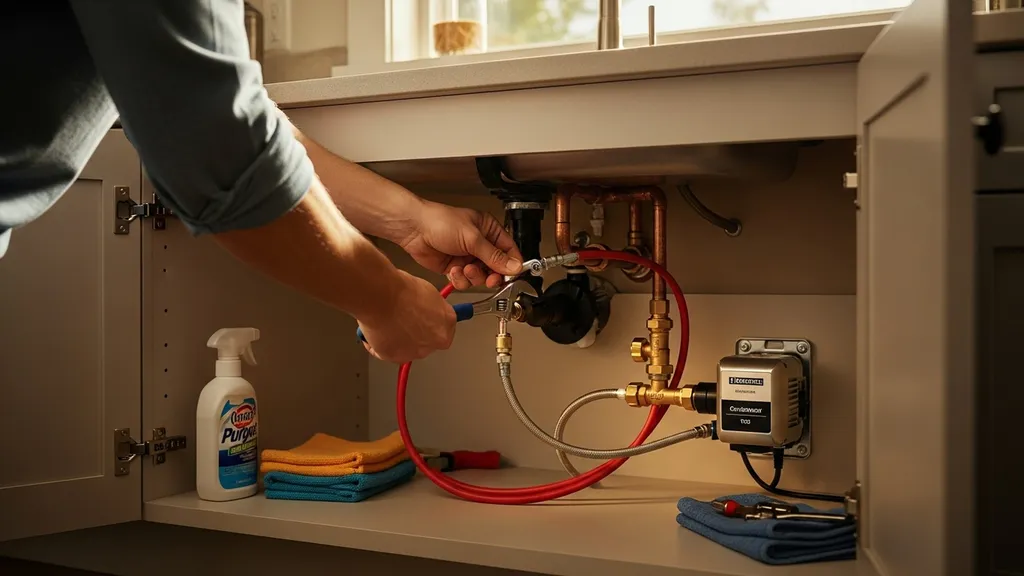
Practical guide to on-demand hot water recirculation for DIY eco-builders: how systems work, install tips, energy math, and retrofit options.
Hot Water Recirculation: On-Demand Systems
Hot water recirculation reduces the time and water wasted waiting for hot tap water by circulating warm water to fixtures only when needed. For many DIY eco-builders, an on-demand hot water recirculation system cuts wait times from 30–90 seconds and prevents 1–3 gallons of cold water per faucet event from going down the drain. This guide explains how on-demand systems work, the parts and controls to choose, step-by-step retrofit and new-build installation guidance, energy and payback math, and practical tips for off-grid or passive-house projects.
TL;DR:
- Save 1,000–4,000 gallons per year for a typical household, depending on pipe length and use
- Use a low-watt recirculation pump (15–60 W) with push-button or temperature controls to minimize energy use
- Retrofit under-sink installs typically take 2–4 hours; verify tankless compatibility and local code for backflow prevention
How Hot Water Recirculation: On-demand Systems Work
Hot water recirculation systems move warm water so it’s immediately available at fixtures. The goal is to avoid the cold purge that happens when a tap is opened and hot water must travel from the heater through long pipe runs. In general use:
- A recirculation loop returns cooled hot water back to the heater (a true return line), or
- An on-demand crossover/bypass at the fixture or under-sink uses a small pump to push warm water back into the cold line until hot arrives.
Key terms:
- Recirculation loop: Dedicated return piping connecting far fixtures back to the water heater.
- Return line: The pipe that carries water back to the heater.
- Crossover valve / cold-water bypass: A controlled valve that allows flow between hot and cold lines at a fixture for on-demand operation.
Typical wait times and waste:
- Average wait for hot at a fixture: 30–90 seconds on long runs.
- Water wasted per event: about 1–3 gallons (varies with pipe diameter and distance).
- Pump power draws for on-demand units commonly range 15–60 W; continuous systems often have higher cumulative energy use because they run more minutes per day.
Components in an on-demand system include a small recirculation pump, an activation sensor or push-button, a check valve to prevent unwanted backflow, and wiring/controls for power and logic. Brands frequently used include Grundfos, Taco, Laing, and Watts for pumps and control hardware. Installation must follow manufacturer instructions and local plumbing code; see local guidance such as the hot water recirculation guidance from Monterey Peninsula Water Management District for code-oriented design notes.
Benefits and Trade-offs of On-demand Hot Water Recirculation for DIY Eco-builders
On-demand recirculation offers clear advantages for water saving and convenience, but it introduces trade-offs in energy use, complexity, and cost.
Water Savings and User Comfort
- Saves potable water that otherwise runs down the drain while waiting for hot. For long pipe runs, on-demand systems can save thousands of gallons per year depending on household habits.
- Improves user comfort: immediate warm water for showers, sinks, and appliances reduces frustration and avoids standing cold-water waste.
- Pairs well with water-conserving fixtures and rainwater or greywater systems to stretch supply; consider overall household strategies such as a water-efficient plumbing guide to maximize benefits.
Energy Implications and Standby Losses vs Continuous Systems
- On-demand pumps typically draw 15–60 W during a call; the total added energy depends on calls per day and minutes per call.
- Continuous recirculation systems avoid repeated pump startup but can run for many hours daily, increasing electrical consumption and distribution heat loss unless the loop is heavily insulated.
- Sample duty-cycle estimate: a low-watt on-demand pump running 6 minutes per use for 10 uses/day at 25 W uses (25 W × 1 hr/day × 365)/1000 = 9.1 kWh/year — modest. If the system is left to run continuously at 25 W, annual energy ≈ 219 kWh.
- There is debate about net energy: water heating losses from continuous loops can outweigh pump energy savings if the loop isn’t well insulated.
Cost Comparison and Lifecycle Trade-offs
- Retrofit under-sink on-demand pumps: low upfront cost ($100–$400 for typical consumer units) and short install time.
- Dedicated return loops in new builds cost more in materials and labor but yield the best long-term convenience and lower per-use energy when insulated properly.
- Lifecycle trade-offs include pump replacement every 5–15 years, check-valve wear, and possible increased water heater cycling for some configurations.
For market context and adoption trends, industry research reports estimate steady growth in the recirculation pump market, which reflects increased interest among homeowners and builders in water-saving plumbing technologies (MarketIntelo market report on hot water recirculation pumps).
System Types and Components for On-demand Recirculation
Common on-demand designs differ by where the pump and control sit and whether a dedicated return line exists.
- Under-sink push-button or motion-activated pumps: A small pump and crossover valve are mounted under the furthest sink. The homeowner presses a button or waves a sensor; the pump circulates warm water back through the cold line until the fixture’s hot tap senses proper temperature.
- Line-mounted pumps and dedicated return loops: Inline pumps sit on the hot return line or in a dedicated loop and are typically controlled by timers or temperature sensors. These are common in new builds.
- Tankless recirculation with integrated controls: Some tankless water heaters have approved recirculation interfaces. Check manufacturer guidance before connecting a pump to a tankless unit.
Comparison/specs table for common pump options:
| Pump type | Typical flow (GPM) | Typical head (ft) | Standby power (W) | Typical price | Install complexity |
|---|---|---|---|---|---|
| Under-sink crossover pump | 0.5–2.0 | 5–15 | 15–40 | $120–$350 | Low |
| Inline/line-mounted pump | 1.0–4.0 | 10–25 | 25–60 | $250–$700 | Medium |
| Integrated tankless recirc module | 0.5–3.0 | Varies | 20–60 | $300–$800 | Medium–High |
Controls and smart integration
- Push-button: Simple and often battery-powered; minimal wiring.
- Motion sensor: Hands-free activation near frequently used sinks.
- Temperature sensor (thermostat): Automatically runs pump until pipe temperature reaches set point.
- Timer or schedule: Useful for morning peaks to preheat lines.
- Smart-home integration: Connect pump relay or sensor to a hub for remote control and logging; see the guide to smart water system integration.
Authoritative sources identify system types and designs; for a technical treatment of system classifications and performance, consult resources like the government research on domestic hot water recirculation (OSTI: Domestic hot water recirculation).
Installing an On-demand Hot Water Recirculation System (DIY Retrofit and New Builds)
Planning
- Identify the farthest-fixture(s) and measure pipe lengths and materials. Long copper runs increase wasted water time.
- Locate pump close to the fixture for under-sink retrofit or on the return loop for line-mounted solutions.
- Check power availability: battery-powered push-button controls simplify wiring; mains-powered relays may require a GFCI-protected circuit.
- Check permitting and local code for backflow prevention and recirculation connections. Some jurisdictions require an atmospheric break or approved backflow device.
Step-by-step Under-sink Retrofit (common Under-sink Pump with Bypass)
- Shut off water to the sink and turn off power if wiring is required.
- Identify hot and cold lines under the sink; relieve pressure by opening a faucet.
- Install a check valve on the hot line if required by the pump manufacturer to prevent flow reversal.
- Install the crossover fitting between hot and cold lines per pump kit instructions (often a 1/2" or 3/8" flexible hose).
- Mount the pump on the cabinet wall or a bracket, keeping it above any wet-floor risk.
- Connect pump fittings and tighten to manufacturer torque specs; avoid over-bending PEX or copper.
- Wire the control: battery push-button is simplest. For mains-powered relays, shut off power at the breaker and follow wiring diagram (use a licensed electrician if unsure).
- Restore water and test: press the button or trigger sensor, check for leaks, and verify hot water arrival time.
Estimated time and difficulty
- Typical under-sink retrofit: 2–4 hours for an experienced DIYer; allow additional time for permit inspections if required.
Watch this step-by-step guide on installing a hot water recirculation pump:
Integrating with Tankless Water Heaters
- Confirm pump compatibility: many tankless manufacturers require a minimum return temperature or outline approved recirculation arrangements. Improper tying of a recirc pump to a tankless unit can cause short-cycling.
- Use a tempering valve or dedicated return if required, and always follow the water heater manufacturer’s recirculation guidelines.
For plumbing layout principles that reduce recirculation needs in new builds, review guidance on how to design a water-efficient plumbing system and examples of water-efficient plumbing layout.
Sizing, Energy Use, and Estimating Payback for On-demand Recirculation
How to Size a Pump and Choose Flow/head Specs
- Match pump flow to the desired purge time and the fixture’s faucet flow. Typical under-sink pumps deliver 0.5–2 GPM; larger inline pumps reach 3–4 GPM for multi-fixture loops.
- Head requirement depends on elevation differences and friction in pipe runs. For most residential on-demand installs, a pump with 10–20 ft of head capacity is sufficient.
- Verify fittings and valves are sized for chosen flow to avoid cavitation or noisy operation.
Simple Energy Math
- Energy (kWh/year) = (Pump wattage × average daily runtime hours × 365) / 1000.
- Example: 25 W pump, 10 calls/day × 6 minutes each = 60 minutes/day → energy = (25 × 1 × 365)/1000 = 9.1 kWh/year.
- Cost = energy × local $/kWh. At $0.15/kWh, annual cost ≈ $1.36.
Sample Payback Scenarios (conservative)
- Small cabin scenario:
- Waste avoided: 5 gallons/day → 1,825 gallons/year saved.
- Pump energy: 9 kWh/year (25 W unit), cost ≈ $1.35/year.
- Pump and kit cost: $200. Simple payback on water savings depends on water pricing; with municipal water at $2.50/1,000 gallons, water cost saved ≈ $4.56/year — long payback but improved comfort and less greywater discharge.
- Family home scenario:
- Waste avoided: 20 gallons/day → 7,300 gallons/year saved.
- Pump energy: 36 kWh/year (50 W equivalent), cost ≈ $5.40/year.
- Pump and install: $400. Water savings at $2.50/1,000 gallons = $18.25/year. Payback on water bill alone is long; value often comes from convenience and community water conservation in drought-prone areas.
Note: These examples use conservative local water pricing. In areas with high water costs or where potable water is scarce, payback is faster. Also consider avoided energy to heat extra water lost: if a household is charged for hot water energy or uses fuel, there may be additional savings.
Further reading on heating efficiency and system impacts is available in posts like the heat pump efficiency ratings guide and residential solar sizing guides (5kW solar sizing, 7kW solar sizing) for off-grid pump energy planning.
Off-grid, Passive-house, and Tankless Integration Considerations for On-demand Recirculation
Using On-demand Recirculation with Solar/battery Systems
- Pump loads are small but not negligible on an off-grid system. Choose the lowest-wattage pump that meets flow and head needs and avoid continuous-run configurations.
- Options to reduce load: battery-backed push-button controls, run pumps only during daylight hours when PV is producing, or integrate with battery management to prevent deep discharge.
- For cabin PV examples, compare pump annual kWh to typical PV production: a 25 W pump using ~9 kWh/year is trivial relative to a 5 kW PV array, but many small off-grid systems need careful budgeting; see the tiny house off-grid options guide.
Passive-house Concerns: Airtightness, Thermal Losses, and System Choices
- Passive-house projects prioritize distribution heat retention. Longer-term energy for a continuous loop increases heat loss from pipework unless insulation is excellent.
- On-demand recirculation reduces standing heat loss compared with continuous loops and is usually preferred for airtight, highly insulated homes.
- For best results, minimize pipe lengths, choose PEX or insulated copper, and use local manifolds to limit distribution distances.
Best practices with tankless water heaters
- Verify minimum flow rates: some tankless units require a minimum recirculation flow or have specific recirculation instructions.
- Avoid deadhead operation and verify the recirculation path doesn’t create unnecessary bypass that prevents the heater from sensing demand.
- Consult tankless manufacturer guidance and local inspector recommendations; resources like the home inspection industry notes offer general insight on system impacts (NACHI on hot water recirculation).
Troubleshooting, Maintenance, and Common DIY Mistakes with On-demand Recirculation
Common issues and quick diagnostics
- No heat at fixture: Check pump power and triggers, then inspect for air in the line. If pump hums but no flow, a stuck or blocked check valve is likely.
- Pump noise or vibration: Mount the pump on rubber isolators and verify inlet fittings are not partially closed. Reduce flow briefly to determine if cavitation is present.
- Cross-connection warming of cold water: If cold taps warm when pump is off, check for failed check valves or incorrect bypass plumbing. This is a health and code concern.
How to test for cross-connections
- Turn off hot water heater and run a cold tap at the fixture. If water warms, there may be an unwanted recirculation path or failed check valve.
- Use a thermometer and a dye test (food-safe dye) in extreme cases to detect cross-paths when isolation tests are inconclusive.
- If cross-connection is suspected and especially where potable water protection is relevant, contact a licensed plumber.
Routine Maintenance Checklist (yearly)
- Inspect pump electrical connections and clean terminals.
- Check and replace check valves if leaking or worn.
- Clean inlet screens or strainers to prevent debris buildup.
- Verify control sensor calibration and battery levels on wireless/battery controls.
- Inspect pipe insulation and repair any damage to reduce heat loss.
For plumbing runs in crawl spaces or similar conditions, address moisture issues to prolong pump life. See advice on crawl space repairs and moisture control in the crawl space moisture fixes article.
Comparing On-demand Hot Water Recirculation vs Continuous Recirculation
Energy and Water Performance Side-by-side
- On-demand systems: Water saved is high for intermittent use; pump energy per event is low; total annual energy depends on duty cycle. Best where usage is sporadic and long pipe runs exist.
- Continuous recirculation: Lower wait time variance, but continuous operation increases distribution heat loss unless loop is highly insulated or the loop is heat-traced and controlled. Better in large homes with many fixtures used frequently.
Comparison table
| Metric | On-demand recirculation | Continuous recirculation |
|---|---|---|
| Water saved per use | High (eliminates purge) | High (also eliminates purge) |
| Pump energy (typical) | 15–60 W during calls | 15–100 W continuous → higher annual kWh |
| Control complexity | Low–medium (buttons, sensors) | Medium–high (timers, thermostats) |
| Install cost (retrofit) | Low ($100–$400) | High (may require return loop work) |
| Suitability with tankless | Good if compatible | Can cause cycling if not integrated properly |
| Best for | Retrofit long runs, new builds wanting minimal heat loss | New builds with insulated return loops and frequent simultaneous use |
When continuous recirculation is preferable
- High-demand properties where fixtures are used frequently and simultaneously (multi-family or commercial).
- New builds where a dedicated, insulated return loop can be installed economically and designed to minimize heat loss.
Decision Checklist: Which System to Choose
- Measure run length: longer runs favor recirculation.
- Count fixture frequency: more frequent use reduces marginal value of recirc per event.
- Assess energy source: off-grid or PV constraints favor on-demand low-watt options.
- Check heater compatibility: for tankless units, follow manufacturer instructions.
- Review local code for backflow and cross-connection requirements.
The Bottom Line: Hot Water Recirculation — On-demand Systems for DIY Eco Homes
On-demand hot water recirculation provides a low-cost, low-energy way for DIY eco-builders to save potable water and improve comfort on runs where wait time is long. Prioritize short pipe runs, well-insulated distribution, and a low-wattage pump with simple controls. If unsure, verify tankless compatibility and local code; use a licensed plumber for complex hookups.
Frequently Asked Questions
Can I retrofit on-demand recirculation without a dedicated return line?
Yes. Many retrofit solutions use an under-sink crossover pump that pushes warm water from the hot line into the cold line back toward the heater until hot water arrives. These systems are often the fastest and least invasive retrofit option. Ensure a check valve is installed and follow the pump manufacturer’s instructions to avoid cross-connections and valve issues.
Will an on-demand pump work with my tankless water heater?
Possibly, but confirm with the tankless manufacturer. Some tankless units require specific recirculation arrangements, minimum flow rates, or a buffer/tempering valve to prevent short-cycling. Never connect a pump in a way that bypasses manufacturer-recommended sensors or safety devices.
Is on-demand recirculation worth it for a tiny house?
Often not. Tiny houses typically have short pipe runs, so wait times are small and water waste per event is low. The added complexity and pump energy may outweigh savings. For tiny or very compact builds, focus first on minimizing runs and installing a nearby point-of-use heater if instant hot is required.
Do recirculation pumps increase legionella risk?
Recirculation itself is not a direct cause of legionella if the system maintains hot water temperatures above recommended thresholds and avoids dead legs where water can stagnate. Maintain hot water storage at safe temperatures, ensure proper system design, and follow local public health guidance. If in doubt, consult a licensed professional.
What routine maintenance does an on-demand recirculation system need?
Inspect electrical connections and control batteries yearly, clean inlet strainers, check and replace worn check valves, and confirm sensors and actuators function correctly. Also inspect pipe insulation and cabinet mounting to prevent vibration and moisture damage. If you find persistent cross-connection or warming of cold taps, call a plumber to diagnose the plumbing layout.