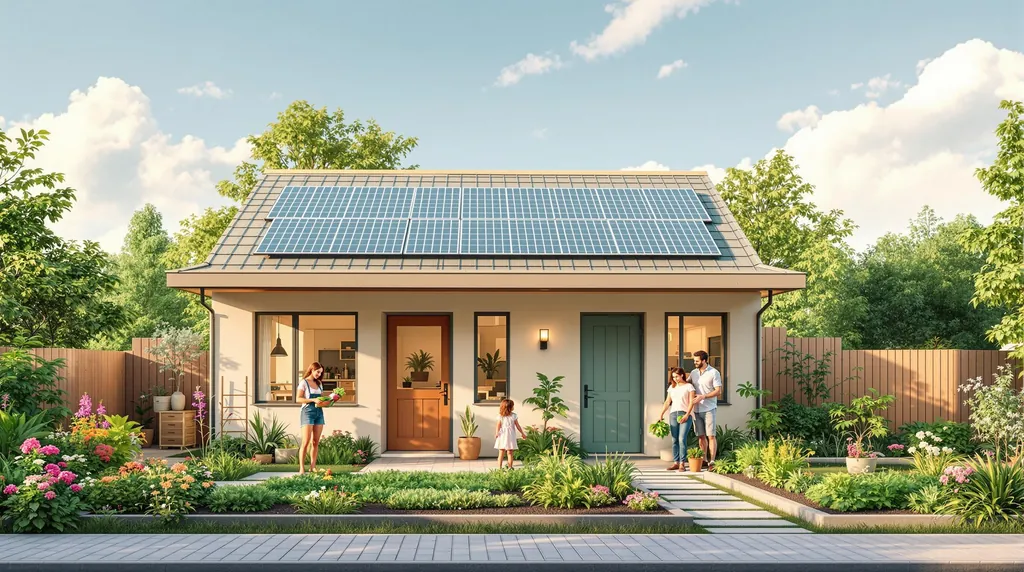
Learn how to build an eco-friendly home on a budget with smart planning, cost-effective materials, and sustainable practices for long-term savings.
FAQ: Building an Eco-Friendly Home on a Budget
Building an eco-friendly home doesn't have to break the bank. With careful planning and smart choices, you can create a sustainable, energy-efficient home while staying within budget. Here's how:
- Costs: Green building adds just $3–5 per square foot upfront but saves money long-term with lower energy bills.
- Materials: Use affordable, eco-friendly options like Ferrock™, reclaimed wood, and recycled flooring. Source locally to save on transportation costs.
- DIY Techniques: Methods like interlocking bricks and soil-cement mortar cut construction costs by up to 92%.
- Energy Systems: Install a basic solar power system for as little as $1,200. Rainwater harvesting can save up to 1,300 gallons annually.
- Natural Cooling/Heating: Passive design strategies like cross-ventilation and strategic landscaping reduce energy use by up to 40%.
- Budget Tips: Focus on essentials like insulation, structure, and energy-efficient systems. Invest in durability over aesthetics.
Building green is an investment in savings, comfort, and sustainability. Start by planning early, setting a realistic budget, and prioritizing features that maximize long-term value.
We built a Passive House on a Budget. TOP TIPS
Low-Cost Green Building Materials
You can build sustainably without breaking the bank by choosing eco-friendly materials and sourcing them locally.
Best Materials for Your Budget
Here's a list of cost-effective, eco-friendly materials that perform well:
| Material | Advantages | Environmental Impact |
|---|---|---|
| Ferrock™ | Stronger than traditional concrete | Absorbs CO₂ and uses recycled materials |
| Wood Foam Insulation | Great thermal performance and control | Made from recycled wood |
| Recycled Flooring | Durable and water-resistant | Made from post-consumer recycled materials |
| Reclaimed Wood | Adds character and charm | Reduces demand for new lumber |
Balancing upfront costs with long-term benefits is key when selecting materials. For example, while traditional cement may be cheaper initially, alternatives like Ferrock™ are more durable and help lower carbon emissions - cement production alone accounts for about 5% of global CO₂ emissions. Similarly, wood foam insulation not only improves temperature control but also enhances energy efficiency, which can significantly lower energy use - insulation impacts nearly 50% of a home's energy consumption.
Finding Local Material Suppliers
Once you've chosen your materials, sourcing them locally can help save both money and resources.
- Local Resource Centers:
- Building reuse centers
- Habitat for Humanity ReStores
- Contractor surplus outlets
- Demolition sites
In early 2024, a homeowner named Alyssa saved big by sourcing locally. She purchased fiberglass batt insulation for $50 (originally over $500) and 2,000 bricks for just $75, compared to their typical value of $4,700.
- Online Platforms:
- Facebook Marketplace
- Craigslist (free section)
- Nextdoor
- Freecycle
Transportation costs can quickly add up, so try to source materials within a 50-mile radius to cut expenses and reduce environmental impact. To ensure the materials meet sustainability standards, check their LEED rating through the U.S. Green Building Council.
Combining smart sourcing with eco-friendly materials can help you stick to your budget while building green.
Money-Saving DIY Methods
Building an eco-friendly home can help you save money while maintaining high standards.
Simple Building Techniques
Using interlocking compressed stabilized earth bricks (ICSEB) can cut wall construction costs by 50% compared to traditional methods. This approach uses less mortar and requires fewer skilled workers.
| Technique | Cost Savings | Key Benefits |
|---|---|---|
| DIY-produced ICSEB | 61% savings | Low labor costs; uses local materials |
| Soil-cement mortar | 92.4% savings | Easy to mix; eco-friendly |
| Hybrid roofs | 23.6% savings | Requires fewer materials |
| Date palm midrib elements | 66% savings | A sustainable alternative to wood |
To ensure durability, cure the bricks for 28 days, add steel stirrups every 20 inches, apply a water-based acrylic finish, and use a 15% cement mix for the first three courses. These techniques not only save money but also reduce environmental impact.
Another tip: Install conduits while building walls. The hollow design of ICSEB makes this process easier, cutting down on labor and avoiding costly modifications later.
The Ecofordable House project is a great example. By using these methods, the project reduced cement usage by 27%, steel requirements by 68%, and fired bricks by 80%. This shows how DIY techniques can deliver both quality and cost efficiency.
Where to Learn Building Skills
If you're looking to learn, Domegaia is offering workshops in 2025:
- April 2025: Dome-building workshop in Jamul, California
- June 2025: Aircrete Masterclass in Mt. Shasta, California
- September 2025: Dome-building workshop in Costa Rica
> "We are on a mission to empower extraordinary people with ordinary means to build & live their dreams." – Domegaia
DIY Green also offers webinars, step-by-step guides, and tool recommendations to help you master sustainable building techniques.
Cost-Effective Off-Grid Systems
Off-grid systems help lower utility expenses, reduce reliance on public utilities, and increase energy independence for homeowners.
Affordable Energy Solutions
Building your own solar power system can be a budget-friendly way to power your home. Greg Seaman from Eartheasy shared his experience of setting up a complete off-grid system for just $1,200. His system powers essentials like a DC refrigerator, LED lights, and small tools.
Here's a breakdown of costs for a basic solar setup:
| Component | Cost Range | Notes |
|---|---|---|
| Solar Panels | $100-250 each | Options include 123W panels ($100) or 250W panels ($250) |
| Charge Controller | $200-250 | Morningstar ProStar30 is a solid choice |
| Batteries | $400 | Two 6-volt golf cart batteries |
| Inverter (300W) | $30 | Basic model for essential power needs |
This setup can be expanded as needed. A general guideline: solar panels typically cost around $1 per watt.
Now, let's explore water-saving systems that complement your off-grid energy efforts.
Practical Water-Saving Systems
Rainwater harvesting is a simple way to reduce water bills and gain independence from city water supplies. A basic system can save about 1,300 gallons of water annually.
| System Type | Cost Range | Best For |
|---|---|---|
| Rain Barrels | $200-2,500 | Small-scale collection, DIY-friendly |
| Above-ground Cisterns | $2,000-12,000 | Larger storage capacity |
| Underground Tanks | $6,500-24,000 | Maximum storage, requires professional installation |
> "Collecting and filtering rainwater is a sustainable practice that can significantly reduce your dependence on external water sources." - Deb Kingsbury, Freelance Writer and Editor
For better efficiency, consider adding a first flush diverter using PVC pipes and fittings.
Finally, let's discuss natural methods to manage heating and cooling costs.
Natural Heating and Cooling
Passive design techniques can cut energy costs by up to 40%, as heating and cooling typically make up 45% of energy use.
Here are some effective strategies:
| Strategy | Implementation | Benefit |
|---|---|---|
| Cross Ventilation | Place windows on opposite walls | Promotes natural airflow |
| Chimney Effect | Use high and low windows | Helps expel hot air naturally |
| Strategic Landscaping | Plant shade trees and shrubs | Guides cool air toward windows |
| Ceiling Fans | Install in main living areas | Makes rooms feel cooler by 4°F |
> "Houses before air conditioning had many tricks up their sleeve. In addition to natural ventilation, the most effective cooling strategies, in order of increasing cost, are: the minimization of indoor heat generation, weatherization, insulation, window shading and glazing, roof whitening and attic ventilation, and trees and landscaping." - Carol Venolia and Kelly Lerner
Keep in mind that setting your thermostat below 78°F increases cooling costs by 8% for each degree. Prioritize natural cooling methods before relying on mechanical systems.
Cost Control for Green Building
Making a Project Budget
Start your budget planning early and involve professionals from the beginning. Patrick Ranger, General Manager at Belvedair, suggests:
> "The first piece of advice I would offer would be to do the exact opposite - choose a general contractor before beginning the design, and involve them in the process. This will help you evaluate costs from the first conceptual drawings, and during all the stages of the design."
Here's a breakdown of key budget categories to consider:
| Budget Category | Key Components | Tips |
|---|---|---|
| Site Preparation | Excavation, foundations, utilities | Get multiple quotes for earthwork |
| Core Structure | Framing, insulation, roofing | Focus on durability over looks |
| Systems | Plumbing, electrical, HVAC | Group wet areas to save on piping |
| Permits & Fees | Building permits, inspections, taxes | Research local requirements early |
These steps help you focus on essential features while planning an efficient and cost-effective design.
Must-Have vs Nice-to-Have Features
Once your budget is in place, it's crucial to separate essential features from optional ones. Patrick Ranger emphasizes:
> "Be sure to place the greatest priority on the components that are difficult to change in the future, like the structure and building envelope. If you end up needing to make material compromises in order to stay on budget, it's better that those be aesthetic; don't risk affecting the performance or durability."
Here are some key features to prioritize:
| Feature | Impact | Cost-Saving Strategy |
|---|---|---|
| Building Envelope | Improves energy efficiency | Invest in high-quality insulation |
| Structural Elements | Ensures long-term durability | Use advanced framing techniques |
| Basic Systems | Maintains core functionality | Group plumbing fixtures |
| Windows & Doors | Enhances energy performance | Choose quality over quantity |
By focusing on these areas, you can protect your investment and avoid costly changes later.
Smart Space Planning
A compact, well-thought-out design saves both materials and energy. Consider these strategies for optimizing space:
| Strategy | Benefit | Implementation |
|---|---|---|
| Simple Building Form | Reduces material waste | Opt for rectangular shapes |
| Standardized Dimensions | Cuts down on custom work | Use standard material sizes |
| Multi-Purpose Spaces | Maximizes usable area | Design rooms with flexible layouts |
| Efficient Room Layout | Lowers utility costs | Group kitchens and bathrooms |
> "By properly planning your new green home before you begin and focusing on the essentials, you will be less tempted to get sidetracked by what tends to break the bank." – The Greenest Living
To further reduce costs, consider sourcing materials locally and exploring recycling options. These small steps can lead to big savings.
Conclusion
Key Takeaways
Building an eco-friendly home on a budget requires careful planning, focusing on the most important features, and managing the project efficiently to maximize long-term benefits. In areas like Whitefish, construction costs range between $400 and $750 per square foot. It's crucial to allocate your resources wisely.
Here's a breakdown of areas that experienced builders emphasize for cost-effective green construction:
| Priority Area | Cost Range | Long-Term Benefits |
|---|---|---|
| High-Efficiency HVAC | $10,000 - $20,000+ | Reduces energy expenses |
| Foundation Work | $20,000 - $40,000 | Ensures structural strength |
| Engineering Design | 5% - 10% of total cost | Improves overall efficiency |
| Architectural Planning | 8% - 15% of total cost | Optimizes space and design |
> "Building a green home could be the most expensive choice most of us ever make. As a result, if you start to wander too far from the budget, a home building plan can soon turn into a nightmare." – The Greenest Living
By focusing on these priorities, you can make informed decisions to kickstart your project.
Steps to Begin
To get started on your eco-friendly home, follow these steps:
- Plan Early: Begin researching and organizing well before construction starts.
- Set a Realistic Budget: Ensure you have the funds to cover essentials like a durable structure.
- Choose the Right Team: Hire an architect with experience in sustainable home design.
- Select Smart Materials: Work with your construction team to find eco-friendly materials that fit your financial plan.
These steps will help you lay the groundwork for a successful and sustainable home-building journey.