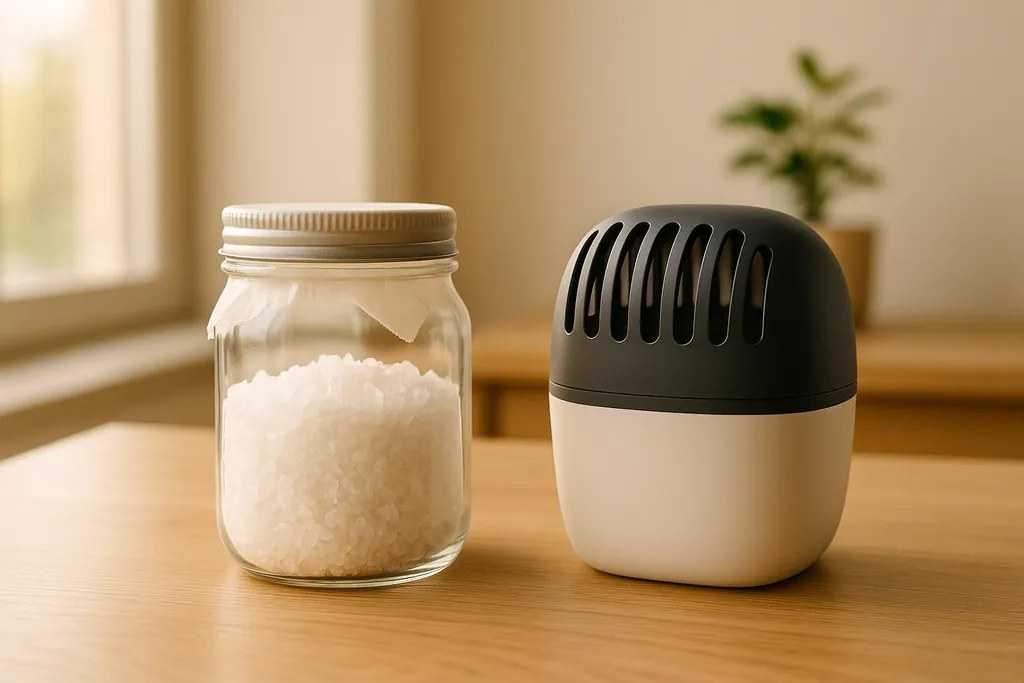
Explore the effectiveness, costs, and environmental impacts of DIY and store-bought moisture absorbers for optimal humidity control at home.
DIY Moisture Absorbers vs. Store-Bought Options
Excess moisture in your home can lead to serious problems like mold, asthma, and costly repairs. Fortunately, moisture absorbers - whether DIY or store-bought - can help manage humidity effectively.
Here’s the key takeaway:
- DIY options (using materials like rock salt, baking soda, or silica gel) are affordable, reusable, and eco-friendly. They’re great for small spaces and mild humidity.
- Store-bought products (like DampRid) are convenient, reliable, and available in disposable or refillable formats. They handle medium spaces but come with recurring costs and more waste.
Quick Tip: Combine both methods for the best results - use DIY for closets and store-bought for bathrooms or basements. Below, we’ll break down costs, effectiveness, and safety to help you decide.
DIY Moisture Eliminator Damp Absorber - CHEAP SAVE $$ Prevent Condensation Mildew Mold
DIY Moisture Absorbers: Methods and Benefits
Homemade moisture absorbers can be surprisingly effective in managing humidity, reducing mold growth, and easing allergy symptoms - all without breaking the bank . While they may not rival the power of commercial dehumidifiers, these DIY options offer affordability, adaptability, and the satisfaction of crafting your own solution.
Common DIY Methods
Using everyday materials, you can create moisture absorbers tailored to your needs. Here are some of the most effective DIY methods:
Rock Salt Bucket System This popular method is both simple and effective. According to Stacy Fisher, an expert writer for _The Spruce_, "Rock salt naturally absorbs moisture out of the air, making it a great choice to use as a dehumidifier" . To set it up, drill holes in the bottom of a 5-gallon bucket, place it inside another bucket, and fill the top bucket with rock salt. As the salt absorbs moisture, water collects in the lower bucket, which can be emptied and refilled as needed .
Calcium Chloride For tackling serious humidity, calcium chloride is a powerful choice. Fisher explains, "Calcium chloride, also commonly known as ice melt, is another type of salt that makes an excellent dehumidifier by condensing moisture" . Simply place calcium chloride in an old sock, tie it closed, and hang it over a bowl to catch the water it collects. Impressively, calcium chloride can absorb over 250% of its weight in water under high-humidity conditions (86°F, 90% relative humidity) over 30 days .
Silica Gel Ideal for smaller spaces, silica gel is easy to use and highly effective. Fisher notes, "Silica gel works great as a dehumidifier, and you can easily make a dehumidifier for yourself by gathering these packets and then placing them together in a jar" . You can recharge silica gel by heating it in your oven at 250°F for a couple of hours . Some silica gel products even include color-changing indicators to signal when they need recharging .
Baking Soda A simple and affordable option, baking soda works well in confined spaces like closets or cabinets. According to _Green Thumb Depot_, "Baking soda is cheap and easy to find. It's great for small areas and helps neutralize odors while absorbing moisture" . Just place a bowl of baking soda in the desired area and replace it when it hardens.
Activated Charcoal This method not only absorbs moisture but also neutralizes odors. _Green Thumb Depot_ highlights that "Charcoal naturally absorbs moisture and odors. It's perfect for creating a homemade dehumidifier for larger areas" . To make one, punch holes in the sides and lid of a clean coffee can, fill it with charcoal, and place it in areas like basements, bathrooms, or closets .
Non-Dairy Coffee Creamer Surprisingly, non-dairy coffee creamer can also absorb moisture. Fill a medium-sized bowl with the creamer and place it in areas like bedrooms or closets. Replace it when it hardens .
For enhanced results, you can improve airflow by drilling ventilation holes in the container, covering it with a mesh screen, and positioning a small fan above it .
Cost and Material Availability
DIY moisture absorbers are both budget-friendly and easy to source. Here’s a quick look at typical costs:
- Reusable silica gel beads: Around $22 for 5 lbs .
- Calcium chloride: Approximately $30 for a 7 lb jug .
- Baking soda and rock salt: Available at most grocery and hardware stores.
- Silica gel and calcium chloride: Widely available online (e.g., Amazon) and at retailers like Walmart and Family Dollar .
Setting up a DIY rock salt dehumidifier costs about $10-15 and can last for months before needing refills. Compare that to commercial units, which often start at $30-50 for basic models, and the savings become clear.
Safety and Environmental Impact of DIY Solutions
DIY moisture absorbers are not only cost-effective but also eco-conscious. Many materials, like silica gel and rock salt, are reusable and have minimal environmental impact . For example, silica gel can be recharged in your oven, and rock salt can be dried and reused multiple times.
However, some materials require careful handling. Shereyll Pineda, a contributing writer for _DoItYourself.com_, cautions:
- "Silica gel should not be ingested, as it is a poisonous substance" .
- "Calcium chloride can cause burns in the mouth, throat, and intestines if ingested. It can also cause serious dehydration and skin dryness. Contact with eyes must be avoided, and hands should be washed thoroughly after handling" .
For households with small children or pets, safer alternatives like baking soda or rock salt are recommended . You can even add aromatic ingredients like dried fruit, coffee beans, lavender, or essential oils for a pleasant scent. _Tea tree oil_, in particular, is noted for its anti-fungal and antibacterial properties .
DIY solutions also don’t require electricity, making them energy-efficient. By integrating moisture management into home design, as suggested by _[DIY Eco Homes](/)_, you can enhance your home’s efficiency while keeping costs and environmental impact low. Up next, we’ll compare these DIY methods with store-bought options to help you decide which is best for your home.
Store-Bought Moisture Absorbers: Features and Costs
Commercial moisture absorbers are a convenient option for tackling humidity issues, offering reliable results but at a higher price point. However, they require regular replacement. These ready-to-use products are widely available across the U.S. and cater to a variety of moisture control needs.
Here’s a closer look at the main product types available in the market.
Types of Store-Bought Products
The U.S. market offers several types of moisture absorbers, each suited to specific conditions and designed with varying levels of effectiveness.
Calcium Chloride-Based Products are among the most popular. These products use calcium chloride crystals to pull moisture from the air. As they absorb water, the crystals harden and gradually dissolve into a liquid brine that collects in a lower chamber. Brands like DampRid dominate this category, offering products in formats such as hanging bags, buckets, and refillable containers .
Silica Gel Absorbers work differently, using adsorption to attract moisture molecules onto the surface of their porous structure. These products are most effective in temperatures between 70°F and 90°F, especially in environments with high humidity levels of 60%–90% relative humidity . Many silica gel absorbers feature color-changing indicators (shifting from blue to pink) to signal when they’re saturated, and they can often be recharged for extended use .
Activated Charcoal Products not only combat moisture but also help eliminate odors. These are often combined with other desiccants, with brands like Arm & Hammer incorporating this technology into their product lines .
Top brands like DampRid and Arm & Hammer offer a range of formats tailored to different spaces and needs. These include hanging bags for closets, portable boxes for small areas, large buckets for basements, refill packs for ongoing use, and rechargeable packets ideal for vehicles like cars and RVs .
Cost and Product Lifespan
Store-bought moisture absorbers come in a range of prices, influenced by factors like size, technology, and brand. Recent tariffs have also contributed to price increases . While these products provide consistent performance, they do come with recurring expenses.
- Entry-Level Options: These products typically cost between $4 and $6. For instance, a DampRid 11-oz Fresh Bucket Moisture Absorber is priced at $3.98 at Lowe’s, while a DampRid Disposable Moisture Absorber (10.5 oz) costs $5.25 at Dollar General .
- Mid-Range Products: Prices in this category range from $12 to $25. Examples include a DampRid 46.2-oz Fresh Hanging Moisture Absorber for $12.48 at Lowe’s and a 3-pack of DampRid 15.4-oz Hanging Moisture Absorbers for $13.39 on Amazon. The DampRid 15.8-oz Unscented Bucket Moisture Absorber is available for $12.97 at Lowe’s .
- Premium and Rechargeable Options: These products are priced higher. For example, the wisedry 2 x 500 Gram Rechargeable Silica Gel Car Dehumidifier costs $22.99 on Amazon, while DampRid’s Hi-Capacity Moisture Absorber Bucket (2 lb. 15.5 oz.) starts at $25.68 .
Most products, such as packets and canisters, last between 1 to 3 months (around 60 days), depending on factors like humidity levels and the size of the space . Reviews highlight their effectiveness in various settings. For instance, customers note that Dollar General’s DampRid product works well over several months in small bathrooms, on pellet stoves during the off-season, and in vehicles . Performance ratings are also strong: DampRid’s Fresh Scent Hanging Moisture Absorber averages 4.7 out of 5 stars from over 23,000 reviews on Amazon, while the wisedry Rechargeable Silica Gel Dehumidifier averages 4.6 out of 5 stars from nearly 18,000 reviews .
Impact on the Environment
When considering store-bought moisture absorbers, it’s important to factor in their environmental impact. Many single-use products, particularly calcium chloride-based absorbers, generate ongoing waste due to their plastic packaging, which often ends up in landfills after 60–90 days of use. Additionally, the liquid brine produced by these products requires proper disposal.
Rechargeable options, like silica gel products, are a more eco-friendly alternative. These can be reactivated by heating them in a home oven at 250°F for several hours, extending their usability . Silica gel is also FDA-approved for direct contact with food and pharmaceuticals in the U.S., though it’s worth noting that silica gel containing cobalt chloride should not be used near consumable items .
Different materials come with varying levels of care. While silica gel is relatively safe and inert, calcium chloride requires careful handling and disposal. Both should be kept out of reach of children and pets, as ingestion can pose health risks .
Finally, the overall environmental footprint of commercial moisture absorbers is higher than that of DIY solutions. This is due to factors like packaging, manufacturing, transportation, retail distribution, and frequent replacement cycles.
DIY vs Store-Bought: Side-by-Side Comparison
Now that we've covered the methods and costs, let's dive into a detailed comparison of DIY and store-bought moisture absorbers. Each option has its pros and cons when it comes to cost, effectiveness, and environmental considerations.
Comparison Table: Key Factors
| Factor | DIY Moisture Absorbers | Store-Bought (Refillable/Bulk) | Store-Bought (Disposable) |
|---|---|---|---|
| Cost per month (USD) | Lower, as materials are inexpensive and often readily available | Around $2.65–$8.50 per month (bulk options like Dry & Dry refill beads are cost-efficient) | Higher over time due to frequent replacements |
| Effectiveness | Best for small, enclosed spaces | Works well for small to medium spaces | Suitable for small, enclosed spaces |
| Lifespan | Varies; reusable desiccants like silica gel can be recharged | Lasts 45 days to 6 months, depending on humidity | Typically lasts 45 days to 6 months |
| Reusability | High (materials like silica gel can be reused) | High (refillable containers can be reused with bulk materials) | Low (single-use only) |
| Environmental Impact | Lower due to reusable materials and minimal packaging | Moderate, as refillable designs reduce packaging waste | Higher, with regular disposal of plastic containers |
For example, bulk refillable options like Dry & Dry beads offer an economical choice. A 15-pound container of Dry & Dry refill beads costs $36.99 and provides months of moisture control when refilling existing containers. On the other hand, disposable options, while convenient, can become pricey over time. A 3-pack of DampRid hanging absorbers costs about $15.90 and typically needs replacement every 60 to 90 days.
The table above highlights the key differences, but how do you decide which option is right for you? Here's a quick guide to help.
When to Choose DIY vs Store-Bought
Go for DIY solutions if:
- You’re dealing with small, enclosed spaces.
- Humidity levels are mild or moderate.
- You want to keep costs low.
- Eco-friendliness is important to you.
- You prefer a customized approach.
Opt for store-bought refillable systems if:
- You need consistent and reliable performance.
- You’re managing medium-sized spaces like bathrooms or small basements.
- Convenience matters, but you also want to save on long-term costs.
- You’re looking for a solution that balances effectiveness with reusability.
Pick disposable store-bought options if:
- Convenience and ease of use are your top priorities.
- You’re addressing temporary moisture issues.
- You want a ready-to-use product with no maintenance required.
As CHOICE household products expert Chris Barnes notes:
> "If you have low-level dampness in small or confined areas of your house, or just want to keep your closets dry, DampRid and equivalent products are not a bad solution. They are cheaper and they work, just at a slower pace" .
For more severe humidity issues or larger spaces, you might need to look beyond moisture absorbers. Mechanical dehumidifiers, for instance, can extract anywhere from 10 ml to 659 ml of water per hour, far surpassing the capacity of desiccant absorbers .
To get the best results, many homeowners combine solutions - using DIY methods for tight spaces, refillable systems for larger areas, and disposable options for short-term needs. This mix-and-match approach can help you maintain optimal moisture levels throughout your home.
Final Recommendations
Choosing between DIY and store-bought moisture absorbers ultimately depends on what you need and prioritize. Both options play a role in managing moisture effectively at home.
Key Takeaways
DIY moisture absorbers are ideal for eco-conscious homeowners dealing with minor humidity issues. Natural desiccants, like baking soda or activated charcoal, can absorb 20–30% of their weight in moisture and are biodegradable . As Faisal Zaman from Green Thumb Depot explained in June 2023:
> "Creating a DIY dehumidifier offers many benefits, making it a popular choice for homeowners... Cost-Effective, Customization, Energy Efficiency, Eco-Friendly, Accessibility, Versatility" .
Store-bought refillable systems strike a balance for those who value convenience. These systems allow for bulk refills, which cut down on packaging waste compared to single-use options.
Environmental impact varies widely between these choices. For example, producing 100 million 5-gram silica gel sachets requires 47 metric tons of plastic, 950 metric tons of chemicals, and 10 million liters of fresh water . In contrast, natural desiccants decompose naturally without harming ecosystems.
Chemical desiccants absorb more moisture - 100–200% of their weight - but come with higher environmental costs compared to natural options . As Streampeak Group noted in November 2024:
> "Natural desiccants have environmental benefits and lower toxicity, making them safer in many applications. On the other hand, chemical desiccants tend to offer higher moisture absorption and can be more cost-effective in specific contexts" .
These insights can help guide your overall strategy for managing moisture in your home.
Tips for Homeowners
Here’s a quick summary of how to optimize moisture control based on cost, effectiveness, and environmental considerations:
- Start small with DIY solutions. Use materials like baking soda, activated charcoal, or rock salt in smaller spaces like closets, bathrooms, or storage areas. These are affordable and easy to find.
- Keep an eye on humidity levels. Aim to maintain indoor humidity between 30–50%. Replace or recharge absorbers regularly to prevent them from becoming oversaturated and releasing moisture back into the air.
- Extend the life of your desiccants. Reactivate materials like silica gel by drying them in a low oven (200°F) or air-drying charcoal. This reduces waste and saves money.
- Mix and match methods. Use DIY absorbers for small spaces, refillable systems for medium-sized areas like basements, and disposable options for short-term needs.
- Tackle large-scale humidity issues with the right tools. If you’re dealing with persistent or widespread moisture problems, consider investing in an electric dehumidifier. While the upfront cost is higher, it’s a good solution for areas like basements or laundry rooms.
For more ideas on sustainable moisture control and energy-efficient home improvements, check out DIY Eco Homes. They offer detailed guides on building practices, eco-friendly materials, and cost-effective ways to create a healthier, greener living space.
FAQs
What’s the best way to decide between DIY and store-bought moisture absorbers for your home?
When deciding between DIY and store-bought moisture absorbers, it’s important to consider the size of the area and the humidity levels you're dealing with.
DIY solutions like baking soda, silica gel, or even black tea are budget-friendly and effective for small spaces with lower humidity, such as closets, cabinets, or bathrooms. These options are perfect for quick fixes without breaking the bank.
For larger areas or spaces with high humidity - think basements or garages - store-bought products like moisture absorber bags or DampRid are better suited. While these options come with a higher upfront cost, they offer consistent, long-term moisture control, making them a reliable choice for ongoing issues. In short, DIY works well for smaller, less humid areas, while commercial products are the go-to for bigger spaces or persistent moisture problems.
What safety precautions should I take when using DIY moisture absorbers like calcium chloride or silica gel?
When working with DIY moisture absorbers like calcium chloride or silica gel, it's essential to handle them carefully to avoid potential risks.
Calcium chloride can cause irritation to your skin and eyes, and breathing in its dust over time might lead to respiratory problems. Plus, it’s corrosive to metals and can be dangerous if ingested, especially for children and pets. Always store it securely to prevent accidents.
Silica gel, though milder, isn’t completely risk-free. If inhaled or ingested, it can still cause irritation. Some silica gel products might even contain cobalt chloride, which is toxic, so always check the label before use. To protect yourself, wear gloves, avoid direct contact, and keep these materials sealed and stored safely away from kids and pets.
How do the environmental impacts of DIY moisture absorbers compare to store-bought ones?
Store-bought moisture absorbers, often made with calcium chloride, come with some drawbacks. If not disposed of correctly, they can add to chemical waste and pose risks when mishandled. On top of that, their manufacturing and packaging processes tend to leave a larger carbon footprint.
On the other hand, DIY moisture absorbers - like those using rock salt - are a greener alternative. They rely on natural, non-toxic, and biodegradable materials, which help minimize waste and pollution. Plus, creating them at home often involves repurposing everyday items, making this option both environmentally friendly and resourceful.