Practical guide to choosing, sizing, and installing heat pumps that run efficiently below zero — options, performance, and off-grid integration for DIYers.
Cold Climate Heat Pumps: Options for Below Zero
Cold climate heat pumps are designed to keep homes warm even when outdoor temperatures drop below zero. For budget-conscious DIY builders, choosing the right system means balancing low-ambient performance, installation complexity, and electrical demands—especially when you plan to use solar or batteries. This guide explains how cold climate heat pumps work, which system types perform at subzero temperatures, how to size for a tight building, installation and siting tips, off-grid integration, and the economics you’ll need to compare.
TL;DR:
- Cold climate heat pumps can run comfortably below zero when sized to a proper heat loss and chosen for low-ambient performance.
- Prioritize inverter-driven compressors, enhanced coils, and verified low-temperature ratings; pair with a staged backup and adequate electrical supply.
- For off-grid or PV pairing, size batteries for average continuous draw and a generator or thermal storage for multi-day cold snaps.
Cold Climate Heat Pumps: How They Keep Homes Warm Below Zero
Heat pumps move heat from outdoors into a home using refrigerant and a compressor; they do not "create" heat the way a resistive element or combustion system does. The efficiency of that transfer is expressed as the coefficient of performance (COP)—the ratio of heat delivered to electrical energy consumed. COP falls as the outdoor-to-indoor temperature difference grows because the compressor works harder to lift heat across a larger temperature gap. Manufacturers may also publish HSPF (Heating Seasonal Performance Factor) and SEER (Seasonal Energy Efficiency Ratio) for seasonal and cooling efficiency.
Key hardware that affects low-ambient performance includes inverter-driven variable-speed compressors, which modulate capacity rather than cycling on and off; low-temperature refrigerant charge and circuits tuned for cold operation; larger or lanced outdoor coils that improve heat pickup; defrost control strategies that minimize energy and comfort penalty during frost events; crankcase heaters and oil separators that protect compressor lubrication; and enhanced controls for oil migration and low-pressure protection. Common refrigerants include R-410A and, increasingly, R-32 and low-GWP blends; always check manufacturer spec sheets and Department of Energy test reports for verified performance in cold conditions.
Research and installation guides show that pairing a high-performing machine with a well-insulated, airtight home is the real key. For background on proven results and recommendations for backup sizing, see the University of Illinois EnergySense summary on cold-climate heat pumps: Cold climate heat pumps work.
Basic Physics: Heat Transfer and Coefficient of Performance (COP)
- Heat flow: Heat moves from warmer to cooler areas; a heat pump captures ambient heat and moves it inside.
- COP: If a heat pump has a COP of 3, it delivers 3 kWh of heat for every 1 kWh of electricity used.
- Temperature effect: Expect falling COP as outdoor temperature drops. Manufacturer low-ambient performance charts are the best source for model-specific curves.
Key Components That Determine Low-ambient Performance
- Variable-speed compressor: Reduces cycling losses and improves efficiency at part load.
- Enhanced outdoor coil: Bigger surface area and different fin patterns raise heat pickup in cold air.
- Advanced defrost: Electric or hot-gas defrost with smart controls reduces run-time loss and indoor temperature swings.
- Crankcase heater/oil management: Keeps oil in the compressor until warm to prevent damage on cold startups.
Cold Climate Heat Pumps: Types That Work in Subzero Temperatures
There are several system types that handle subzero conditions. Which makes sense for a DIY or self-build project depends on your site, skills, and budget.
Cold-climate Air-source Heat Pumps (ccashp) and Ductless Mini-splits
Cold-climate air-source units and ductless mini-splits are increasingly engineered to operate at -15°F to -20°F and sometimes lower. These systems are attractive for DIY retrofits and small builds because of limited ductwork and relatively simple indoor unit mounting. Brands offer cold-climate lines with variable-speed compressors and improved coils. For a deeper buying overview on air-source options and model categories, see our air source heat pump guide.
Pros: lower upfront cost than geothermal, simpler for phased installs, works well with zoned control. Cons: performance drops as temps fall, requires defrost cycles, outdoor unit must be properly sited to avoid wind/ice issues.
Ground-source (geothermal) Heat Pumps
Ground-source heat pumps tap relatively stable ground temperatures and maintain high efficiency even in severe winters. They demand more site work—horizontal trenches or vertical boreholes—and higher initial cost and permitting. For long-term operating savings and steady COP in subzero weather, geothermal can be ideal on properties where drilling or trenching is feasible.
Pros: steady efficiency at subzero temps, reliable year-round. Cons: high upfront cost, more complex civil work, less DIY-friendly for novices.
Air-to-water and Hydronic Cold-climate Options
Air-to-water systems heat a hydronic loop (radiators, in-floor heating, buffer tanks). They integrate well with thermal storage, giving better comfort and smoother defrost cycles. These systems can pair with solar thermal or PV/electric systems and can use thermal mass to ride through short cold events.
Pros: comfortable heat delivery, useful with buffer tanks and thermal storage. Cons: requires plumbing skills and components; installer knowledge of hydronic controls is important.
Hybrid Systems and Backup Heat Strategies
Hybrid systems combine a heat pump with an electric resistance element, biomass stove, or condensing gas furnace. For DIYers, staged backups that kick in during extreme cold or when power is limited are common: configure controls so the heat pump runs first and backup supports peak demand or safety. See government and university guidance that recommends planning a backup that can cover heat load if the heat pump fails: Heat pumps cold climates do they work.
Cold Climate Heat Pumps: Sizing and Capacity for Below-zero Homes
Sizing a heat pump starts with a real heat-loss calculation, not rules of thumb. A properly executed Manual J-style calculation determines the peak design load at your location’s design temperature and maps that load to required heat pump capacity at low ambient temps.
Why Accurate Heat Loss Matters (and How to Estimate It)
A heat-loss estimate accounts for insulation levels, continuous insulation, air tightness, glazing area, infiltration, and solar gains. Over-sized heat pumps cycle inefficiently; under-sized units struggle during cold snaps and shorten equipment life. Use a heat-loss tool early in planning—our heat loss calculator is a good starting point for DIYers to estimate design loads before committing to equipment.
Using Heat Pump Sizing Tools and Manual J Adjustments
After a baseline heat loss, compare the required heat output at design temperature to the manufacturer’s published capacity at that outdoor temperature. Many ccASHP spec sheets provide capacity curves at 47°F, 17°F, 5°F, and -13°F (or similar). When a heat pump’s rated capacity falls below your design load at the local design temperature, consider a larger outdoor unit, parallel compressors, or a hybrid backup. Training modules on cold-climate sizing are helpful: see the U.S. Department of Energy training on cold-climate heat pump sizing for method details: Hvac cold climate heat pump sizing.
Example Sizing Workflow for a Small Cabin (illustrative Calculation)
This is an example only—do not use it as a final design. Suppose a well-insulated 600 ft² cabin has an estimated heat loss of 6,000 Btu/h at a -10°F design temp. Convert to kW: roughly 1.76 kW. If a candidate heat pump provides 2.2 kW at -10°F per the spec sheet, it would meet the peak load. Factor in a 10–20% reserve for extreme events or envelope uncertainty. If the spec sheet shows only 1.4 kW at -10°F, you’d choose a larger unit or plan a staged backup.
For a practical tool, run your Manual J result through our heat pump sizing calculator to map required heat load to models.
Cold Climate Heat Pumps: Performance, COP, and Model Comparisons (specs Table)
How a model performs at -10°F, -5°F, and 0°F varies by design. Ratings change because capacity falls and defrost cycles introduce penalties. Look for manufacturer curves showing COP or capacity at multiple fixed temperatures; verify with DOE, NEEP, or lab test reports where possible.
How Ratings Change at -10°F, -5°F, and 0°F — What to Watch For
- At 0°F, many modern ccASHPs remain significantly more efficient than resistive electric heat.
- At -10°F, COPs often decline; some systems still deliver COPs in the 1.5–2.5 range depending on design and defrost behavior. (Range given as illustrative; consult manufacturer data.)
- Defrost cycles temporarily reduce delivered heat; frequency depends on wind, humidity, and unit placement. Models with smart hot-gas defrost tend to restore operation faster than basic electric defrost, reducing comfort impact.
Comparison/specs Table: System Types and Typical Performance Notes
| System type | Typical operating temp range | COP trend at -10°F (qualitative) | Defrost frequency/impact | Pros | Cons | Typical installation complexity |
|---|---|---|---|---|---|---|
| Cold-climate ASHP / ductless mini-split | -20°F to 50°F | Often 1.5–2.5 (varies) | Moderate; refrigerant hot-gas or electric styles | Lower upfront cost, good for zoning | Defrost pauses, outdoor exposure | Low–medium |
| Ground-source (geothermal) | -10°F to 70°F (stable) | Often 3+ (stable) | Low; ground stable | Consistent COP, minimal defrost | High civil work and cost | High |
| Air-to-water / hydronic ASHP | -15°F to 45°F | 1.8–3.0 (depends on water delta) | Moderate; buffer tanks help | Smooth heat delivery, thermal storage | Needs plumbing/hydronics skills | Medium–high |
| Hybrid (ASHP + resistance or boiler) | -20°F to 50°F | Variable; pump efficiency declines, backup adds heat | Dependent on primary unit | Flexible, lower risk of cold failure | More complex controls | Medium |
When comparing models, read spec sheets for capacity at given outdoor temps, COP or PLR (part-load ratio), and low-ambient testing standards. Look for HSPF and any mention of low-temperature certification. Third-party lab reports or DOE datasets provide additional credibility. For how building envelope upgrades improve heat pump performance and reduce required capacity, see our article on continuous insulation.
Cold Climate Heat Pumps: Installation and Siting Tips for Cold Conditions
Correct siting and installation make a big difference to performance and longevity in snowy, windy environments. A poor mount can mean repeated ice build-up, frequent defrost cycles, and premature service calls.
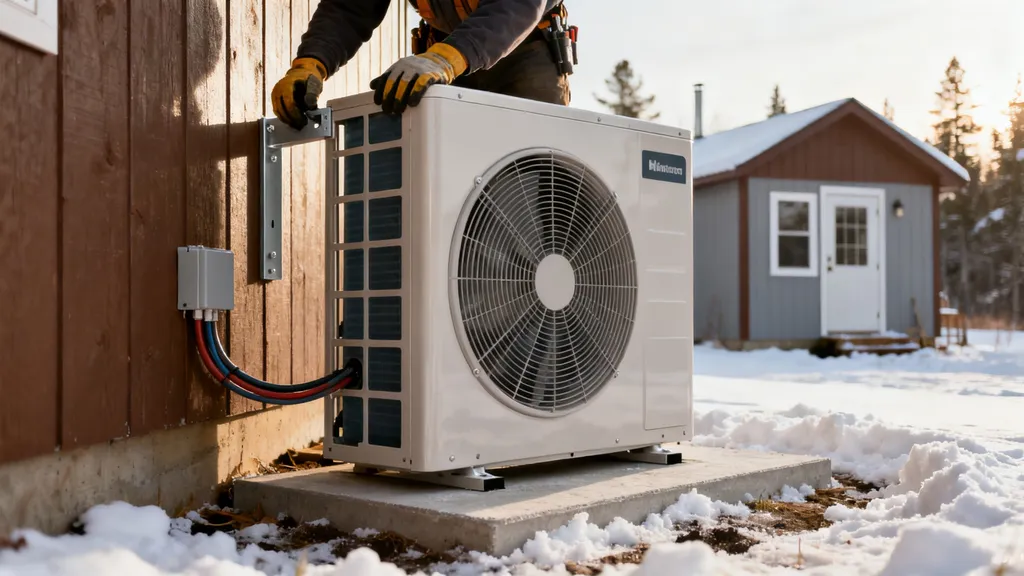
- Mount above snow-line: Place the outdoor unit on a raised pad or wall bracket high enough to stay clear of drifting snow and plow spray.
- Provide wind shelter: A simple louvered screen or partial windbreak can reduce frosting and defrost frequency without blocking airflow.
- Allow drainage: Design defrost drainage paths so melted ice leaves the immediate area and cannot refreeze at the base of the unit or near line-set entries.
- Isolate vibration: Rubber mounts and anti-vibration feet lower structure-borne noise in cold, brittle environments.
- Route line-sets carefully: Keep refrigerant lines inside insulated chase or use pre-insulated line-sets; avoid long exposed runs that need trace heating.
- Defrost management: Position outdoor unit where runoff won’t refreeze against the building; provide an accessible drain or pan for condensate and defrost melt.
- Cold-weather accessories: Low-ambient kits, crankcase heaters, and suction line heat are sometimes recommended for extreme climates—only install per manufacturer instructions.
For a visual demonstration, check out this video on 2025 cold climate heat pump in minnesota:
For window upgrades and airtightness measures that reduce heating load and improve comfort with any heat pump, read our article on window energy efficiency.
Quick post-winter checklist after first cold season: check mounting fasteners, inspect for oil spots or refrigerant leaks, verify defrost drain paths, and confirm crankcase heater operation if installed.
Cold Climate Heat Pumps: Integrating with Off-grid, Solar, and Backup Systems
Off-grid heating with a heat pump is possible but requires careful electrical planning. Heat pumps have both steady-state draw and potential startup or surge events; variable-speed units generally have lower startup surge but still need inrush considerations for inverter selection.
Matching Heat Pump Electric Load with PV and Battery Sizing
Estimate the heat pump’s average power draw during heating operation from manufacturer input power at target outdoor temps and expected runtime (based on heat-loss and COP). For PV + battery systems, size batteries to handle nights and cloudy days and include a strategy for periods of extended cold with low solar yield. For guidance on how a heat pump’s load fits a typical off-grid PV system, see our solar system sizing and tiny house solar sizing guides.
Backup Strategies for Multi-day Cold Snaps
- Generator integration: Sized to carry peak compressor inrush and full heating load or staged backup. Verify inverter charger and generator inrush specs before depending on them.
- Thermal storage: Buffer tanks with hydronic systems can store heat and allow the heat pump to run intermittently, which is friendlier to small generators.
- Staged heating: Configure controls so the heat pump runs first and backup resistive or combustion heating supplements only when needed.
Off-grid Case Examples and Control Strategies (hybrid Prioritization)
A small cabin with a ccASHP might use PV to cover daytime heat-pump use and a generator for overnight or multi-day events. Control logic should prioritize heat pump use when PV is available, and automatically shift to backup when battery state-of-charge is low or outside temperature forces high heat demand. The EPA and Energy Star materials and NEEP guidance discuss demand management and use-case trade-offs for off-grid and grid-tied heat pumps: Essential resources. Also see our roundup on off-grid heating options for practical trade-offs.
Cold Climate Heat Pumps: Cost Considerations, Incentives, and Operating Economics
Budget planning must consider both upfront and lifetime costs. Upfront categories include equipment, electrical upgrades (panel, wiring), site prep (pads, wind screens), and installation labor. Ongoing costs include electricity, scheduled maintenance, and possible repair parts.
Upfront vs Long-term Operating Costs (what to Include in Comparisons)
- Equipment cost: Outdoor unit(s), indoor units, controls, and accessories.
- Site prep: Concrete or bracket mounts, trenching for line-sets, and any roof or structural work.
- Electrical work: Service upgrade, subpanels, or dedicated circuits.
- Installation labor: Refrigerant handling requires certified installers for warranty compliance.
- Operating costs: Annualized electricity consumption, which depends on COP at real-world temps and seasonal runtime.
Where to Look for Incentives, Rebates, and Financing
Incentives vary widely. Check federal programs, state or provincial rebates, and local utility incentives. Manufacturer and dealer rebates can also be available. For credible guidance on incentive programs and installer tools, consult official program pages and your local utility’s rebate listings.
Simple Payback Example (illustrative) and Sensitivity to Electricity Prices
A payback framework inputs: installed cost, installed COP at your design condition, annual heating load (kWh), and local electricity rate. For illustration only: if a heat pump reduces annual delivered heat kWh compared to resistance heating by a factor equal to its seasonal COP, multiply that by your rate to get annual savings; divide installed incremental cost by annual savings to estimate payback. The result is highly sensitive to electricity price, COP assumptions, and local heating demand.
Key Points Checklist: Choosing a Cold Climate Heat Pump for DIY and Self-build Projects
- Verify design temperature: Use local climate data for your design day so capacity matches real conditions.
- Complete a heat-loss: Run a Manual J or use our heat loss calculator before picking equipment.
- Choose system type: Match site, budget, and DIY skill—ccASHP, geothermal, or hydronic each have trade-offs.
- Confirm low-ambient performance: Read manufacturer capacity and COP curves at subzero temps.
- Plan for defrost and drainage: Ensure melt water drains away from the foundation and line-set entries.
- Size electrical supply: Check inrush and continuous draw for battery/inverter/generator compatibility.
- Design a backup strategy: Specify staged backup that covers extended cold snaps or equipment failure.
- Account for service access: Mount and space units so filters and coils are reachable in winter.
- Insulate and tighten the envelope: Use continuous insulation and improved windows to reduce peak demand.
- Document warranties and manuals: Keep manufacturer manuals accessible and follow recommended maintenance.
- Budget for commissioning: Have a qualified tech verify refrigerant charge and controls at startup.
- Save the checklist: Use this as a planning worksheet during procurement and installation.
The Bottom Line: Which Cold Climate Heat Pump is Right for Your Below-zero Project
For most budget-minded DIYers, a well-chosen cold-climate air-source heat pump provides the best balance of cost, ease of installation, and low-ambient performance—provided you size it from a solid heat-loss and plan electrical/backup capacity. Geothermal is attractive where site and budget allow, and hydronic systems paired with buffer tanks offer smoother comfort and better thermal storage. Next steps: run a heat-loss, compare manufacturers’ low-temperature data, and plan your electrical and backup strategy before ordering equipment.
Frequently Asked Questions
Can a heat pump heat a house at -20°F?
Some cold-climate heat pumps are rated to operate at or below -20°F, but real-world performance depends on the model, installation, and building envelope. Manufacturers publish capacity and COP curves at specific outdoor temperatures—use those to confirm whether a model can meet your design heat load at -20°F. University and government guidance also recommend planning a backup heat source to cover rare failures or extreme events (see EnergySense: Cold Climate Heat Pumps Work!).
Do I still need backup heat with a cold-climate heat pump?
Plan for backup. Many installers design staged backups (resistive electric, a boiler, or a generator) so the heat pump runs as primary and backup supports peak loads or when power is limited. Backup sizing should be informed by your peak heat-loss calculation and worst-case multi-day cold snaps.
Are ductless mini-splits better for cold climates?
Ductless mini-splits can perform well in cold climates when using cold-climate models with inverter compressors and appropriate low-ambient tuning. They’re especially good for zoned heating and retrofit projects because they avoid duct losses. Check model curves for capacity at your design temperature and plan for defrost impacts in very cold, humid, or windy sites.
How often [do heat pumps](https://cleanheat.ny.gov/heat-pumps-cold-climates-do-they-work/) need maintenance in snowy regions?
Annual preventative maintenance is typical: clean coils, check refrigerant charge, test controls, and verify defrost and drainage. In snowy regions, also inspect mounting, clear snow and ice from around the outdoor unit, and confirm crankcase heater operation if present. Follow manufacturer maintenance intervals to keep warranty coverage intact.
Will a heat pump work with off-grid solar batteries?
Yes, but careful sizing is required. Variable-speed compressors lower peak inrush compared with older single-speed units, which helps. Size batteries for expected runtime and include a generator or planned demand-management for multi-day low-sun periods. For practical sizing workflows, consult off-grid and PV sizing guides such as our 7 kW and 10 kW system articles and Energy Star/NEEP guidance on demand management.