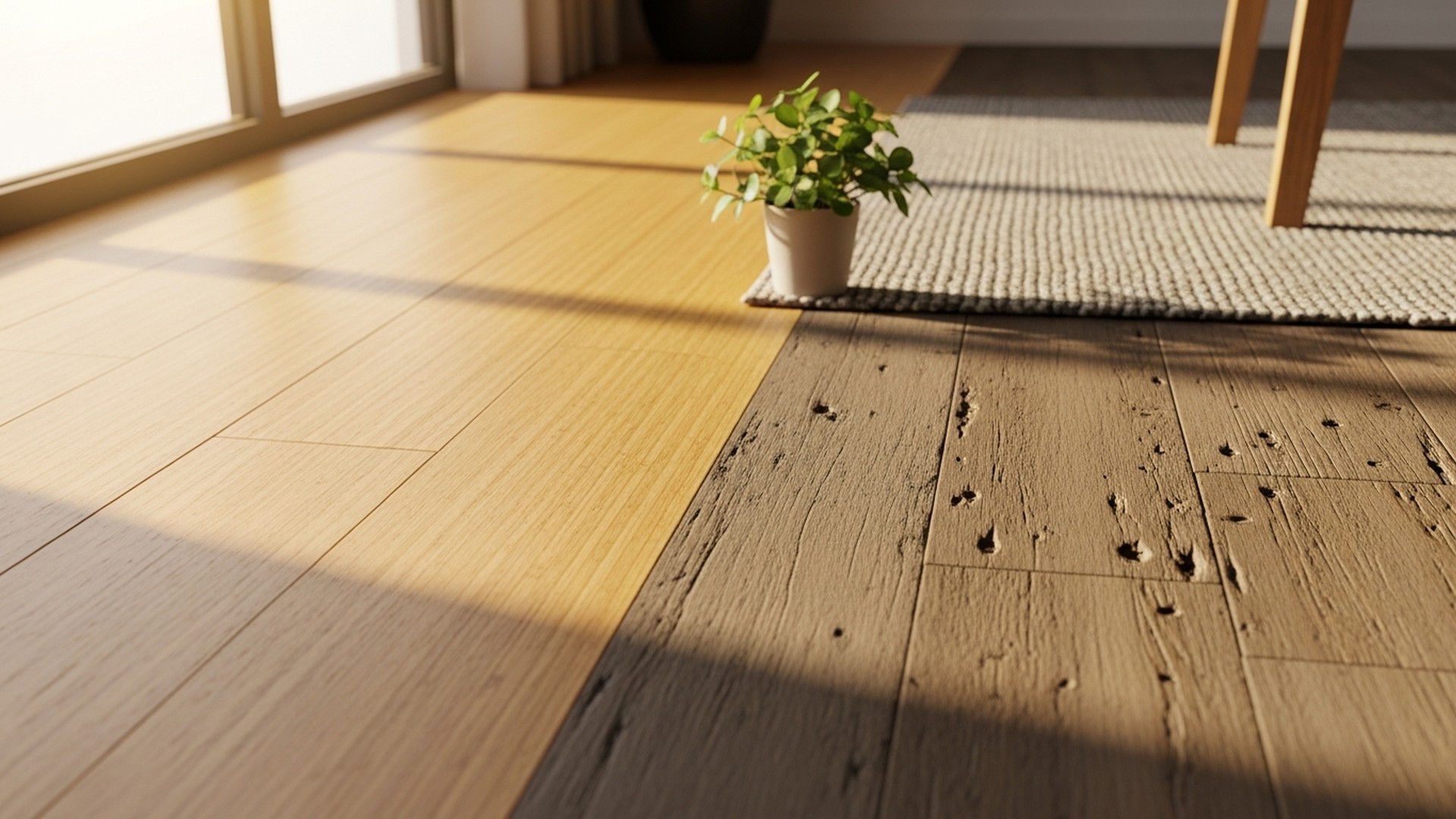
Compare bamboo flooring and reclaimed hardwood for sustainability, cost, durability, VOCs, and installation to choose the best eco-friendly option for your project.
Bamboo Flooring vs Reclaimed Hardwood: Sustainable Choices for Eco-Friendly Interiors
Choosing between bamboo flooring and reclaimed hardwood affects cost, indoor air quality, embodied carbon, and long-term maintenance. This article compares the two across durability (Janka), lifecycle impact, VOC risk, installation, and practical DIY guidance so budget-conscious eco-builders can make an informed selection for their project.
TL;DR:
- Bamboo is typically cheaper at $2–$6/ft² material, strand-woven types can exceed 3,000–3,500 lbf Janka and offer good hardness; reclaimed hardwood runs $3–$10+/ft² depending on species and provenance.
- Reclaimed hardwood score: lowest embodied carbon when reused, high finish longevity (can be sanded 3–10+ times depending on thickness); risks include old finishes (lead/arsenic) and hidden metal that require processing.
- For quick installs on a budget or high-hardness needs, choose engineered or strand-woven bamboo; for authenticity, resale appeal, and maximal reuse benefit, choose well-processed reclaimed hardwood. Use the materials cost estimator to model local prices and lifetime costs.
For current reference points, review ProductPlan product management resources and Mind the Product community.
Related guides: How to Choose Budget-Friendly Green Materials (2026), Hempcrete or Insulated Concrete Forms — When to Choose Each for Green Building, Spray Foam vs Cellulose Insulation — Pros, Cons and Carbon Impact for Homes, and Blandex vs Plywood: Which Should You Use? Pros, Cons & Expert Verdict.
Bamboo Flooring vs Reclaimed Hardwood: Quick TL;DR and comparison table
The table below gives a direct side-by-side view of common decision metrics for DIY eco-builders. Use it as a fast reference before reading the deeper sections.
| Metric | Bamboo (typical) | Reclaimed hardwood (typical) |
|---|---|---|
| Material cost (per ft²) | $2–$6 (material); engineered/plank higher | $3–$10+ (salvage vs pre-processed varies widely) |
| Janka hardness (examples) | Strand-woven: ~3,000–3,500+ lbf; natural strip bamboo: ~1,200–1,400 lbf | Oak: ~1,290 lbf; Hickory: ~1,820 lbf; reclaimed old-growth often denser |
| Carbon footprint/lifecycle | Fast regrowth (3–6 years); shipping from Asia can add emissions | Reuse avoids new harvest; lowest embodied carbon if locally sourced |
| Renewability/availability | Highly renewable species (Moso), predictable supply chain | Limited and variable; depends on local salvage markets |
| VOC/formaldehyde risk | Risk from adhesives in engineered products; look for CARB/TSCA compliance | Low for solid reclaimed; risk if old finishes present (lead, arsenic) |
| Installation difficulty | Floating, glue-down, or nail; engineered easier for DIY | Can be re-milled/engineered for tongue-and-groove; raw salvage needs milling |
| Maintenance | Routine cleaning; strand-woven less sanding-friendly | Can be refinished multiple times if sufficient thickness |
| Refinishing potential | Engineered: limited; solid: moderate | High if full-thickness boards or re-milled solids |
| Best use cases | Budget remodels, DIY installs, high-hardness needs with strand-woven | Historic restorations, high-resale projects, owners prioritizing reuse |
Refer to the materials cost estimator to plug in local labor rates and shipping when comparing these numbers for your build.
Bamboo Flooring vs Reclaimed Hardwood: Bamboo flooring deep-dive
Overview: types and how bamboo is made
Bamboo flooring comes in three common types: natural strip (tongue-and-groove strips), engineered bamboo (thin bamboo veneer over a plywood substrate), and strand-woven bamboo (fibers compressed with resin into dense planks). Bamboo culms are typically harvested at 3–6 years for optimal density. Strand-woven production shreds fibers and compresses them under heat and pressure, producing planks with very high Janka ratings—often reported above 3,000 lbf. For technical properties of wood and engineered products, consult the USDA Forest Products Laboratory’s Wood Handbook for context on strength and dimensional stability (https://www.fpl.fs.usda.gov).
Common finishes include UV-cured polyurethane and penetrating oils. Plank widths vary; many manufacturers offer 3/8" engineered options for basements and 3/4" solid or engineered products for above-grade installs.
Strengths of bamboo for eco interiors
- Fast regrowth: Bamboo reaches harvestable size in 3–6 years, far quicker than hardwood trees. FAO reports on bamboo note its rapid renewable cycle and carbon sequestration potential (http://www.fao.org/3/i1750e/i1750e.pdf).
- High hardness: Strand-woven bamboo competes with or surpasses many hardwoods in indentation resistance. That makes it durable for high-traffic areas.
- Predictable supply: Commercial bamboo mills produce consistent plank sizes and grades, simplifying DIY planning.
- Versatile installation: Available as floating floors, glue-down planks, or engineered systems that work over plywood subfloors and many radiant-heat systems (check manufacturer specs).
Weaknesses and common pitfalls
- VOC and adhesive risk: Engineered and strand-woven products can contain urea-formaldehyde resins or high-VOC adhesives. In the U.S., look for CARB/TSCA-compliant products and low-VOC/Greenguard-certified finishes to reduce indoor air risks (see California Air Resources Board guidance https://ww2.arb.ca.gov/our-work/programs/airborne-toxic-control-measure-1).
- Stability in humidity: Natural strip bamboo can cup or gap in high humidity without proper acclimation and subfloor prep. Strand-woven types are more dimensionally stable but still require proper moisture control.
- Refinishing limits: Strand-woven bamboo is often dense with thin wear layers; it may not accept multiple full-depth sanding cycles like thick solid hardwood.
Best for: ideal projects and use-cases
- Budget-conscious remodels where raw material cost is important and consistent plank size aids DIY installation.
- High-traffic rooms where strand-woven hardness is desired.
- Installations over radiant heat when using manufacturer-approved engineered bamboo planks.
Costs, installation, and maintenance (practical tips)
- Material cost: $2–$6/ft² for common bamboo planks; premium strand-woven and engineered prefinished boards cost more.
- Acclimation: Allow 48–72 hours for boxes to acclimate in the install space; longer in very dry or humid conditions.
- Installation methods: Floating (click-lock) is easiest for DIY; glue-down gives a more permanent feel over concrete; nailing/stapling for full-thickness boards works over plywood subfloors.
- Underlayment: Use a vapor retarder under concrete substrates; choose underlayments that match acoustical and thermal needs.
- Maintenance: Sweep and damp-mop with manufacturer-approved cleaners. Recoat with a compatible finish every 5–10 years depending on traffic. Avoid harsh chemicals and steam mops.
A practical install video that shows strand-woven bamboo production, hardness tests, and an installation demo is useful for DIYers to visualize differences before buying:
Watch this step-by-step guide on installing bamboo flooring - floated DIY method:
For other ways bamboo is used in eco-homes, see the article on bamboo acoustic panels.
Bamboo Flooring vs Reclaimed Hardwood: Reclaimed hardwood deep-dive
Overview: sources and types of reclaimed wood
Reclaimed hardwood comes from barn beams, demolition boards, old-growth timbers, and even industrial pallets (less desirable). Typical species include oak, walnut, chestnut, and heart pine. Suppliers either sell raw salvage or mill the material into re-milled planks, engineered reclaimed veneers, or full-thickness boards. Old-growth timbers often have tighter growth rings and greater density than modern sawtimber.
Strengths of reclaimed hardwood for sustainable interiors
- Embodied carbon savings: Reuse avoids the emissions and resource extraction associated with new lumber. The EPA’s sustainable materials management guidance explains how reuse reduces lifecycle impacts (https://www.epa.gov/smm).
- Aesthetics and market value: Patina, nail holes, and tight grain patterns provide a look many buyers value; reclaimed species can boost resale in markets that value authenticity.
- Durability: Many reclaimed boards come from dense old-growth stock and can be sanded and refinished multiple times, extending useful life decades.
Weaknesses, safety, and variability
- Hidden hazards: Old finishes may contain lead or arsenic (common in pre-1978 paints and wood treatments). The EPA’s lead information pages detail testing and abatement steps (https://www.epa.gov/lead). Salvage wood also often contains embedded nails, spikes, or metal that must be removed before milling.
- Supply variability: Sourcing consistent widths, lengths, and species can be difficult. Costs can spike for rare species or locally rare reclaimed stock.
- Processing costs: Raw salvage is labor-intensive—testing, cleaning, milling, de-nailing, and kiln-drying add costs. Pre-processed reclaimed boards cost more than raw salvage but save time.
When possible, work with reputable reclaimers who provide provenance and milling information. Reclaimers that kiln-dry and mill boards reduce the risk of later movement or hidden metal.
Best for: when reclaimed wood is the right pick
- Historic home restorations requiring matching species or profiles.
- Projects prioritized for reuse and lowest embodied carbon where local salvage is available.
- High-end interiors where unique patina and resale value matter.
For strategies on reducing onsite waste and maximizing the value of reuse, consult tips on how to reduce construction waste.
Bamboo Flooring vs Reclaimed Hardwood: Other sustainable flooring options to consider
Brief alternatives can outperform both bamboo and reclaimed hardwood in specific situations.
- Cork: Naturally renewable (cork oak bark regrows) and resilient underfoot. Best for moderate-traffic rooms and spaces where acoustic dampening and some elasticity are desired. Cork performs better than wood in some moisture-prone ground-floor applications.
- Marmoleum (natural linoleum by Forbo): A low-VOC, biodegradable sheet flooring option made from linseed oil and natural materials. It resists bacteria and has a long lifecycle with proper maintenance.
- FSC-certified new hardwood and reclaimed-engineered systems: Where local reclaimed stock is scarce, an FSC- or PEFC-certified new hardwood or reclaimed-engineered product can balance provenance with supply stability.
When to choose an alternative:
- Basement or high-moisture locations: Use cork or approved engineered options with vapor control rather than solid hardwood.
- Allergy-sensitive households: Marmoleum and cork are often better choices due to low VOCs and anti-microbial surfaces.
Short pros/cons:
- Cork: Pros — cushion, thermal comfort, renewable; Cons — denting from heavy furniture
- Marmoleum: Pros — low VOC, washable; Cons — requires proper subfloor prep
- FSC-certified hardwood: Pros — verified responsible sourcing; Cons — higher cost than non-certified wood
Bamboo Flooring vs Reclaimed Hardwood: Which should you choose?
Scenario-based recommendations
- Budget DIYer + quick install: Choose engineered strand-woven bamboo click-lock planks. They give low material cost, fast floating installation, and high hardness for families with kids and pets. Decide factors: upfront material cost, ease of install, and available local stock.
- Off-grid or self-build where embodied carbon matters most: Prioritize locally sourced reclaimed hardwood if available. Reuse reduces embodied carbon dramatically versus shipping new material long distances. Decision factors: local salvage availability and processing capacity.
- Tiny-house builder (weight and moisture concerns): Engineered bamboo or thin engineered reclaimed hardwood veneers over a lightweight substrate can reduce weight and improve dimensional stability under fluctuating humidity.
- Historic home renovator aiming for authenticity: Reclaimed hardwood that matches species and patina. Expect higher processing and finishing work but better match and resale pull.
- High-traffic family home seeking low-maintenance: Strand-woven bamboo or a dense reclaimed species finished with durable UV-cured polyurethanes. Choose products with proven low-VOC finishes.
For help comparing costs across these scenarios, see the buyer’s guide on choosing green materials.
Bamboo Flooring vs Reclaimed Hardwood: Installation, moisture and lifetime cost considerations
Moisture, underlayment and radiant heat compatibility
- Acclimation windows: 48–72 hours for most premade products; 5–7 days for large deliveries or extreme climates. Target indoor relative humidity (RH) around 30–50% during installation.
- Underlayment choices: Use a vapor barrier on concrete slabs under glue-down installations. Floating floors need sound-reducing underlayment. Cork underlayment adds thermal comfort.
- Radiant heat: Engineered bamboo and engineered reclaimed systems are generally more compatible with radiant floor heating than 3/4" solid boards; always check manufacturer limits for surface temperature and adhesive compatibility.
For detailed moisture control tactics (vapor barrier selection, slab prep), consult our guide on vapor barriers and basement moisture control. Also note market price shifts and availability risks in the long term—see material cost trends to plan procurement timing.
Refinishing, repairs and expected lifetime
- Bamboo: Strand-woven bamboo can last 20+ years with good maintenance but may only accept superficial re-coating. Solid bamboo can be sanded a few times depending on wear-layer thickness.
- Reclaimed hardwood: Typical solid reclaimed boards with 3/4" thickness can be sanded and refinished 3–10+ times over many decades. Re-milled reclaimed planks with thin veneers have more limited sanding cycles.
- Repairs: For both materials, keep spare planks from the original batch for future repairs. Reclaimed pieces are often unique and may require custom matching.
Rough lifetime cost comparison (materials + maintenance) — sample 20-year model
- Strand-woven bamboo: Material $3.50/ft² avg + installation $4/ft² = $7.50/ft² upfront. Recoat at year 8 ($0.50/ft²) and minor repairs → estimated 20-year cost ≈ $9–$12/ft².
- Reclaimed hardwood (pre-processed): Material $7/ft² avg + installation $5/ft² = $12/ft² upfront. Refinish cycles at years 7 and 15 ($1.50–$3/ft² each) → estimated 20-year cost ≈ $16–$22/ft².
These are sample figures; local labor, shipping, and processing vary. Use the materials cost estimator and consult market cost trends when budgeting.
Bamboo Flooring vs Reclaimed Hardwood: Health, certifications, and safety
VOCs, finishes, and standards to check
VOCs and formaldehyde are a primary indoor-air concern. In the U.S., CARB/TSCA standards regulate formaldehyde emissions from composite wood products (https://ww2.arb.ca.gov/our-work/programs/airborne-toxic-control-measure-1). For product-level VOC assurance, look for GREENGUARD certification (UL GREENGUARD) and FloorScore (SCS Global Services) which test flooring emissions (https://spot.ul.com/microbial/greenguard and https://scsglobalservices.com/programs/floorscore-certification).
Use low-VOC finishes and allow a curing period with ventilation before occupying a remodeled room. Our ventilation guide offers practical strategies to reduce indoor VOC concentrations: ultimate guide to ventilation for small eco-homes.
Certifications and labels worth trusting
- FSC/PEFC: For wood or bamboo provenance and responsible forest management.
- CARB/TSCA compliance: For formaldehyde emissions on composite products.
- GREENGUARD / FloorScore: For low-VOC, IAQ-tested finishes and flooring.
- Manufacturer technical sheets: Check technical data for wear-layer thickness and adhesive VOC limits.
Safety checklist for reclaimed wood
- Test suspect painted surfaces for lead before sanding or refinishing; EPA guidance explains testing and necessary abatement (https://www.epa.gov/lead).
- De-nail and X-ray or magnet-scan boards to find embedded metal before milling.
- Kiln-dry reclaimed boards to remove moisture and kill pests.
- If old preservative treatments are present (e.g., arsenic in pressure-treated timbers), consult hazardous-waste handling guidelines.
The Bottom Line
Bamboo and reclaimed hardwood both offer sustainable paths, but trade-offs matter: bamboo delivers fast renewability and affordable, high-hardness options; reclaimed hardwood maximizes embodied-carbon savings and unique character at the cost of variable supply and prep work. Match the choice to project priorities—budget, moisture conditions, and the value placed on reuse.
Is bamboo flooring more sustainable than reclaimed hardwood?
Short answer: it depends. Bamboo has rapid regrowth (harvestable in 3–6 years) and is renewable, but many bamboo products ship long distances and may use high-emission adhesives. Reclaimed hardwood usually has the lowest embodied carbon because it avoids new harvest entirely. Lifecycle comparisons favor reclaimed wood when it is locally sourced and properly processed; bamboo can be more sustainable when certified and manufactured with low-VOC adhesives.
Can reclaimed hardwood contain lead or other hazards?
Yes. Wood salvaged from older buildings may have lead-based paint, arsenic treatments, or embedded metal. The EPA provides guidance on lead testing and abatement (https://www.epa.gov/lead). Best practice is to test suspect boards before sanding, remove surface coatings safely, and work with reclaimers who kiln-dry and de-nail material prior to sale.
Will bamboo hold up in a kitchen or basement?
Bamboo can work in kitchens if properly finished and maintained, and strand-woven bamboo offers good hardness for spills and traffic. Basements are riskier: use engineered products designed for slabs and pair them with proper vapor barriers and subfloor systems. For basements and high-moisture areas, cork or certain engineered floors often perform better than solid bamboo.
How many times can reclaimed hardwood be refinished?
It depends on thickness and how the board was milled. Full-thickness 3/4" reclaimed boards can often be sanded and refinished 3–10+ times over decades. Reclaimed-engineered or thin-veneer boards have more limited sanding cycles. Confirm wear-layer thickness from the supplier before assuming multiple refinish options.
Is strand-woven bamboo harder than oak?
Often yes. Strand-woven bamboo commonly measures above 3,000 lbf on the Janka scale, while red oak is about 1,290 lbf. But "hardness" is one measure; dimensional stability, finish, and wear behavior matter too. Use Janka values as a starting point, then check manufacturer performance tests for wear and scratch resistance.